
Home » Business Development » Innovation » Important Tips for Bringing Design Thinking to Your Workplace

9 Important Tips for Bringing Design Thinking to Your Workplace

A team of professionals collaborating in a modern office, discussing ideas with sketches and sticky notes as part of a design thinking approach.

Modern workplaces face complex problems every day. Teams deal with changing customer needs, tight deadlines, and constant competition. Traditional problem-solving often fails in such environments because it relies too much on assumptions and past experience.

This is where design thinking helps.

Design thinking focuses on people, not just processes. It encourages teams to understand real problems before jumping to solutions. It promotes collaboration, experimentation, and learning. Most importantly, it helps workplaces build solutions that actually work.

In this blog, you will learn practical tips to bring design thinking into your workplace. These tips are simple, realistic, and easy to apply, even if your team is new to this approach.

Turn everyday workplace challenges into practical, people-focused solutions

What Is Design Thinking in the Workplace?

Design thinking is a structured way to solve problems by focusing on human needs. In the workplace, it means understanding employees, customers, and stakeholders before making decisions.

Instead of asking, “What solution should we build?” it asks, “What problem are we really solving?”

This approach usually follows five stages:

  • Empathize

  • Define

  • Ideate

  • Prototype

  • Test

In a workplace setting, these stages do not have to be formal or complex. Even small teams can use them during meetings, planning sessions, or process reviews.

The key difference from traditional decision-making is mindset. Design thinking values curiosity, empathy, and learning over quick fixes.


Why Design Thinking Matters for Modern Organizations

Organizations today operate in uncertain conditions. Customer expectations change fast. Technology evolves quickly. Rigid systems struggle to keep up.

Design thinking helps because it:

  • Keeps people at the center of decisions

  • Encourages teamwork across departments

  • Reduces risk by testing ideas early

  • Improves employee and customer experience

  • Builds a culture of innovation

When teams adopt this mindset, they stop reacting to problems. They start understanding them deeply.


Key Tips for Bringing Design Thinking to Your Workplace

Tip 1: Start With Real Problems, Not Assumptions

Many teams assume they already know the problem. This often leads to weak solutions.

Instead, start by observing what is actually happening. Talk to employees. Listen to customers. Watch how processes work in real life.

For example, if customer complaints increase, do not guess the reason. Speak to support staff. Review real conversations. Identify patterns.

When teams focus on real problems, they save time and effort later.


Tip 2: Build Empathy Across Teams

Empathy means understanding how others feel and think. In workplaces, this applies to both employees and customers.

Encourage teams to step into each other’s roles. Let managers observe frontline work. Allow team members to shadow colleagues from other departments.

This practice breaks silos. It builds respect. It also reveals issues that reports often hide.

Empathy creates better solutions because it reflects real experiences, not assumptions.

Small experiments today can lead to meaningful innovation tomorrow

Tip 3: Create a Safe Environment for Ideas

Innovation struggles in fear-based cultures. If people fear criticism, they stop sharing ideas.

Create spaces where all ideas are welcome during early discussions. Separate idea generation from evaluation. Avoid judging ideas too quickly.

Leaders should listen more and interrupt less. Junior team members should feel comfortable speaking up.

When people feel safe, creativity improves naturally.


Tip 4: Encourage Collaboration, Not Hierarchy

Design thinking works best in diverse groups. Different perspectives lead to stronger ideas.

Build cross-functional teams. Include people from operations, marketing, HR, finance, or technology when possible.

Avoid letting hierarchy control discussions. Good ideas do not depend on job titles.

Collaboration helps teams see problems from multiple angles. This reduces blind spots and improves outcomes.


Tip 5: Think Small and Experiment Often

You do not need large budgets or long timelines to start. Small experiments work better.

Test ideas on a limited scale. Try them with one team, one branch, or one process. Learn from results. Improve quickly.

Simple prototypes work well. These can be sketches, role-plays, mock workflows, or basic digital demos.

Small experiments reduce risk and build confidence.


Tip 6: Replace Long Meetings With Hands-On Workshops

Many workplaces rely too much on meetings. These often drain energy without producing results.

Design thinking prefers action. Use short workshops instead. Focus on activities like brainstorming, mapping journeys, or sketching ideas.

Set clear goals for each session. Limit discussion time. Encourage participation from everyone.

Hands-on sessions keep teams engaged and focused on outcomes.


Tip 7: Train Leaders to Act as Facilitators

Leaders play a critical role in shaping culture. In design thinking environments, leaders act as facilitators, not controllers.

They ask open questions. They encourage exploration. They support experimentation.

Instead of giving answers, they guide teams to discover solutions themselves.

This approach builds ownership and trust within teams.


Tip 8: Make Design Thinking Part of Daily Work

Design thinking should not feel like an extra task. It should blend into daily work.

Teams can use it during problem reviews, process improvements, hiring decisions, or customer feedback analysis.

Even small habits help. Asking “Who does this affect?” or “What problem are we solving?” keeps thinking human-centered.

Over time, this mindset becomes part of the workplace culture.


Tip 9: Measure Impact, Not Just Ideas

Ideas alone do not create value. Impact does.

Track improvements in efficiency, satisfaction, quality, or engagement. Collect feedback regularly. Use data to refine solutions.

If something does not work, learn from it. Adjust and try again.

Continuous learning strengthens the process.
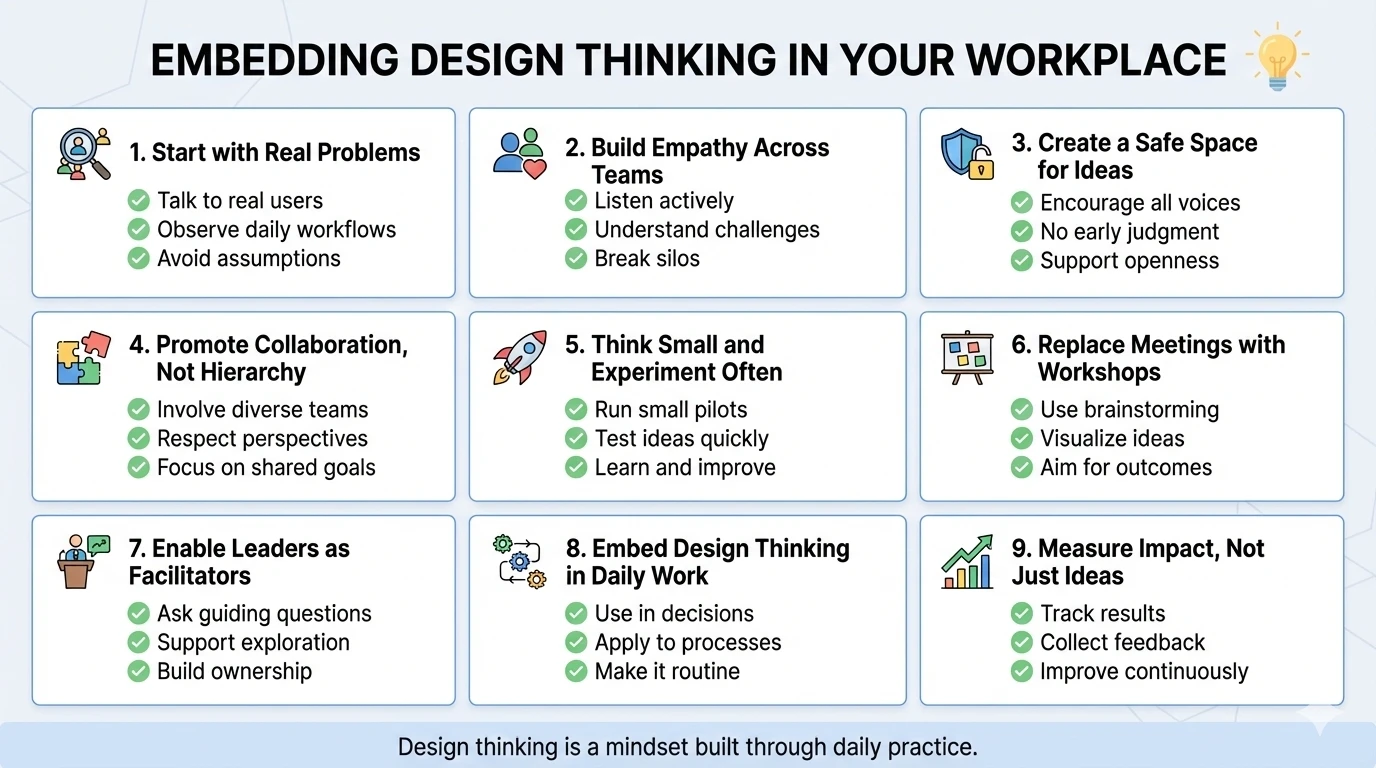
An infographic showing a nine-step checklist for applying design thinking in the workplace, including collaboration, empathy, experimentation, and measuring impact.

Build a workplace culture that solves problems, not just reacts to them

How to Introduce Design Thinking in Your Workplace (30-Day Plan)

You can start without major disruption. Here is a simple plan.

Week 1: Identify One Real Problem
Choose a problem that affects people directly. Keep it specific and manageable.

Week 2: Build Empathy
Talk to those affected. Observe workflows. Document pain points.

Week 3: Ideate Together
Run a short workshop. Generate multiple ideas. Avoid judging early.

Week 4: Prototype and Test
Create a simple solution. Test it with users. Collect feedback and refine.

This approach builds momentum and confidence.
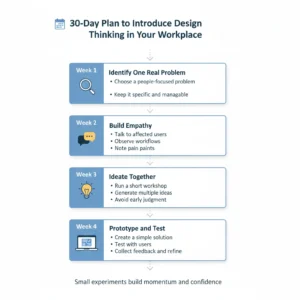
A vertical infographic showing a four-week timeline for introducing design thinking at work, covering problem identification, empathy building, idea generation, and prototype testing.


Common Challenges While Adopting Design Thinking

Many organizations face obstacles during adoption.

Some common challenges include:

  • Resistance to change

  • Lack of time

  • Fear of failure

  • Treating design thinking as a one-time event

These issues are normal. They reflect existing culture and habits.


How to Overcome These Challenges

Leadership support is essential. Leaders must model the behavior they expect.

Start small. Show quick wins. Communicate learning openly.

Focus on mindset, not tools. Design thinking is about how people think, not just methods.

Consistency matters more than perfection.

Conclusion

Design thinking is not limited to designers or innovation labs. Any workplace can adopt it.

It begins with empathy. It grows through collaboration. It succeeds through experimentation.

Small steps create meaningful change. One problem, one team, one solution at a time.

If organizations commit to learning and people-centered thinking, they build workplaces that adapt, innovate, and grow.

Leave a Reply

Your email address will not be published. Required fields are marked *