Common Mistakes Graduate Students Make While Learning Data Analytics
Data analytics has become one of the most popular career choices among graduate students. Many students from science, commerce, management, and even non-technical backgrounds are choosing data analytics because it promises good career growth, stability, and relevance across industries.
However, while learning data analytics, many graduate students struggle. Not because data analytics is impossible, but because they unknowingly make certain mistakes during their learning journey.
This blog explains the common mistakes graduate students make while learning data analytics, why these mistakes happen, and how to avoid them. If you are a student or a recent graduate planning a career in data analytics, this guide will help you learn with clarity and confidence.
Learning data analytics becomes easier when you avoid common mistakes early
Table of Contents
ToggleMistake 1: Starting Data Analytics Without Understanding What It Really Is
Confusing Data Analytics With Data Science or AI
Many graduate students start learning data analytics without clearly understanding what data analytics actually involves. Some assume it is the same as data science, while others think it is mainly about artificial intelligence or machine learning.
Data analytics focuses on:
Collecting data
Cleaning and organizing data
Analyzing patterns
Creating insights for decision-making
Without clarity, students feel lost early in the learning process.
Why This Creates Confusion
When expectations do not match reality, motivation drops. Students either feel overwhelmed or bored, thinking they chose the wrong field.
How to Avoid This Mistake
Before starting, clearly understand:
What a data analyst does daily
How data analytics differs from data science
Where data analytics is used in real companies
This foundation makes learning smoother.
Mistake 2: Trying to Learn Too Many Tools at the Same Time
Tool Overload at the Beginner Stage
Graduate students often try to learn Excel, SQL, Python, Power BI, Tableau, statistics, and machine learning together. This creates confusion instead of confidence.
Why This Slows Learning
Learning too many tools simultaneously prevents depth. Students remember commands but fail to understand when and why to use them.
A Better Learning Approach
Learn tools in sequence:
Excel for data basics
SQL for data extraction
Python for analysis
Visualization tools for insights
This structured path reduces stress and builds confidence.
Mistake 3: Ignoring Programming Fundamentals in Data Analytics
Assuming Data Analytics Does Not Require Programming
Some students believe data analytics is purely tool-based and skip programming basics, especially Python or SQL.
Why Programming Still Matters
Even basic programming helps you:
Clean data efficiently
Automate repetitive tasks
Handle large datasets
Ignoring programming limits growth in data analytics roles.
How Much Programming Is Enough
You do not need advanced programming. You need:
Basic Python syntax
Loops and conditions
Data manipulation logic
Strong basics are sufficient for entry-level roles.
Mistake 4: Memorizing Commands Instead of Understanding Concepts
Learning Syntax Without Context
Many students focus on remembering commands rather than understanding why they are used.
Why This Is a Problem
During interviews or projects, memorized commands fail when faced with new problems. Understanding concepts helps you adapt.
How to Fix This
Always ask:
What problem does this function solve?
When should I use it?
What happens if data changes?
This approach builds real analytical thinking.
Clear fundamentals and the right guidance can save months of confusion
Mistake 5: Skipping Data Cleaning and Preprocessing
Jumping Straight to Analysis
Graduate students often rush to visualization or modeling without spending time on data cleaning.
Why Data Cleaning Is Critical
In real projects:
Data is messy
Values are missing
Formats are inconsistent
Most analytics work happens before analysis.
What Students Should Practice
Handling missing values
Removing duplicates
Fixing data types
This skill is highly valued in data analytics jobs.
Mistake 6: Avoiding Statistics Due to Fear
“I Am Not Good at Math”
Many students feel scared of statistics and try to skip it entirely.
Why Basic Statistics Is Necessary
Data analytics relies on:
Mean, median, mode
Variance and standard deviation
Correlation and trends
Without these concepts, insights lack accuracy.
How to Learn Statistics Comfortably
Learn statistics through examples and datasets, not formulas alone. Practical understanding matters more than theory.

Mistake 7: Not Practicing With Real-World Datasets
Learning Only Through Tutorials
Many graduate students watch videos but do not practice independently.
Why This Is Risky
Without hands-on practice:
Confidence stays low
Interview performance suffers
Problem-solving skills remain weak
Better Practice Strategy
Use real datasets from:
Business
Finance
Healthcare
Marketing
Practice analyzing and explaining insights.
Mistake 8: Ignoring Projects and Portfolio Building
Believing Certificates Are Enough
Certificates alone do not prove your skills.
Why Projects Matter More
Projects show:
Your thinking process
Tool usage
Problem-solving ability
Recruiters trust portfolios more than certificates.
How Many Projects Are Enough
2–4 well-explained projects are enough for graduate-level entry roles.
You don’t need to rush—consistent learning builds real analytical skills
Mistake 9: Comparing Your Progress With Others
The Comparison Trap
Some students learn faster. Others take time. Comparing progress creates anxiety.
Why Comparison Is Unfair
Everyone has a different background, learning speed, and exposure.
Healthier Mindset
Focus on your progress:
What you learned last month
What you can do today
What you will improve next
This builds confidence and consistency.
Mistake 10: Waiting Too Long to Apply for Jobs
“I Will Apply After Learning Everything”
Many graduates delay job applications thinking they are not ready.
Why This Is a Big Mistake
You learn faster when you:
Face interviews
Receive feedback
Understand real expectations
When to Start Applying
Start applying when:
Basics are clear
You can explain projects
You are comfortable learning on the job
Mistake 11: Not Understanding Business Context
Focusing Only on Technical Output
Data analytics is not just numbers and charts. It is about business decisions.
Why Business Understanding Matters
Companies want insights, not just dashboards.
What Students Should Learn
Why data is analyzed
How insights impact decisions
How to communicate findings clearly
This skill differentiates good analysts.
Mistake 12: Poor Communication of Insights
Knowing Data but Not Explaining It
Many students struggle to explain their analysis in simple language.
Why Communication Is Crucial
A data analyst must:
Explain findings to non-technical people
Tell a clear story using data
How to Improve
Practice explaining insights verbally and in writing using simple words.
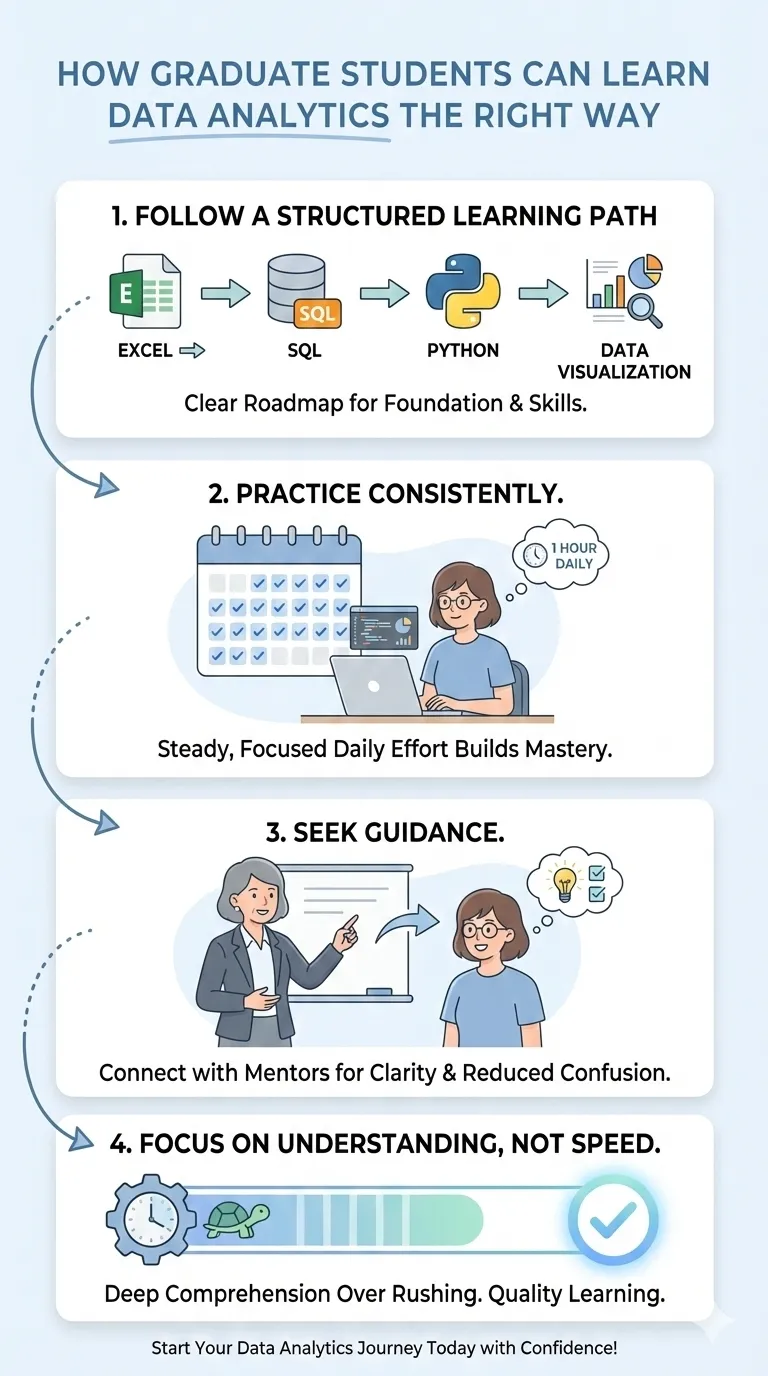
How Graduate Students Can Learn Data Analytics the Right Way
Follow a Structured Learning Path
Avoid random learning. Follow a step-by-step roadmap.
Practice Consistently
Daily practice, even for one hour, builds momentum.
Seek Guidance
Good mentorship reduces confusion and saves time.
Focus on Understanding, Not Speed
Slow learning with clarity is better than fast learning with confusion.

Final Thoughts for Graduate Students
Learning data analytics is not about being perfect. It is about building clarity, consistency, and confidence.
If you avoid these common mistakes while learning data analytics, your journey becomes smoother and more rewarding. Focus on fundamentals, practice with real data, build projects, and trust your learning pace.
Data analytics is a skill that grows with practice. Learn patiently, and the results will follow.
FAQs
Is data analytics difficult for graduate students?
No. With structured learning and practice, data analytics is manageable for graduates from any background.
Do I need advanced programming for data analytics?
No. Basic programming skills are enough for entry-level data analytics roles.
How long does it take to become job ready in data analytics?
Most graduate students become job ready within 4–6 months with consistent practice.
Are projects necessary for data analytics jobs?
Yes. Projects demonstrate practical skills and improve job opportunities.