From Classrooms to Microlearning for Employee Training: What's Really Changing
Think about the last time you sat through a three-hour corporate training session. Did you remember everything by Monday morning? Probably not. You are not alone — and that is exactly the problem that microlearning for employee training is solving right now.
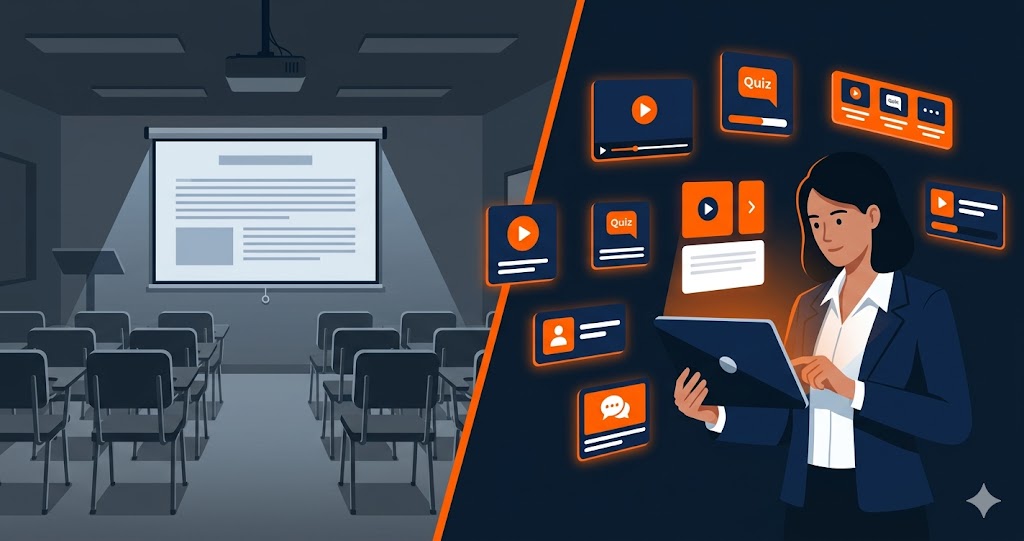
Organisations across industries are rethinking how they develop their people. The shift from rigid, hour-long classroom workshops to short, focused digital learning experiences is not just a trend — it is a fundamental change in how adults learn, retain information, and apply new skills on the job.
In this blog, we explore how microlearning is outperforming traditional training in both knowledge retention and measurable ROI, and what this means for your business development strategy in 2026.
Innovation is not a department — it is a habit. Build the skills that turn every employee into a driver of business growth.
Table of Contents
ToggleWhy Classroom Training Is No Longer Enough
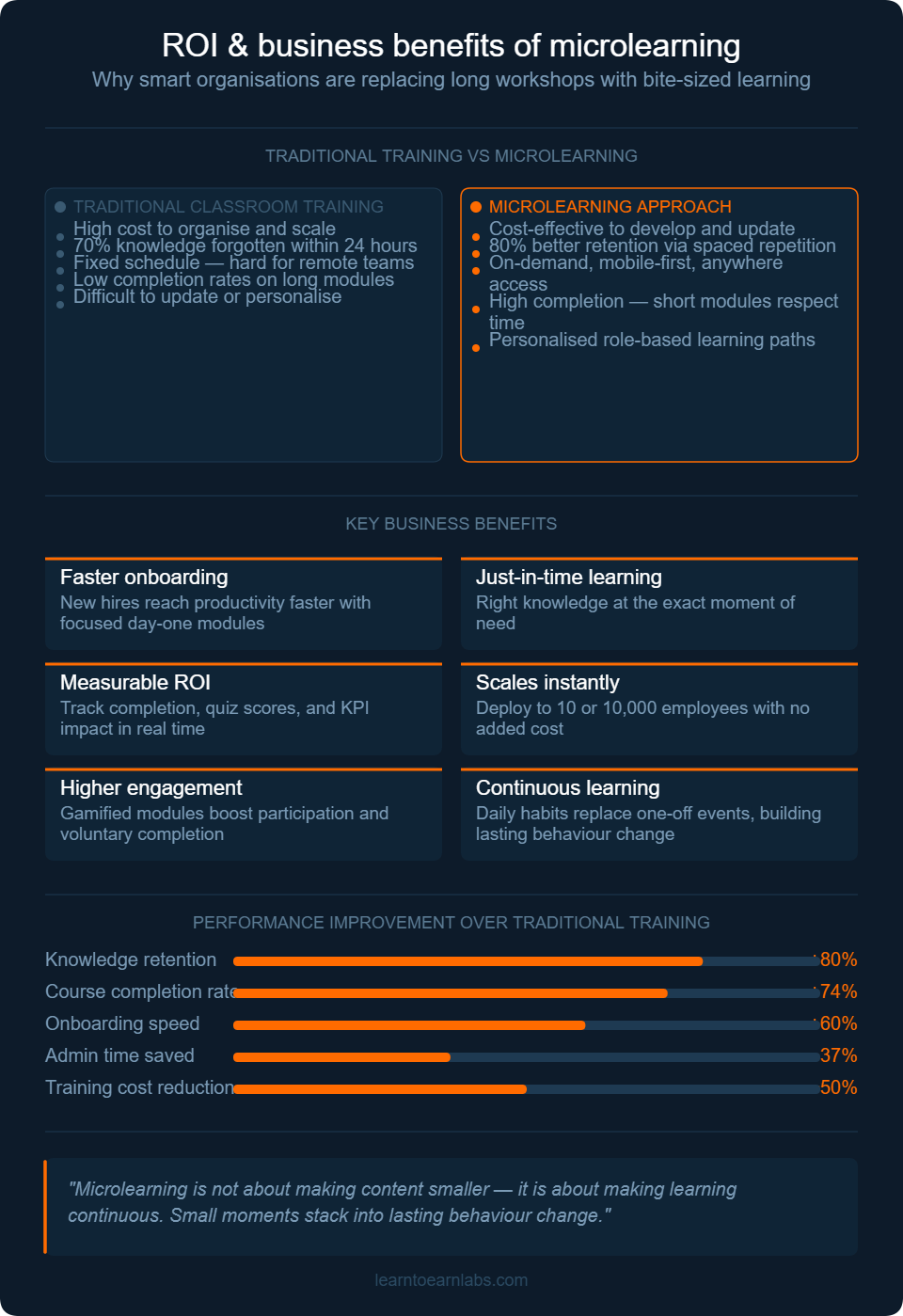
For decades, the default model for corporate skill development was the classroom. A trainer walks in, delivers content for hours, employees take notes, and everyone hopes something sticks. The reality? Research consistently shows that employees forget up to 70% of what they learn within 24 hours of a training session — a phenomenon known as the forgetting curve.
“The forgetting curve tells us that without reinforcement, nearly all new information is lost within a week. Traditional classroom training, by design, does almost nothing to address this.”
Beyond poor retention, classroom-based training is expensive to organise, difficult to scale across remote or hybrid teams, and almost impossible to personalise. As organisations deal with faster skill cycles, constant process changes, and distributed workforces, the one-size-fits-all classroom model simply cannot keep up. This is why classroom training is no longer enough for today’s dynamic business environment.
The modern workforce needs something fundamentally different — learning that is fast, relevant, accessible, and built around real work moments rather than scheduled events.
The businesses that lead tomorrow are training for it today. Stop waiting for the right moment — it is already here.
Bite-Sized Learning Modules for Employees: A Smarter Way to Train
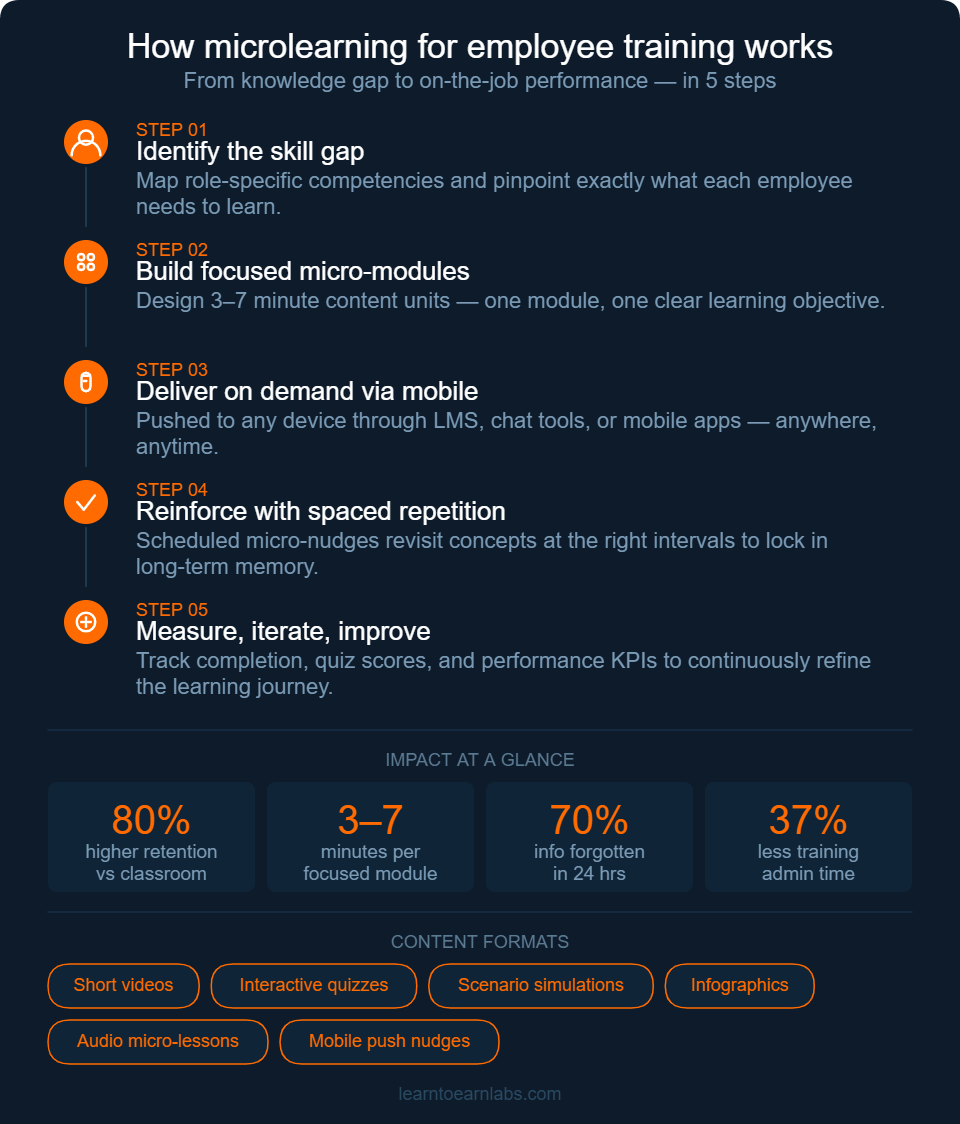
Microlearning is not simply about making content shorter. It is about making learning continuous, contextual, and outcome-driven. A well-designed microlearning module delivers one focused concept, one specific skill, or one actionable decision in three to seven minutes — exactly when the learner needs it.
Bite-sized learning modules for employees come in many formats: short explainer videos, interactive quizzes, scenario-based simulations, infographics, audio podcasts, and mobile push notifications. What they share is instructional precision — every second serves a clear learning objective.
Here is what makes this approach work so powerfully:
- Learners can access a module during a coffee break, between meetings, or while commuting
- Content is updated quickly — no need to rebuild entire course libraries
- Completion rates are significantly higher than long-form courses
- Each module reinforces a single skill, reducing cognitive overload
- Managers can track progress in real time through modern LMS dashboards
Companies that have adopted bite-sized learning report not just higher engagement, but faster onboarding times and measurable improvements in on-the-job performance.
Microlearning and Knowledge Retention: The Science Behind It
The connection between microlearning and knowledge retention is rooted in cognitive science. Two principles explain why short, repeated learning experiences outperform long-form sessions: spaced repetition and reduced cognitive load.
Spaced repetition in workplace learning means revisiting information at increasing intervals over time. Instead of cramming everything into one day, employees encounter the same concept in small doses across days or weeks. This dramatically strengthens long-term memory formation.
Reduced cognitive load means that when learners are not overwhelmed by hours of dense content, they can focus fully on absorbing and applying what matters most. A five-minute module on how to handle a difficult client call is far more actionable than a two-hour workshop that covers every possible scenario.
Research suggests that short, targeted learning sessions can increase retention by up to 80% compared to traditional formats — making microlearning one of the highest-ROI investments in any L&D strategy.
Additionally, on-demand training for remote employees becomes seamlessly possible with microlearning. A team member in Mumbai, Bangalore, or Agra can access the same high-quality module as a colleague in any global office — on their own schedule, on any device.
Great ideas come from skilled minds. Invest five minutes a day in learning, and watch your team become your biggest competitive advantage.
Mobile Learning for Corporate Teams: Training That Goes Where Work Goes
Mobile learning for corporate teams is no longer a nice-to-have feature — it is the delivery standard that modern employees expect. As of 2026, mobile learning accounts for a significant and growing portion of how employees access training content globally.
Microlearning and mobile learning are a natural partnership. Short modules are built for small screens. They load fast, require no physical setup, and support the way real work happens — in moments, not marathons.
Whether it is a short training video for employees on a new compliance regulation, a quick quiz to reinforce last week’s sales technique, or a two-minute walkthrough of a software update, mobile microlearning puts the right knowledge in front of the right person at exactly the right moment.
This is what learning professionals call just-in-time learning in the workplace — support that arrives when performance demands it, not weeks in advance during a scheduled classroom session.
How Microlearning Improves Employee Performance Across the Business
Understanding how microlearning improves employee performance requires looking beyond completion rates. The real measure is behaviour change — are employees doing their jobs better, faster, and with more confidence after training?
The answer, consistently, is yes — when microlearning is designed strategically. Here is how the impact shows up across business functions:
- Sales teams trained with role-specific micro-modules close deals faster and handle objections more confidently
- Onboarding time decreases because new hires access focused, digestible content rather than overwhelming manuals
- Compliance training completion rates improve dramatically when delivered as short, targeted modules instead of hour-long e-learning courses
- Leadership development becomes continuous rather than episodic, with two-minute “leadership blocks” reinforcing skills managers need daily
Gamified learning modules for the workforce take this a step further by embedding points, badges, leaderboards, and scenario challenges into the microlearning experience. This creates intrinsic motivation — employees are not just completing training, they are actively engaging with it.
Meanwhile, employee training completion rates — one of the most tracked metrics in L&D — improve significantly when content is short and purposeful. When employees feel that training respects their time, they show up for it.
Measuring ROI of Employee Training Programs
One of the most persistent challenges in corporate training has been proving business value. Traditional metrics like “seats filled” and “hours of training delivered” tell you nothing about whether employees are performing better.
Modern microlearning platforms built around a strong blended learning strategy for companies provide data that actually matters: module completion rates by role, knowledge assessment scores before and after training, time-to-competency for new hires, and direct correlation between training completion and performance KPIs.
This makes the case for cost-effective employee training solutions much clearer. Microlearning costs less to develop, update, and deliver than traditional instructor-led training — and it delivers measurably better outcomes. The ROI case is not just theoretical; it shows up in reduced error rates, faster onboarding, and stronger sales performance.
For business leaders and L&D managers looking to justify training budgets to the boardroom, microlearning provides the data, the efficiency, and the outcomes that traditional classroom sessions simply cannot match.
Research suggests that short, targeted learning sessions can increase retention by up to 80% compared to traditional formats — making microlearning one of the highest-ROI investments in any L&D strategy.
Building a Blended Learning Strategy: Microlearning in Context
It is important to be clear: microlearning is not the end of all other training formats. A well-designed blended learning strategy for companies combines the strengths of multiple approaches — using microlearning for reinforcement, just-in-time support, and skill refreshers, while reserving longer sessions for deep dives, collaborative workshops, and complex certifications.
Think of microlearning as the connective tissue that holds a broader learning ecosystem together. A new employee might attend a one-day onboarding workshop, then reinforce each concept through daily five-minute modules over the following two weeks. A sales professional might complete a quarterly skills review, then receive targeted micro-nudges throughout the quarter to keep those skills sharp.
Upskilling employees with digital learning tools becomes far more sustainable when organisations stop thinking in terms of “training events” and start building continuous learning journeys. Microlearning is the engine that makes those journeys possible — scalable, data-driven, and genuinely effective.
The New Age of Corporate Training Has Already Arrived
The shift from classrooms to microlearning is not coming — it is already here. Organisations that embrace bite-sized, mobile-first, data-driven learning are developing more capable, more confident, and more agile workforces. Those that cling to the traditional model are watching their training budgets deliver diminishing returns.
The question is no longer whether microlearning works. The research, the retention data, and the business results all point in the same direction. The question is how quickly your organisation can build a learning culture that makes continuous, meaningful skill development part of everyday work.
At Learn2Earn Labs, we believe that training done right is not a cost — it is a competitive advantage. Whether you are an individual looking to grow your career or an organisation building your next generation of talent, the new age of learning is shorter, smarter, and more powerful than ever.
Key Takeaways
- Microlearning delivers focused content in 3–7 minutes, dramatically improving retention over traditional classroom formats
- Spaced repetition and reduced cognitive load are the scientific foundations that make bite-sized learning so effective
- Mobile learning makes training accessible to remote, hybrid, and frontline employees on any device
- Gamification and just-in-time support increase engagement and real-world application of skills
- A blended learning strategy combines microlearning with structured training for the best overall outcomes
- The ROI of microlearning is measurable, documented, and significantly stronger than hour-long workshops