Difference Between Sales, Marketing, and Business Development
Table of Contents
ToggleIntroduction
Many students who want to build a career in business often hear terms like sales, marketing, and business development. These terms are commonly used in companies, job descriptions, internships, and business discussions. However, many graduates and university students still find it difficult to understand the exact difference between them.
At first glance, these three fields may look similar because all of them help companies grow. But in reality, each department has different goals, responsibilities, strategies, and career opportunities. Understanding these differences is important for students because it helps them choose the right career path based on their interests and skills.
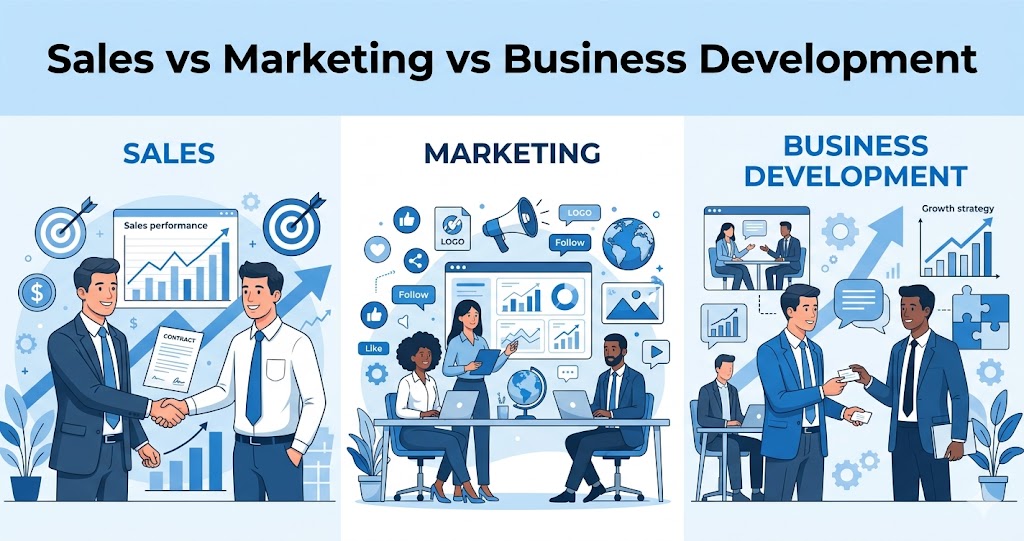
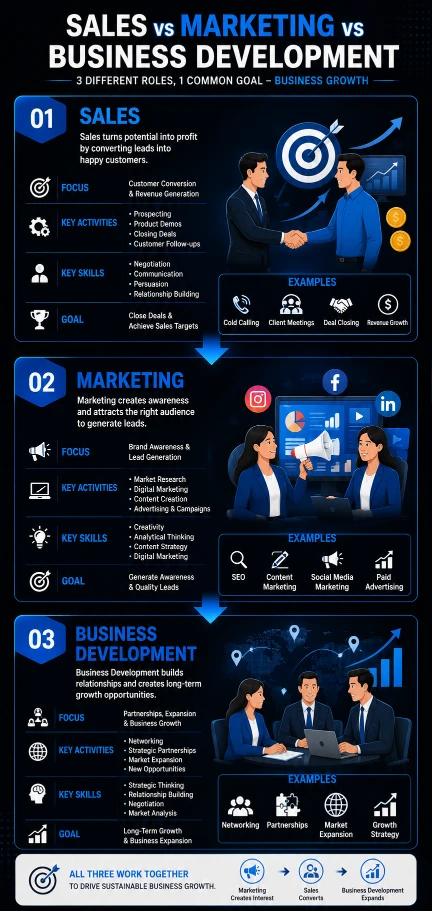
In modern businesses, sales teams focus on converting leads into customers, marketing teams create awareness and attract potential customers, while business development professionals build long-term growth opportunities and strategic partnerships. Together, they contribute to the success and expansion of a business.
In this guide, you will learn:
- What sales, marketing, and business development mean
- Their key responsibilities
- The major differences between them
- Career opportunities in each field
- Skills students should develop
- How AI is changing these industries
By the end of this article, you will have a clear understanding of which career path may be the best fit for you.
Turn your business ideas into real opportunities with practical startup and innovation training designed for future entrepreneurs and leaders
What Is Sales?
Definition of Sales
Sales is the process of selling products or services to customers. The main goal of sales professionals is to generate revenue for the company by convincing potential customers to make a purchase.
Sales teams directly interact with customers and focus on closing deals. They play a crucial role in increasing company profits and maintaining customer relationships.
For example, when a customer visits a car showroom and a sales executive explains the features, pricing, and benefits of a vehicle, that is part of the sales process.
Main Responsibilities of Sales Professionals
Sales professionals are responsible for:
- Identifying potential customers
- Communicating product benefits
- Understanding customer needs
- Negotiating prices and contracts
- Closing deals
- Maintaining customer relationships
- Achieving sales targets
Their performance is often measured through monthly or quarterly revenue goals.
Common Sales Activities
Cold calling
Sales representatives contact potential customers through phone calls or emails to introduce products or services.
Product demonstrations
Sales professionals explain how a product works and how it benefits customers.
Closing deals
The most important responsibility in sales is converting interested prospects into paying customers.
Client follow-ups
Sales teams regularly follow up with customers to maintain relationships and encourage repeat business.
Skills Required in Sales
Successful sales professionals usually possess the following skills:
- Excellent communication
- Persuasion abilities
- Negotiation skills
- Confidence
- Relationship building
- Problem-solving
- Active listening
Students who enjoy interacting with people and working in target-driven environments may find sales careers exciting.
Career Opportunities in Sales
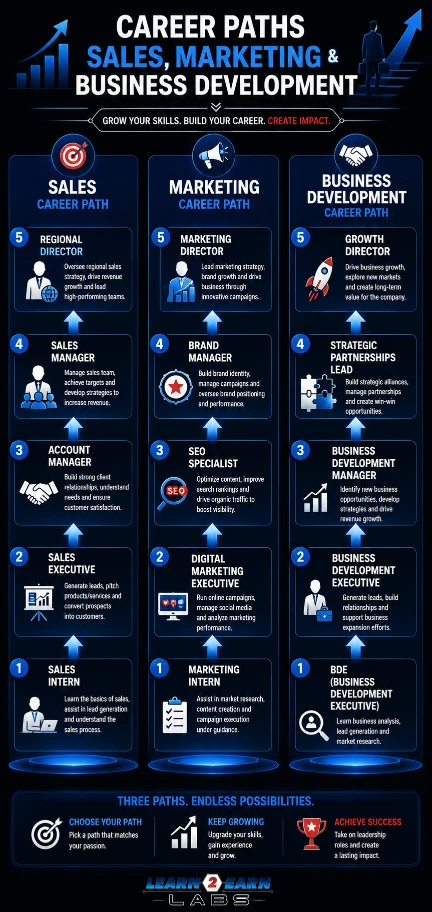
Popular career options in sales include:
- Sales Executive
- Sales Representative
- Account Manager
- Territory Sales Manager
- Sales Consultant
- Regional Sales Manager
Many industries such as technology, healthcare, automobiles, education, and real estate hire sales professionals.
Learn modern business strategies, entrepreneurial skills, and innovation techniques to build a successful career in today’s competitive world
What Is Marketing?
Definition of Marketing
Marketing is the process of promoting products or services to attract and engage customers. The main purpose of marketing is to create brand awareness and generate interest in a company’s offerings.
Unlike sales, marketing usually focuses on attracting customers before they make a purchase decision.
For example, social media advertisements, YouTube campaigns, SEO blogs, and TV commercials are all part of marketing activities.
Main Responsibilities of Marketing Teams
Marketing teams are responsible for:
- Understanding customer behavior
- Conducting market research
- Promoting products and services
- Building brand identity
- Running advertising campaigns
- Generating leads for the sales team
Marketing professionals help companies connect with the right audience.
Common Marketing Activities
Market research
Companies analyze customer needs, preferences, and market trends.
Advertising
Marketing teams create campaigns through digital and traditional media.
Social media marketing
Businesses use platforms like Instagram, LinkedIn, Facebook, and YouTube to engage audiences.
Content marketing
Blogs, videos, and educational content are created to attract customers.
Branding
Marketing teams shape how customers perceive a company or product.
Skills Required in Marketing
Students interested in marketing should develop:
- Creativity
- Analytical thinking
- Communication skills
- SEO knowledge
- Social media management
- Data analysis
- Content creation skills
Modern marketing heavily depends on digital platforms and technology.
Career Opportunities in Marketing
Popular marketing careers include:
- Digital Marketing Executive
- SEO Specialist
- Social Media Manager
- Brand Manager
- Content Strategist
- Marketing Analyst
Marketing careers are growing rapidly due to the rise of online businesses and digital advertising.
Gain industry-ready business skills, develop innovative thinking, and prepare yourself for startup success with expert-led training programs
What Is Business Development?
Definition of Business Development
Business development focuses on creating long-term growth opportunities for a company. It involves building relationships, identifying new markets, forming strategic partnerships, and expanding business opportunities.
Business development is broader than sales because it focuses on the overall growth strategy of the organization.
For example, if a company partners with another brand to enter a new market, that is part of business development.
Main Responsibilities in Business Development
Business development professionals are responsible for:
- Identifying growth opportunities
- Building partnerships
- Expanding into new markets
- Lead generation
- Networking with industry professionals
- Strategic planning
- Maintaining business relationships
Their work helps companies achieve sustainable long-term growth.
Common Business Development Activities
Networking
Attending conferences, seminars, and business events to build professional relationships.
Building partnerships
Collaborating with other companies to create mutual benefits.
Market expansion
Finding new customer segments or geographic markets.
Strategic planning
Creating growth strategies for the company.
Lead generation
Identifying potential clients and business opportunities.
Skills Required in Business Development
Business development professionals need:
- Strategic thinking
- Communication skills
- Relationship management
- Negotiation abilities
- Networking skills
- Problem-solving
- Market analysis skills
Students who enjoy strategy, networking, and business growth may enjoy this field.
Career Opportunities in Business Development
Popular business development careers include:
- Business Development Executive (BDE)
- Business Development Manager (BDM)
- Partnerships Manager
- Growth Strategist
- Corporate Development Associate
Business development roles are common in startups, IT companies, consulting firms, and multinational corporations.
Key Differences Between Sales, Marketing, and Business Development
| Feature | Sales | Marketing | Business Development |
|---|---|---|---|
| Main Goal | Generate revenue through direct selling | Create awareness and attract customers | Build long-term growth opportunities |
| Focus Area | Customer conversion | Brand promotion & lead generation | Partnerships & expansion |
| Customer Interaction | Direct communication | Indirect through campaigns | Strategic relationship building |
| Core Skills | Negotiation, persuasion | Creativity, analytics | Networking, strategy |
| Work Style | Target-driven | Creative & analytical | Growth-focused |
| Time Horizon | Short-term results | Medium-term engagement | Long-term business growth |
| Examples | Closing deals, client meetings | SEO, social media, advertising | Strategic partnerships, expansion |
Difference in Goals
Sales aims to increase immediate revenue by converting leads into customers. Marketing focuses on attracting potential customers and building brand awareness. Business development works on long-term growth opportunities and strategic partnerships.
Difference in Responsibilities
Sales teams directly interact with customers to close deals. Marketing teams create campaigns to attract customers. Business development professionals identify new business opportunities and build partnerships.
Difference in Customer Interaction
Sales professionals communicate directly with customers. Marketing teams mostly communicate through campaigns and content. Business development professionals interact with business partners, investors, and industry leaders.
Difference in Strategy and Execution
Sales focuses on execution and achieving targets quickly. Marketing combines creativity and strategy to attract audiences. Business development involves long-term planning and expansion strategies.
Difference in Career Paths
Sales careers are performance-driven and target-oriented. Marketing careers are creative and analytical. Business development careers focus on networking, growth strategy, and relationship building.
How Sales, Marketing, and Business Development Work Together
Marketing Generates Leads
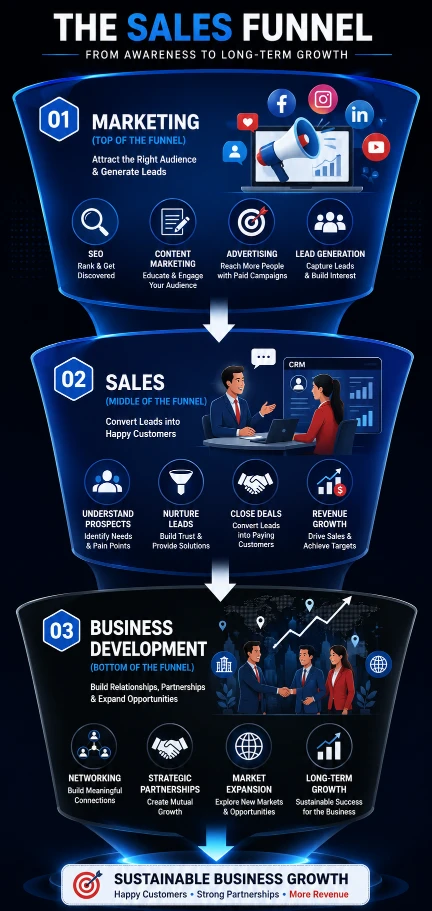
Marketing teams attract potential customers through advertisements, SEO, social media, and content marketing.
Sales Converts Leads into Customers
After marketing generates leads, sales professionals contact prospects and convert them into paying customers.
Business Development Creates Long-Term Growth Opportunities
Business development professionals create partnerships, enter new markets, and develop expansion strategies that support long-term company growth.
Add Funnel/Workflow Diagram Here
Example Workflow:
- Marketing attracts customers
- Sales converts customers
- Business development expands opportunities
Real-World Example of Sales, Marketing, and Business Development
Example: Apple / Amazon / Nike / Zomato
Large companies use all three departments to grow successfully.
Role of Marketing
Companies like Nike and Apple use advertisements, influencer campaigns, and social media marketing to create brand awareness.
Role of Sales
Sales teams in companies like Amazon and Apple focus on converting customer interest into purchases through online stores and retail outlets.
Role of Business Development
Business development teams create partnerships, enter international markets, and explore new business opportunities.
For example, food delivery platforms like Zomato partner with restaurants to expand their business network.
Which Career Option Is Best for Students?
Choose Sales If You Enjoy
- Talking with people
- Negotiation
- Convincing customers
- Working toward targets
- Fast-paced environments
Sales careers can provide excellent income opportunities through incentives and commissions.
Choose Marketing If You Enjoy
- Creativity
- Social media
- Branding
- Advertising
- Content creation
Marketing is ideal for students interested in digital platforms and creative communication.
Choose Business Development If You Enjoy
- Networking
- Strategic thinking
- Building partnerships
- Business growth
- Relationship management
Business development is suitable for students who enjoy long-term planning and business strategy.
Skills Students Should Start Learning Today
Communication Skills
Strong communication is important in all three fields.
Digital Marketing Basics
Students should learn SEO, social media marketing, email marketing, and content marketing.
Networking & LinkedIn
Building professional connections can help students discover internships and job opportunities.
Data Analysis
Understanding customer behavior and business performance is becoming increasingly important.
CRM Tools
Customer Relationship Management tools like Salesforce and HubSpot are widely used in businesses.
AI Tools for Business
Students should learn AI-based tools used for automation, analytics, and customer engagement.
How AI Is Changing Sales, Marketing, and Business Development
AI in Marketing
AI helps marketers analyze customer behavior, personalize campaigns, and automate content recommendations.
AI in Sales Automation
Sales teams use AI tools for lead scoring, email automation, and customer tracking.
AI in Customer Relationship Management
Modern CRM systems use AI to improve customer relationships and predict customer needs.
Future Career Scope
Students with knowledge of AI, automation, and digital tools will have better career opportunities in the future business environment.
Common Misconceptions Students Have
“Sales and Marketing Are the Same”
Sales focuses on selling products, while marketing focuses on attracting customers.
“Business Development Only Means Sales”
Business development includes partnerships, market expansion, and long-term strategy, not just selling.
“Marketing Is Only Social Media”
Marketing includes branding, research, advertising, customer analysis, SEO, and many other activities.

Frequently Asked Questions (FAQs)
Is business development the same as sales?
No. Sales focuses on converting leads into customers, while business development focuses on creating long-term growth opportunities and partnerships.
Which career pays more: sales, marketing, or business development?
Income depends on industry, skills, and experience. Sales professionals may earn high commissions, while marketing and business development roles can offer strong long-term career growth.
Is business development a good career for graduates?
Yes. Business development offers excellent career opportunities in startups, IT companies, consulting firms, and multinational organizations.
What skills are needed for business development?
Important skills include communication, networking, strategic thinking, negotiation, and relationship management.
Can marketing students work in sales?
Yes. Many marketing students successfully transition into sales roles because both fields involve customer understanding and communication skills.
Which field has better future opportunities?
All three fields have strong future demand. However, digital marketing, AI-driven sales, and strategic business development are growing rapidly.
Conclusion
Sales, marketing, and business development are three essential functions that help businesses grow and succeed. Although they work closely together, each field has different goals, responsibilities, and career opportunities.
Sales focuses on generating revenue through customer conversions. Marketing creates awareness and attracts potential customers. Business development builds long-term partnerships and expansion opportunities.
For students and graduates, understanding these differences is important for choosing the right career path. If you enjoy communication and targets, sales may be ideal. If you are creative and interested in digital platforms, marketing could be a better choice. If you enjoy networking and strategic growth, business development may suit you best.
As businesses continue to evolve in the digital and AI-driven era, professionals with strong communication, analytical, and technology skills will have excellent career opportunities across all three fields.