Home » Prompt Engineering » The Developer’s Guide to Prompt Engineering for APIs: Postman, Swagger, and AI Together

How to Use AI, Postman and Swagger Together for API Development

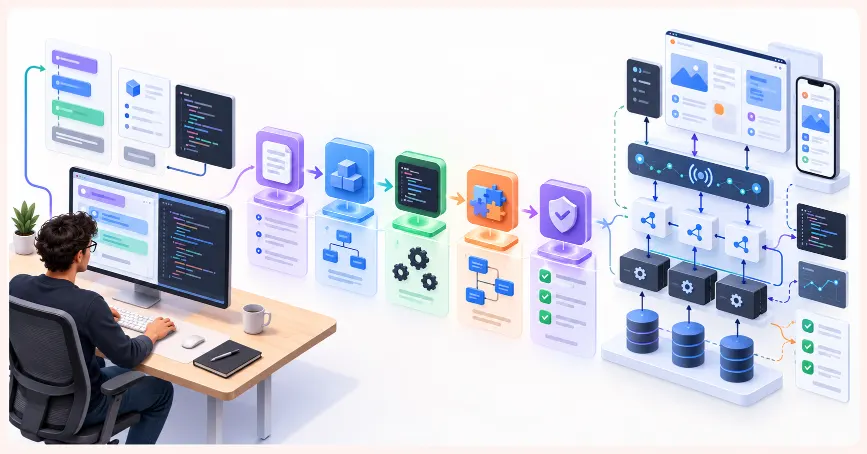
Developer integrating AI, Postman, Swagger and API testing in a connected development workflow

The three tools every modern API developer needs to use together — and almost nobody does

Most developers use Postman to test APIs. Most use Swagger to document them. Most are beginning to use AI to build them. What almost nobody does is use all three together as an integrated workflow — and that gap is costing developers hours every week in repeated work, inconsistent documentation, and testing cycles that could be automated.

When all three work together, the API is designed, documented, generated, and tested in a fraction of the time any single tool alone would take — with each stage feeding directly into the next.

This blog walks you through that integrated workflow. The prompts are specific. The applications are concrete. The output is an API development process that is faster, more consistent, and more professional than what most developers currently practise.

Learn2Earn Labs AI Integrated Digital Marketing Training banner featuring AI-powered marketing skills, SEO, Google Ads, social media marketing, analytics, automation, practical projects, internship experience, and career-focused learning.

AI Integrated Digital Marketing Training

Build practical skills in SEO, Google Ads, Social Media Marketing, Analytics, Content Marketing, and AI-powered workflows through projects, live classes, internship exposure, and industry-focused learning.

Why the integration matters: the problem with doing these separately

Most API developers follow this sequence: write the controller code, test manually in Postman, add Swagger annotations later, wonder why the documentation does not match what Postman shows, repeat for every endpoint.

This is the disconnected approach. Documentation is an afterthought. Testing is manual. When something changes in the API — a field is renamed, a response structure is modified — three artefacts need updating: the code, the Postman collection, and the Swagger documentation. Any one missed creates a mismatch that a frustrated frontend developer discovers at the worst possible time.

The integrated approach reverses this. The API design is the starting point. Everything — code, tests, documentation — is generated from that design with AI as the synthesis engine. When the design changes, the prompts that regenerate each artefact are already structured and ready to run.

This is architecturally cleaner too — it forces the API contract to be thought through before code is written, rather than discovered by reading code after the fact.
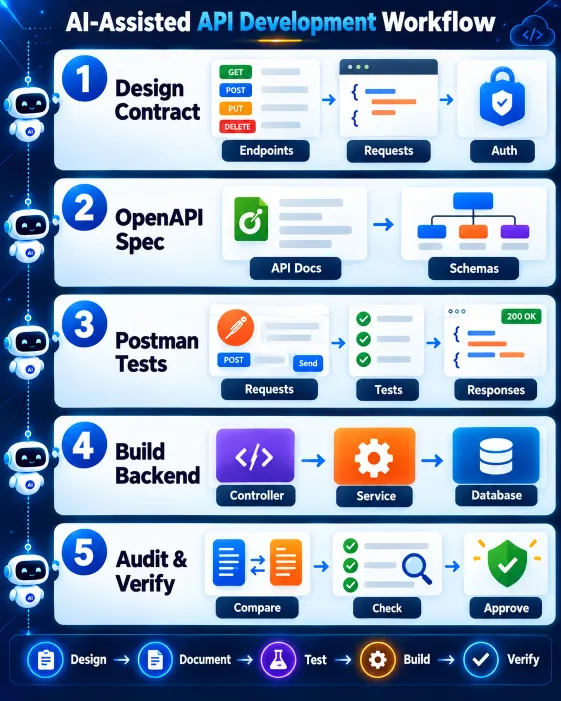
Infographic showing API design, OpenAPI specification, Postman testing, backend development and AI-assisted auditing

Stage 1: design the API contract first with AI

Before code is written, before Postman collections are created, before Swagger annotations are added — design the API contract with AI.

Most developers skip this because they feel they already know what the API needs. That feeling is usually accurate for simple cases and wrong for the edge cases that cause bugs in production. Using AI to interrogate the design before implementation catches those cases early.

I am designing a REST API for a [describe your application].

The first resource is [Resource] with these operations: [list in plain language]

For each endpoint define:

- HTTP method and path (strict REST conventions)
- Request body: field types, validations, required vs optional
- Success response structure and HTTP status code
- All error responses with status codes and meaningful messages
- Query parameters for filtering, sorting, pagination
- Authentication: public or requires JWT

Flag any design decisions with multiple valid approaches

and briefly explain the trade-offs.

The last instruction — “flag design decisions where multiple valid approaches exist” — is the most valuable part. It surfaces ambiguity that would otherwise only appear after the code is written and someone asks “why did you design it this way?”

The output is a complete API contract document. Every subsequent stage builds from it.

Stage 2: generate the OpenAPI/Swagger specification directly

With the API contract defined, generate the OpenAPI specification — not as annotations in code, but as a standalone YAML file that can be imported into Swagger UI, used to generate Postman collections, and referenced by the AI in subsequent prompts.

Generate a complete OpenAPI 3.0 specification in YAML for the [Resource] endpoints

we designed.

Include:

- info: title, version, description
- servers: dev and production URLs as variables
- Complete path definitions for all endpoints
- Request body schemas with all validation constraints (minLength, maxLength, minimum, maximum, enum, pattern)
- Response schemas for all success and error responses
- Reusable $ref components for request bodies, response DTOs, and error response structure
- JWT Bearer security scheme definition
- Security requirement applied to all protected endpoints

Must be valid and importable into Swagger UI without modification.

This generates a specification file that is the single source of truth for the API — importable into Swagger UI for interactive documentation, into Postman to auto-generate a collection, and referenceable in subsequent AI prompts to ensure generated code matches the specification exactly.

Generating the specification before the code is an architectural discipline that most developers have not practised but immediately recognise as correct once they try it.
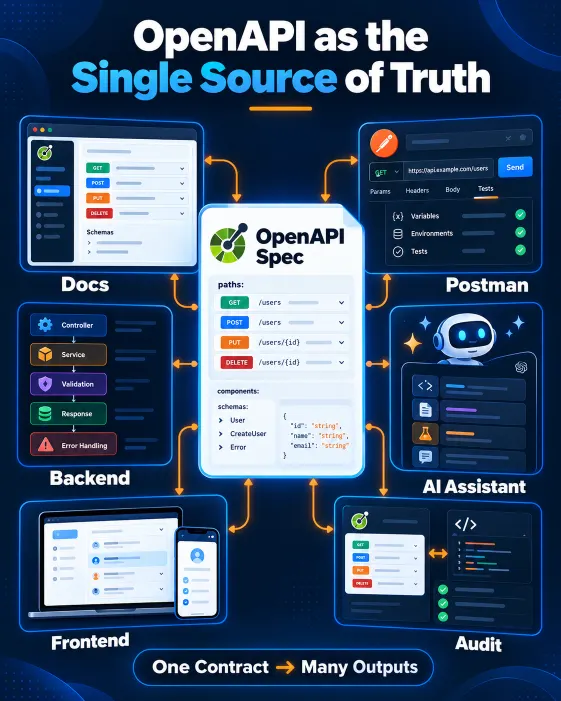

Infographic showing OpenAPI connecting Swagger documentation, Postman tests, backend code, AI and frontend integration
AI Integrated Full Stack Development training with React Node.js MongoDB and AI tools at Learn2Earn Labs

AI Integrated Full Stack Development Training

Master HTML, CSS, JavaScript, React, Node.js, Express.js, MongoDB, REST APIs, and AI-powered development workflows through live coding, practical projects, internship opportunities, and career-focused training.

Stage 3: generate the Postman collection from the specification

Rather than building a Postman collection endpoint by endpoint, generate it from the OpenAPI specification.

Postman supports direct OpenAPI import — paste the YAML file and it generates a collection with all endpoints, request structures, and example values in minutes. The collection is guaranteed to match the specification, not whatever was typed by hand.

What the auto-generated collection does not include is test logic. Use AI to generate that.

I have a Postman collection for a [Resource] REST API. For each endpoint

in the collection, write Postman test scripts that:


POST /[resource]:

- Assert status 201 on success
- Assert response body contains id, createdAt fields
- Assert id is a number and is stored in a Postman collection variable for use in subsequent requests
- Assert status 400 when required fields are missing
- Assert status 409 when [duplicate condition, e.g. "name already exists"]

GET /[resource]/:id:

- Assert status 200 and correct structure when valid id is used
- Assert status 404 when id does not exist
- Assert that all fields defined in the response schema are present

PUT /[resource]/:id:

- Assert status 200 and that the updated fields reflect the request body
- Assert status 404 when id does not exist
- Assert status 400 for invalid field values

DELETE /[resource]/:id:

- Assert status 204 on success
- Assert the resource no longer exists by following with a GET request
  and asserting 404

Write each test script as JavaScript in Postman’s pm.test() format.

Storing the created resource’s id in a collection variable is what allows test scripts to chain — POST creates a resource and stores its id, all subsequent requests use that stored id. A disconnected set of endpoint tests becomes an integrated sequence validating the full resource lifecycle.

Stage 4: generate the backend implementation from the specification

With the OpenAPI specification as the reference, generate the actual controller and service code — and instruct the AI explicitly to match the specification.

Generate the Spring Boot controller for [Resource] using the OpenAPI specification.

Requirements:

- Every endpoint path, HTTP method, and response status code must exactly match the specification
- Request body validation must enforce all specification constraints (@Valid with Bean Validation annotations)
- Success responses use exact field names from response schemas
- Error responses use the standard error structure from the components section
- @Operation, @ApiResponse, @Parameter annotations must use descriptions from the specification — do not write new ones
- Controller delegates all business logic to a [Resource]Service — include the service interface alongside the controller

Flag any specification ambiguities or unresolved design decisions.

“Do not write new descriptions — use the ones from the specification” is specifically important. Without it, AI generates Swagger annotations with different language from the specification, creating exactly the documentation inconsistency the entire workflow is designed to prevent.

Stage 5: use AI to audit the implementation against the specification

Once the implementation is complete, close the loop with a verification prompt.

Audit this Spring Boot controller implementation against this OpenAPI specification.

OpenAPI spec: [paste YAML]

Controller: [paste controller code]

Check:

  1. Does every spec path and HTTP method have a corresponding controller endpoint?
  2. Are request body field names and types consistent between spec and code?
  3. Are HTTP status codes consistent with spec response definitions?
  4. Are all required request validations enforced in the controller?
  5. Is the response structure consistent with spec response schemas?

List every discrepancy, where it is in the controller, and the correct implementation.

This audit prompt is the quality gate that prevents the most frustrating outcome of API development: a specification documenting one API and a codebase implementing a slightly different one. Running it before the frontend team begins integration avoids the debugging sessions that consume hours and damage working relationships.

Student learning React Native mobile app development with AI, Expo, APIs, and practical projects at Learn2Earn Labs.

AI Integrated React Native Mobile App Development Training

Build a job-ready mobile app development profile through practical coding, industry-style projects, AI-assisted workflows, career preparation, mentor-guided learning, real-world app deployment, API integration, and hands-on portfolio development.

How Learn2Earn Labs builds this fluency in full stack developers

At Learn2Earn Labs, API development is taught as an integrated discipline — not separate modules for Spring Boot, Postman, Swagger, and AI, but a unified workflow where all four are practised together on every live project.

Students in the Full Stack Web Development and Java Full Stack programs design API contracts before writing code, generate OpenAPI specifications from those contracts, use those specifications to generate both Postman test collections and backend implementations, and audit the implementation against the specification before a feature is considered complete.

This workflow mirrors how professional API teams operate at product companies and funded startups. It is not just taught — it is the method by which every project in the program is built. Students graduate with the muscle memory of design-first API development and the prompt engineering fluency to execute it efficiently.

Career counselling at Learn2Earn Labs prepares students to demonstrate this full-lifecycle API workflow in technical interviews — because product companies are increasingly evaluating whether candidates can do more than write endpoint code that works in isolation.

With alumni placed at TCS, Accenture, Cognizant, Infosys, and Nagarro, and with decades of experience shaping developer careers across India, Learn2Earn Labs understands where the professional standard is moving — and prepares every student to meet it.

Visit learntoearnlabs.com or write to team@learntoearnlabs.com

Conclusion

Postman, Swagger, and AI are not three separate tools for three separate parts of the job. They are three parts of the same workflow — design, document, generate, test, audit — where each stage feeds the next and AI is the synthesis engine that keeps them coherent.

The specification is the contract. The contract is the starting point. Everything else flows from it.

Start there.

FAQs Frequently Asked Questions

1. How can AI help with API development?

AI can assist developers with API contract design, OpenAPI specification generation, backend code, validation rules, documentation, Postman test scripts, debugging, and implementation audits. The best results come when AI is given a clearly defined API contract and relevant project context.

2. Can Postman and Swagger be used together?

Yes. An OpenAPI specification can be used for interactive Swagger documentation and imported into Postman to create API collections. Using the same API specification for both helps keep testing and documentation aligned with the intended API contract.

3. What is the role of OpenAPI in API development?

OpenAPI provides a machine-readable description of an API, including endpoints, HTTP methods, request schemas, responses, validation requirements, authentication, and error structures. It can serve as a central contract for documentation, testing, implementation, and integration.

4. Can AI generate Postman API tests?

Yes. AI can help generate Postman test scripts for status codes, response structures, required fields, validation errors, resource creation, updates, deletion, and chained API workflows. Developers should still review and run the tests against the actual implementation.

5. What is a good workflow for AI-assisted API development?

A structured workflow is to define the API contract first, generate the OpenAPI specification, create the Postman collection and tests, build the backend against the specification, and finally audit the implementation against the original API contract.