How Developers Can Use Prompt Chaining to Build Complex App Features With AI
Table of Contents
ToggleThe difference between asking AI for a feature and building a feature with AI
Most developers disappointed with AI-generated code share the same experience. They described what they wanted in a single prompt and got back something structurally plausible but wrong in ways that compounded. The authentication logic did not integrate with the error handling. The database schema did not account for relationships the service layer assumed. The API response format did not match what the frontend expected.
The problem was not the AI. The problem was the approach.
Describing a complete, complex feature in one prompt and expecting coherent output is like briefing a contractor on an entire building renovation in one conversation and expecting integrated blueprints, electrical plans, and plumbing schematics that reference each other correctly. Each document might be fine individually. The integration will be inconsistent because the context that should flow from one to the next was never established.
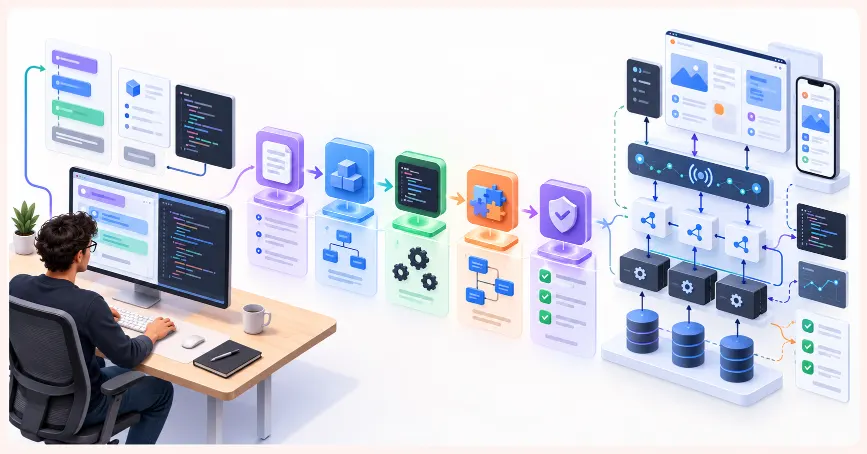
Prompt chaining solves this — breaking a complex feature into a sequence of connected prompts where the output of each becomes the context for the next, so the AI builds each layer with full knowledge of every layer before it.
This blog explains exactly how it works, how to structure a chain for a real feature, and why developers who build this way produce better output than those who do not.
AI Integrated Digital Marketing Training
Build practical skills in SEO, Google Ads, Social Media Marketing, Analytics, Content Marketing, and AI-powered workflows through projects, live classes, internship exposure, and industry-focused learning.
What prompt chaining actually is
Prompt chaining is not multiple unrelated prompts in the same session. It is a deliberate sequence where:
- Each prompt explicitly references the output of the previous one
- Earlier decisions become constraints later prompts must respect
- Feature complexity is distributed across the chain, not concentrated in one prompt
- The developer reviews and validates each output before it becomes context for the next
The chain is a technique for getting coherent output — where every component is generated with full awareness of every other component, because that awareness was explicitly built into the sequence.
Single-prompt: components that work individually. Chaining: components that work together. That distinction is the entire difference between AI-assisted development that creates more work and AI-assisted development that genuinely accelerates it.
The anatomy of a good prompt chain
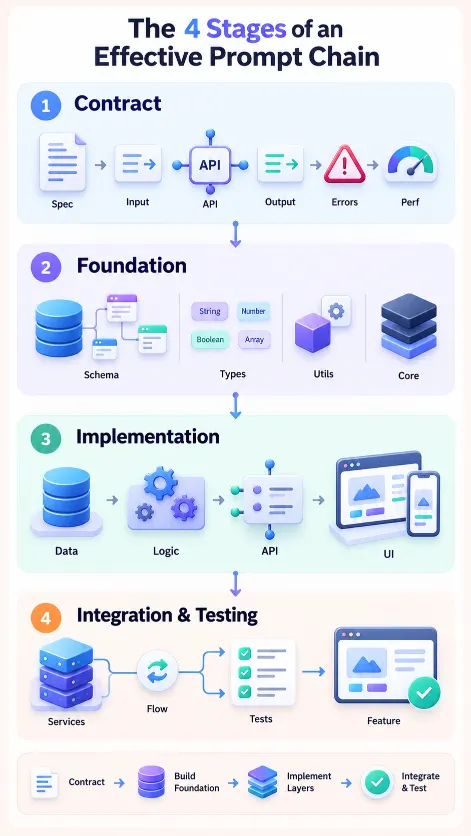
A well-structured prompt chain has four stages, regardless of the feature being built.
Stage 1: The contract.
Define the complete interface before any implementation. What flows in? What flows out? What are the error conditions and performance constraints? This produces the specification every subsequent stage builds from.
Stage 2: The foundation.
Generate the lowest-level components — schemas, data types, utility functions — before anything that depends on them. Dependent layers can then reference them accurately.
Stage 3: The implementation layers.
Generate each layer in dependency order — data access, business logic, API, UI — with each layer given the previous layer’s output as explicit context.
Stage 4: Integration and testing.
Generate integration code that connects the components and tests that verify the feature end to end.
This structure mirrors the actual dependency graph of most features: tests depend on implementation, implementation depends on schema, schema depends on contract. Building in dependency order produces coherent integration.
A concrete example: building a user notification system
Here is how it works for a specific, moderately complex feature: a real-time notification system where users receive in-app notifications when specific events occur.
Chain prompt 1: the contract
I am building a user notification system for a Node.js Express application.
Define the complete contract:
Notification data model fields (recipient, type, title, content, metadata, read status, timestamps, delivery channels)
Notification types: order_placed, payment_received, message_received, system_alert — define the metadata shape for each type
Events that trigger notifications and the data they carry
Delivery channels: in-app (WebSocket), email (async), push (mobile)
API endpoints: get notifications with pagination and unread count, mark one as read, mark all as read, delete notification
WebSocket connection management strategy
Performance constraints: max in-app delivery latency, retention period
Produce as a technical specification. This document is the reference
for all subsequent prompts in this chain.
The AI’s response is a structured specification — field definitions, type schemas, API contracts, WebSocket strategy. Review and refine it before the next prompt. Every decision here becomes a constraint the rest of the chain must respect.
AI Integrated Full Stack Development Training
Master HTML, CSS, JavaScript, React, Node.js, Express.js, MongoDB, REST APIs, and AI-powered development workflows through live coding, practical projects, internship opportunities, and career-focused training.
Chain prompt 2: database schema and types
Using the specification from prompt 1: [paste specification]
Generate:
- Mongoose schema for Notification with all fields, types, and indexes for the query patterns defined
- TypeScript types:
– NotificationType enum
– NotificationMetadata union type (one variant per notification type)
– NotificationDocument (Mongoose document type)
– CreateNotificationPayload
- NotificationStatus enum (unread, read, deleted)
Schema must support: unread notifications per user sorted by createdAt desc,
unread count per user, bulk mark-as-read in a single operation.
This prompt cannot be written without prompt 1’s specification — it references notification types, query patterns, and API requirements defined there. The output — schema and TypeScript types — becomes the foundation for every layer above.
Chain prompt 3: the notification service
Using the notification system specification and the Mongoose schema
and TypeScript types we created:
[Paste the specification from prompt 1]
[Paste the schema and types from prompt 2]
Generate the NotificationService class with:
– createNotification(payload: CreateNotificationPayload): Promise<NotificationDocument>
Creates the notification, saves to database, triggers delivery
– getUserNotifications(userId: string, page: number, limit: number):
Promise<{ notifications: NotificationDocument[], total: number, unreadCount: number }>
– markAsRead(notificationId: string, userId: string): Promise<NotificationDocument>
Verify the notification belongs to the requesting user before marking
– markAllAsRead(userId: string): Promise<number>
Returns count of notifications marked as read
– deleteNotification(notificationId: string, userId: string): Promise<void>
– triggerDelivery(notification: NotificationDocument): Promise<void>
Dispatches to WebSocket for in-app, queue for email and push
Use constructor injection for dependencies: notificationRepository,
webSocketService, emailQueue, pushQueue
Every method signature and return type in this prompt is grounded in prompts 1 and 2. The integration is coherent because the context was deliberately carried forward.
Chain prompt 4: WebSocket integration
Using the notification service we created:
[Paste the service interface from prompt 3]
Generate the WebSocketNotificationService that:
– Maintains a Map of userId → Set<WebSocket> for connected clients
– connect(userId: string, ws: WebSocket): void — registers a connection
– disconnect(userId: string, ws: WebSocket): void — removes connection
– sendToUser(userId: string, notification: NotificationDocument): void
Sends to all active connections for the user, handles disconnected sockets
– getActiveUserIds(): string[] — returns users with active connections
Also generate the Express WebSocket route handler that:
– Authenticates the WebSocket upgrade request using JWT
– Registers the connection with the WebSocketNotificationService
– Handles disconnect cleanup
– Sends any unread notifications to the client immediately on connection
The WebSocketNotificationService should be a singleton injected
into the NotificationService’s triggerDelivery method.
This prompt cannot produce coherent output without prompt 3. triggerDelivery calls webSocketService.sendToUser — generated here with exactly the signature the service expects, because both derive from the same chain.
Chain prompt 5: tests and verification
Using the complete notification system we have built:
[Paste the service from prompt 3]
[Paste the WebSocket service from prompt 4]
Generate:
- Unit tests for NotificationService using Jest with mocked dependencies
Cover: createNotification with each notification type, getUserNotifications, pagination, markAsRead authorization check (should throw if user doesn’t own notification), markAllAsRead count return, triggerDelivery dispatches to correct channels
- Integration tests for the WebSocket connection lifecycle:
Connect → receive pending notifications → receive new notification → disconnect
- A seed script that creates test notifications of each type for a test user
AI Integrated React Native Mobile App Development Training
Build a job-ready mobile app development profile through practical coding, industry-style projects, AI-assisted workflows, career preparation, mentor-guided learning, real-world app deployment, API integration, and hands-on portfolio development.
Why prompt chaining produces fundamentally better output
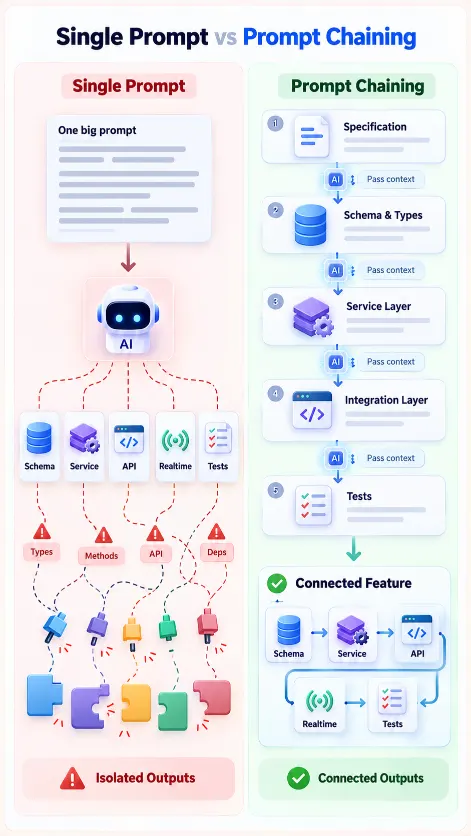
Compare the single-prompt approach with the five-prompt chain.
The single-prompt output has a schema, a service, and WebSocket code. But the TypeScript types may not match the schema. The WebSocket method signatures may not match how the service calls them. The test mocks may not match the dependency interfaces.
The chain output has the same components — and they fit together, because every component was generated with explicit awareness of every component it depends on.
The time invested in structuring the chain returns many times over in the integration work that never needs to happen.
How Learn2Earn Labs teaches prompt chaining in every technical program
At Learn2Earn Labs, prompt chaining is not an advanced topic saved for later. It is introduced at the first live project involving more than one interconnected component — which happens within the first few weeks for most students.
Students across Full Stack Web Development, React Native, Java Full Stack, and other technical programs practise prompt chaining on every multi-layer feature: contract first, foundations before implementations, layer by layer with each prompt grounded in the last, chain closed by tests verifying the integration.
Instructors review the chain structure alongside the code. A student who generates disconnected prompts and patches integration manually is developing the wrong habit. One who builds a deliberate chain — with each prompt explicitly grounded in previous outputs — is developing the discipline that separates developers who use AI fluently from those who use it occasionally.
Career counselling prepares students to walk through a prompt chain in a technical interview — explaining the sequence structure, what constraints carried forward, and how chaining produced coherent integration. This articulation about AI-assisted development is what companies at the forefront of adopting these tools actively look for.
With alumni placed at TCS, Accenture, Cognizant, Infosys, and Nagarro, and with decades of experience preparing developers for India’s job market, Learn2Earn Labs trains every student to build with AI the way professionals build — not as a shortcut, but as a discipline.
Visit learntoearnlabs.com or write to team@learntoearnlabs.com
Conclusion
Single-prompt: plausible components that do not integrate. Deliberate chain: components designed to work together, because each was generated with full awareness of what it depends on.
Prompt chaining is not a technique for getting more from AI. It is a technique for getting coherent output — and coherence is what determines the difference between a working feature and individually reasonable but collectively broken code.
Structure the chain. Carry the context forward. Review before you proceed.
Frequently Asked Questions
1. What is prompt chaining in AI development?
Prompt chaining is a structured way of using AI where a complex task is divided into a sequence of connected prompts. Each new prompt uses decisions or outputs from earlier prompts as context, allowing different parts of a feature to be developed consistently rather than independently.
2. Why is prompt chaining better than using one large prompt?
A single large prompt can generate components that look correct individually but do not integrate properly. Prompt chaining carries specifications, types, interfaces and other decisions forward so later components are generated with awareness of what already exists. This can reduce mismatches between schemas, services, APIs, integrations and tests.
3. What are the main stages of a good prompt chain?
A well-structured prompt chain can be organised into four stages: defining the contract, creating foundational components, generating implementation layers in dependency order, and completing integration and testing. This follows the natural dependency structure of many software features.
4. Can prompt chaining be used to build full-stack application features?
Yes. Prompt chaining can be used across multiple application layers. The article demonstrates this through a notification system where AI is used sequentially to define the technical contract, database schema and TypeScript types, service layer, WebSocket integration and tests.
5. Should developers review each AI response before continuing a prompt chain?
Yes. Each output should be reviewed and refined before it becomes input for the next prompt. Because later prompts depend on earlier decisions, allowing an incorrect assumption to continue through the chain can create errors across several implementation layers.