AI-Integrated Industry Training:
Web Development, Data Analytics, Digital Marketing, Java & Python
|
2 Months Practical Training + 1 Month Internship
|
Fee:
₹9,999 per Program
|
Apply Now

What Actually Happens to Your Application
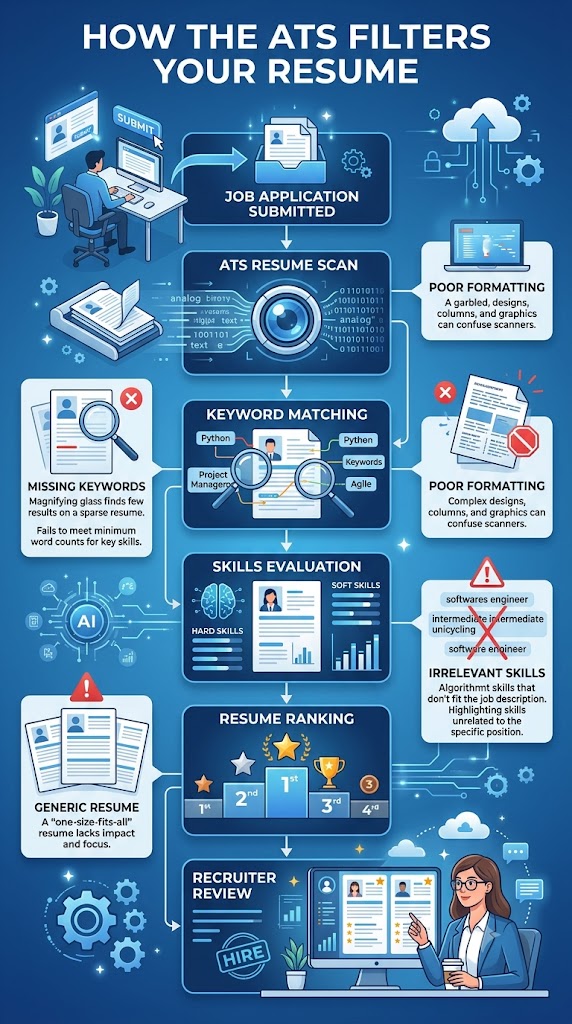
When you hit “Apply Now,” your resume does not land directly on a recruiter’s desk. In most mid-size and large companies, it goes through an Applicant Tracking System — ATS.
An ATS is software that automatically scans, filters, and ranks resumes before a human ever sees them. It looks for specific keywords, formatting compatibility, relevant skills, and role-match signals. Resumes that do not pass the ATS filter never reach a recruiter — no matter how qualified the candidate is.
Here is what makes this worse: most freshers and job seekers are submitting the same generic resume to every application. One resume. One hundred jobs. The ATS was not built to reward that approach. It was built to surface the most relevant match for a specific role.
When your resume is not tailored to the job description — with the right keywords, the right skill mentions, and the right structure — it gets filtered out automatically. The recruiter never sees it. The rejection is not personal. It is algorithmic.
The Other Reasons Mass Applying Does Not Work
Even when a resume does make it past the ATS, several other factors kill a generic application.
Your resume looks like everyone else’s
When a recruiter opens 200 shortlisted profiles that all use the same template and the same vague language — “good communication skills,” “team player,” “hardworking” — nothing stands out. There is no reason to call you over the next person.
You are applying for roles you are not clearly qualified for
Mass applying means applying broadly. Roles that do not closely match your skill level hurt your shortlist ratio and waste application slots.
Recruiters check LinkedIn before they call
An incomplete profile or one that does not match your resume sends many recruiters elsewhere before they ever dial your number.
No referral means no context, no trust
A referred profile goes to the top of the review pile. A cold application from a stranger gets filtered. That gap is larger than most people realize.
What to Do Instead: A Strategy That Actually Works
Fixing your job search does not require more time. It requires a different approach. Here is what works in the current hiring environment.
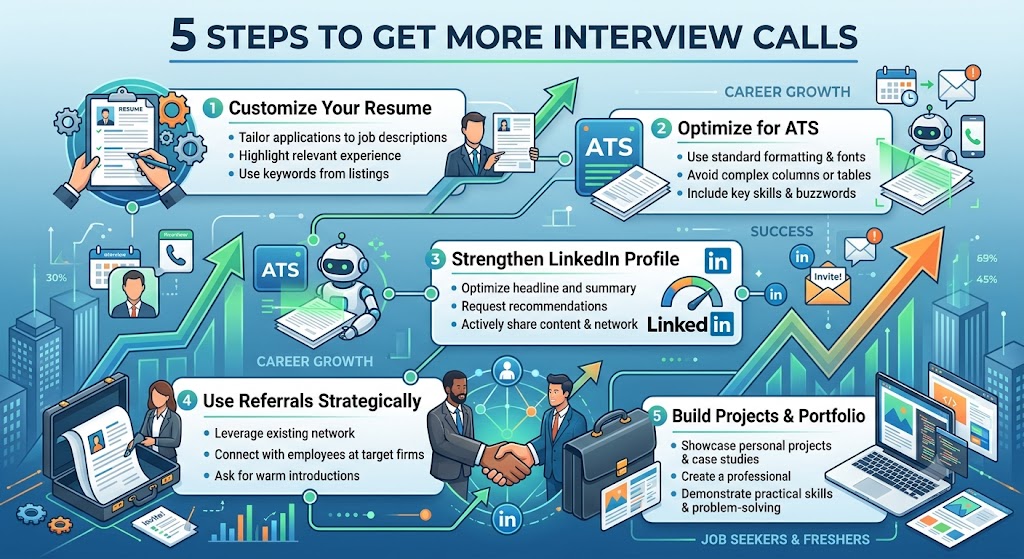
1. Apply to fewer jobs, but apply properly
Target 10 to 15 roles at a time instead of 100. For each role, read the job description thoroughly and customize your resume to reflect the exact skills, tools, and experience the role asks for. Use the same language the job description uses. This is not about lying — it is about relevance. You are making it easy for both the ATS and the recruiter to see why you are the right fit.
2. Fix your resume structure
A strong resume in 2025 is not a list of everything you have ever done. It is a targeted document that makes one argument: this person has what this role needs.
Lead with a two-line professional summary that speaks directly to the role. Follow with a skills section that lists relevant tools and technologies clearly. Under experience or projects, describe outcomes — not just responsibilities. “Built a full stack inventory management system used by 3 clients” is more compelling than “worked on web development projects.”
For freshers, live project experience, internship work, and training program outcomes carry real weight. Do not leave them out or bury them at the bottom.
3. Build a LinkedIn profile that works while you sleep
Your LinkedIn profile is a searchable asset. Recruiters use LinkedIn to proactively find candidates — not just to vet ones who applied. A complete profile with a strong headline, a written summary, listed skills, and evidence of projects or training means you can get discovered by recruiters even when you are not actively applying.
Connect with recruiters in your target industry. Engage with relevant content. Comment on posts in your field. Visibility on LinkedIn directly correlates with inbound recruiter interest — and that is fundamentally different from sending cold applications.
4. Use referrals as a primary strategy, not a backup
Most job seekers treat referrals as a bonus — something that happens if you are lucky enough to know someone. Flip that thinking. Make referrals a deliberate, proactive part of your job search.
Identify companies you want to work for. Find people who work there through LinkedIn or alumni networks. Reach out with a genuine, specific message — not a copy-paste template asking for a referral. Build a connection first. Most people who have been through a job search are willing to help someone who approaches them thoughtfully.
5. Work on what actually gets you shortlisted — skills and proof
Here is the truth no job portal will tell you: if you are not getting interviews, what is on your resume matters more than how many places it is sent.
Companies today want candidates who demonstrate real, applicable skills — especially in technology and digital fields. They want to see what you have built, what tools you know, and whether you can do the job from day one. A degree tells them you completed a course. A portfolio of real projects tells them you can actually work.
If your resume currently lists only academic qualifications, the fastest way to improve your shortlist ratio is to add demonstrable skills and project work — built through structured training in your chosen field.
The Role of Career Guidance in a Smarter Job Search
Most job seekers navigate this alone — relying on generic advice from job portal blogs or outdated tips from relatives. The job market is complex enough now that having someone guide you through it — someone who knows how hiring actually works and how to position your specific background — makes a measurable difference. Not hand-holding. Just not wasting months on a strategy that was never going to work.