Your LinkedIn Profile Is the Reason You're Not Getting Interview Calls
Table of Contents
ToggleRecruiters Checked Your Profile. Then They Moved On
You applied. You waited. Nothing came.
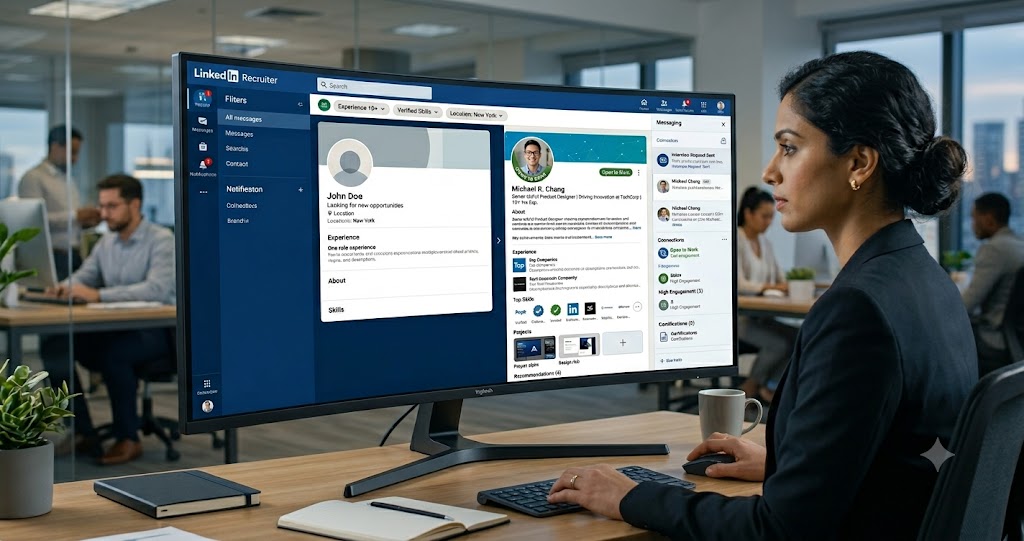
What you did not see is what happened on the other side. A recruiter received your application, liked something on your resume, opened your LinkedIn profile to learn more and within 30 seconds, moved to the next candidate.
Not because you were unqualified. Because your profile did not back you up.
This happens to candidates across India every single day people with real skills and genuine potential, but a LinkedIn profile that communicates none of it. A blank headline. A missing photo. A summary that says “looking for opportunities.” No projects. No activity. No story.
In 2025, your LinkedIn profile is not a formality. It is where recruiters decide whether you are worth a phone call. If it does not make a strong case in the first 30 seconds, you lose that opportunity silently without ever knowing it happened.
This blog tells you exactly what recruiters look at, what kills your chances, and what a profile that actually gets calls looks like.
Opportunities don’t always go to the most qualified candidates—they go to the candidates recruiters can find and trust
How Recruiters Actually Use LinkedIn
Before fixing your profile, understand how it gets evaluated.
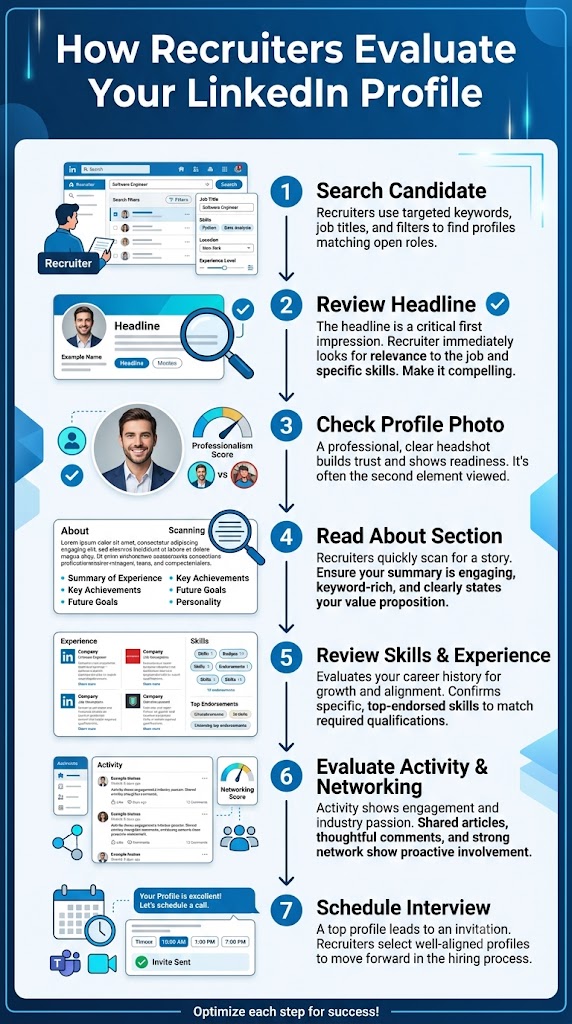
Recruiters use LinkedIn in two ways. First, they vet applicants they search your name after receiving your resume to validate what you have claimed and get a fuller picture. Second, and more importantly, recruiters actively search LinkedIn using keywords, filters, and skill tags to find candidates proactively. They are not waiting for applications. They are hunting for profiles that match their requirements.
If your profile does not contain the right keywords and signals, you are invisible to both of these processes. Right now, for most job seekers, it is not working for them on either front.
The Sections That Are Costing You Interview Calls
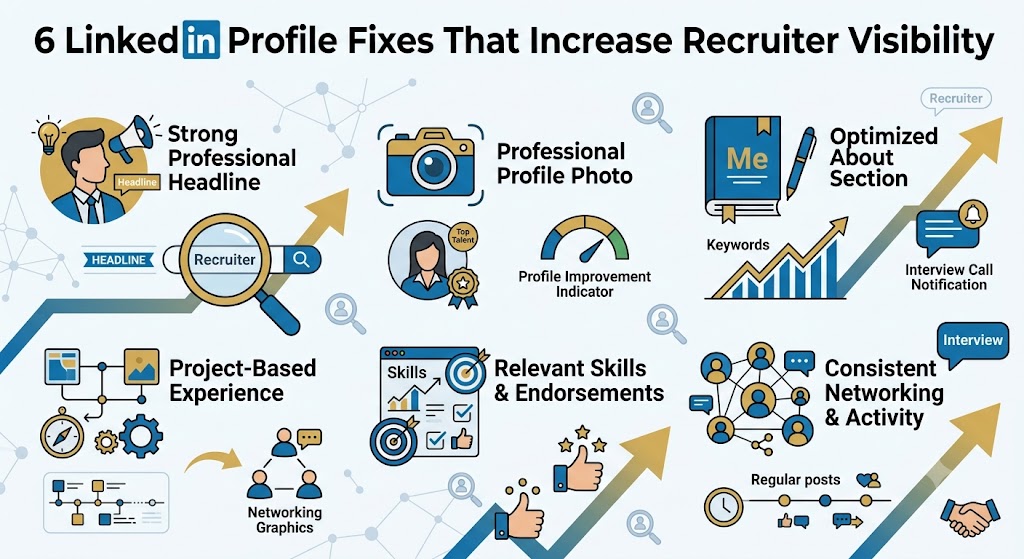
Your Headline Is Generic and That Is a Serious Problem
The single most wasted space on LinkedIn is the headline.
Most people leave it as the default “Student at XYZ College” or “Looking for Job Opportunities” or just their degree name. These headlines communicate nothing useful to a recruiter. They do not appear in search results for the skills companies need. They do not differentiate you from the thousands of other profiles with identical defaults.
Your headline is searchable text. It is the first line a recruiter reads after your name. It is the deciding factor in whether they click into your profile or scroll past it.
A strong headline tells a recruiter three things in one line: what you do, what you are good at, and what kind of role you are targeting.
Weak headline: “B.Tech Computer Science | Fresher | Looking for Opportunities”
Strong headline: “Full Stack Developer | React.js | Node.js | MongoDB | Open to Developer Roles”
The second headline shows up when a recruiter searches for “React developer” or “Node.js fresher.” The first one shows up for nothing. That difference alone determines whether you get found.
Your Profile Photo Is Either Missing or Wrong
Profiles with a professional photo receive 21 times more profile views and 36 times more messages than profiles without one according to LinkedIn’s own data. That is not a marginal improvement. That is a different category of visibility entirely.
The photo does not need a professional photographer. Clear, well-lit, front-facing, plain background. No group photos, no sunglasses, no cropped party selfies. A confident expression and decent lighting are all it takes.
You’re About Section Is Either Empty or Useless
The About section is your 2,600-character opportunity to tell your story in your own voice. Most people leave it blank. The ones who fill it usually write something like: “I am a hardworking individual with good communication skills seeking a challenging position.”
That sentence tells a recruiter nothing. It sounds like every other profile they read that day.
A strong About section answers four questions: Who are you professionally? What skills and tools do you work with? What have you built or accomplished? And what kind of role or opportunity are you looking for?
Write it in first person. Be specific about your skills and projects. Mention the tools and technologies you have worked with by name these become searchable keywords. Keep it between 150 and 300 words. End with a call to action: “Open to full stack developer roles feel free to reach out.”
This is not about being flashy. It is about being clear, specific, and findable.
Your LinkedIn profile is your digital first impression. Make it strong enough to open doors before the interview even begins
Your Experience and Projects Section Has No Evidence
For freshers and recent graduates, this is often the section that feels the hardest to fill and the one that matters most to recruiters who are trying to understand what you can actually do.
Here is the rule: if you do not have formal work experience, your projects are your experience. Every training program project, freelance assignment, college project, or personal build belongs here described with specificity and outcomes.
Do not write: “Worked on a web development project.”
Write: “Built a full stack e-commerce application using React.js, Node.js, and MongoDB. The application includes user authentication, product filtering, cart management, and Razorpay payment integration. Deployed on Render.”
The second description shows a recruiter exactly what you built, what stack you used, and that you know how to take a project to completion. That is evidence. That is what gets calls.
Your Skills Section Is Not Being Used Strategically
LinkedIn’s Skills section directly influences how often you appear in recruiter searches. When a recruiter filters for “React.js” or “Digital Marketing” or “Data Analytics,” they are filtering by the skills listed on profiles. If your skills section is empty or full of vague entries like “Microsoft Office” and “Leadership,” you will not show up for the roles you actually want.
Add every relevant technical skill with its proper name the name companies actually use in job descriptions. React.js, not “React.” Node.js, not “backend development.” Google Analytics, not “analytics tools.”
Get endorsements from classmates, trainers, or colleagues for your key skills. Profiles with endorsed skills rank higher in recruiter searches. Ask the people you have trained with or worked alongside to endorse three to five of your most important skills.
Your Activity Tells Recruiters Everything About Your Seriousness
A recruiter who opens your profile and sees that you have not posted, shared, or engaged with anything in months draws a quiet conclusion: this person is not serious about their field.
Contrast that with a candidate whose profile shows regular activity sharing industry articles, commenting thoughtfully on posts about their domain, occasionally posting about a project they built or a concept they learned. That profile signals genuine interest and professional awareness. It makes the recruiter more confident in making a call.
You do not need to post daily. Two to three meaningful engagements per week a share, a comment, a short post about something you built or learned is enough to make your profile feel alive and your interest look real.
The Network You Are Not Building Is Costing You
Your LinkedIn connections are not just a number they are the infrastructure of your professional visibility.
When you connect with people in your target industry developers, marketers, HR professionals, college alumni, trainers your activity appears in their feed and their activity informs yours. When a recruiter at a target company searches for candidates, second-degree connections surface higher in results. Strategic networking is not about collecting connections. It is about building the infrastructure that makes opportunities find you.
Build the skills, projects, and professional presence that make recruiters reach out to you first
How Learn2Earn Labs Helps You Build a LinkedIn Profile That Gets Results
At Learn2Earn Labs, LinkedIn profile building is a structured, hands-on part of career preparation not a one-time checkbox before job applications begins.
Every student’s profile is reviewed against the actual standards recruiters at target companies use headline strength, keyword coverage, About section quality, project descriptions, and skills completeness. Generic profiles are sent back for revision. Profiles not optimized for recruiter searches do not pass review.
Beyond the profile, students receive guidance on strategic networking, content engagement for visibility, and how to present training and project work as genuine evidence of capability not as a substitute for “real experience.”
This sits within a broader career preparation framework: resume building, mock interviews, placement support, and one-on-one career counselling all calibrated to what the current market actually requires. Students across programs in Full Stack Development, React Native, Digital Marketing, Data Analytics, and Business Development leave with a complete professional presence that is built to get found, shortlisted, and hired.
With 12+ years of experience, 5000+ alumni, and placements at TCS, Accenture, Cognizant, Infosys, and Nagarro, Learn2Earn Labs understands exactly what hiring managers look for and builds that into every stage of the process.
If your LinkedIn profile is not generating calls and you want structured guidance on fixing it along with the skills and preparation to back it up speak with the team at Learn2Earn Labs.
Visit learntoearnlabs.com or write to team@learntoearnlabs.com
Conclusion: Your Profile Is Either Working for You or Against You
Every day you leave your LinkedIn profile incomplete, generic, or inactive is a day recruiters find someone else instead of you.
The good news is that this is entirely fixable. Every section discussed in this blog can be improved in a single focused session. A stronger headline, a professional photo, a specific About section, detailed project descriptions, strategic skills, and consistent activity these changes cost nothing but time and attention.
But they change everything about how you are perceived, how often you are found, and how many calls you get.
Your profile is either making the case for you or quietly costing you opportunities. Make it work for you starting today.
FAQ’s
Q1. Why is my LinkedIn profile not generating recruiter calls?
Common reasons include a weak headline, incomplete profile, lack of relevant keywords, missing projects, and low profile activity.
Q2. How important is the LinkedIn headline?
The headline is one of the most important ranking factors in recruiter searches and is often the first thing recruiters see.
Q3. What should I write in my LinkedIn About section?
Include your professional background, key skills, projects, achievements, career goals, and relevant keywords recruiters search for.
Q4. Should freshers add projects to LinkedIn?
Yes. Projects demonstrate practical skills and often serve as proof of capability when formal work experience is limited.
Q5. How often should I be active on LinkedIn?
Engaging with industry content two to three times per week can improve visibility and demonstrate professional interest.