What Is Prompt Engineering and Why Every Developer Needs to Learn It Right Now
Table of Contents
ToggleThe Skill That Is Quietly Dividing Developers Into Two Groups
Two developers. Same college, same programming language, same experience level. One ships a feature in two hours. The other is still debugging after two days.
What is the difference?
In 2025, that difference has a name: prompt engineering.
It is not a trend. It is not optional. It is the one skill that is actively separating developers who grow from developers who stagnate and if you have not started learning it yet, this blog will tell you exactly why that needs to change today.
The developers winning right now didn’t get lucky. They got better at prompting. So can you
What Is Prompt Engineering?
Prompt engineering is the skill of writing clear, specific, and well-structured instructions for AI tools so that you consistently get accurate, production-quality output.
When you use tools like ChatGPT, GitHub Copilot, Claude, or Google Gemini, you are communicating with a large language model. What you type how specific you are, what context you provide, how you structure the request determines whether the AI gives you something genuinely useful or something completely off target.
That instruction is called a prompt. Crafting it effectively is prompt engineering.
Here is the simplest way to understand it. Compare these two requests:
Weak prompt: “Write a login function in Node.js.”
Engineered prompt: “Write a JWT-based login function in Node.js using Express.js. Validate email and password against a MongoDB collection using Mongoose. Return a signed JWT token with 7-day expiry. Return structured error responses for invalid credentials and missing fields. Follow REST API best practices.”
The first gives you something basic that you will rewrite anyway. The second gives you something close to production-ready. Same AI. Different skill. Completely different result.
Why Every Developer Needs This Skill Right Now
AI tools are now part of the standard development environment
GitHub Copilot has over 1.3 million active developer users. ChatGPT is used daily across every development domain. Tools like Cursor, Tabnine, and Amazon CodeWhisperer are being adopted by companies of every size. These are no longer optional extras they are becoming as standard as a code editor.
And job descriptions have started catching up. AI tool proficiency is appearing as a required skill, not a bonus, in developer hiring.
The output quality depends entirely on how you prompt
This is the part most developers miss. The AI does not know what you want it only knows what you tell it. Two developers using the exact same tool will get completely different results based on the quality of their prompts.
Poor prompt → generic, often broken code that creates more work than it saves. Strong prompt → contextual, structured, usable code that cuts development time significantly.
Developers who cannot use AI effectively are falling behind
Companies expect more output than ever. When AI allows a developer to build in hours what once took days, any developer not using it is operating at a real disadvantage in productivity, in interviews, and in salary conversations.
The gap between AI-fluent developers and AI-ignorant developers is widening every month. And it is far easier to close that gap now than it will be a year from now.
How Prompt Engineering Fits Into a Developer’s Real Workflow
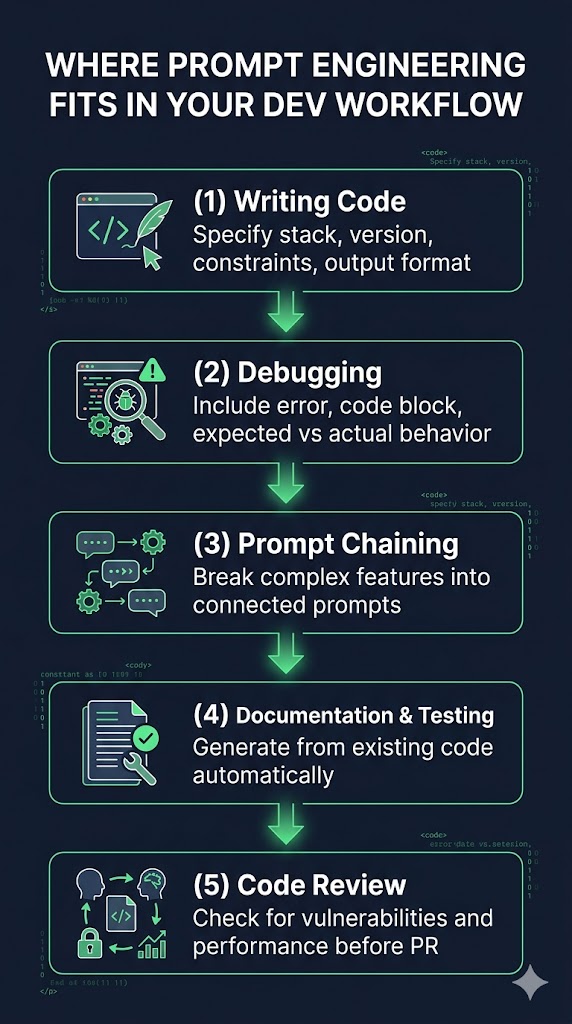
This is not theoretical. Here is where prompt engineering delivers immediate, practical value.
Writing code faster: With the right prompt including stack, version, use case, constraints, and expected output format you get code you can actually use. Without it, you get something you spend an hour fixing.
Debugging smarter: Instead of pasting an error and hoping, an engineered debugging prompt includes the error message, the relevant code block, the expected behavior, and the actual behavior. The AI then pinpoints the issue in context, not in guesswork.
Building with prompt chaining: Complex features from database schema to API endpoints to frontend components can be built step by step using a series of connected prompts. Each output feeds the next prompt. This technique, called prompt chaining, is how experienced developers use AI on full-scale features without losing control of the output.
Automating documentation and testing: Two tasks developers universally avoid. With the right prompts, AI generates both from existing code saving hours every week.
Code review and security checks: A well-crafted prompt can ask AI to review your code for vulnerabilities, performance issues, or naming conventions before you even submit a pull request.
Same AI, same tools different results. The only variable is how well you prompt
What Makes a Prompt Strong? The Core Elements
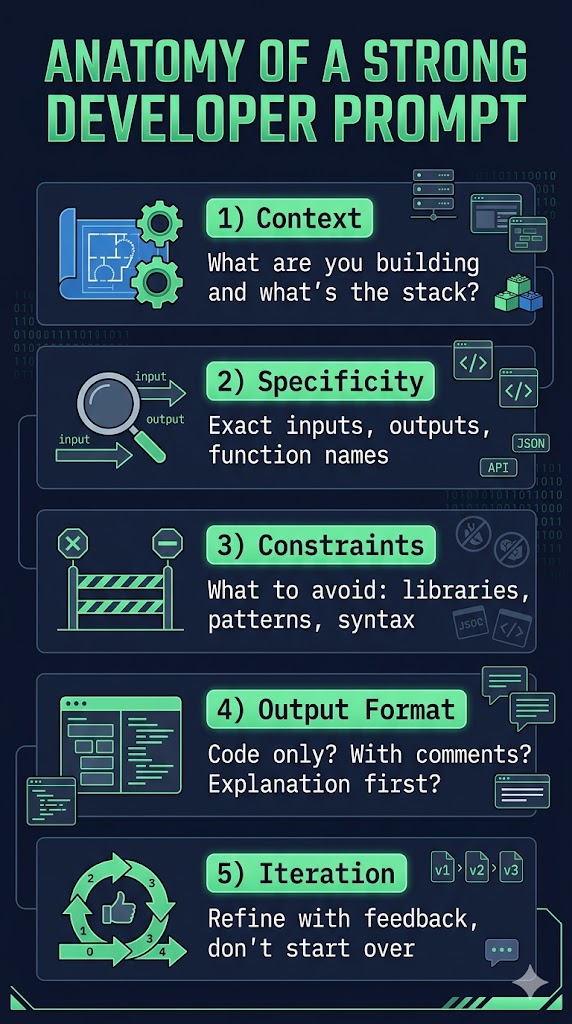
If you want to start today, every effective developer prompt should include these components:
Context – What are you building? What is the tech stack? Where does this fit in the project?
Specificity – Exact function names, data types, expected inputs, outputs, and any edge cases.
Constraints – What to avoid: legacy syntax, specific libraries, security anti-patterns.
Output format – Do you want just code? Code with comments? An explanation first?
Iteration – Prompt engineering is a conversation. If the first output misses, refine the prompt with specific feedback rather than starting over.
This becomes second nature with practice. And once it does, your development speed and output quality change permanently.
Prompt Engineering Is Different Across Development Domains
This is an important point that often goes unmentioned.
Full stack developers need prompts that address both layers frontend components, backend logic, API design, and database interactions simultaneously. Context about how those layers communicate is critical.
Mobile app developers using React Native or Flutter need to specify platform targets (iOS, Android, or both), navigation patterns, device-specific behavior, and performance constraints like memory and battery. Generic prompts produce generic and often broken mobile UI.
Java developers need prompts that account for object-oriented design patterns, Spring Boot configuration, Hibernate ORM relationships, and enterprise-grade exception handling. The architectural context is what makes the difference.
Domain-specific prompt engineering is where the real productivity gains happen. General prompting knowledge is a starting point. Applying it to your exact tech stack is the actual skill.
What This Skill Does to Your Salary and Career
Let’s be direct about the numbers.
Entry-level developers with basic coding skills are starting at ₹3–4 LPA in India. Developers who also demonstrate AI tool proficiency and prompt engineering skills are consistently being placed at ₹5–8 LPA for their first role because they produce more from day one.
Mid-level developers who add this skill are commanding higher rates in both employment and freelancing, where client expectations around delivery speed have risen sharply.
The reason is simple: companies pay for output. A developer who ships faster, debugs faster, and documents more thoroughly because they know how to use AI effectively delivers more measurable value. The market prices that accordingly.

Every hour you spend learning prompt engineering saves ten hours of debugging later.
How Learn2Earn Labs Is Building This Into Developer Training
At Learn2Earn Labs, prompt engineering is not a separate module added at the end of a course. It is integrated into every stage of the development programs.
Across Full Stack Development (MERN and Java), React Native Mobile App Development, and other tech tracks, students are trained to work with AI tools from the very first week. The training is hands-on, not theoretical.
Here is what that looks like in practice:
Students are assigned real features and required to complete them using structured AI prompts not manual searching. This trains context-setting and output evaluation from the start. Debugging sessions include AI-assisted diagnosis using student-crafted prompts, building both independence and AI fluency simultaneously. Code submissions go through AI review using the student’s own prompts before instructor review building the habit of quality evaluation. Prompt refinement exercises teach students how to take a weak prompt and improve it, which is the core skill that transfers to every real project.
Beyond the technical training, Learn2Earn Labs provides career counselling, interview preparation, mock interviews, and placement support including guidance on how to communicate AI skills confidently in job interviews, because knowing the skill and knowing how to present it are two different things.
With 12+ years of experience, 5000+ alumni, and placements in companies like Accenture, TCS, Cognizant, and more, Learn2Earn Labs has a proven track record of taking students from learning to earning across every experience level and educational background.
If you are a student, fresher, or working professional ready to build AI-integrated development skills the right way, speak with the Learn2Earn Labs team and get a clear picture of which program fits your goals.
Visit learntoearnlabs.com or reach out at team@learntoearnlabs.com
Start Learning Prompt Engineering Today Practically
You do not need to wait for a course to begin. Here are four things you can do right now:
Use AI on a real task today. Open ChatGPT or GitHub Copilot and apply it to something you are actually working on. Do not experiment on dummy problems.
Be intentional about every prompt. Before you submit, ask: have I given context? Have I been specific about the output? Have I mentioned the stack?
Compare prompts. Take one task and try three different phrasings. Study which gives the best output and understand why.
Build a prompt library. Document what works for tasks you repeat often debugging, scaffolding, test writing. This becomes a personal competitive asset over time.
Conclusion: The Window Is Still Open But Not for Long
There was a time when knowing how to search effectively on Google was considered a bonus skill. Now it is assumed. Prompt engineering is on the same trajectory except the gap between knowing it and not knowing it is wider, and the consequences of ignoring it are more immediate.
Every developer is going to use AI tools. The question is whether you use them passively getting mediocre output and wondering why or actively, as a genuine productivity multiplier.
The developers building strong careers right now made the decision to take this seriously early. That window is still open.
Start learning it. Practice it on every project. And if you want a structured, career-focused environment where AI is woven into how you learn to build software from day one, Learn2Earn Labs is the place to start.