What Hiring Managers Actually Check in a Digital Marketing Fresher's Resume
Table of Contents
ToggleYou sent the application. Now here’s what happens on the other side
Most digital marketing freshers believe that once they hit “Apply,” the rest is up to luck. A hiring manager opens their resume, reads it top to bottom, and either calls them or does not.
That is not what happens.
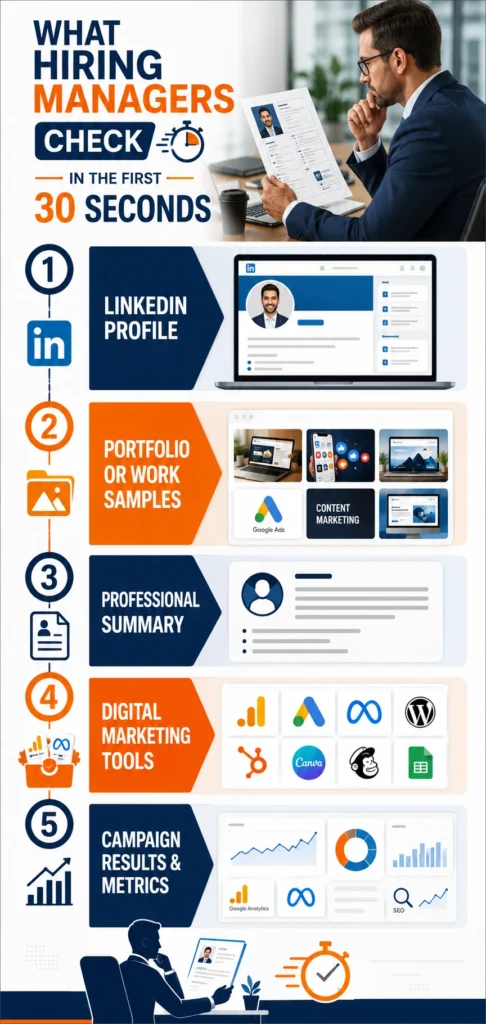
What actually happens is faster, more specific, and more ruthless than most candidates expect. A hiring manager at a marketing agency or a digital team inside a company typically spends about 30 to 45 seconds on a fresher’s resume during the first pass. In that time, they are not reading they are scanning for specific signals. If those signals are present, the resume goes into the shortlist pile. If they are not, it does not matter how good the rest of the resume looks.
The good news is that those signals are not mysterious. They are predictable, learnable, and absolutely something you can put on your resume before your next application.
This blog breaks down exactly what hiring managers look for when they open a digital marketing fresher’s resume section by section, signal by signal so you can stop guessing and start getting calls.
AI Integrated Digital Marketing Training
Build practical skills in SEO, Google Ads, Social Media Marketing, Analytics, Content Marketing, and AI-powered workflows through projects, live classes, internship exposure, and industry-focused learning.
Why digital marketing resumes are different from tech resumes
Before getting into specifics, it is worth understanding something many freshers miss.
Digital marketing is a field where almost anyone can claim almost anything. There are no licensing exams, no standardised degrees, and no single certification that proves competence. This makes hiring managers in digital marketing more sceptical about resume claims than recruiters in most other fields. When a developer says they know React.js, a coding test settles it in two minutes. When a digital marketing fresher claims to know SEO or Meta Ads, the verification is harder.
So, hiring managers look for evidence, not just claims. Every point on your resume that is a claim without backing is weaker than it looks. Every point tied to a real result, a real project, or a recognised certification is significantly stronger.
Keep that principle in mind as you read each section below.
The first thing they check: your digital presence
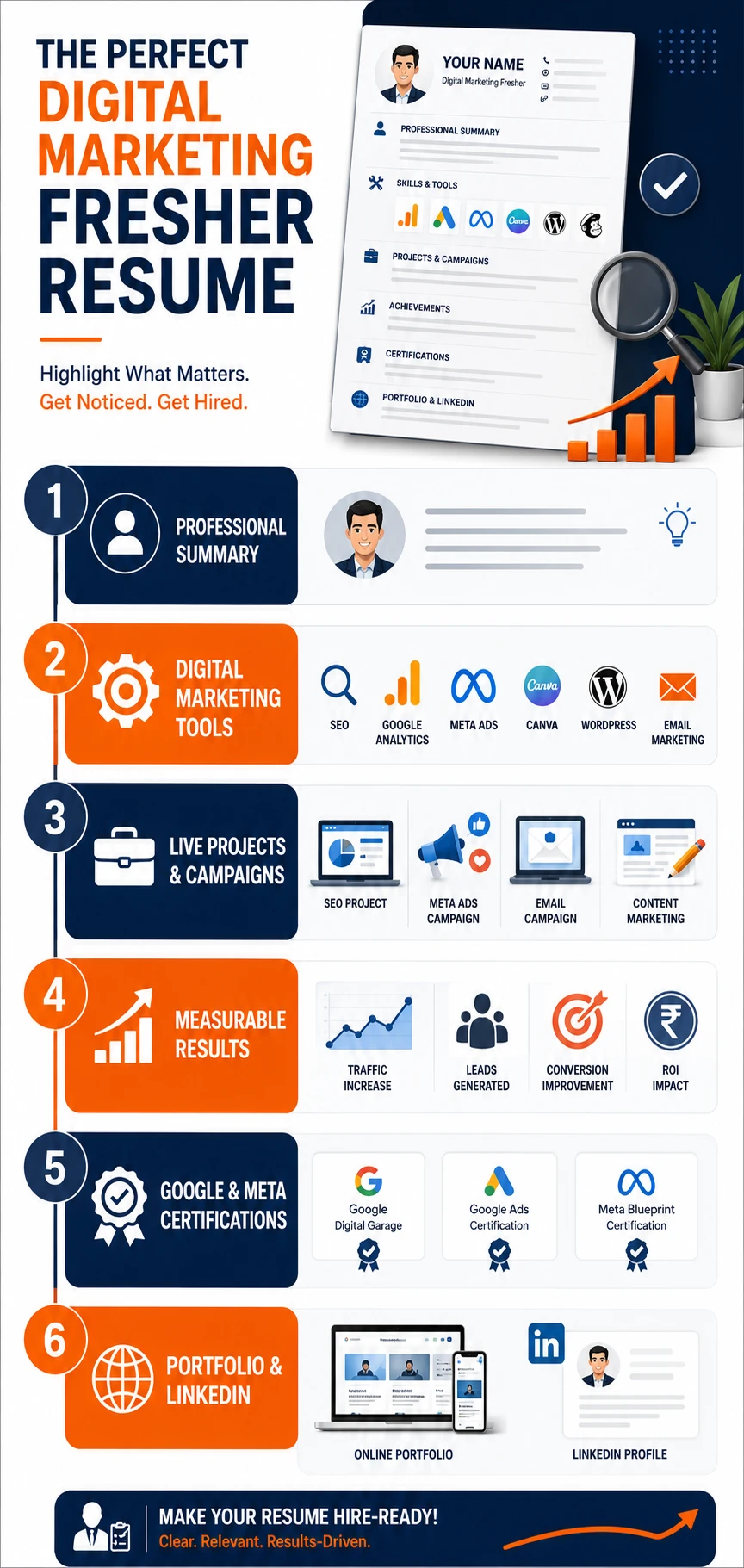
Before a hiring manager opens your resume properly, many do a quick search your LinkedIn profile, your portfolio, any online presence linked to your application.
This sounds informal. In digital marketing, it is not. Your ability to present yourself online is literally the job. If you are applying to manage a brand’s digital presence and your own is nonexistent or careless, that is a direct signal about your capability.
A complete LinkedIn profile with a professional headline and real project mentions immediately puts you ahead of most freshers who apply with nothing online. A portfolio link even a basic one with two or three documented campaign samples is something a hiring manager remembers.
You do not need a professional website. A well-organised Google Drive folder with campaign screenshots, SEO reports, content calendars, or analytics dashboards is enough to show you have actually done something, not just read about it.
What they scan in the first 30 seconds
Once the resume is open, here is what a hiring manager’s eye actually moves to first.
Your headline or professional summary
They want to know in one or two lines exactly who you are and what you have done. “Digital marketing fresher seeking opportunity” is invisible. “Digital marketing trainee with hands-on experience in SEO, Google Analytics, and Meta Ads | Managed organic content for a brand with 8,000+ followers” is something they stop and read. The difference is specificity. One is a description of your intention. The other is a description of your work.
Your skills section
They are checking for tool names. Not categories actual tool names. Google Analytics, Google Search Console, SEMrush, Ahrefs, Canva, Meta Business Suite, Mailchimp, HubSpot, WordPress. If your skills section lists “social media management” and “content creation” without naming a single specific tool, a hiring manager immediately wonders whether you have actually used anything or whether you just learned about it in a textbook.
Any numbers anywhere on the resume
This is the most important signal and the most commonly absent one. Numbers mean: “I did not just work on things. I produced results.” Grew Instagram followers from 1,200 to 6,500 in three months. Improved a blog’s organic traffic by 43% over six weeks. Managed a Meta Ads campaign with a ₹15,000 budget and a cost-per-click of ₹4.20. These numbers do not have to be massive they have to be real and specific. A single genuine metric on a fresher resume does more for your shortlist chances than an entire paragraph of claimed skills.
AI Integrated Digital Marketing Training
Build practical skills in SEO, Google Ads, Social Media Marketing, Analytics, Content Marketing, and AI-powered workflows through projects, live classes, internship exposure, and industry-focused learning.
What they read carefully after the initial scan
If the first scan produces enough positive signals, the hiring manager will now actually read your resume. Here is what gets looked at carefully.
Your project and campaign section
This is the most important section on a fresher digital marketing resume, and most candidates either leave it vague or skip it entirely.
Every project entry should answer four questions: what was the objective, what did you specifically do, what tools did you use, and what was the result? “Ran social media campaigns for a local brand” tells a hiring manager nothing. “Managed Instagram and Facebook content for a local clothing brand over eight weeks and grew the page engagement rate from 2.1% to 5.7% using Reels, carousel posts, and targeted hashtag research” tells them you understand engagement metrics, you know how to use different content formats, and you can produce a measurable result. That is worth a call.
If you ran a mock campaign during training, include it. If you helped a local business or a college event with their digital presence, include it. If you grew your own Instagram or YouTube channel with intention, include the numbers. Hiring managers do not care if you were paid. They care if you actually did it.
Your certifications
In digital marketing, certifications from recognised platforms carry genuine weight at the fresher level. Google Digital Garage, Google Ads, HubSpot Content Marketing, Meta Blueprint, SEMrush Academy these are names hiring managers recognise. They do not guarantee a call, but they signal that you sought structured learning beyond your degree. A certification from an unknown platform contributes very little. One from Google or HubSpot, paired with a project showing you applied what you learned, is a strong combination.
Your education and academic background
For digital marketing specifically, the degree matters far less than in many other fields. A BCom graduate with a strong campaign portfolio and Google certifications is a stronger candidate than an MBA graduate with no hands-on experience and a resume full of theory. Hiring managers know this, and most of them evaluate accordingly.
What does matter in the education section is whether you did anything during your college years that is relevant a college magazine, a social media committee, any event promotion or communication role. These signal early exposure to the domain and are worth mentioning.
What makes a hiring manager immediately put your resume aside
Some things on a digital marketing fresher resume do not just fail to help they actively reduce your chances.
Generic objective statements. Skill sections listing “communication,” “creativity,” and “teamwork” with no tool names. Project descriptions that are one line and mention no results. Inconsistent formatting. Spelling errors particularly painful on a resume for a role where written communication is part of the job description.
In digital marketing, your resume is itself a piece of content. If the person reading it cannot understand in the first 30 seconds what you have done and why you are worth calling, you have failed the first brief before the interview even began.

AI Integrated Digital Marketing Training
Build practical skills in SEO, Google Ads, Social Media Marketing, Analytics, Content Marketing, and AI-powered workflows through projects, live classes, internship exposure, and industry-focused learning.
How Learn2Earn Labs prepares freshers for exactly this standard
At Learn2Earn Labs, the digital marketing program is built around this reality from the very beginning. Students do not just learn what SEO is they work on live campaigns, create actual content calendars, run ad sets, analyse real data using Google Analytics, and build a project portfolio that has the kind of specificity and numbers that hiring managers are looking for.
Resume building at Learn2Earn Labs is not a template exercise. Each student’s resume is reviewed specifically against what recruiters in digital marketing roles actually look for with direct feedback on whether project descriptions are detailed enough, whether certifications are appropriately positioned, and whether the skills section reflects the tools the industry actually uses.
Career counsellors work with students on LinkedIn optimisation, portfolio presentation, and how to talk about their projects in interviews with the same specificity that makes their resume stand out. The goal is always the same: a student who walks into an interview with real work to show and real numbers to back it up.
With 15+ years of experience and alumni placed at companies across digital marketing, technology, and business roles, Learn2Earn Labs understands the gap between what freshers typically produce and what hiring managers actually want and closes it deliberately, program by program.
If you are a digital marketing fresher who wants to build a resume that hiring managers actually shortlist and the skills and projects to back it up start with a conversation with the team at Learn2Earn Labs.
Visit learntoearnlabs.com/contact-us or write to team@learntoearnlabs.com
Conclusion
Hiring managers are not looking for the most enthusiastic fresher. They are looking for the one who shows the clearest evidence of having actually done something in the field.
That evidence lives in the numbers on your resume, the tools you can name, the campaigns you can describe specifically, and the certifications that show you sought structured learning.
Your resume is a brief. Make the case clearly, back every claim with something real, and give them a reason in the first 30 seconds to read the next 30 seconds. That is how you get the call.
FAQ’s
Q1. What do hiring managers look for in a digital marketing fresher’s resume?
Hiring managers look for practical experience, campaign results, tool proficiency, certifications, and evidence of real digital marketing work.
Q2. Should freshers include digital marketing projects on their resumes?
Yes. Live projects, mock campaigns, freelance work, and personal marketing initiatives demonstrate practical skills and improve interview chances.
Q3. Which digital marketing tools should be listed on a fresher’s resume?
Include tools such as Google Analytics, Google Search Console, Meta Business Suite, Canva, WordPress, HubSpot, Mailchimp, SEMrush, and Ahrefs if you have practical experience.
Q4. Are Google and Meta certifications important for freshers?
Yes. Certifications from Google, Meta, HubSpot, and SEMrush strengthen a fresher’s profile when supported by practical projects.
Q5. How long do recruiters spend reviewing a fresher’s resume?
Most recruiters spend around 30–45 seconds on the first review before deciding whether to shortlist the candidate.