How to Use AI to Create a Complete Business Plan for a Startup in One Weekend
Table of Contents
ToggleMost startup ideas die before they become plans. AI is changing that
You have an idea. Maybe you have had it for months sitting quietly in the back of your head during office hours, keeping you up past midnight, surfacing every time you read about someone who built something similar and made it work.
But between the idea and the actual start lies one wall that stops most aspiring entrepreneurs cold: the business plan.
Not because it is intellectually impossible. Because it feels overwhelming. Where do you start? How do you estimate revenues when you have not sold anything? How do you describe a market you understand intuitively but cannot put numbers on?
Most people stall here for months. Some stall indefinitely.
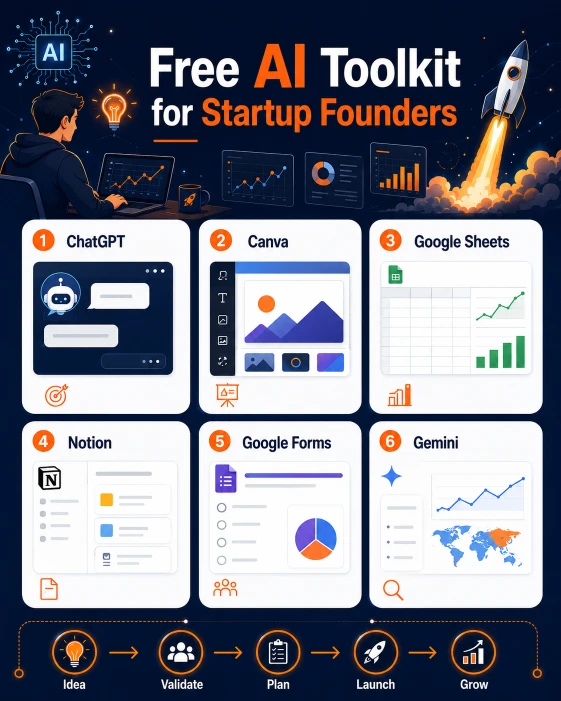
Here is what has changed: AI tools primarily ChatGPT can now guide you through every section of a business plan with the same quality of structured thinking that once required a consultant or an MBA. Not by thinking for you. By scaffolding the process, drafting the sections, and helping you pressure-test assumptions so that one focused weekend produces something genuinely usable.
This blog walks you through exactly how.
AI Integrated Digital Marketing Training
Build practical skills in SEO, Google Ads, Social Media Marketing, Analytics, Content Marketing, and AI-powered workflows through projects, live classes, internship exposure, and industry-focused learning.
What a real business plan actually needs to contain
Before opening any AI tool, know what you are building. A business plan is not a dream document. It is a structured argument that answers one question: why will this business work, and how?
Every serious business plan covers: an executive summary stating the concept and opportunity; a problem and solution section; a market analysis covering size, target customer, and timing; a business model explaining how you make money; a go-to-market strategy for acquiring first customers; an operations plan; financial projections with a break-even point; and a team section.
That is a lot. But broken into sections, tackled one at a time over a weekend, with AI handling the drafting and structural heavy lifting it is entirely achievable.
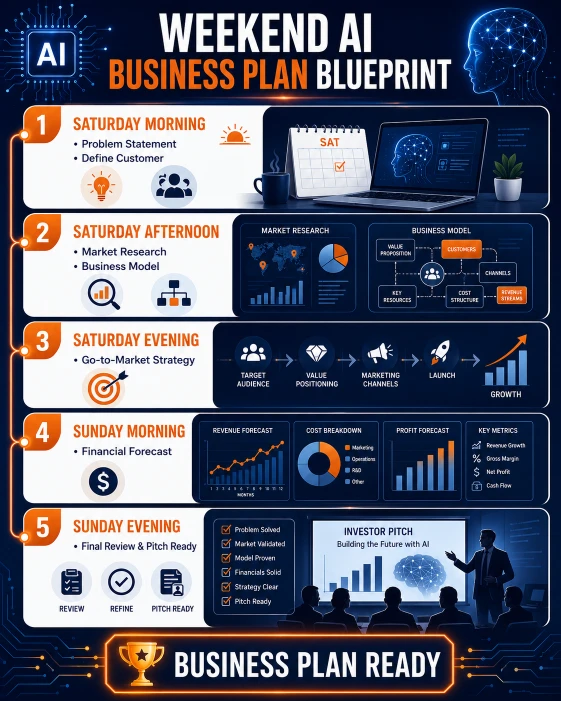
Saturday morning: the foundation
Start with the problem not your solution.
Open ChatGPT and describe your idea in plain language. Explain what gap you noticed, who is experiencing it, and why current options are not solving it well enough. Then ask ChatGPT to sharpen the problem statement make it more specific, more quantifiable, more compelling.
Then ask: “What questions would an investor or a sceptical friend ask about this?” Let it generate the tough questions. Answer them. This process state the problem, get challenged, refine the answer is what a good advisor would put you through. You are doing it in an hour with a free tool.
Once the problem is clear, describe your product or service and ask ChatGPT to help articulate the unique value what makes it different, why now, why this approach.
By Saturday midday, you should have a crisp problem-solution section you can confidently defend.
Saturday afternoon: market and model
Market analysis is where most first-time founders either go vague (“our market is huge”) or freeze because they do not know how to find data.
Give ChatGPT your industry, geography, and target customer. Ask it to identify the relevant market size total addressable market, serviceable market, and the realistic slice you could capture in year one. Ask what trends support demand for your solution right now and who your primary competitors are.
Treat ChatGPT’s numbers as directional, not definitive. For India-specific data, cross-reference with Statista, MSME government reports, or NASSCOM publications. The AI gives you structure and reasoning; you verify the key figures.
For the business model, ask ChatGPT to walk you through different revenue models for a business like your subscription, one-time fee, commission, freemium, retainer. Then ask it to model a simple unit economics calculation: what does acquiring one customer cost, what do they pay, what is the margin? That structured thinking is what separates a credible plan from a wishful one.
AI Integrated Full Stack Development Training
Master HTML, CSS, JavaScript, React, Node.js, Express.js, MongoDB, REST APIs, and AI-powered development workflows through live coding, practical projects, internship opportunities, and career-focused training.
Saturday evening: go-to-market strategy
How you get your first ten customers is more important than how you plan to get your first ten thousand.
A go-to-market strategy for a startup does not need to be complex. It needs to be honest. Who specifically is your first customer, where do you find them, what will you say to get their attention, and what does the sales process look like from first contact to closed deal?
Ask ChatGPT to help you build a go-to-market strategy for your first 90 days. Give it your product, your target customer profile, your budget constraint (assume very limited), and the channels available to you LinkedIn, WhatsApp, Instagram, referrals, local networks, cold email. Ask it to suggest a sequenced approach: what to do in week one, what to layer in by week four, what success looks like at the 90-day mark.
Then ask it to generate the messaging you would use to reach your ideal customer a cold email opener, a LinkedIn outreach message, an Instagram bio that communicates your value proposition immediately. These are not final copies. They are first drafts that you refine in your own voice. But having them on paper is what converts a strategy section from a vague intention into something that looks and feels executable.
Sunday: financials, operations, and the full document
Sunday is for the sections that feel most intimidating and for pulling everything into a single document.
Financial projections do not need to be precise at the idea stage. They need to be logical. Start with assumptions: how many customers do you realistically expect to acquire in month one, month three, month six? What do they pay? What are your fixed costs tools, hosting, rent if any, your own time valued at a realistic rate? What are your variable costs per customer?
Ask ChatGPT to help you build a simple 12-month revenue and cost model based on these assumptions. Ask it to identify the break-even point the month where revenue exceeds costs. Ask it to flag which assumptions are most sensitive meaning which ones, if wrong, would most significantly change the outcome. That sensitivity awareness is exactly the kind of thinking investors look for and most first-time founders miss entirely.
For the operations section, describe how the business actually runs. Who does what. What tools and systems you need. What your capacity looks like in month one versus month six. Ask ChatGPT to help structure this into a clear, readable format.
By Sunday afternoon, you have all the sections drafted. Now ask ChatGPT one final, powerful thing: “Review this business plan and tell me the five weakest points where the logic is thin, where assumptions are unsupported, and where an investor would push back hardest.”
The answers to that question become your revision list. Spend Sunday evening addressing them. What you end up with is a business plan that has been through a round of critical review before anyone else has seen it.
What AI cannot replace and why that matters
Let us be direct about something important.
AI can structure your thinking, draft your sections, challenge your assumptions, and model your financials. It cannot validate your market with real customer conversations. It cannot tell you whether people will actually pay for your specific product at your specific price in your specific market. It cannot replace the experience of speaking to ten potential customers and hearing how they describe the problem in their own words.
The business plan you build with AI this weekend is a starting point a hypothesis on paper. The next step after building it is testing it. Taking the customer profile AI helped you define and finding five real people who match it. Taking the problem statement and asking them if it resonates. Taking the pricing and asking if they would pay it.
That is where the real business is built in the gap between the plan and the market’s response to it.
AI Integrated React Native Mobile App Development Training
Build a job-ready mobile app development profile through practical coding, industry-style projects, AI-assisted workflows, career preparation, mentor-guided learning, real-world app deployment, API integration, and hands-on portfolio development.
How Learn2Earn Labs supports startup founders and aspiring entrepreneurs
Building a business plan in a weekend is possible. Building a business that actually works requires something more sustained the right skills, the right guidance, and the right community to think alongside.
At Learn2Earn Labs, startup consultation and business development training are not afterthoughts. They are a core part of what the institute offers to students and professionals who want to build something of their own.
The AI-integrated Business Development and Freelancing program at Learn2Earn Labs trains students in exactly the kind of applied, practical business thinking this blog covers market analysis, business modelling, go-to-market strategy, client acquisition, proposal writing, and financial fundamentals. Every concept is taught through real assignments, not just theory.
Beyond the program, Learn2Earn Labs provides one-on-one startup consultation for students and alumni who are actively building something helping them refine their ideas, stress-test their assumptions, and identify the fastest path from concept to first customer.
With decades of experience working with students, freshers, and professionals across technology, marketing, and business, the team at Learn2Earn Labs understands what it takes to go from idea to execution and provides the structured support that makes that journey significantly shorter and less lonely.
If you have an idea, you have been sitting on, or a plan you have already started and want honest feedback on, the conversation starts here.
Visit learntoearnlabs.com or write to team@learntoearnlabs.com
Conclusion
The business plan that has been sitting in your head for months can be on paper by Sunday night.
AI will not build your business for you. But it will eliminate the most common reason good ideas never become plans the paralysis of not knowing where to start, what structure to follow, or how to think through the parts that feel too complex without a business degree.
One focused weekend. A clear process. The right tools. That is all it takes to turn an idea into something you can show, defend, and begin to act on.
Start this Saturday.
Frequently Asked Questions
1. Can AI create a complete business plan for a startup?
Yes. AI tools like ChatGPT can help draft business plans, market research, financial projections, customer personas, and go-to-market strategies. However, founders should validate assumptions with real market research.
2. Which AI tool is best for writing a startup business plan?
ChatGPT is one of the most effective AI tools for creating business plans because it assists with brainstorming, structuring sections, financial modeling, and refining business strategies.
3. How long does it take to create a business plan using AI?
A focused entrepreneur can prepare a strong first draft over a weekend by using AI to organize ideas, generate content, and review the overall business plan.
4. Can AI help with financial projections for a startup?
Yes. AI can generate revenue forecasts, estimate costs, calculate break-even points, and identify key financial assumptions. These figures should be verified using reliable market data.
5. What should every startup business plan include?
A comprehensive business plan should include an executive summary, problem statement, solution, market analysis, business model, marketing strategy, operations plan, financial projections, and growth roadmap.