
Home » Career » The Unspoken Rules of Corporate Life Nobody Teaches You in College

The Unspoken Rules of Corporate Life Nobody Teaches You in College

Young professional beginning their first corporate job while learning workplace communication, teamwork, professionalism, and career growth skills

College prepares you for a lot of things. The actual workplace is not one of them

You studied for four years. You attended lectures, passed exams, completed assignments, maybe even did an internship. You got your degree. And then you walked into your first job and realized, fairly quickly, that almost nothing you learned in college had prepared you for what actually happens inside a company.

Not because your education was bad. But because colleges teach you the technical knowledge of a profession — they rarely teach you how to survive, grow, and eventually thrive inside the human environment where that profession is practiced.

The corporate world runs on a set of rules that nobody writes down, nobody announces, and nobody officially teaches. They are absorbed over years of observation, uncomfortable mistakes, and advice from seniors who learned the hard way themselves.

This blog puts those rules in one place — clearly, honestly, and without sugarcoating — so that you do not have to spend the first two years of your career learning them through trial and error.

Learn2Earn Labs AI Integrated Digital Marketing Training banner featuring AI-powered marketing skills, SEO, Google Ads, social media marketing, analytics, automation, practical projects, internship experience, and career-focused learning.

AI Integrated Digital Marketing Training

Build practical skills in SEO, Google Ads, Social Media Marketing, Analytics, Content Marketing, and AI-powered workflows through projects, live classes, internship exposure, and industry-focused learning.

Your first impression is set in the first few weeks, not the first day

Most freshers believe the first impression is made on the first day — the way they dress, the way they introduce themselves, the energy they bring into the room. That matters. But the lasting first impression is built over the first three to four weeks, through dozens of small, observed behaviors.

Are you on time consistently or do you arrive a few minutes late every day? Do you listen in meetings or look at your phone? When given a task, do you ask clarifying questions before you start or disappear and return with something entirely different from what was expected?

None of these things are in your job description. All of them are being noticed.

The first few weeks are a window where colleagues and managers form a mental model of who you are — reliable or careless, engaged or disinterested, someone to invest in or someone to manage carefully. Once that model forms, it is surprisingly sticky. It takes months of consistent behavior to change it.

Treat every small action in your first month as if someone important is watching. Because they usually are.
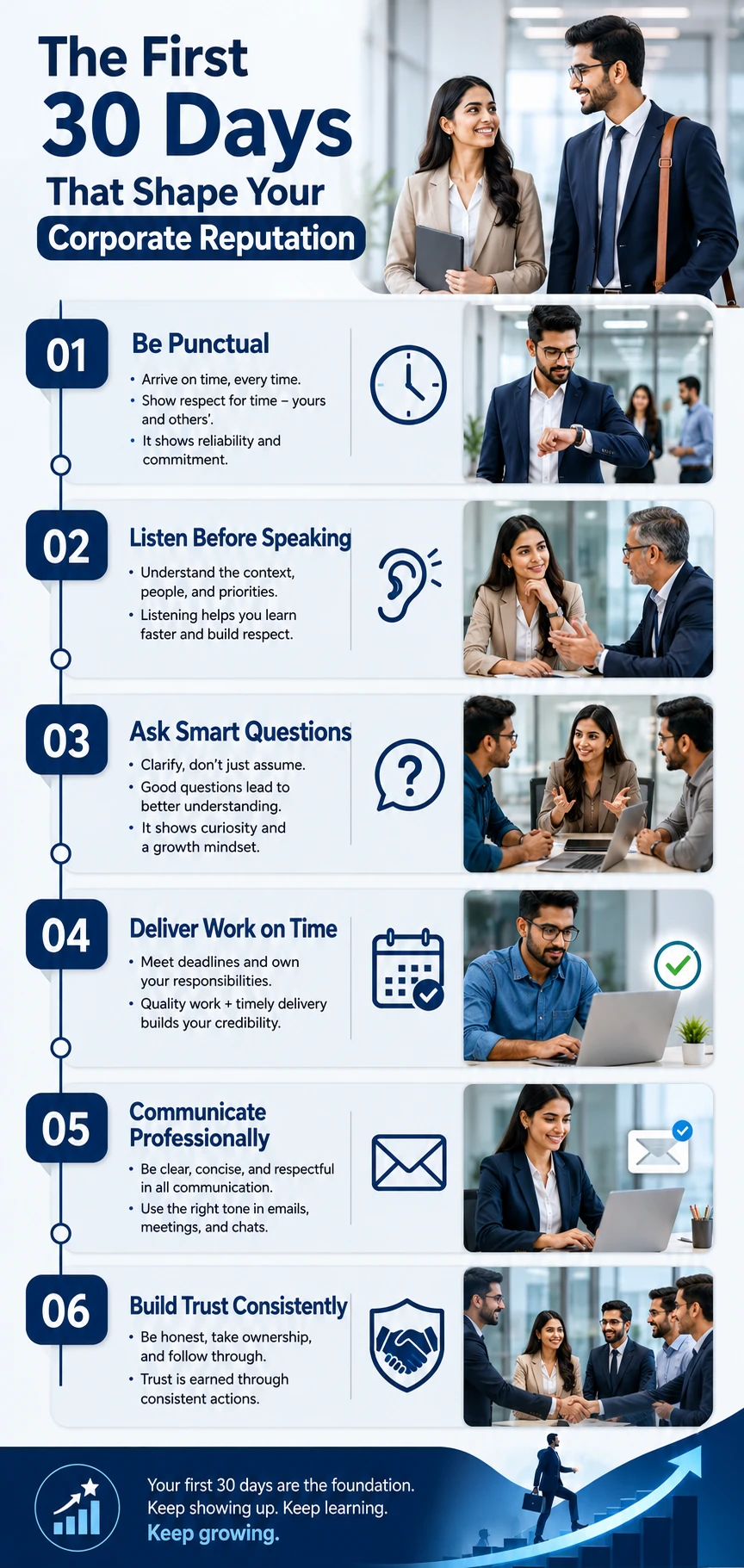
Infographic showing the key habits that help freshers create a positive first impression in corporate workplaces


Being good at your job is the entry requirement, not the reward

This is probably the hardest thing for high-achieving freshers to accept.

In college, talent and hard work get recognition — marks, awards, appreciation from professors. The system rewards individual performance transparently.

Corporate environments are more complicated. Being technically good at your job is expected — it is the baseline, not the differentiator. The people who grow faster and move up are usually not the best at the technical work alone. They are the ones who combine technical ability with communication, collaboration, relationship-building, and the capacity to make the people around them better.

Technical excellence still matters. But it will not take you as far as you might expect on its own. The people who seem to grow effortlessly are almost always doing the visible technical work alongside a quieter set of relational skills that most freshers have never been asked to develop.

Nobody is waiting for you to figure things out on your own

In college, figuring things out independently is celebrated. There is time for discovery, and the process itself is part of the learning.

In a corporate environment, your time costs money. Every hour you spend stuck on something that a five-minute conversation with a colleague could have solved is an hour of lost productivity. Struggling silently for two days before asking for help is not independence — it is poor resource management.

Asking specific questions early and communicating clearly when you are blocked are skills corporate environments value. The freshers seen as high-potential early on are almost always the ones who ask smart questions, involve their managers early, and are honest about what they do not know.

The version to avoid is different — asking for hand-holding on every small decision, needing approval before any step, or bringing problems without having thought through even one possible solution. The middle ground: be resourceful enough to make genuine attempts, and communicative enough to escalate quickly when those attempts hit a wall.

AI Integrated Full Stack Development training with React Node.js MongoDB and AI tools at Learn2Earn Labs

AI Integrated Full Stack Development Training

Master HTML, CSS, JavaScript, React, Node.js, Express.js, MongoDB, REST APIs, and AI-powered development workflows through live coding, practical projects, internship opportunities, and career-focused training.

Your relationship with your manager matters more than almost anything else

Most freshers focus on impressing their entire office. In practice, the relationship that most directly shapes your first few years is the one with your immediate manager.

Your manager decides what work you get. They decide how your performance is evaluated. They are the primary voice that represents you in conversations about promotions, pay, and opportunities that you will never even know are being discussed. A manager who believes in you will advocate for you in rooms you are not in. A manager who has written you off will not.

This does not mean you should be political or fake. It means you should be intentional. Understand what your manager values — quality, speed, communication, initiative, documentation — and make sure your work reflects those values specifically. Keep them informed about what you are working on without being high-maintenance about it. When something goes wrong, tell them before they find out from someone else. When you have an idea, share it — briefly and practically, not as a lecture.

The goal is not to make your manager like you. It is to make your manager trust you. Trust is built through reliability, honesty, and a consistent pattern of doing what you said you would do by when you said you would do it.

Emails and communication are more important than most freshers realise

In college, communication is informal — WhatsApp messages, quick verbal updates, casual back-and-forth. In a corporate environment, written communication carries real weight.

A poorly written email to a client or senior stakeholder reflects on your professionalism and on your team. An email that is unclear, too long, or missing key information creates more work for the person receiving it. Doing this repeatedly quietly earns you a reputation for being careless.

The basics that matter: respond within a reasonable time, even if just to acknowledge and give a timeline. Keep professional emails short and clear. Lead with the most important point. Use a clear subject line. Proofread before sending — especially to senior people or clients.

Freshers noticed positively early in their careers are often the ones who write clearly — because it is surprisingly rare, and it signals maturity well beyond the job title.

Visibility matters, but the wrong kind will hurt you

There is a version of visibility that helps your career — being known for delivering quality work, contributing meaningfully in discussions, being the person people think of when a certain kind of problem needs solving.

And there is a version of visibility that hurts it — talking the most in meetings without saying the most valuable things, putting your name on work that was largely done by others, or developing a reputation for office politics rather than substance.

The distinction is simple but easy to blur when you are eager to prove yourself early. The freshers who build the best long-term reputations are usually the ones who let their work speak first and their personality follow naturally from that foundation. They are not invisible — but their visibility is earned, not performed.

One practical habit worth building early: when you contribute to something significant, make sure the people who matter know about it — not through self-promotion, but through natural communication. A brief update to your manager, a concise summary in the right meeting, a project note that clearly shows who did what. These things add up over time without making you look like you are campaigning for attention.

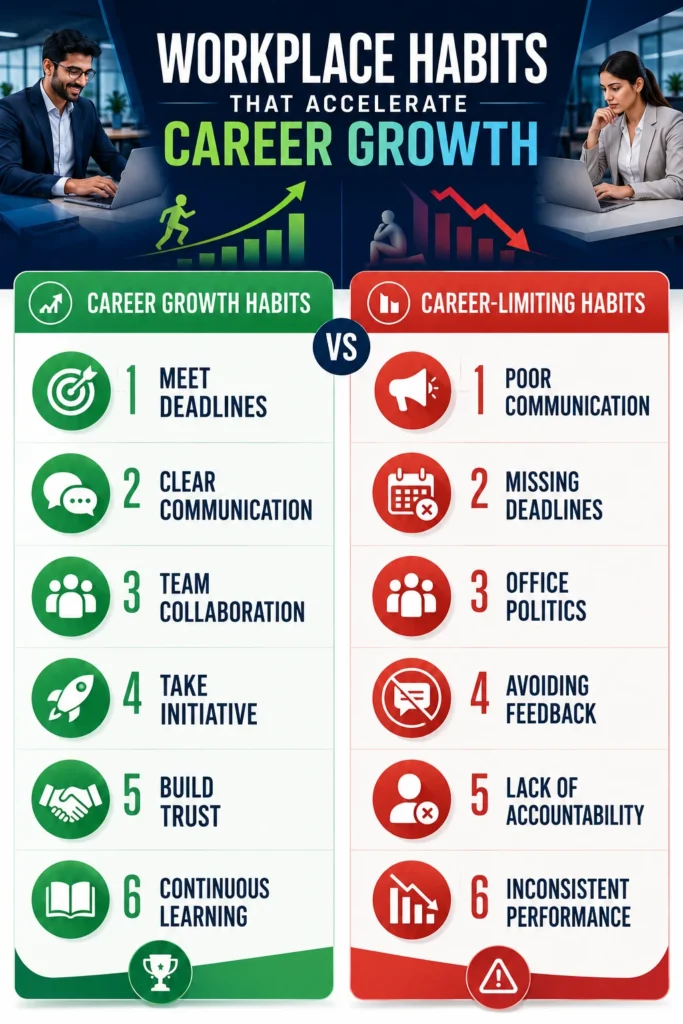
Infographic comparing productive workplace habits with behaviors that slow career growth for freshers
Student learning React Native mobile app development with AI, Expo, APIs, and practical projects at Learn2Earn Labs.

AI Integrated React Native Mobile App Development Training

Build a job-ready mobile app development profile through practical coding, industry-style projects, AI-assisted workflows, career preparation, mentor-guided learning, real-world app deployment, API integration, and hands-on portfolio development.

How Learn2Earn Labs prepares students for the real world, not just the job

Technical skills get you the interview. They get you through the first round, and maybe the second. But what happens after that — the first month, the first year, the trajectory of your early career — is shaped largely by the soft skills, the communication habits, and the professional awareness that most training programs never touch.

At Learn2Earn Labs, career preparation goes well beyond the technical curriculum. Students in every program — Full Stack Web Development, React Native Mobile App Development, Digital Marketing, Data Analytics, AI and Data Science, and Business Development — receive structured guidance on corporate communication, professional behaviour, workplace expectations, and the kind of real-world readiness that helps them not just get the job but keep it and grow in it.

Career counsellors at Learn2Earn Labs have worked with thousands of students over 15+ years, across placements at companies including TCS, Accenture, Cognizant, Infosys, and Nagarro. That experience translates into very specific, practical guidance — not generic advice about “being professional,” but honest, grounded conversations about what corporate environments actually look like, what managers actually value, and what the first year actually demands from a fresher who wants to build a serious career.

The goal at Learn2Earn Labs is not to produce students who can pass an interview. It is to produce professionals who can walk into a corporate environment and navigate it with clarity, confidence, and the self-awareness that most freshers spend years developing on their own.

If you want that foundation — built alongside practical technical skills and real placement support — speak with the team at Learn2Earn Labs.

Visit learntoearnlabs.com or write to team@learntoearnlabs.com

Conclusion

The technical skills you build will open the door. But the unspoken rules of corporate life — how you communicate, how you manage relationships, how you handle visibility, how you ask for help, how you show up every single day — are what determine how far you go once you are inside.

None of this is complicated. But almost none of it is taught.

Now you know. The next step is applying it — from your very first week, in every small interaction that nobody is officially grading but everyone is quietly noticing.

FAQ’s

Q1. What are the most important unspoken rules of corporate life?

Being punctual, communicating professionally, taking ownership of your work, building trust, and collaborating effectively are some of the most important workplace habits.

Q2. Why is communication important in corporate jobs?

Clear communication improves teamwork, prevents misunderstandings, builds trust with managers, and creates a professional reputation.

Q3. How can freshers make a good first impression at work?

Be reliable, arrive on time, ask thoughtful questions, complete tasks responsibly, and maintain a positive attitude during your first few weeks.

Q4. How important is the relationship with your manager?

Your manager often influences performance reviews, career development opportunities, project assignments, and professional growth.

Q5. What is the biggest mistake freshers make in corporate life?

Trying to solve every problem alone without communicating early, along with inconsistent communication and poor workplace professionalism.