Home » Career » Gap Year, Low Grades or Wrong Degree? Build a Strong Tech Career in India

How to Build a Strong Tech Career in India Despite a Gap Year, Low Grades or the Wrong Degree

Indian learners from different academic backgrounds building practical technology skills through coding, analytics, digital marketing and mobile app development.

The question behind the question

When someone asks “can I still build a tech career with a gap year, low grades, or the wrong degree?” — what they are really asking is something more personal.

Am I too late? Have I already made decisions that closed the door permanently?

The answer to both is no — and this blog is going to make that case specifically and honestly, with enough detail that you leave with a clear picture of what the path forward actually looks like.

But first, a necessary truth: the tech industry in India is not a meritocracy based on your marksheet. It is a meritocracy based on what you can build, what you can do, and how clearly you can demonstrate it. The moment you understand that distinction, the gap year stops being a liability, the low grades stop being a wall, and the wrong degree stops being a permanent misdirection.

Learn2Earn Labs AI Integrated Digital Marketing Training banner featuring AI-powered marketing skills, SEO, Google Ads, social media marketing, analytics, automation, practical projects, internship experience, and career-focused learning.

AI Integrated Digital Marketing Training

Build practical skills in SEO, Google Ads, Social Media Marketing, Analytics, Content Marketing, and AI-powered workflows through projects, live classes, internship exposure, and industry-focused learning.

What the tech industry in India actually values

Most students have a version of tech hiring in their head that is either outdated or simply wrong.

Yes, large IT companies use CGPA filters and degree requirements in mass campus recruitment. That is one door — not the only one, and not even the most interesting one for someone who wants a career they are genuinely proud of.

Outside campus recruitment, the tech hiring market in India is enormous and largely skills-based. Startups, product companies, digital agencies, and the growing freelance and remote market hire primarily on ability. They look at GitHub profiles, live projects, problem-solving in technical rounds, and the quality of what you can demonstrate on the spot.

A developer who can build a full stack application with clean code and thoughtful architecture gets interviews at product companies and funded startups regardless of whether their degree says Computer Science or Commerce. A digital marketer who can show measurable campaign results gets hired regardless of CGPA.

This is not wishful thinking. It is the consistent reality of how thousands of people in India have built strong tech careers from unconventional starting points.

The gap year: what it actually signals and how to reframe it

A gap year triggers one question in a recruiter’s mind: what did you do with that time?

The gap itself is not the problem. The absence of a convincing answer is.

A year spent upskilling, building projects, earning certifications, or completing a structured training programme is not a gap at all — it is investment time. In a technical interview, saying “I took a year to get serious about the skills I wanted — completed a full stack development programme, built three live projects, and became genuinely job-ready rather than rushing into something I was not prepared for” is not a weakness. For many interviewers, it signals self-awareness and deliberate thinking they find genuinely refreshing.

What you cannot do is leave the gap vague or unexplained. Own the story. Tell it as a period of intentional direction-finding. If you built something during that time, bring proof — a GitHub link, a deployed project, a campaign result, a recognised certification.

The gap year becomes a liability only when defined by what you did not do. When defined by what you built, it becomes evidence of initiative.

Low grades: the honest reality and the way through

Low grades close some doors. That is true and worth acknowledging directly.

Mass campus recruitment often has CGPA cutoffs. Some companies still use academic performance as a primary filter even at the experience hire level.

Those doors are narrower. They are not the only doors.

Beyond campus recruitment, the tech industry evaluates primarily through technical assessments, live coding rounds, portfolio reviews, and interview performance. None of these have a CGPA filter. They have a skill filter — and a skill filter can be cleared by anyone who has developed genuine competence, regardless of what their marksheet says.

The practical path is not to apologise for low grades or pretend they do not exist. It is to build such a compelling body of work that grades become a secondary data point in a conversation that is primarily about capability.

A candidate with a 5.8 CGPA and three live projects — a full stack application with payment integration, a Power BI dashboard built from real data, and a React Native app on the Play Store — is more interesting to most product company and startup hiring managers than a candidate with an 8.5 and nothing to show. Put every hour that might go toward grade anxiety into building things a recruiter can actually evaluate.


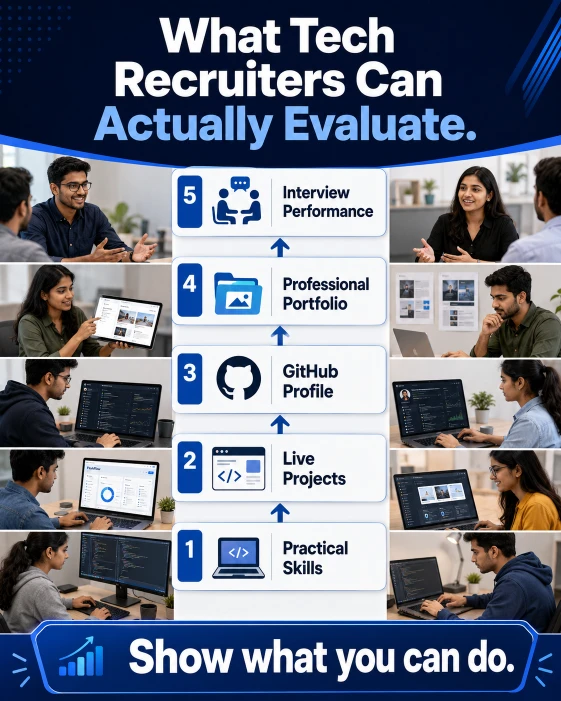
Infographic showing the practical skills, live projects, GitHub profile, portfolio and interview performance that technology recruiters can evaluate.
AI Integrated Full Stack Development training with React Node.js MongoDB and AI tools at Learn2Earn Labs

AI Integrated Full Stack Development Training

Master HTML, CSS, JavaScript, React, Node.js, Express.js, MongoDB, REST APIs, and AI-powered development workflows through live coding, practical projects, internship opportunities, and career-focused training.

Wrong degree: why it matters far less than you think

India’s education system has spent decades telling students that your degree determines your career. In the context of India’s tech industry in 2025, that relationship is more myth than reality.

Some of the strongest developers, digital marketers, data analysts, and business development professionals in Indian tech companies today hold degrees in Commerce, Arts, Law, Architecture, and dozens of other fields with no direct relationship to their current work.

What changed? They upskilled intentionally, built real projects, and demonstrated ability in the domain they wanted to enter. They treated the transition as a decision that required investment — in time, in structured learning, in a portfolio — and they made it.

The tech industry has largely embraced non-traditional backgrounds. Diverse thinking, communication skills from humanities education, analytical habits from commerce training, creative sensibilities from design — these are qualities technically homogeneous teams often lack and actively want.

A B.Com graduate who completed a rigorous full stack programme, built real applications, and can hold their own in a technical interview is not a less credible developer than someone with a B.Tech. In many interview rooms, they are more memorable.

The common thread: what actually matters in every scenario

Whether the obstacle is a gap year, low grades, or the wrong degree — the path through all three is the same.

Demonstrable skills. Prove that you can do the work — not just describe it. Real projects, real code, real campaigns, real dashboards. Something a recruiter can look at and evaluate independently.

A narrative that owns your journey. Candidates who are defensive or vague about a non-standard background lose interviews they could have won. Candidates who speak clearly and confidently about the decision they made to invest in their skills, and the work that decision produced — these candidates win rooms.

Targeting the right opportunities. Not every company fits every background. Startups, product companies, digital agencies, and remote-first firms are largely skills-based in their hiring. Build your record there first. That record is what eventually opens even the more conventional doors.

Consistent upskilling. Tech moves fast. The candidate always learning and always building is always more employable than the one who completed one course and stopped. Learning is a permanent habit, not a one-time sprint.

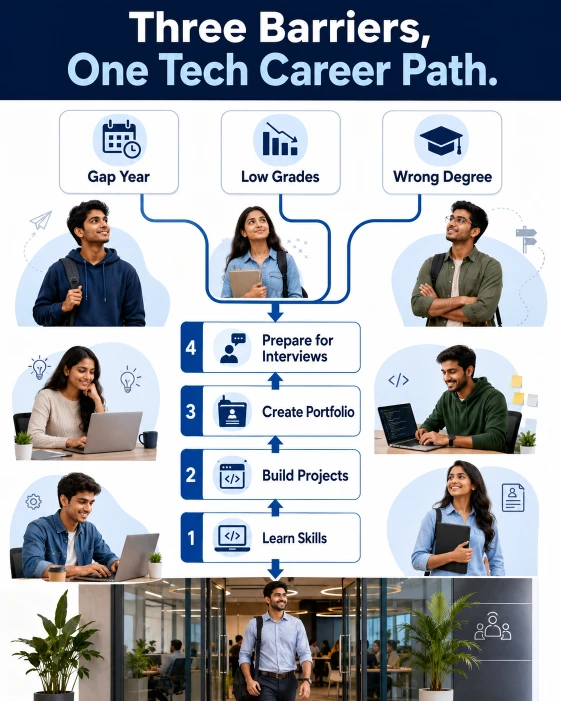
Infographic showing how people with a gap year, low grades or an unrelated degree can build a tech career through skills, projects, portfolios and interview preparation.
Student learning React Native mobile app development with AI, Expo, APIs, and practical projects at Learn2Earn Labs.

AI Integrated React Native Mobile App Development Training

Build a job-ready mobile app development profile through practical coding, industry-style projects, AI-assisted workflows, career preparation, mentor-guided learning, real-world app deployment, API integration, and hands-on portfolio development.

How Learn2Earn Labs has helped candidates from exactly this situation build real careers

At Learn2Earn Labs, the students who walk in with a gap year, a low CGPA, or a degree that has nothing to do with tech are not exceptions. They are a significant and valued part of every batch.

The programme is designed from the ground up to meet people where they are — regardless of academic background, regardless of how circuitous the route was, regardless of how far behind they feel when they start. What matters is where they want to go, and what they are willing to do to get there.

Every student at Learn2Earn Labs — whether they are in Full Stack Web Development, React Native Mobile App Development, Digital Marketing, Data Analytics, AI and Data Science, or Business Development — builds real, deployable projects during the programme. Not case studies. Not academic exercises. Real applications, real campaigns, real dashboards that go into a portfolio and stay there, available to show any recruiter who asks.

Career counselling at Learn2Earn Labs begins with an honest conversation about where the student stands and what the fastest, most realistic path to employment looks like given that specific starting point. Resume building, interview preparation, LinkedIn optimisation, mock interviews, and placement support are all structured around the individual student’s situation — not a generic template.

Alumni from Learn2Earn Labs have been placed at companies including TCS, Accenture, Cognizant, Infosys, and Nagarro. Many of them came in with the exact profile this blog describes — a gap year, grades below 7, a degree that did not belong to the field they wanted to enter. What changed was not their past. What changed was what they built, how they presented it, and the support they had in navigating the path from learning to earning.

With decades of experience working with students and professionals across technology, marketing, and business, the team at Learn2Earn Labs understands both sides of this challenge — what holds people back and what actually moves them forward.

If you have a gap year, low grades, or a degree in the wrong field — and you are serious about building a tech career — the conversation starts with a single step.

Visit learntoearnlabs.com or write to team@learntoearnlabs.com

Conclusion

The tech career you want is not reserved for people who took the straight path, graduated with distinction, or studied exactly the right subject at the right college.

It is built — piece by piece, project by project, skill by skill — by people who decided that their starting point was not their destination.

Your gap year, your grades, your degree — these are the beginning of your story, not the end of it. The only question that matters now is what you build next.

Frequently Asked Questions

1. Can I get a tech job in India with low grades?

Yes. Low grades may limit some campus placement opportunities that use CGPA cut-offs, but many startups, product companies, digital agencies and remote-first employers focus more on practical skills, projects, assessments and interview performance.

2. Does a gap year affect my chances of getting a tech job?

A gap year can raise questions, but it does not automatically prevent you from building a tech career. Explain how you used the time to learn skills, complete training, earn relevant certifications or build real projects, and support your explanation with evidence.

3. Can I become a software developer without a computer science degree?

Yes. Candidates from commerce, arts and other non-technical backgrounds can move into software development by learning the required technologies, building deployable projects, creating a strong portfolio and preparing thoroughly for technical interviews.

4. What should I build to prove my tech skills to recruiters?

Build work that recruiters can evaluate directly, such as deployed web applications, mobile apps, dashboards, data projects, digital marketing campaigns or a well-maintained GitHub portfolio. Quality, relevance and your ability to explain the work matter more than the number of projects.

5. Which employers should candidates with non-traditional backgrounds target?

Startups, product companies, digital agencies, freelance clients and remote-first firms are often practical targets because they commonly assess candidates through skills, portfolios, assignments and interviews. Review every job description carefully because eligibility requirements vary by employer.