Home » Career » What Happens to Your Career If You Keep Skipping Upskilling for Another Year?

What Happens If You Skip Upskilling for Another Year?

Student participating in a realistic mock interview with an evaluator to improve confidence and placement interview performance

One more year. That is what most people tell themselves.

Not forever. Just one more year. Things will settle down. Work will get less busy. The timing will be better.

And then another year passes. And then another.

This is the most expensive professional decision most people never consciously make — not a deliberate choice to stop learning, but an indefinite postponement that quietly compounds into a career that has drifted far from where it could have been.

Whether you are a student wondering if a training programme is worth it right now, a fresher putting off upskilling until after you find a job, or a working professional who has been meaning to update skills for two years — this blog is for you.

Not to scare you. To show you, specifically and honestly, what consistently happens: the cost of skipping upskilling for another year is not staying where you are. It is falling behind in ways that become progressively harder to reverse.

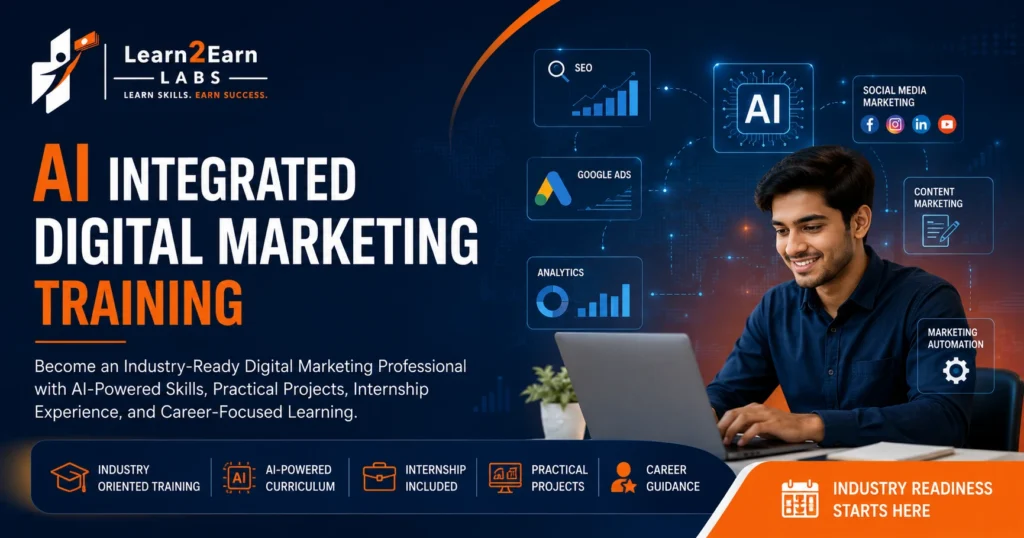
Learn2Earn Labs AI Integrated Digital Marketing Training banner featuring AI-powered marketing skills, SEO, Google Ads, social media marketing, analytics, automation, practical projects, internship experience, and career-focused learning.

AI Integrated Digital Marketing Training

Build practical skills in SEO, Google Ads, Social Media Marketing, Analytics, Content Marketing, and AI-powered workflows through projects, live classes, internship exposure, and industry-focused learning.

The world did not wait for you to be ready

The Indian tech and digital industry is moving at a pace with no historical precedent.

Two years ago, prompt engineering was not a job skill. Today, companies actively filter for AI tool proficiency in technical and marketing roles. Two years ago, generative AI was a curiosity. Today, it is embedded in development workflows, content creation, data analysis, and business development at companies of every size.

Tools that were optional in 2022 are expected in 2025. Skills that were differentiating in 2023 are becoming baseline today. And the skills differentiating now — AI-integrated development, data-driven marketing, machine learning applications — will be expected within two years.

This is not speculation. It is the consistent pattern of how India’s technology and digital job market has evolved. Skills move from cutting-edge to expected faster than ever before. The professional who is not actively learning is not standing still — they are falling behind a market that is moving forward without them.

What one year of skipping upskilling actually costs you

Most people think of skipping upskilling as a neutral decision. A pause. A holding pattern until conditions improve.

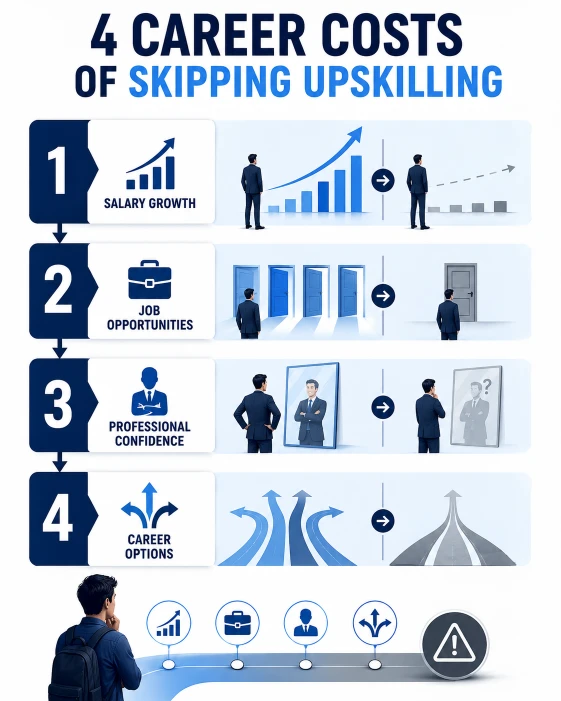
It is not neutral. It is a decision with compounding consequences — and those consequences operate on at least four dimensions simultaneously.

The salary dimension

The gap between a professional with current, in-demand skills and one whose skills have not been refreshed in two to three years is significant and widening.

In technology roles, developers working with modern stacks and AI-assisted workflows command packages 30 to 50 percent higher than developers using the same base language without updated frameworks or AI proficiency. In digital marketing, a professional who understands AI-driven content strategy and performance analytics earns dramatically more than one who peaked at basic social media management.

Every year of not upskilling compounds the distance between your current earnings and what the market would pay for an updated version of your skill set.

The opportunity dimension

The roles being created right now — AI-integrated developer positions, growth marketing roles, data analyst positions feeding directly into business strategy — did not exist in their current form two years ago. They will not be available to candidates who cannot demonstrate the relevant skills.

Each year you skip, a cohort of professionals who did not skip enters these roles, gains experience, builds their resume, and deepens their network. The gap between you and them is not one year — it is one year of your stagnation plus one year of their growth. A two-year effective gap created by a one-year delay.

The confidence dimension

This is the one most career advice ignores — and possibly the most destructive.

When you know your skills are outdated, you apply with less confidence. You interview defensively. You hesitate to pursue roles that excite you because you are not sure you would clear the technical round. You negotiate less aggressively because the offer feels like a more accurate reflection of your value than it should be.

Outdated skills do not just reduce your market value. They reduce your belief in your market value — and that self-doubt becomes an invisible tax on every professional interaction you have.

The optionality dimension

Optionality — the ability to make choices about your career rather than having choices made for you — comes directly from being genuinely skilled and genuinely current.

When your skills are current, you can negotiate, turn down mediocre offers, change employers, freelance, consult. You have options because the market has multiple places that want what you offer.

When skills have drifted, those options close quietly, one by one — over a period you often do not notice until you need to make a move and discover the leverage you expected is no longer there.

Infographic showing four career costs of skipping upskilling: salary, opportunities, confidence and career options
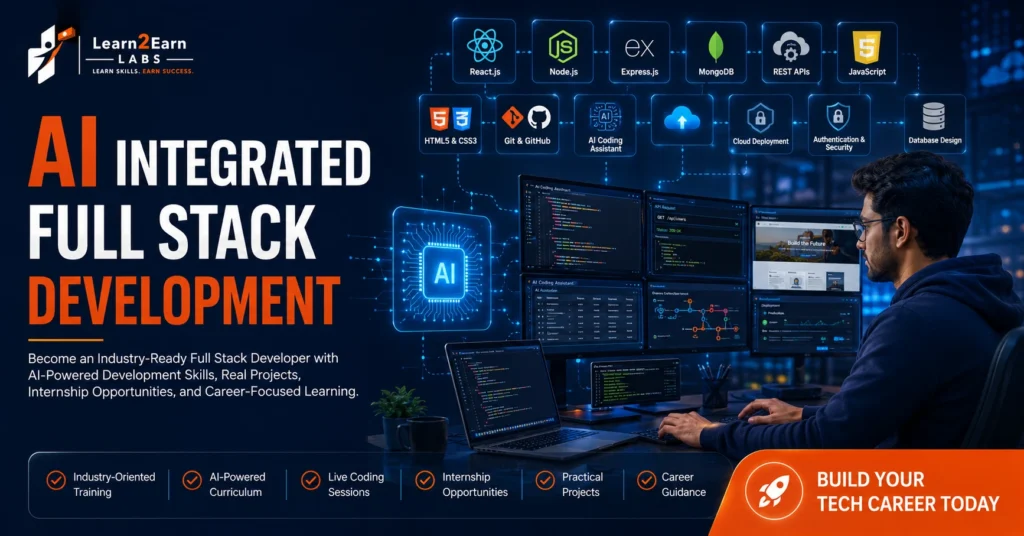
AI Integrated Full Stack Development training with React Node.js MongoDB and AI tools at Learn2Earn Labs

AI Integrated Full Stack Development Training

Master HTML, CSS, JavaScript, React, Node.js, Express.js, MongoDB, REST APIs, and AI-powered development workflows through live coding, practical projects, internship opportunities, and career-focused training.

Why “I will do it when I have more time” does not work

The “more time later” logic rests on a premise that is almost never true: that your current commitments will reduce, leaving a clear window for focused learning.

For students, that window arrives after college. Then after the job search settles. Then after the first six months at work. For working professionals, it opens when the quarter ends, when the team is less stretched, when appraisals are done.

The window almost never opens — because life does not create space for learning. You have to create it deliberately, within the constraints that already exist.

Professionals who consistently upskill are not the ones with more time. They are the ones who decided learning was a present priority, not a future one — and structured their weeks accordingly, even in small, imperfect increments.

One focused hour of structured learning per day, sustained over six months, produces a meaningful, verifiable skill upgrade. Not a large commitment. But it requires deciding that “later” is not an acceptable timeline.

The compounding advantage of those who did not wait

Every professional who begins a structured upskilling programme today and completes it in six months enters the job market with credentials, live projects, and demonstrable new skills. Their resume improves. Their interview performance improves. Their options expand.

At that same six-month mark, the professional who decided to wait “one more year” is exactly where they are today — except the market has moved six more months without them.

At the twelve-month mark, the gap is not one year. It is the sum of one person’s progress and another person’s stagnation. In fast-moving fields like technology and digital marketing in India, that can represent multiple generations of tooling and expectation.

The professionals building the strongest careers right now are not extraordinary people. They are consistent people who made the decision to start — and kept going. The gap between them and the ones who are struggling is almost always shorter than it appears. But it widens every month the decision is delayed.
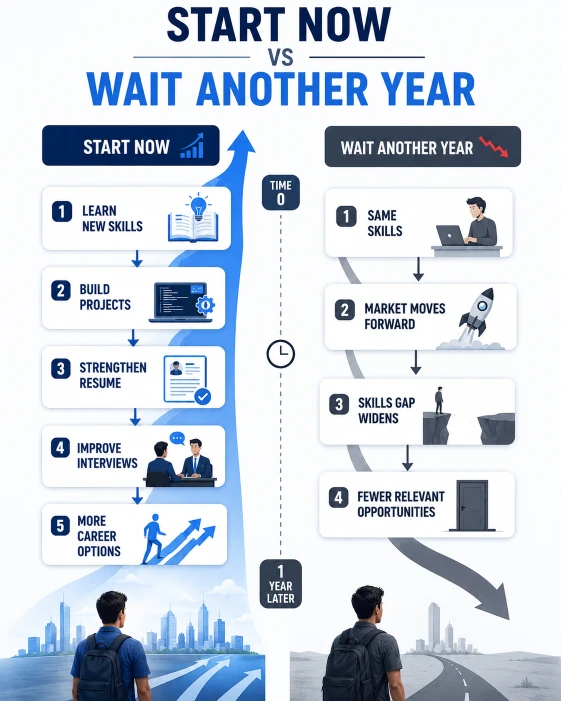
Infographic comparing career progress from starting upskilling now versus delaying it for another year

What upskilling actually looks like in 2025

One reason people keep postponing is an outdated picture of what upskilling involves — full-time programmes, long commutes, enormous fees, years before anything changes.

That is not what career-focused upskilling looks like today.

The most effective programmes in 2025 are practical and project-based, built around live deliverables rather than theory. They are AI-integrated — teaching not just foundational skills but how to use AI tools to work faster and produce more. They have clear employment-focused outcomes: resume-ready projects, placement support, and career counselling built in from the start.

They do not require you to pause your life. Many run alongside existing commitments — designed for students still in college, freshers job-searching, and working professionals who cannot step away.

The question is not whether upskilling is possible given your current situation. It is whether your current situation — if nothing changes — is taking you where you actually want to go.
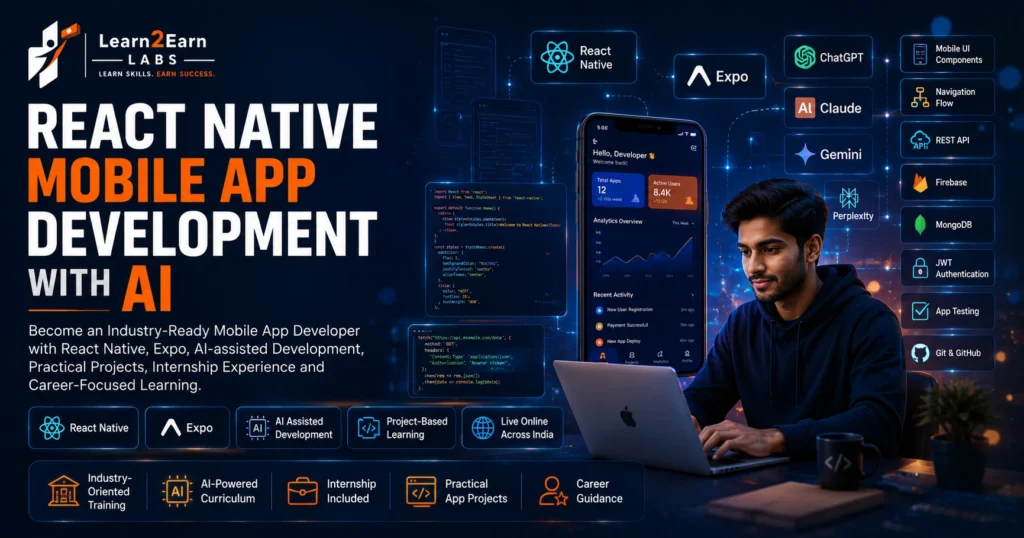
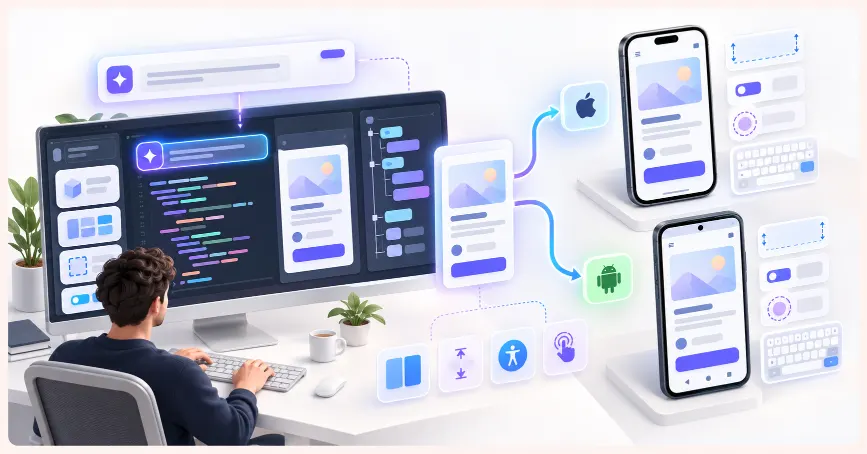
Student learning React Native mobile app development with AI, Expo, APIs, and practical projects at Learn2Earn Labs.

AI Integrated React Native Mobile App Development Training

Build a job-ready mobile app development profile through practical coding, industry-style projects, AI-assisted workflows, career preparation, mentor-guided learning, real-world app deployment, API integration, and hands-on portfolio development.

How Learn2Earn Labs closes the upskilling gap — completely and practically

At Learn2Earn Labs, the entire programme philosophy is built around one premise: every student who walks in should leave with skills that are visibly and verifiably better than the ones they had when they arrived — and those skills should be immediately usable in the job market.

The AI-integrated programmes at Learn2Earn Labs — Full Stack Web Development, React Native Mobile App Development, Digital Marketing, Data Analytics and Data Science, AI and Machine Learning, and Business Development and Freelancing — are built around live projects, real tools, and genuine career outcomes. Students do not study concepts and hope for the best. They build things, use industry-standard tools, and leave the programme with a portfolio that gives a recruiter something specific and compelling to shortlist.

Career counselling at Learn2Earn Labs begins with an honest assessment of where a student currently stands and what a realistic, achievable path to employment looks like from that point. Resume building, LinkedIn optimisation, mock interviews, and placement support are structured around individual goals — not a one-size-fits-all template.

With decades of experience shaping careers across technology, marketing, and business — and alumni placed at companies including TCS, Accenture, Cognizant, Infosys, and Nagarro — Learn2Earn Labs has a direct, ground-level understanding of what the Indian job market is asking for right now, and what it will ask for in the next two to three years.

If you have been telling yourself “one more year” — this is the year to stop saying it.

Visit learntoearnlabs.com or write to team@learntoearnlabs.com

Conclusion

Skipping upskilling for another year is not a pause. It is a choice — and like every choice, it has consequences that compound quietly in the background whether you are paying attention to them or not.

The salary you are not earning. The roles you are not being considered for. The confidence you are slowly losing. The options that are closing without announcement.

These are the real costs. They do not show up as a single moment of crisis. They show up gradually, in the growing distance between where you are and where you imagined you would be.

The best time to start was a year ago. The second-best time — the only time that is actually available to you — is today.

Frequently Asked Questions

For GEO, I recommend keeping answers direct and self-contained. This makes them useful not only for readers but also easier for search engines and AI answer systems to interpret.

1. What happens if you do not upskill regularly?

If you do not upskill regularly, your existing skills may become less relevant as technologies, tools and employer expectations change. Over time, this can reduce your access to better job opportunities, weaken your competitiveness and limit your career options.

2. Why is upskilling important for career growth?

Upskilling helps professionals keep their knowledge relevant, develop in-demand capabilities and demonstrate their ability to adapt. Practical new skills can strengthen your resume, improve interview readiness and open opportunities for career advancement or job changes.

3. Can delaying upskilling for one year affect your career?

Yes. A one-year delay can create more than a simple one-year skills gap because the job market and other professionals continue progressing during that period. In fast-changing fields such as technology, data and digital marketing, delaying learning can make catching up increasingly difficult. This reflects the article’s central “compounding gap” argument.

4. What skills should professionals learn to stay competitive?

The right skills depend on your career path, but professionals should focus on skills that are currently relevant to their target roles. These may include AI-assisted workflows, software development, data analytics, digital marketing, machine learning and other practical skills supported by projects and demonstrable work.

5. How can students and working professionals start upskilling?

Start by identifying the gap between your current skills and the requirements of your target role. Choose structured, practical learning that includes projects and real tools, then dedicate consistent weekly time to developing and applying those skills. The article specifically argues that learning needs to be deliberately incorporated into existing commitments rather than postponed until more free time appears.

Leave a Reply