Table of Contents
ToggleSix months feels like a phase. The career world treats it as a signal.
When graduation ends and a job has not arrived, most freshers settle into a waiting posture. Applications go out. Interviews occasionally happen. Time passes. Somewhere between month two and month four, the wait stops feeling temporary and starts feeling like a pattern.
Six months of unemployment after graduation is more common in India than anyone admits — and more expensive than anyone calculates. Not just financially, though the financial cost is real. The costs that compound most dangerously are the ones that do not show up in a bank account. They show up in your resume, your skills, your confidence, and in how the job market reads your profile as the months stack up.
This blog names those costs specifically. Not to create anxiety — but because understanding what is actually at stake is what turns a passive wait into a deliberate strategy.
AI Integrated Digital Marketing Training
Build practical skills in SEO, Google Ads, Social Media Marketing, Analytics, Content Marketing, and AI-powered workflows through projects, live classes, internship exposure, and industry-focused learning.
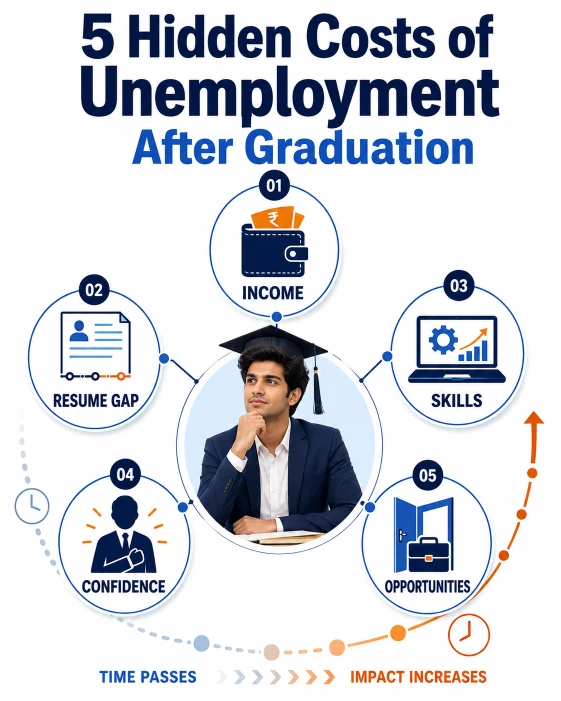
The financial cost: more than you think, compounding faster than you expect
If the starting salary for your target role is ₹4 to ₹6 LPA, six months of unemployment represents ₹2 to ₹3 lakh in lost income. Significant for any recent graduate — but it is not just lost income. It is a later start on the savings, investments, and financial independence that compound over time.
The professional who enters the workforce at 22 and the one who enters at 23 do not differ by one year of salary. They differ by one year of network development, one year of on-the-job skill compounding, one year of reputation building. Over a ten-year career, that difference does not stay one year. It grows.
Beyond income: the courses purchased to fill the gap, the job portal subscriptions, the interview travel, the emotional toll that affects decision-making quality and health. These costs are rarely tracked but consistently present.
The resume cost: a gap that starts speaking before you do
In the Indian job market, a six-month gap immediately after graduation raises one silent question in every recruiter’s mind: why? The answer — formed before you have said a word — defaults to the most conservative interpretation unless the resume itself provides a better one.
That interpretation is not flattering. It suggests the candidate either was not competitive enough for campus placement, or tried the open market for six months and could not convert — which implies something about skills, preparation, or approach.
None of these may be accurate for your situation. But they are the conclusions a recruiter draws in the absence of contrary information. Because most freshers with a gap simply list dates and hope nobody notices, the conservative interpretation is the one that sticks.
The resume cost is not just the gap itself. It is the narrative vacuum that forms around it when it is not actively managed.
The skills cost: the market moved while you waited
In 2025, the pace at which the job market’s expectations are shifting has no historical precedent.
The skills that were differentiating when you graduated are, in many fields, baseline expectations six months later. Tools companies were beginning to adopt when you left college are now embedded in workflows and expected of entry-level candidates. AI-integrated practices that were cutting-edge in your final year are, by month six of your unemployment, things every competitive applicant is expected to demonstrate.
A fresher who graduated with good foundational skills and spent six months waiting is competing against freshers who graduated at the same time and spent six months upskilling. The second group is not more talented — but they are more current. In India’s technology and digital sector right now, more current means more competitive in a way that cannot be overstated.
The skills cost is not about what you forget. It is about the distance that opens between where you are and where the market has moved while you were waiting.
AI Integrated Full Stack Development Training
Master HTML, CSS, JavaScript, React, Node.js, Express.js, MongoDB, REST APIs, and AI-powered development workflows through live coding, practical projects, internship opportunities, and career-focused training.
The confidence cost: what six months without professional validation does to your self-belief
Professional confidence — the kind that lets you walk into a room and present yourself as someone worth hiring — is built through doing, through being evaluated and found capable, through small wins that accumulate into a genuine sense of direction. When six months passes without any of that, the inner narrative shifts.
You begin applying more defensively — targeting roles slightly below what you actually want, because you have started to believe a safer bet is appropriate. You interview with a background anxiety that was not there when you graduated: the need to prove the gap was not your fault, that you are as capable as your resume suggests. That anxiety is visible to interviewers even when you cannot feel yourself projecting it.
The candidates who crack interviews after an extended gap are almost never the ones who waited for confidence to return. They are the ones who found structured ways to rebuild it — through project work, through training, through mock interviews — through environments where they were evaluated and found capable before the high-stakes real interview arrived.
The opportunity cost: which doors start to close after six months
The roles being created right now are being filled by people who entered the market while you were still searching. By the time you apply in your seventh month, the team that was being built has been built. The need is different.
Campus recruitment cycles — which many companies run once a year — pass entirely. A company hiring aggressively for freshers in October is not running the same drive in April. The window closed, and the next one opens in ten months.
Some companies prefer candidates within one to two years of degree completion. Six months is not a problem in this regard. Eighteen months begins to be. Every month of delay makes a clean, strong entry increasingly complicated.
The gap that looks like a gap: how to make six months mean something else
The six-month gap on your resume is not inevitable as a liability. What is inevitable is that it exists chronologically. What is not inevitable is that it reads as unemployment.
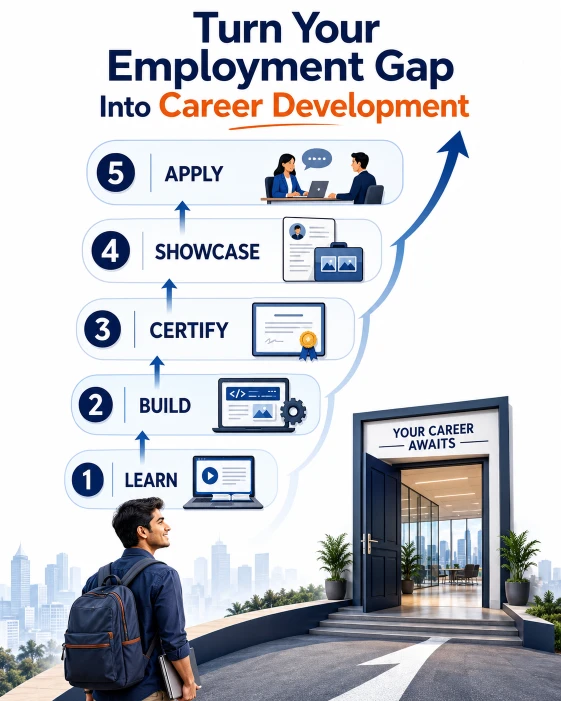
A six-month period containing a structured training programme, live projects, industry certifications, or documented freelance work is not a gap. It is a development period — one that can be presented in a resume and interview with specificity and confidence.
The fresher who says in an interview: “After graduation, I spent six months completing a full stack development programme, built three live projects including a deployed e-commerce application, and earned two certifications in AI-integrated development” — that fresher is not explaining a gap. They are presenting an investment.
That answer changes the recruiter’s silent question from “why were they not placed?” to “that is someone who took initiative during a difficult period.” The six months on the calendar are identical. The professional reading is completely different.
The difference between a damaging gap and a valuable investment is almost entirely determined by what you do during those six months — not how long they lasted.
AI Integrated React Native Mobile App Development Training
Build a job-ready mobile app development profile through practical coding, industry-style projects, AI-assisted workflows, career preparation, mentor-guided learning, real-world app deployment, API integration, and hands-on portfolio development.
How Learn2Earn Labs turns a gap year into a career launchpad
At Learn2Earn Labs, the students who arrive having spent weeks or months in unsuccessful job searches are not unusual. They are a significant part of every batch — and for many of them, the experience of joining a structured, serious programme is what changes the entire trajectory of their search.
The transformation is practical, not motivational. A student who arrives with a resume showing a gap and no projects leaves with a resume showing structured training, live projects with specific technology stacks and outcomes, certifications from recognised platforms, an optimised LinkedIn profile, and a portfolio that gives a recruiter something specific to evaluate.
More importantly, they leave with demonstrable skills — the kind that hold up when tested in a technical interview, not just the kind that look good in a list.
Every programme at Learn2Earn Labs — Full Stack Web Development, React Native Mobile App Development, Digital Marketing, Data Analytics and Data Science, AI and Machine Learning, and Business Development and Freelancing — is built around live projects, real tools, and career outcomes. The AI-integrated curriculum means students are not just learning yesterday’s skills — they are building the skills the market is asking for right now and will keep asking for over the next several years.
Career counselling, resume building, LinkedIn optimisation, mock interviews, and placement support with alumni placed at TCS, Accenture, Cognizant, Infosys, and Nagarro — all of this is part of what Learn2Earn Labs provides. And it is accessible to any student, regardless of their degree, their CGPA, or how long their gap has been.
With decades of experience shaping careers across technology, marketing, and business, the team at Learn2Earn Labs has seen what six months of deliberate upskilling does to a candidate’s market position. It is not a small difference. It is often the difference between continued rejection and a strong, confident offer.
If your graduation was months ago and you are still searching — this is the moment the search changes.
Visit learntoearnlabs.com or write to team@learntoearnlabs.com
Conclusion
Six months of unemployment after graduation is not a catastrophe. It is a window — one that is still open, still manageable, still completely possible to use in a way that produces a strong outcome.
But it is a window that costs more than it appears to cost on the surface. Financially. On the resume. In skills. In confidence. In the opportunities that quietly move on while the search extends.
The question is not whether you can afford to wait another month. The question is what you are going to do with the time that is still available.
Use it. Build something. Show up as someone who invested rather than someone who waited. The job market responds very differently to those two versions of the same six months.
Frequently Asked Questions
1. Is it normal to be unemployed for 6 months after graduation?
A six-month job search after graduation does not automatically mean there is something wrong with your career. However, as the gap becomes longer, it becomes increasingly important to show how you have used that time. Training, projects, certifications, freelance work, internships, or other relevant activities can demonstrate continued professional development.
2. Does a 6-month employment gap look bad on a resume?
A six-month employment gap does not automatically make a resume weak. The bigger issue is an unexplained gap. If you can demonstrate that you used the period to develop relevant skills, complete projects, earn certifications, gain practical experience, or undertake structured training, you can present the period as professional development rather than simply inactivity. This is one of the article’s central arguments.
3. How should freshers explain an employment gap after graduation?
Be honest and specific. Explain what you did during the period and focus on measurable professional development. Mention relevant training, projects, certifications, internships, freelance assignments, or skills you developed and be prepared to demonstrate what you learned.
4. What should I do if I am unemployed after graduation?
Avoid spending the entire period only submitting applications. Continue applying for suitable roles, but also identify skill gaps, develop practical projects, improve your resume and LinkedIn profile, practise interviews, build a portfolio, and learn tools relevant to your target role. The article emphasizes structured activity as a way to rebuild both capability and confidence.
5. Can upskilling help explain a career gap?
Yes. Relevant upskilling can provide evidence that you used the employment gap productively. Structured training combined with projects, certifications, or practical work gives you specific achievements to include on your resume and discuss during interviews.