Table of Contents
Toggle“100% placement assistance” is one of the most misleading phrases in Indian education.
Walk into almost any training institute in India. Browse their website. In the first paragraph, in bold, you will find: 100% placement assistance. Guaranteed interviews. Dedicated placement cell.
Then speak to students who went through the programme six months ago.
The gap between what was promised and what was delivered is one of the most consistent disappointments in the Indian training market. Students join partly on the strength of placement claims, complete the training with genuine effort, and then discover that “placement assistance” meant a PDF of job portal links, a WhatsApp group with occasional vacancy updates, and a vague assurance that “we will forward your resume when something comes up.”
That is not placement support. That is placement theatre — the performance of support without the substance.
This blog defines what genuine placement support actually looks like, identifies exactly what most institutes substitute for it, and gives you the questions to ask before committing time, money, and six months of your career trajectory to any programme.
AI Integrated Digital Marketing Training
Build practical skills in SEO, Google Ads, Social Media Marketing, Analytics, Content Marketing, and AI-powered workflows through projects, live classes, internship exposure, and industry-focused learning.
What placement support is not

Start here, because it is the more useful distinction.
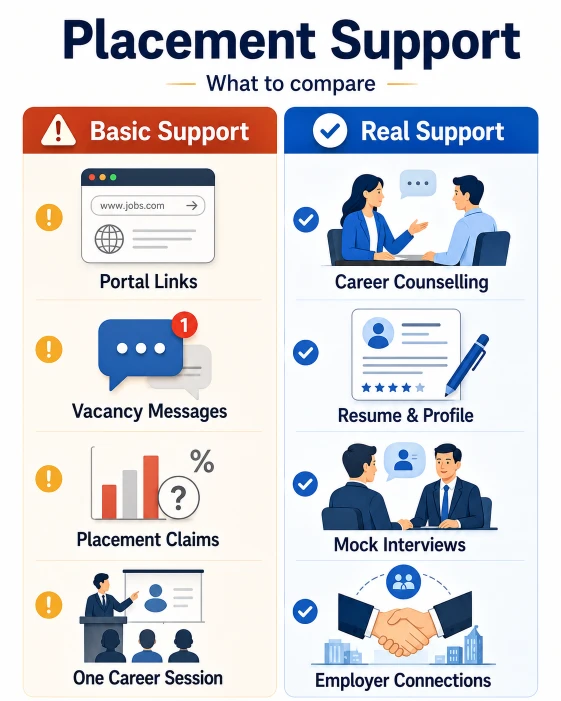
A list of job portals is not placement support.
Telling students to create profiles on Naukri and LinkedIn requires no knowledge of the student’s profile, no employer relationships, and no real effort. Every student can find Naukri without help.
Occasional vacancy sharing is not placement support.
Sending a WhatsApp message when a company posts publicly means the institute is watching the same boards every student has access to. There is no preferential access, no employer relationship, no reason the student’s application is treated differently than any other.
A placement percentage without transparency is not evidence.
“92% placed” sounds impressive until you ask: within what timeframe? In relevant roles? At what salary? Through the institute’s direct effort or the student’s own searching? Most institutes cannot answer these specifically — because the definition of “placed” is broad enough to be meaningless.
A single career session at the end is not placement support.
Resume building in the final week and one mock interview before graduation are gestures, not processes. By the time these happen, the student is entering the market with no ongoing support and no meaningful employer relationship.
What genuine placement support actually looks like
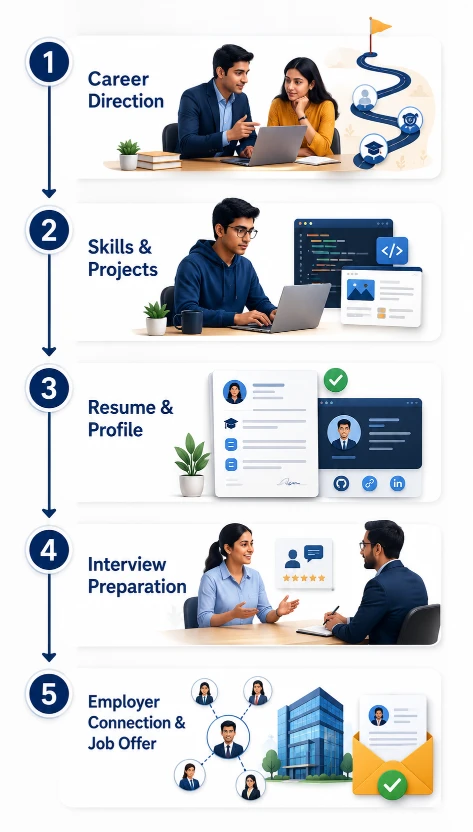
Real placement support is not an event. It is a process — one that runs alongside technical training from the early weeks of the programme, builds progressively as the student’s skills develop, and continues well beyond the day the programme officially ends.
Here is what that process actually contains.
Career counselling from day one.
A student joining full stack development with a commerce background and a 6.1 CGPA has a very different path to employment than one with a CS degree. Genuine support begins by understanding where each student actually is and building a roadmap that is specific, realistic, and continuously updated as skills develop.
Resume building that reflects real skills.
A resume built on the programme’s live projects — described with specificity, stack detail, and the outcome language recruiters in that domain actually shortlist for — is fundamentally different from a generic fresher resume. Genuine support means an actual review against current industry standards. Not a template. Not a format suggestion.
Interview preparation that matches the actual interview.
MERN stack technical rounds ask different things than Java interviews. Digital marketing interviews are different from data analytics ones. Genuine preparation means domain-specific mock interviews, conducted by people who know what those rooms actually look like, with written actionable feedback before the next attempt.
Employer relationships that predate the student’s job search.
Access to companies that have hired the institute’s students before — and trust the training quality enough to consider a referred profile with presumed credibility — is built over years of consistent delivery. This is expensive and slow to build. It is why most institutes do not have it. It is what separates genuine placement pull from placement claims.
Support that continues until the offer arrives.
A student without a job 30 days after graduation needs continued engagement — targeted advice, resume refinement based on market response, interview feedback analysis. Genuine placement support does not end at graduation. It ends at the offer letter.

AI Integrated Full Stack Development Training
Master HTML, CSS, JavaScript, React, Node.js, Express.js, MongoDB, REST APIs, and AI-powered development workflows through live coding, practical projects, internship opportunities, and career-focused training.
The questions to ask before you join any institute
Every institute will tell you they offer placement support. The way to know whether that support is real is not to read their website — it is to ask specific, verifiable questions during your admission inquiry.
Ask for specific company names where students have been placed in the last 12 months.
Not general categories — company names. If the institute cannot name specific employers, the placement record is either weak or inflated.
Ask what percentage of placed students found their job through the institute’s direct effort versus their own job searching.
Most institutes honest about this will have a lower institute-placed number than their headline figure. That is fine — it just changes expectations appropriately. An institute that cannot or will not distinguish between the two is hiding something.
Ask to speak with two or three recent alumni directly.
Not website testimonials. Real conversations with people who went through the programme in the last year. Ask what the placement support actually looked like in practice — not what was promised, but what was delivered.
Ask what happens if you are not placed within 60 days of completing the programme.
A genuine answer describes a specific, continued process. An evasive answer will be some version of “we will try our best” — which is not a process, it is a hope.
Ask for the specific steps of their placement process.
From resume building to employer outreach to mock interviews to post-graduation follow-up. An institute with a genuine process describes it in detail. An institute with only claims will be vague, redirect to success rate statistics, or change the subject.
Why most institutes cannot deliver on placement promises
The honest reason is simple: the consequences of not delivering fall entirely on the student, not the institute.
A student who completes training and is not placed does not typically get a refund. They simply add to the silent majority of students who were disappointed and cannot easily recover — financially or professionally.
Building genuine placement infrastructure is expensive. It requires dedicated career counselling staff, sustained employer relationships, repeated domain-specific mock interviews, and continued post-graduation engagement. None of this is cheap. None of it is scalable by a marketing team that only knows how to make claims.
The institutes that actually deliver have made this investment over time — through consistent outcomes, through alumni networks built by placing students who then refer others — and have enough confidence in their track record to show it in verifiable specifics rather than headline percentages.
The tell is simple: an institute that delivers on placement talks about process. An institute that does not talks about percentages.
AI Integrated React Native Mobile App Development Training
Build a job-ready mobile app development profile through practical coding, industry-style projects, AI-assisted workflows, career preparation, mentor-guided learning, real-world app deployment, API integration, and hands-on portfolio development.
What placement support looks like at Learn2Earn Labs
At Learn2Earn Labs, placement support is not a feature added to the end of a training programme. It is an integrated, ongoing process that runs from the first week of training to the moment a student holds an offer letter.
Career counselling begins on day one — with an honest assessment of where the student stands, what their target roles look like, and what needs to be built between now and their first interview. Resume building happens throughout the programme as projects are completed — not in a single rushed session in the final week. Interview preparation, including repeated domain-specific mock interviews calibrated to the actual technical and HR rounds in the student’s target field, happens progressively, with written feedback after each session so the student can improve before the next attempt.
Employer relationships at Learn2Earn Labs are real and built over decades of consistent delivery. Alumni placed at TCS, Accenture, Cognizant, Infosys, and Nagarro are not statistics on a website. They are the accumulated result of a placement process that has worked for students across all backgrounds, all CGPAs, and all starting points — including gap years, wrong degrees, and low grades.
The placement support does not stop when training ends. Students still searching after graduation continue to receive resume refinement, targeted application guidance, interview coaching, and the kind of personal, sustained engagement that most institutes explicitly do not provide because maintaining it is costly.
Every programme — Full Stack Web Development, React Native Mobile App Development, Digital Marketing, Data Analytics and Data Science, AI and Machine Learning, and Business Development and Freelancing — is built with this end-to-end placement process as a core commitment, not an afterthought.
If you have been disappointed by vague placement promises before — or if you want to make the right decision the first time — the conversation at Learn2Earn Labs will be specific, honest, and worth every minute.
Visit learntoearnlabs.com or write to team@learntoearnlabs.com
Conclusion
“100% placement assistance” is easy to say. Delivering it is hard — which is why most institutes that say it cannot show you exactly what it means in practice, describe it in specific steps, or name the employers it has reached.
The standard to hold any institute to is simple: show me the process, name the companies, connect me with the alumni who actually used it. If an institute cannot do all three before you join, the placement support it promises after you join will almost certainly be a disappointment.
You are not just investing money in a training programme. You are investing months of your career trajectory — time that has a real cost if the outcome is a certificate rather than a job.
Genuine placement support exists. It is specific, sustained, verifiable, and built on years of doing what was promised — not years of saying it. And it makes the difference between a training programme that ends with a certificate and one that ends with a career.
Frequently Asked Questions
1. What does placement support actually mean?
Placement support is a structured process that helps students prepare for and pursue relevant employment opportunities. Genuine support may include career counselling, resume and profile development, project preparation, domain-specific mock interviews, employer connections, application guidance and continued career support rather than simply sharing vacancies.
2. Is placement assistance the same as a job guarantee?
No. Placement assistance means an institute supports a student’s career preparation and job search. A job guarantee implies a promised employment outcome. Students should therefore understand exactly what services are included instead of assuming that phrases such as “100% placement assistance” guarantee a job.
3. How can I check whether a training institute provides genuine placement support?
Ask for specific and verifiable information. Request names of companies that hired recent students, ask how many placements resulted directly from the institute, speak with recent alumni, understand the resume and interview preparation process, and ask what support continues after course completion. These are the same checks recommended in the article.
4. What should good placement support include?
Good placement support should ideally include personalised career counselling, resume and professional-profile development, relevant project preparation, domain-specific mock interviews, written feedback, employer connections, application guidance and continued support during the student’s job search.
5. When should placement preparation begin during a training programme?
Placement preparation should begin early in the programme, not during the final week. Career direction, skill gaps, projects, resume development and interview readiness should improve progressively as the student’s skills develop.