Home » Career » No Work Experience? Build a Capstone Project That Proves You Can Do the Job

How a Capstone Project Can Replace Work Experience on a Fresher Resume

Indian fresher showcasing a completed capstone project and portfolio while preparing for a job interview

The experience problem that almost every fresher faces — and the solution most of them miss

Every fresher hits the same wall at some point.

The job requires experience. You have no experience. You cannot get experience without a job.

This circular logic frustrates every generation of first-time job seekers. For most freshers in India, it feels genuinely unsolvable — particularly when entry-level roles somehow still expect one to two years of relevant work experience.

Here is what most freshers do not know: a well-built capstone project — structured, specific, technically complete, and professionally documented — does not just approximate work experience. In many technical and digital roles, it replaces it.

Not as a workaround. Not as a lesser substitute that a recruiter politely acknowledges before moving on. As a genuine signal of capability that directly answers the question every recruiter is asking when they scan a fresher resume: can this person actually do the work?

This blog explains what makes a capstone project credible enough to replace experience, how to build one that does that job, and how to present it so a recruiter sees capability before they see the absence of a job title.

Learn2Earn Labs AI Integrated Digital Marketing Training banner featuring AI-powered marketing skills, SEO, Google Ads, social media marketing, analytics, automation, practical projects, internship experience, and career-focused learning.

AI Integrated Digital Marketing Training

Build practical skills in SEO, Google Ads, Social Media Marketing, Analytics, Content Marketing, and AI-powered workflows through projects, live classes, internship exposure, and industry-focused learning.

What recruiters are actually looking for when they want experience

When recruiters say they want experience, they do not mean they want you to have clocked a specific number of months at a specific company. What they actually want to know is: have you done this kind of work? Do you understand how a real project comes together — from requirements to implementation to testing to delivery? Can you work with the tools this role requires in a context more complex than a tutorial?

“Six months as a junior developer” on a resume creates the assumption that the candidate encountered real problems, made real decisions, and produced real output. That assumption is the shorthand experience provides.

A capstone project that was genuinely complex, genuinely built, and genuinely documented provides the same evidence — sometimes more directly. Because the recruiter can look at it. They can visit the deployed application, read the GitHub repository, evaluate the architecture decisions. A job title cannot be evaluated that directly. A well-built project can.

The purpose of experience on a resume is to provide evidence of capability. A capstone project that provides equally direct, equally verifiable evidence is doing exactly the same job.

What makes a capstone project credible enough to replace experience

Not every project earns this status. A basic CRUD app built from a YouTube tutorial, submitted to GitHub with no README and three commits, is not going to replace six months of work experience in any recruiter’s assessment.

What separates a project that earns serious consideration from one that gets politely skipped is specificity, completeness, and documentation.

Specificity means the project solves a real, recognisable problem. Not “a web app” — a patient appointment management system, an AI-assisted inventory tracker, a real estate platform with a recommendation engine. The more specifically the problem is defined, the more the project shows that the builder understood requirements, scoped a solution, and built toward a defined outcome. That is exactly what real work involves.

Completeness means the project is actually deployed. Not “a work in progress” — a live, functional application a recruiter can interact with. Deployment signals that the developer understood how to put code in front of a user, which requires solving an entirely different class of problems than development alone. A project deployed on Render, Vercel, or the Play Store carries significantly more weight than one that runs only locally.

Technical depth means the project demonstrates more than surface knowledge. Authentication and authorisation, third-party API integration, database relationships, state management, performance considerations — these signal engagement with the harder, more realistic aspects of building software.

Documentation means a well-written GitHub README that explains the problem, the stack, the features, and how to set it up. This is not a nicety — it is the difference between a project that communicates capability and one that requires the recruiter to do detective work. Recruiters rarely do that. They move to the next profile.
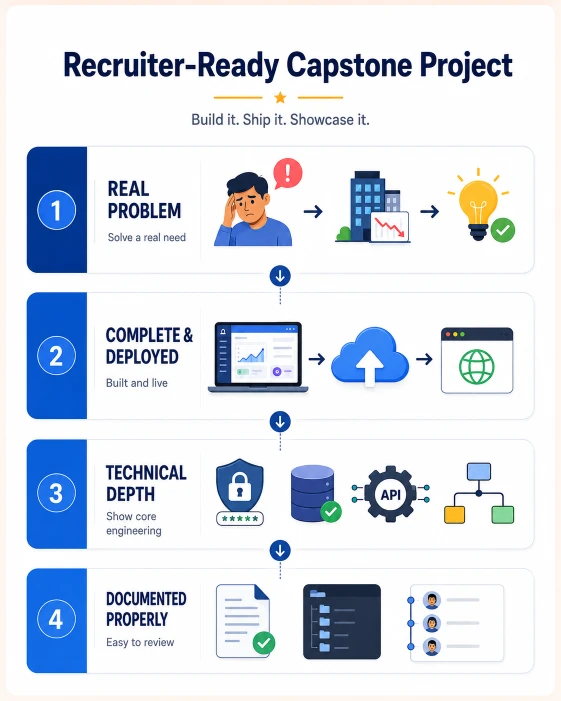
Four qualities of a strong capstone project including real problem solving, deployment, technical depth and documentation

How to build a capstone project that does this job

The projects that genuinely replace work experience on a resume are not the most technically complex ones. They are the most purposefully built ones — the ones where every decision was deliberate and can be articulated.

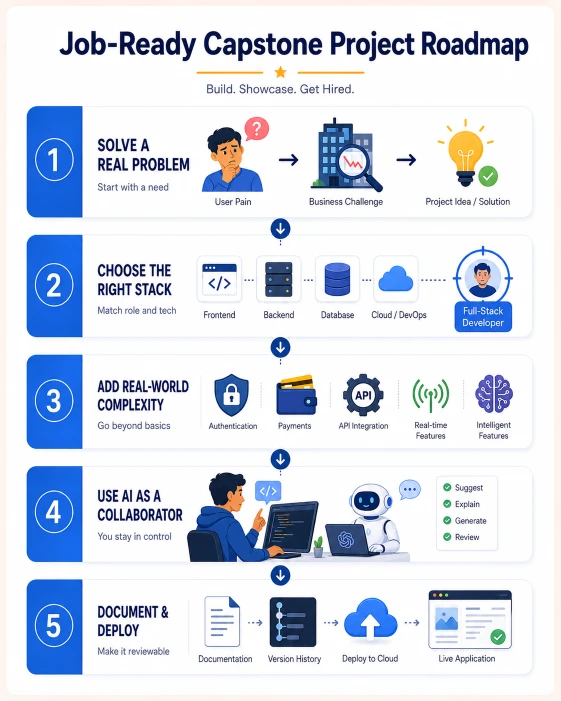
Start with a real problem.

Browse LinkedIn posts, Reddit communities, and conversations with small business owners for genuine pain points technology could address. A project built to solve something real is more interesting, more complete, and far more defensible in an interview than one built to demonstrate a technology for its own sake.

Choose a stack relevant to your target role.

Targeting MERN stack roles? The capstone must be in React, Node.js, Express, and MongoDB. Java full stack? Spring Boot with React or Angular. React Native? Build a mobile app and deploy it to the Play Store. A stack mismatch reduces the project’s relevance immediately.

Integrate at least one real-world complexity.

JWT authentication, Razorpay or Stripe payment integration, WebSocket real-time features, external API integration, or an embedded ML model — any of these pushes the project beyond tutorial territory into what real professional work involves. Choose one relevant to your target role and build it properly.

Use AI tools as a collaborator, not a crutch.

Build with GitHub Copilot or ChatGPT assistance — but be able to explain every component of the resulting code. That combination is itself a demonstration of the AI-integrated development skill companies are actively looking for right now.

Document as you build, not after.

The README, commit history, deployment steps, and architectural decisions become your evidence. A commit history showing gradual, meaningful progress signals professional discipline. A single commit with the entire project signals something was rushed or copied without ownership.
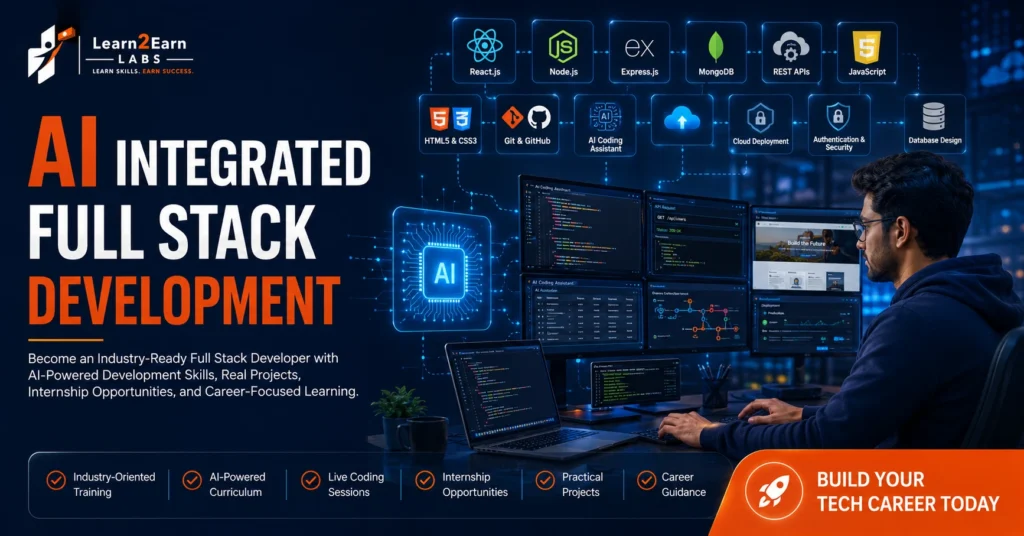
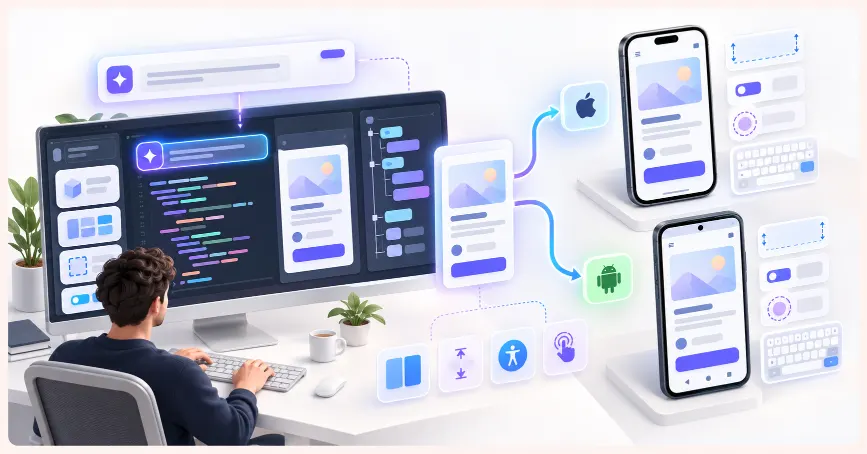
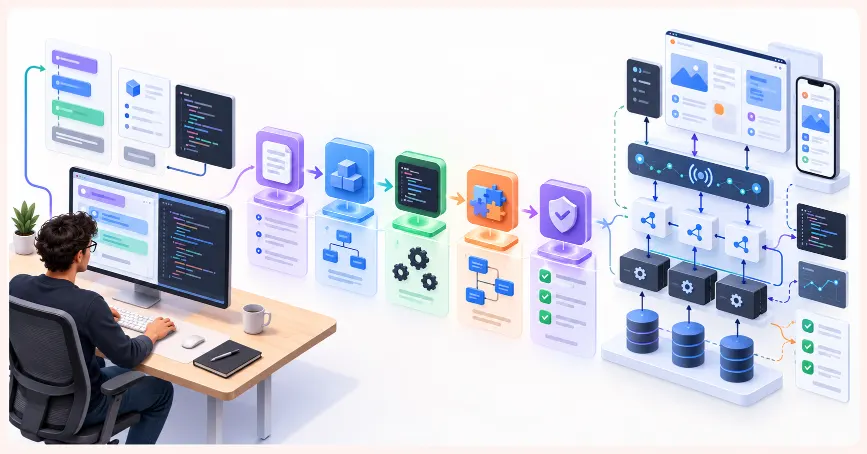
AI Integrated Full Stack Development training with React Node.js MongoDB and AI tools at Learn2Earn Labs

AI Integrated Full Stack Development Training

Master HTML, CSS, JavaScript, React, Node.js, Express.js, MongoDB, REST APIs, and AI-powered development workflows through live coding, practical projects, internship opportunities, and career-focused training.

How to present it on your resume

The project section on a fresher resume should lead, not follow. Before education, before certifications, before anything that does not directly demonstrate ability to do the job.

Each entry should contain: the project name with a live link, the technology stack listed precisely using the exact names companies use in job descriptions, a one-to-two line description of what it does and what problem it solves, and two to three bullet points on the specific features that demonstrate real technical depth.

Weak: “Developed a web application using React and Node.js.”

Strong: “Patient appointment management system | React.js, Node.js, Express.js, MongoDB, JWT — Full stack application enabling clinics to manage appointments with role-based access for admins and doctors. Integrated real-time notifications via Socket.io, JWT authentication, and SMS reminders via Twilio API. Deployed on Render. [Live demo] [GitHub]”

The second entry tells the recruiter the stack, the purpose, the complexity, and gives them direct access to verify every claim. It does not say “I can build things.” It shows something built. That is what replaces the experience line.

How Learn2Earn Labs builds capstone projects that actually move careers

At Learn2Earn Labs, capstone projects are not an optional bonus at the end of the programme. They are the central deliverable — the thing every student builds from day one, with every concept, every technology, and every mentor session oriented toward making that project something a recruiter would stop and genuinely read.

Students across all technical programmes — Full Stack Web Development, React Native Mobile App Development, Data Analytics and Data Science, AI and Machine Learning, and Digital Marketing — build live, deployed projects with real features, real documentation, and real architectural decisions made with guidance from trainers who understand both the technology and what the current market demands.

Projects at Learn2Earn Labs are reviewed against recruiter standards, not academic ones. Specificity of the problem statement, completeness of the feature set, depth of the technical implementation, quality of the README and documentation, and the student’s ability to walk through every decision confidently in a simulated interview — these are the metrics. A project that meets these standards is a project that functions as evidence in a real interview room.

Career counselling ensures each project is presented on the resume with the right language, the right level of technical detail, and the right placement on the page to earn recruiter attention in the first ten seconds of scanning. The project does not just exist — it is positioned to be found, evaluated, and remembered.

With alumni placed at TCS, Accenture, Cognizant, Infosys, and Nagarro — many placed specifically on the strength of a capstone project built during the programme — and with decades of experience shaping careers across technology, marketing, and business, the team at Learn2Earn Labs knows the precise difference between a project that impresses in a classroom and one that impresses a recruiter. The entire programme is built around closing that gap.

If you want to build a capstone project that genuinely moves your career forward — with the skills, the mentorship, and the placement support to ensure it does — speak with the team at Learn2Earn Labs.

Visit learntoearnlabs.com or write to team@learntoearnlabs.com

Student learning React Native mobile app development with AI, Expo, APIs, and practical projects at Learn2Earn Labs.

AI Integrated React Native Mobile App Development Training

Build a job-ready mobile app development profile through practical coding, industry-style projects, AI-assisted workflows, career preparation, mentor-guided learning, real-world app deployment, API integration, and hands-on portfolio development.

Conclusion

The experience requirement that feels like a wall is not actually about years. It is about evidence.

Evidence that you understand how a real project comes together. Evidence that you can work with the tools and the complexity the role requires. Evidence that you have made real decisions, solved real problems, and produced something that functions in the real world.

A capstone project built with purpose, depth, and documentation provides exactly that evidence — in a form that is more directly evaluable than a job title from a role nobody can verify.

You do not need six months at a company to prove you can do the work. You need one project that proves it beyond doubt.

Build the project. Document it properly. Present it correctly. Then walk into the interview ready to talk about every decision you made — because that conversation is what closes the gap between “fresher with a project” and “candidate worth hiring.”

Frequently Asked Questions

1. Can a capstone project replace work experience on a fresher resume?

A strong capstone project can help compensate for limited professional experience by providing recruiters with direct evidence of your skills. A deployed and properly documented project can demonstrate problem-solving, technical decisions, implementation, testing and delivery. However, its value depends on the quality, relevance and depth of the project rather than simply calling something a capstone project. The article makes this distinction clearly.

2. What makes a capstone project impressive to recruiters?

A recruiter-ready capstone project should solve a specific real-world problem, be complete and deployed, demonstrate meaningful technical depth, and include clear documentation. Features such as authentication, APIs, database relationships, real-time functionality or other relevant complexities can make the project more representative of professional work.

3. How should a fresher add a capstone project to a resume?

Include the project name, a live project link, the exact technology stack, a concise explanation of the problem it solves, and two or three strong points demonstrating important features or technical complexity. Where appropriate, provide links to both the live application and the project repository so recruiters can verify your work.

4. Which capstone project should I build for placement?

Choose a project relevant to the role you want. For example, candidates targeting MERN roles should demonstrate technologies such as React, Node.js, Express and MongoDB, while a Java full-stack candidate should build using technologies relevant to Java-focused job requirements. The project should solve a real problem rather than exist only to demonstrate a technology.

5. Can I use AI tools to build my capstone project?

Yes, AI tools can assist with project development, but you should understand and be able to explain the code, architecture and decisions in the finished project. The article recommends using AI as a collaborator rather than allowing it to become a substitute for understanding the work.

Leave a Reply