Home » Prompt Engineering » How to Use AI to Build a Complete Java Full Stack CRUD App Without Wasting Hours on Boilerplate

How to Build a Java Full Stack CRUD App with AI Using Spring Boot and React

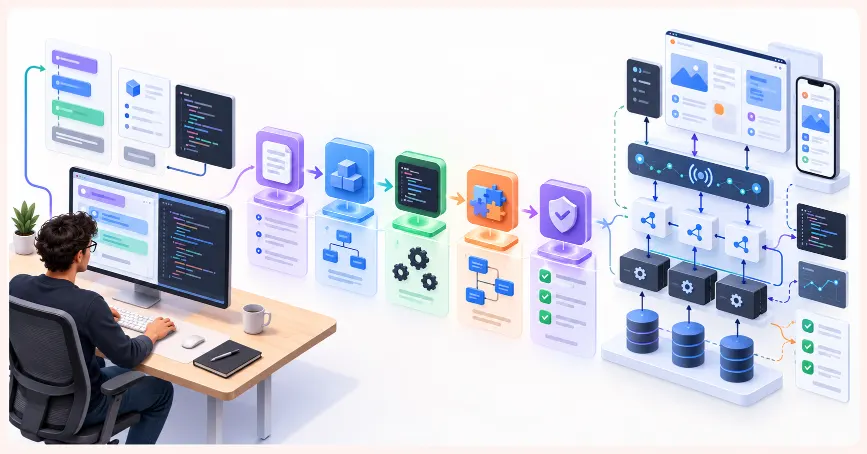
Developer building a Java full stack CRUD application with AI, Spring Boot, React and database layers

Every Java full stack developer knows the feeling. The feature is simple. The boilerplate is not.

You have a clear requirement. Build a product management module. Standard CRUD — create, read, update, delete. Nothing architecturally novel.

And yet you spend the first four hours writing entity classes, repository interfaces, service methods, controller endpoints, request DTOs, response DTOs, exception handlers, and validation annotations — before a single line of actual business logic exists.

This is the boilerplate tax every Java full stack developer pays. Spring Boot is powerful and production-grade. It is also verbose. Setting up one resource correctly — with proper layering, validation, error handling, and response formatting — requires significant code that is structurally identical to the resource before it and the one before that.

AI changes this calculation entirely. Not by replacing judgment or architectural decisions — by eliminating the mechanical translation of those decisions into working code, freeing the developer to focus on the parts that actually require thinking.

This blog shows exactly how to use AI to build a complete, production-appropriate Java full stack CRUD application without wasting hours on boilerplate. The prompts are specific. The workflow is structured. The output is code you can actually use.

Learn2Earn Labs AI Integrated Digital Marketing Training banner featuring AI-powered marketing skills, SEO, Google Ads, social media marketing, analytics, automation, practical projects, internship experience, and career-focused learning.

AI Integrated Digital Marketing Training

Build practical skills in SEO, Google Ads, Social Media Marketing, Analytics, Content Marketing, and AI-powered workflows through projects, live classes, internship exposure, and industry-focused learning.

The right mental model before you start

AI in Java full stack development is not a code generator you describe an entire application to and wait for a complete project. That produces generic, loosely coupled code that fits no real project structure.

The right model is layered, sequential generation with full context at each step. Build the application one layer at a time — entity, repository, service, controller, DTO — with each prompt informed by everything that came before. The AI becomes a collaborator who knows the project context because you have kept it informed.

This produces architecturally coherent code — where the repository returns the type the service expects, where the service throws the exception the controller handler catches, where the response DTO matches what the frontend expects. That coherence cannot come from a single large prompt. It comes from a deliberate, layer-by-layer workflow.
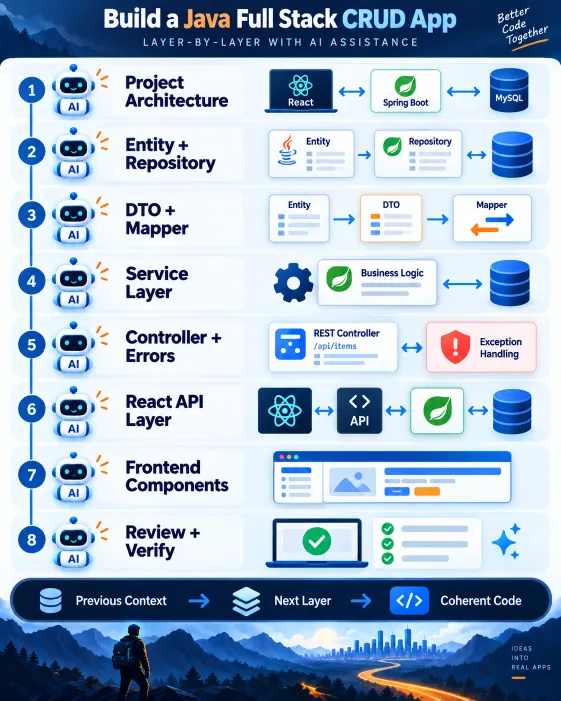
Infographic showing a layer-by-layer AI workflow for building a Java full stack CRUD application

Step 1: define the project structure first

Before generating a single class, use AI to define and document the architecture.

I am building a Java full stack CRUD application:

- Spring Boot 3.x with Java 17
- Spring Data JPA with MySQL
- Spring Security with JWT
- Maven | React.js frontend
First resource: Product — id (Long, auto), name (String, required, max 100),
description (String, optional, max 500), price (BigDecimal, required, min 0),
stockQuantity (Integer, required, min 0), category (String, required),
createdAt and updatedAt (JPA-managed)

Define the complete package structure (base: com.example.app), naming conventions

for entities, repositories, services, controllers, and DTOs,

and the standard ApiResponse<T> wrapper for all API responses.

This prompt produces the project skeleton — the conventions every subsequent prompt will reference. Having this defined first is what makes every subsequent generation coherent rather than inconsistent.

Step 2: generate the entity and repository

With the project structure defined, generate the JPA entity and repository interface together — because their relationship is tight and generating them separately produces mismatched types.

Using the project structure defined, create the Product entity and JPA repository.

Entity:

- @Entity, @Table, @Id, @GeneratedValue with full JPA annotations
- @CreationTimestamp and @UpdateTimestamp for audit fields
- Bean validation: @NotBlank, @Size, @NotNull, @DecimalMin, @Min on relevant fields
- equals() and hashCode() based on id only
- toString() excluding large fields
Repository (extends JpaRepository<Product, Long>):
- findByCategory(String category) → List<Product>
- findAll(Pageable pageable) → Page<Product>
- existsByName(String name) → boolean

The entity and repository become the ground truth for every subsequent layer. Getting this right — with proper validation annotations and the query methods the application will actually need — prevents rework at every layer above.
AI Integrated Full Stack Development training with React Node.js MongoDB and AI tools at Learn2Earn Labs

AI Integrated Full Stack Development Training

Master HTML, CSS, JavaScript, React, Node.js, Express.js, MongoDB, REST APIs, and AI-powered development workflows through live coding, practical projects, internship opportunities, and career-focused training.

Step 3: generate the DTOs and mapper

Request and response DTOs are where most developers spend more time than they should. AI eliminates that.

Using the Product entity, generate:

  1. ProductRequestDTO (create and update):
   - All fields except id, createdAt, updatedAt
   - Validation annotations matching entity constraints
  1. ProductResponseDTO (Java record syntax, Java 17):
   - All fields including id, createdAt, updatedAt
   - Price formatted as String with 2 decimal places
  1. ProductMapper (@Component, manual mapping — no MapStruct):
   - toEntity(ProductRequestDTO dto)
  - toResponseDTO(Product entity)
   - toResponseDTOList(List<Product> entities)

Using Java records for response DTOs is a modern practice that signals professional code quality — one the AI will not default to unless specifically instructed.

Step 4: generate the service layer with proper exception handling

The service layer is where business logic lives and where most of the meaningful architectural decisions in a CRUD application reside.

Create ProductService using constructor injection (not @Autowired field injection).

Custom exception: ResourceNotFoundException extends RuntimeException

with constructor(String resourceName, String fieldName, Object fieldValue)

Methods:

- createProduct(ProductRequestDTO) → ProductResponseDTO
(check existsByName, throw IllegalStateException if duplicate)
- getProductById(Long id) → ProductResponseDTO
(throw ResourceNotFoundException if absent)
- getAllProducts(int page, int size, String sortBy, String sortDir) → Page<ProductResponseDTO>
- getProductsByCategory(String category) → List<ProductResponseDTO>
- updateProduct(Long id, ProductRequestDTO) → ProductResponseDTO
(fetch existing entity, update fields, save — do not create a new entity instance)
- deleteProduct(Long id) → void

Apply @Transactional appropriately. Read-only methods: @Transactional(readOnly = true).

“Do not create a new entity instance” is the kind of constraint that prevents a consequential JPA mistake — creating a detached entity instead of updating the managed one — that AI without instruction would happily reproduce.

Step 5: generate the controller with global exception handling

Create ProductController and GlobalExceptionHandler.

Controller (base: /api/v1/products):

- ResponseEntity<ApiResponse<T>> for all responses
- OpenAPI annotations (@Tag, @Operation, @ApiResponse) on every endpoint
- POST /, GET /{id}, GET / (page, size, sortBy, sortDirection),
  GET /category/{category}, PUT /{id}, DELETE /{id}

GlobalExceptionHandler (@RestControllerAdvice):

- ResourceNotFoundException → 404
- IllegalStateException → 409
- MethodArgumentNotValidException → 400 with map of field → error message
- Exception → 500 with generic message

All use the same ApiResponse<T> structure.

Specifying OpenAPI annotations produces a controller that is API-documented from the moment it is generated — a signal of professional maturity that most entry-level candidates never demonstrate.

Step 6: generate the frontend API layer and components

With the backend complete, switch context to the React frontend.

I have a Spring Boot REST API at http://localhost:8080/api/v1/products.

The API returns responses wrapped in:

{ success: boolean, message: string, data: T, timestamp: string }

For paginated responses, data is:

{ content: Product[], totalElements: number, totalPages: number, number: number }

Create:

  1. A productService.js file using Axios with:
   - Base URL configuration from environment variable
  - Functions: createProduct, getProductById, getAllProducts (with pagination params),
    getProductsByCategory, updateProduct, deleteProduct
  - Interceptor that attaches Authorization header from localStorage JWT token
   - Consistent error extraction from the response wrapper
  1. A useProducts custom hook that:
   - Manages products state, loading, and error
  - Exposes all CRUD operations
  - Handles pagination state
   - Uses the productService functions internally

Generating the service and hook together ensures the hook’s interface matches what the service provides — the same coherence principle applied to the frontend.

Student learning React Native mobile app development with AI, Expo, APIs, and practical projects at Learn2Earn Labs.

AI Integrated React Native Mobile App Development Training

Build a job-ready mobile app development profile through practical coding, industry-style projects, AI-assisted workflows, career preparation, mentor-guided learning, real-world app deployment, API integration, and hands-on portfolio development.

What to verify before shipping any AI-generated Java code

AI-generated Spring Boot code is usually structurally correct. It is occasionally wrong on details that matter. Before committing any AI-generated code to a real project, verify specifically:

Transaction boundaries.

@Transactional at the service layer, not the controller. Read-only operations use @Transactional(readOnly = true).

Lazy loading and N+1 queries.

If your entity has relationships, verify AI has not generated code triggering N+1 queries through lazy loading in loops.

Exception handling completeness.

Test every GlobalExceptionHandler handler is reachable — exceptions thrown in the service match those caught in the handler.

Validation annotation scope.

Confirm DTO validation annotations are enforced — controller method parameters annotated with @Valid or @Validated.

JWT security configuration.

Verify the security config correctly permits public endpoints and protects secured ones.

These verifications take minutes. They prevent the category of production issues most expensive to debug and most damaging to a portfolio project’s credibility.
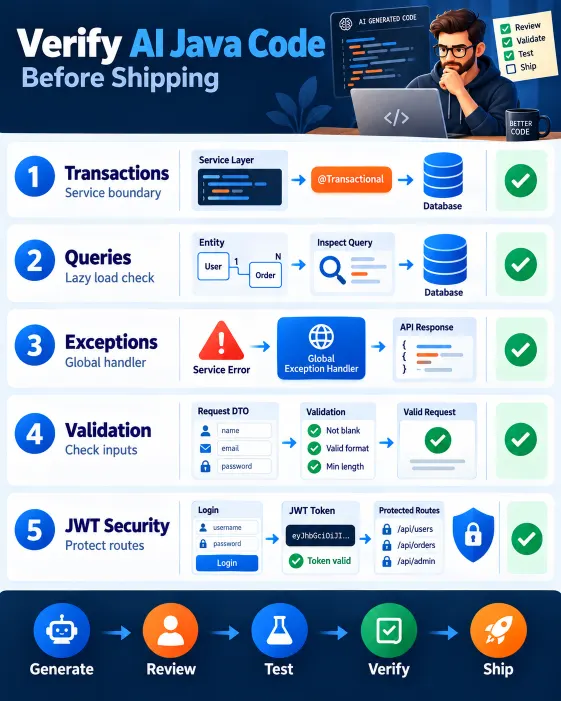
Infographic showing transaction, database, exception, validation and JWT security checks for AI-generated Java code

How Learn2Earn Labs teaches Java full stack development this way

At Learn2Earn Labs, the Java Full Stack Development program is built around this kind of AI-integrated, layer-by-layer workflow — not as a shortcut to skip learning the stack, but as the professional method that produces both deeper understanding and higher-quality output.

Students do not use AI to avoid understanding Spring Boot, JPA, or the architectural principles behind service layers and DTOs. They use it the way a senior developer does — as a collaborator that handles mechanical translation of well-understood decisions into correct code, freeing mental bandwidth for decisions that actually require thinking.

Every project is built this way: structured prompts, layered generation, critical review, deliberate modification. Students learn to evaluate AI output against architectural decisions already made — and to override it when the output does not match those decisions.

Career counselling at Learn2Earn Labs prepares students to walk through their AI-integrated workflow in technical interviews — because explaining how and why you used AI, not just that you did, is what separates candidates who demonstrate genuine technical depth from those who are merely familiar with the tools.

With alumni placed at TCS, Accenture, Cognizant, Infosys, and Nagarro, and with decades of experience shaping developer careers across India’s job market, Learn2Earn Labs trains every student to produce production-level Java full stack development.

Visit learntoearnlabs.com or write to team@learntoearnlabs.com
Conclusion

Boilerplate is not learning. It is translation — converting decisions you have already made into syntactically correct Java. AI does translation better and faster than any developer, every time.

What requires the developer is everything before and after the translation: the architectural decisions, the business logic, the verification that the output is correct, and the judgment to override the AI when it is not.

Build the architecture in your head. Define it in the prompt. Generate the code. Verify it. Ship it.

That is the workflow. And the developer who practises it consistently produces more, ships faster, and builds better software than the one who is still writing boilerplate by hand.

Conclusion

Boilerplate is not learning. It is translation — converting decisions you have already made into syntactically correct Java. AI does translation better and faster than any developer, every time.

What requires the developer is everything before and after the translation: the architectural decisions, the business logic, the verification that the output is correct, and the judgment to override the AI when it is not.

Build the architecture in your head. Define it in the prompt. Generate the code. Verify it. Ship it.

That is the workflow. And the developer who practises it consistently produces more, ships faster, and builds better software than the one who is still writing boilerplate by hand.