The difference between a digital marketer who uses AI and one who doesn't — in real numbers
Table of Contents
ToggleThe productivity gap is no longer theoretical. It is measurable, growing, and showing up in hiring decisions.
This is not a blog about whether AI will change digital marketing. It already has.
The question that matters now — the one that determines which digital marketers build strong careers over the next few years and which ones compete for the same roles they could have taken two years ago — is whether you are on the side of the change that benefits you.
The most honest way to illustrate the gap is with numbers. Not projected numbers from a research paper. The kind that show up in the actual daily workflow of a digital marketer: how long it takes to build an SEO content strategy, how much social media content a marketer can produce in a week, how many ad copy variants can be tested in a campaign cycle, and what the salary difference looks like when this productivity gap becomes visible in a hiring conversation.
This blog puts those numbers on the table.
AI Integrated Digital Marketing Training
Build practical skills in SEO, Google Ads, Social Media Marketing, Analytics, Content Marketing, and AI-powered workflows through projects, live classes, internship exposure, and industry-focused learning.
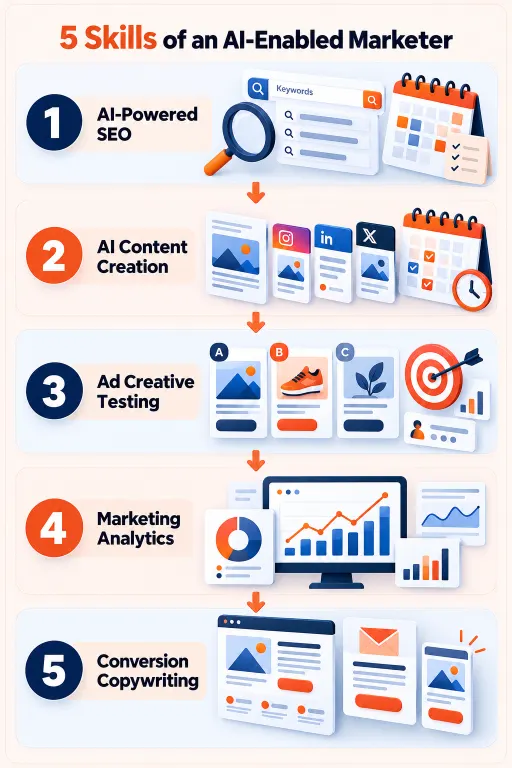
Task 1: building an SEO content strategy
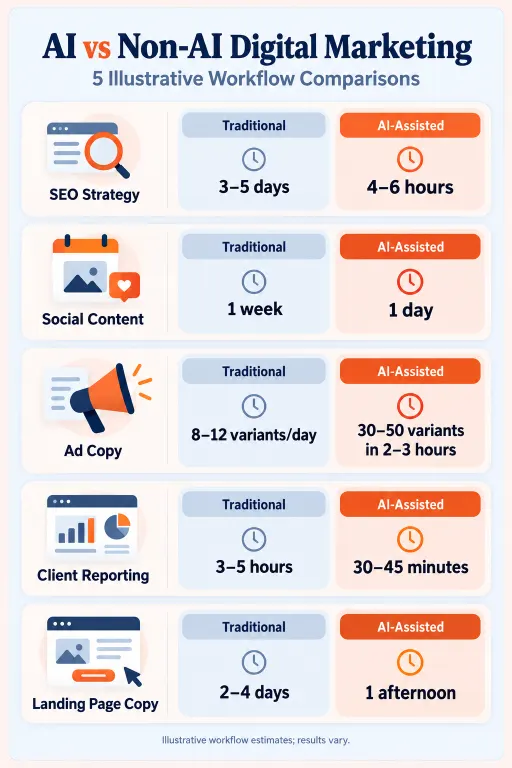
Without AI: A competent digital marketer building an SEO content strategy from scratch — keyword research, competitor gap analysis, content pillar mapping, topic clustering, editorial calendar — typically needs three to five working days for a thorough strategy covering one niche. Most freshers and early-career marketers without paid SEO tools take longer and produce less comprehensive output.
With AI: The same marketer using the ChatGPT-based workflow can produce a complete strategy — audience profiling, content pillars, keyword universe, competitor gap analysis, detailed content briefs, and a 12-week editorial calendar — in four to six hours of focused work. Not a superficial version. A comprehensive one, built in layers.
The number: Three to five days versus four to six hours. Roughly a 10x reduction in strategy development time, with comparable or greater depth.
What this means: An AI-fluent marketer can produce monthly content strategies for multiple clients simultaneously — structurally impossible for a single non-AI marketer to do profitably. The business model of digital marketing services changes completely at this speed.
Task 2: social media content production
Without AI: A social media marketer producing content for one brand — captions, hashtag sets, content ideas across three platforms — typically produces fifteen to twenty posts per week working full-time on that account. A full month of content for one active brand is roughly a week of net creation time.
With AI: The same marketer using structured content prompts produces a month’s worth of content ideas, captions in multiple tones for A/B testing, hashtag sets, and carousel script outlines in a single working day. Time goes to selection, refinement, and creative judgment — not to mechanical first-draft production.
The number: One week of net content creation reduced to one focused day. The marketer can now manage four accounts at the quality level a non-AI marketer manages one.
What this means for income: A non-AI marketer managing one brand at ₹15,000 to ₹20,000 per month hits a ceiling quickly. An AI-fluent marketer managing four accounts at the same quality level earns ₹60,000 to ₹80,000 per month from the same hours. The productivity multiplier converts directly into income.
Task 3: ad copy and creative testing
Without AI: Writing and testing ad copy is one of the most time-intensive parts of performance marketing. A competent copywriter producing Google Ads or Meta Ads creative from scratch — multiple headline variations, description variations, different angles targeting different audience segments — might produce eight to twelve creative variants in a working day. Testing those variants, analysing what works, and iterating takes another two to three days per campaign.
With AI: A marketer using structured prompts generates thirty to fifty creative variants in two to three hours — covering multiple emotional angles, benefit framings, audience segments, and objection-handling approaches. AI does not replace judgment about which variant to test first. It removes the creative generation bottleneck where most performance marketers get stuck.
The number: Eight to twelve variants in a day versus thirty to fifty in three hours. This is not just faster — it is a qualitatively different testing capability. More variants means more data, faster learning, and statistically stronger optimisation. Campaigns converge on better-performing creative faster simply because there are more data points.
AI Integrated Full Stack Development Training
Master HTML, CSS, JavaScript, React, Node.js, Express.js, MongoDB, REST APIs, and AI-powered development workflows through live coding, practical projects, internship opportunities, and career-focused training.
Task 4: client reporting and analytics narrative
Without AI: Producing a monthly performance report for a digital marketing client — pulling data, interpreting results, writing the narrative, and recommending next steps — takes most marketers three to five hours per client. Across five clients, that is fifteen to twenty-five hours per month — nearly a full working week.
With AI: A marketer feeding data into a structured AI analysis prompt can produce the written components of a client report in thirty to forty-five minutes. The marketer still makes the strategic judgments about what the data means for the client’s business — but the mechanical translation of data into narrative is handled by AI.
The number: Three to five hours per client reduced to thirty to forty-five minutes. Across five clients, twelve to twenty hours per month returned to the marketer. At a consultancy billing rate, that returned time is direct additional revenue capacity.
Task 5: landing page and email copy
Without AI: Writing a high-converting landing page from scratch — headline variations, body copy, objection-handling, CTA — takes a competent copywriter two to four days. A welcome email sequence of five to seven emails takes similar time.
With AI: Using the structured prompt workflow, a complete landing page copy structure — above-the-fold, problem section, solution section, social proof, objections, CTA — is produced in one focused afternoon. A five-email welcome sequence takes two to three hours, with multiple tone variations for A/B testing.
The number: Two to four days reduced to one afternoon. A marketer billing ₹10,000 to ₹25,000 per landing page can produce two to three per week instead of one — without working more hours.
What the productivity gap looks like in a salary conversation
When a digital marketing candidate demonstrates at an interview that they manage an SEO content strategy workflow producing monthly strategies in four to six hours, handle social media for four clients simultaneously, and run ad campaigns with thirty-plus creative variants per cycle — that candidate is describing a productivity level a non-AI marketer cannot match regardless of experience level.
The market is beginning to price this difference explicitly. Digital marketing roles at product companies, funded startups, and growth-stage businesses increasingly list AI tool proficiency as required or strongly preferred. Companies that have already adopted AI-assisted workflows want marketers who can integrate from day one, not those who need to be trained on tools after hiring.
The salary premium for AI-fluent digital marketers is not yet standardised — it varies by city, company type, and role. But the pattern is consistent: AI-fluent marketers are shortlisted faster, receive offers more quickly, and command packages 20 to 40 percent higher than peers with equivalent experience but without AI tool fluency.
Every month the gap widens — because AI-fluent marketers are not just more productive. They are accumulating experience in AI-integrated workflows that compounds in value, building a skill set that becomes more differentiated with each passing month.
The skill that is not being taught in most marketing programs
Most digital marketing training programs in India — short courses, online certifications, semester-long programs — are not producing graduates with genuine AI tool fluency. They produce graduates who know what AI tools exist, who may have used ChatGPT for a few exercises, but who do not have the structured, prompt-engineered workflows that produce the productivity numbers described in this blog.
The gap between a marketer who has heard of AI tools and one who has built real workflows is exactly the gap this blog describes. One produces an SEO strategy in four hours. The other takes four days — and produces something shallower.
AI Integrated React Native Mobile App Development Training
Build a job-ready mobile app development profile through practical coding, industry-style projects, AI-assisted workflows, career preparation, mentor-guided learning, real-world app deployment, API integration, and hands-on portfolio development.
What Learn2Earn Labs builds instead
At Learn2Earn Labs, the Digital Marketing program is built explicitly around AI-integrated marketing workflows — not as a separate AI module, but as the working method across every content, SEO, performance marketing, and analytics skill in the curriculum.
Students do not just learn that AI can help with content strategy. They build content strategies using the structured six-layer prompt workflow that produces the four-to-six-hour output this blog describes. They do not just learn that AI can help with ad copy. They run prompt-driven creative testing cycles that generate thirty-plus variants and develop the selection and analysis instincts to use that data effectively.
Every outcome in this blog — the time reductions, the capacity expansions, the salary premiums — is the natural result of a marketer who has both the marketing knowledge and the AI workflow fluency to operate at this level. Learn2Earn Labs builds both, throughout the program.
Career counselling prepares students to articulate their AI-integrated workflows in interviews — which is where the productivity gap becomes a salary gap, and where a strong candidate becomes a strong offer.
With alumni placed at TCS, Accenture, Cognizant, Infosys, and Nagarro, and with decades of experience shaping digital marketing and business careers across India, Learn2Earn Labs understands what it takes to be the marketer companies are competing for — not the marketer who is competing for companies.
Visit learntoearnlabs.com or write to team@learntoearnlabs.com
Conclusion
The numbers in this blog are not aspirational. They are the working reality for digital marketers who have built genuine AI workflow fluency and use it daily.
Strategy: 10x faster. Social content: 4x the capacity. Ad copy: 4x the variants. Reporting: 5x faster. Copywriting: 3x the output.
Each multiplier compounds on the others. A marketer operating at all five is not marginally more productive than a non-AI marketer. They are in a different category of professional capability — one the market is increasingly willing to pay a premium for.
The window to be ahead of that curve is still open. But it is narrowing every month.
Frequently Asked Questions
1. How does AI improve digital marketing productivity?
AI can improve digital marketing productivity by reducing the time spent on repetitive and first-draft tasks such as keyword grouping, content ideation, ad copy generation, reporting narratives, and landing page copywriting. Tools such as ChatGPT help marketers generate structured drafts and explore more alternatives. However, marketers still need to validate information, interpret results, refine content, and make strategic decisions.
2. What is the difference between an AI digital marketer and a traditional digital marketer?
The main difference is how artificial intelligence is integrated into everyday workflows. A traditional digital marketer may perform research, content drafting, reporting, and campaign planning primarily through manual processes. An AI-enabled marketer uses AI tools to assist with these activities while applying marketing knowledge and human judgment. Performance depends on skills, experience, data quality, and the effectiveness of the workflows.
3. Which digital marketing tasks can be completed faster using AI?
AI can help accelerate several digital marketing activities, including SEO content planning, social media caption drafting, advertising creative variations, marketing report preparation, email copywriting, and landing page content development. The amount of time saved depends on task complexity, available data, review requirements, and the marketer’s ability to use AI effectively.
4. Can learning AI tools increase a digital marketer’s salary?
Learning AI tools may improve a digital marketer’s career opportunities by expanding their practical skills and helping them demonstrate efficient workflows. However, a salary increase is not guaranteed. Compensation depends on experience, technical expertise, campaign results, location, employer expectations, and market demand. Building a portfolio of verified AI-assisted projects can help candidates demonstrate their capabilities during interviews.
5. What AI skills should digital marketing students learn in 2026?
Digital marketing students should develop practical skills in AI-assisted SEO strategy, keyword research, social media content planning, advertising creative development, marketing analytics, reporting, and conversion copywriting. They should also learn prompt engineering, fact-checking, data privacy practices, and performance evaluation. Applying these skills to real projects is more valuable than learning tool names alone.