How to write Facebook and Instagram ad copy with AI using 5 ChatGPT prompts
Table of Contents
ToggleThe scroll stops in 1.7 seconds. Your ad copy has even less time than that.
Facebook and Instagram feed ads compete against everything — friend updates, reels, memes, news, and every other ad in the auction. If your ad does not create a visual or verbal interruption in under two seconds, it is invisible.
The mistake most marketers make when using AI to write ad scripts is asking for “a Facebook ad about [product].” What comes back is polished, grammatically correct copy that describes the product calmly and rationally — exactly wrong for a medium where attention is captured by pattern interruption, emotional resonance, or a surprise.
This blog provides the specific prompt templates that solve this problem — for video ad scripts, static image copy, carousel ads, and retargeting messages — with psychological principles built into each prompt so the AI produces output engineered to stop a scroll, not just describe a product.
AI Integrated Digital Marketing Training
Build practical skills in SEO, Google Ads, Social Media Marketing, Analytics, Content Marketing, and AI-powered workflows through projects, live classes, internship exposure, and industry-focused learning.
Why ad copy written for feeds is different from every other copy format
A user scrolling their feed is in passive consumption mode. They are not looking for a solution, not in research mode, not comparing options. They are killing time — and your ad is an interruption to that activity.
The only way an ad earns attention in this context is by connecting to something the user is already feeling fast enough that the interruption feels relevant rather than intrusive. An ad that opens with a problem they are currently experiencing, a claim that contradicts what they expect, or a visual trigger that matches a pattern in their life creates a moment of recognition that causes the scroll to pause.
This means feed ad copy must be written in reverse order from most marketing copy. Most copy begins with the product and moves to the benefit. Feed ad copy must begin with the user’s experience and move to the product only after that connection is established.
Every template in this blog builds this principle into the structure — starting with the audience’s current emotional state, not the brand’s message.
Template 1: The pattern interrupt hook (Video Ad)
Video ads are evaluated in the first three seconds. The hook — opening visual and audio — determines whether the next twenty seconds get watched. This template generates five hook options, each using a different pattern interrupt technique:
Product/service: [describe] | Audience: [specific description]
Offer: [value proposition] | Objective: [awareness / consideration / conversion]
Tone: [educational / urgent / empathetic / humorous / provocative]
Generate 5 video ad hooks — each using a different technique:
- Bold statement: contradicts a common belief this audience holds
- Problem mirror: describes the audience’s painful situation so accurately they feel seen (2-3 sentences)
- Result-first: opens with the outcome before mentioning the product
- Question: a single specific question impossible to scroll past without answering (not “Are you tired of X?” — more specific and unexpected)
- Social proof: a specific result surprising enough to be worth stopping for (a number, a transformation, a specific timeframe)
Each hook: 15 seconds spoken max (35-40 words).
Do not mention the brand name in any hook. Each hook should create a question the rest of the ad must answer.
Template 2: The full 30-second video Ad script
With a hook selected, generate the full 30-second script:
Selected hook: [paste]
Product/service: [describe] | Audience: [description]
Offer: [free trial / discount / consultation, etc.]
Core objection this audience has: [name it]
Structure:
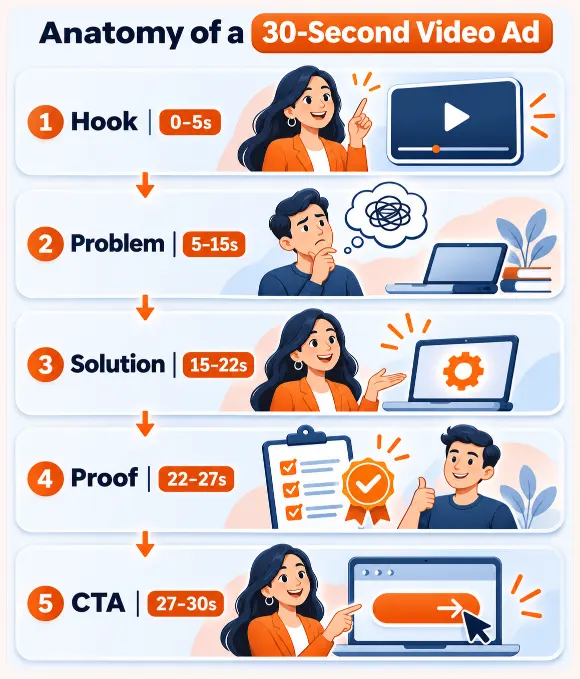
- Hook (0-5s): [paste selected hook]
- Problem expansion (5-15s): deepen the problem — make the viewer feel it is costing them something real
- Solution introduction (15-22s): introduce as the solution — focus on the mechanism, not the features
- Proof element (22-27s): one specific, credible social proof (a number, a result, a customer quote)
- CTA (27-30s): one specific action (link in bio, swipe up, click button)
Rules:
- Spoken language: contractions, short sentences, natural rhythm
- Avoid: “amazing,” “incredible,” “life-changing,” “game-changing” — all generic claim language
- “I” should appear more than the brand name
- Mark [VISUAL CUE] where specific visuals reinforce the script
- 75-90 words spoken
“The word ‘I’ should appear more than the brand name” is specifically important. Video ads primarily about the brand feel like commercials. Video ads primarily about the viewer’s experience feel like content — and consistently outperform in feed environments by a significant margin.
Template 3: Static image Ad copy
Static image ads use two copy elements: primary text (above the image) and the headline (below the image). Each has a different job and a different optimal length:
Product/service: [describe] | Audience: [description]
Image description: [what the visual shows]
Campaign stage: [cold / warm / hot audience]
Primary text options (above the image):
- Option A: Lead with the problem (2-3 sentences, ends with implied promise)
- Option B: Lead with the result (2-3 sentences, opens with outcome desired)
- Option C: Lead with social proof (specific result/testimonial, then explains why it is achievable)
Headline (below the image, 5-7 words max):
- 3 options per primary text variant (9 headlines total)
- Each: specific enough to be believed, creates curiosity without manufactured scarcity, matches the tone of its variant
CTA button recommendation for each variant with reason: (Learn More / Shop Now / Sign Up / Get Quote / Download / Try Free)
Note: cold audiences need more primary text context; warm and hot can be more direct — they already have brand familiarity.
AI Integrated Full Stack Development Training
Master HTML, CSS, JavaScript, React, Node.js, Express.js, MongoDB, REST APIs, and AI-powered development workflows through live coding, practical projects, internship opportunities, and career-focused training.
Template 4: Carousel Ad sequence
Carousel ads allow storytelling across multiple cards — consistently outperforming single-image ads for complex offers because they enable sequential persuasion rather than cramming everything into one frame: Product/service: [describe] | Audience: [description] | 5 cards
Write as a sequential persuasion story:
Card 1 (hook — stops the scroll):
- Headline: one provocative or curiosity-generating statement
- Body: one sentence creating a reason to swipe
Card 2 (problem):
- Headline: names the problem more precisely
- Body: 1-2 sentences agitating the problem (make it feel more urgent than the viewer currently perceives)
Card 3 (solution):
- Headline: introduces the product as the solution
- Body: the mechanism in 1-2 sentences (how it works, not what it is)
Card 4 (proof):
- Headline: one specific, credible result claim
- Body: the social proof detail that makes it believable
Card 5 (CTA):
- Headline: restates the primary offer
- Body: one sentence removing final friction (guarantee, free trial, no commitment)
- CTA button: [specify]
Each card = the next logical step in a conversation, not a standalone ad.
Template 5: Retargeting Ad copy for warm audiences
Retargeting ads are written for people who already know the brand — meaning they have a reason they did not buy the first time. This template identifies and addresses that reason directly:
Retargeting audience: [e.g. “visited product page but did not add to cart” / “added to cart but did not complete purchase” / “watched 50%+ of video ad but did not click through”]
Product: [describe]
Most likely reason they did not convert: [price / timing / needed more information / not sure / forgot / distracted]
Write 3 variants:
Variant 1 (addresses the objection):
- Implicitly acknowledges they have seen the product before
- Names and neutralises the most likely objection in 1-2 sentences
- Offers something that removes the friction (limited-time offer, social proof, FAQ-style reassurance)
Variant 2 (new information):
- Introduces information not in the first ad (different benefit, case study, missed feature)
- Does not reference the previous interaction explicitly
Variant 3 (genuine urgency):
- Uses a real deadline or limited availability
- No manufactured scarcity language
- Respects the viewer’s intelligence
Each variant: primary text (3-5 sentences) + headline (5-7 words) + CTA
How Learn2Earn Labs trains digital marketers to write paid Ad copy
At Learn2Earn Labs, paid advertising copy is taught in the Digital Marketing program as a discipline with its own psychology, format rules, and testing methodology — not as an extension of content writing or social media copywriting.
Students learn all five ad formats covered in this blog, practise generating copy with the structured prompt templates described here, and run mock split tests to understand which copy elements drive performance differences. Ad copy is reviewed not just for writing quality but structural correctness — does the hook interrupt the pattern, does the body deepen the problem before introducing the solution, does the CTA match the campaign stage?
Career counselling prepares students for performance marketing roles where the ability to produce multiple tested variants quickly — rather than a single polished piece slowly — is what clients and employers actually value.
With alumni placed at TCS, Accenture, Cognizant, Infosys, and Nagarro, and with decades of experience shaping digital marketing careers across India, Learn2Earn Labs produces marketers who understand both the creative and strategic dimensions of paid advertising.
Visit learntoearnlabs.com or write to team@learntoearnlabs.com
AI Integrated React Native Mobile App Development Training
Build a job-ready mobile app development profile through practical coding, industry-style projects, AI-assisted workflows, career preparation, mentor-guided learning, real-world app deployment, API integration, and hands-on portfolio development.
Conclusion
The difference between a Facebook and Instagram ad that stops the scroll and one that gets ignored is not the budget. It is the structure of the copy — whether the hook connects to something the audience is already feeling, whether the body deepens the problem before introducing the solution, and whether the CTA matches where the viewer is in their decision-making journey.
Most ad copy produced by AI without structured prompts fails these tests because it is written for a brochure, not for a feed. It describes the product. It does not interrupt the viewer’s experience.
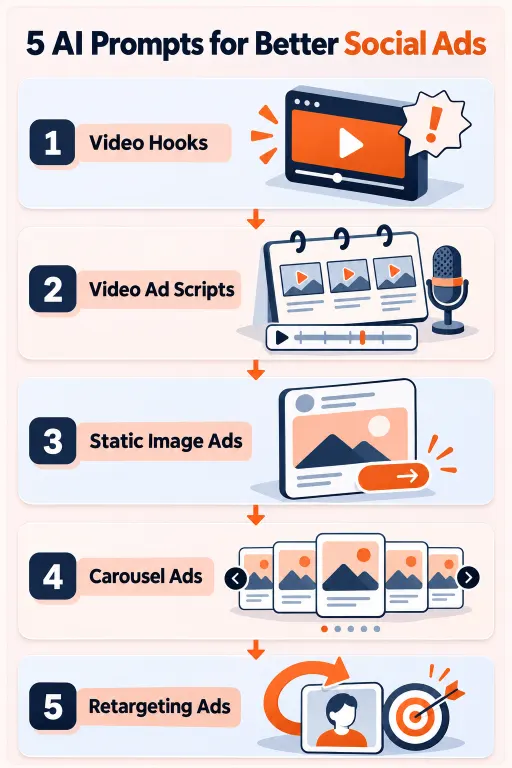
The five prompt templates in this blog — hook options, full video scripts, static image copy, carousel sequences, and retargeting variants — give the marketer a structured approach to producing the second type of copy: copy that earns its way into the viewer’s attention rather than demanding it.
Run the hook template first. Generate five options. Choose the one that most accurately names what the audience is already feeling. Test it. Then scale the one that stops the scroll.
The ad that converts is almost always the one that felt less like an ad.
Frequently Asked Questions
These questions are written to address related informational searches about Facebook and Instagram advertising, AI ad copywriting, video hooks, carousel ads, and retargeting.
1. How can I use ChatGPT to write Facebook and Instagram ads?
You can use ChatGPT to write Facebook and Instagram ads by providing details about your product, target audience, campaign objective, main customer problem, and offer. Ask it to generate multiple versions of video hooks, ad scripts, primary text, headlines, and calls to action. Review each version for accuracy, relevance, and compliance with Meta’s advertising policies, then test suitable variations using real campaign data.
2. What makes a Facebook or Instagram ad stop the scroll?
An effective Facebook or Instagram ad quickly attracts attention through a relevant visual, compelling opening, relatable problem, useful demonstration, or credible outcome. The opening should connect with the audience and communicate why the content matters. Strong creative execution, clear messaging, and a suitable call to action can improve engagement, but no particular hook or script structure guarantees that viewers will stop scrolling.
3. How do I write a 30-second video ad script using AI?
To write a 30-second video ad script using AI, provide ChatGPT with your target audience, offer, campaign objective, and selected opening hook. Ask it to organize the script into five stages: hook, problem, solution, supporting proof, and call to action. Use short, conversational language and include visual directions for the editor. Read the script aloud and adjust the wording to fit the intended video duration.
4. Can ChatGPT create carousel ad copy for Instagram and Facebook?
Yes. ChatGPT can create carousel ad copy by dividing your message into a sequence of connected cards. A useful five-card format introduces an engaging hook, explains the customer’s problem, presents the solution, provides credible evidence, and ends with a clear call to action. Each card should communicate one main idea while contributing to the overall story. Review the copy for accuracy and ensure the visual design remains consistent.
5. How can AI improve Facebook and Instagram retargeting ads?
AI can help develop retargeting ad variations for audiences who have previously interacted with a business, where such targeting is permitted. ChatGPT can suggest different messaging angles, answer common objections, highlight additional product benefits, and create relevant calls to action. Effective retargeting also requires appropriate audience permissions, valid tracking practices, accurate claims, and ongoing campaign performance analysis.