AI-Integrated Industry Training:
Web Development, Data Analytics, Digital Marketing, Java & Python
|
2 Months Practical Training + 1 Month Internship
|
Fee:
₹9,999 per Program
|
Apply Now

What makes a WhatsApp message feel spammy — and what makes it feel human
A message feels spammy when it prioritises the sender’s need over the recipient’s interest — when urgency is not real, when it opens with the brand name rather than something the recipient cares about, when it is clearly the same message sent to thousands of people.
A message feels human when it respects WhatsApp’s conversational register. WhatsApp is not email — it is a personal messaging app where people talk to family and colleagues. A message that lands here should feel like it was written by someone who knows something about the recipient, not because it is the cheapest way to blast a list.
Spammy signals: All-caps urgency (“OFFER ENDS TODAY”), generic openings (“Hi, we have a great offer”), impersonal references (“Dear Customer”), unspecific benefit claims (“Best quality, lowest price”), excessive emoji, CTA buttons with no conversational context.
Human signals: Recipient’s name or a specific interaction reference in the opening, one credible and specific benefit relevant to this recipient, a conversational tone, a single clear action, and language that treats the recipient as an intelligent adult.
The prompts in this blog produce the second set of signals and systematically prevent the first.
The WhatsApp message anatomy
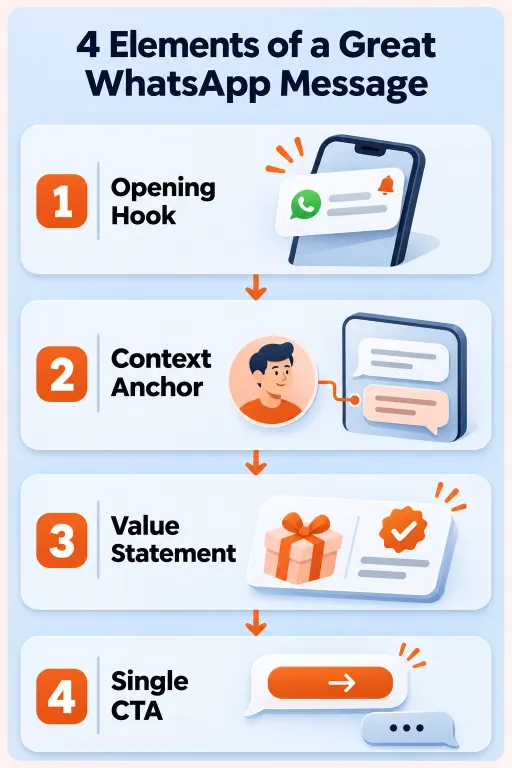
Every effective WhatsApp marketing message has four components, each with a specific function that must be served even in 80 words.
The opening hook determines whether the rest gets read. On WhatsApp, the first few words appear in the notification preview. “Hi! We are delighted to inform you that…” is dead before it is opened. The hook must contain something the recipient cares about before the brand mentions itself.
The context anchor establishes why this message is relevant to this recipient now. Even a minimal anchor — “Since you enquired about our courses last month” — transforms a generic broadcast into something that feels targeted.
The value statement is one specific, credible benefit — not “great offers” but “₹2,000 off the full stack program you asked about, valid through Friday.” Specific numbers and conditions are what convert a vague claim into something worth responding to.
The single CTA is one action, stated plainly, with a reason to take it now that does not rely on manufactured urgency.
All four fit in 80 to 120 words — the optimal length for a WhatsApp message read in full. Longer messages get skimmed. Shorter ones often lack context to produce a response.
Prompt 1: the context-anchored message
The most important single technique for writing WhatsApp messages that do not feel spammy is the context anchor — connecting the message to something real and specific about the recipient.
Business and offering: [describe]
Recipient: [specific description — not “potential customer” but “someone who visited our website and viewed the full stack program page three times but has not enrolled”]
Context anchor (why reaching out now): [e.g. “They attended a free webinar last week” / “They enquired 2 weeks ago” / “They visited the pricing page recently”]
Most relevant offer for this person: [specific]
Desired action: [reply / click / call]
Write a WhatsApp message that:
- Opens with the recipient’s first name and a context-specific reference (not “Dear Customer” — a real, relevant reference)
- States the context anchor in the first sentence
- One specific, concrete benefit with a number or deadline if applicable
- One CTA in conversational language (“Want me to reserve your spot?” not “CLICK HERE”)
- Reads like a message from a helpful person, not a broadcast system
- 80-100 words maximum
- Avoid: all-caps, excessive emoji, generic urgency, filler phrases
Write 3 versions with different opening angles.

Prompt 2: the re-engagement message
Re-engagement messages for contacts who have gone cold are the most challenging WhatsApp marketing copy to write — because the recipient already has a reason not to respond, and a generic message will confirm that reason.
Contact profile: [who they are and their history — e.g. “enrolled in a free trial 3 months ago, did not convert to paid, no engagement since”]
Most likely reason they went cold: [cost concern / timing wasn’t right / got busy / tried a competitor]
What has genuinely changed worth telling them: [new payment option / updated content / new batch / relevant alumni story]
Write a re-engagement message that:
- Acknowledges the gap without excessive apology or passive-aggression
- Names what has changed specifically (not “exciting updates” — the actual update)
- Gives a specific, low-barrier reason to respond (a one-line answer question, or an offer that removes the original friction)
- Treats the recipient as someone worth talking to, not a number to reactivate
- 70-90 words | Tone: warm, direct, no pressure
Write 2 versions — one leading with what changed, one opening with a question.
“Not ‘exciting updates’ — the actual update” is the most important element of this prompt. Vague re-engagement messages confirm to the recipient that nothing has changed. Specific ones give a real reason to reconsider.
Prompt 3: the event or deadline message
Event and deadline messages are most prone to manufactured urgency. This prompt creates genuine urgency — real because the deadline is real — rather than “OFFER ENDS TONIGHT” language that has been used so many times it has lost all persuasive force:
Event/deadline: [e.g. “last batch of the year starting Monday, 6 seats remaining”]
Recipient: [who they are and why this deadline is specifically relevant]
Real consequence of missing it: [specific — not “you’ll miss out”]
Why this is worth acting on: [one specific reason]
Write a message that:
- States the specific deadline or event date in the first two sentences
- Names the consequence in concrete terms (“next batch is in February — that’s a 3-month gap” not “don’t miss out”)
- Requires no prior knowledge of the brand to understand (self-contained)
- Ends with a single action easy to take in 30 seconds
- No manufactured urgency words: HURRY, LAST CHANCE, ACT NOW, DON’T MISS OUT, LIMITED TIME ONLY
- 80-100 words
Prompt 4: the follow-up sequence
A single message rarely converts. A well-structured follow-up sequence — three to four messages sent over a period of days or weeks — is what actually moves prospects through a decision. The challenge is writing a sequence where each message adds value rather than repeating the same ask with increasing desperation.
Offer and prospect position: [describe]
Initial touchpoint already sent: [describe]
Reason prospect has not responded: [best guess at objection or friction]
Write a 3-message follow-up sequence:
- Message 1 (day 2-3): adds new information or a specific testimonial addressing the most likely objection — does not repeat the original message
- Message 2 (day 5-7): shifts angle — different benefit or different consequence of not acting, still no repetition
- Message 3 (day 10-14): final message — acknowledges this is the last on this topic, offers to be useful differently if timing isn’t right, leaves the door open without pressure
Each message: 60-80 words.
Tone escalates in warmth, not in desperation.
Sequence should feel like a conversation, not a system extracting a conversion.
The final message structure — acknowledging it is the last message and offering to be useful in another way — is the most counterintuitive element of a WhatsApp follow-up sequence. Recipients who were not ready to convert often respond precisely because the lack of pressure makes the brand trustworthy. A door left open gracefully is more likely to be walked through than one being pushed closed by urgency.