Home » Prompt Engineering » How to conduct a complete digital marketing audit with AI: A practical one-day ChatGPT workflow

How to conduct a digital marketing audit with AI in one day

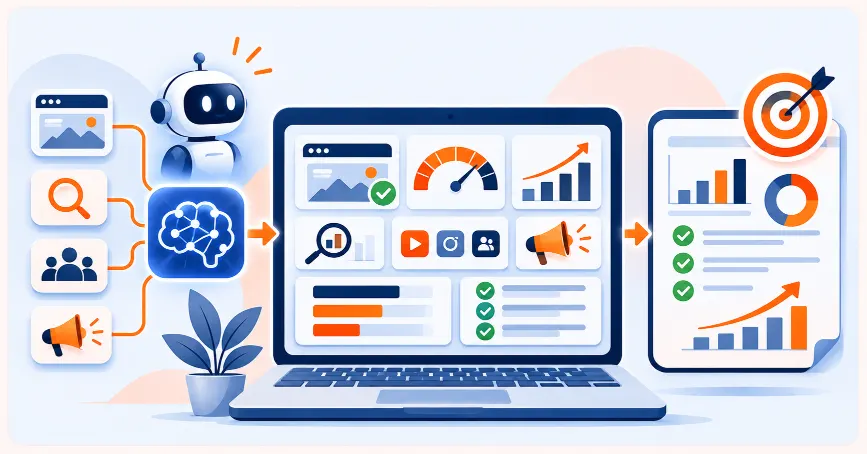
Vector illustration of an AI-assisted digital marketing audit with website SEO analysis, social media analytics, advertising performance, competitor insights, and a client report dashboard.

A digital marketing audit used to take a week. Here is how AI compresses it to one day — without losing the depth.

Digital marketing audits are one of the highest-value services a marketer can offer a client — revealing exactly what is working, what is broken, and where the biggest untapped opportunities are across SEO, social media, paid advertising, content, email, and website performance.

They are also one of the most time-intensive deliverables in the service catalogue. A thorough audit of even a mid-size brand’s digital presence — reviewing analytics data, crawling the website, analysing competitor positioning, assessing content quality, and synthesising it all into an actionable report — typically takes three to five days for an experienced agency team.

Most freelance marketers offer a stripped-down version instead: a surface-level review that checks obvious boxes but lacks the depth that produces genuine insight. Clients sense this. The audit that should be the foundation of the engagement becomes a formality nobody trusts enough to act on.

AI changes what is possible here — dramatically. Not by replacing the marketer’s judgment, but by accelerating the analysis and generating the report components that consume the most time. A marketer who knows how to use AI for audit work produces a genuinely comprehensive audit in one focused day that a traditional workflow would take a week to deliver.

This blog walks through the full one-day workflow — phase by phase, prompt by prompt — so the output is not just faster but structurally better than what most marketers produce without AI.

Learn2Earn Labs AI Integrated Digital Marketing Training banner featuring AI-powered marketing skills, SEO, Google Ads, social media marketing, analytics, automation, practical projects, internship experience, and career-focused learning.

AI Integrated Digital Marketing Training

Build practical skills in SEO, Google Ads, Social Media Marketing, Analytics, Content Marketing, and AI-powered workflows through projects, live classes, internship exposure, and industry-focused learning.

The audit framework: Eight domains, One day

A comprehensive audit covers eight domains: website and technical SEO, on-page SEO and content, social media presence, paid advertising performance, email marketing, competitor positioning, brand and messaging consistency, and the synthesis report with prioritised recommendations.

The one-day workflow has three phases. Morning is domain-by-domain data gathering and analysis. Afternoon is cross-domain synthesis — identifying patterns that individual domain reviews miss. End of day is the client-ready report.
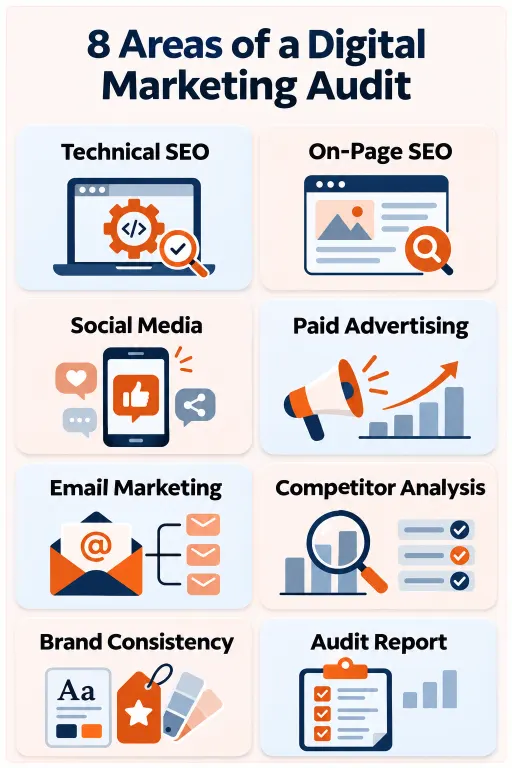
8 Essential Areas of a Complete Digital Marketing Audit

Phase 1 (morning): Domain-by-domain analysis

Domain 1: Website and Technical SEO

Run the client’s website through Screaming Frog, Sitebulb, or Google Search Console and export the data. Then use AI to interpret it:

Technical SEO data for [client website URL]:

[Paste: page count, crawl errors, redirect chains, broken links, duplicate content flags, Core Web Vitals, mobile usability issues, XML sitemap status, robots.txt status]

Produce:

  1. Severity-ranked list of technical issues (critical / high / medium / low)
  2. Plain-language explanation of each issue and why it matters for rankings
  3. Recommended fix for each with implementation complexity, (developer required / CMS fix / configuration change)
  4. The 3 issues to prioritise first based on potential SEO impact

Format: table with columns: Issue | Severity | Impact | Fix | Complexity

Domain 2: On-page SEO and Content Quality

Client website: [URL] | Industry: [niche] | Audience: [description]

Top 10 most-visited pages and top 5 blog posts data:

[Paste: page titles, meta descriptions, H1s, word counts, internal linking patterns, content age, keyword data from Search Console/Ahrefs/SEMrush]

Produce:

  1. Title tag and meta description quality assessment  (specificity, keyword inclusion, click-worthiness)
  2. Content gap assessment: what topics relevant to this audience are missing from the current content library?
  3. Internal linking assessment: are key pages receiving adequate link equity?
  4. Content freshness: what needs updating vs archiving?
  5. Top 3 on-page recommendations with estimated traffic impact

Domain 3: Social Media presence audit

Client: [name] | Platforms: [LinkedIn, Instagram, Facebook, Twitter/X]

Profile data:

[Paste: follower counts, posting frequency, engagement rates, content mix, last 10 post types with approximate performance, bio and profile completeness]

Produce:

  1. Platform-by-platform assessment: which shows strongest organic traction and why?
  2. Content strategy assessment: clear content pillar structure or ad hoc posting?
  3. Engagement rate benchmarks for this industry (provide typical range for context)
  4. The 3 biggest gaps or missed opportunities
  5. Recommended content focus for the next 90 days on the highest-potential platform

Domain 4: Paid Advertising quick assessment

Platforms: [Google Ads, Meta Ads]

Data:

[Paste: ad spend, impressions, clicks, CTR, CPC, conversions, conversion rate, ROAS, campaign structure overview]

Produce:

  1. Performance against typical industry benchmarks for this niche
  2. Wasted spend analysis: where is budget consumed without proportionate return?
  3. Creative assessment: which ad sets underperform on CTR (likely a creative issue)?
  4. Landing page alignment: is the post-click experience losing conversions?
  5. Top 3 optimisation recommendations ranked by estimated ROAS impact

AI Integrated Full Stack Development training with React Node.js MongoDB and AI tools at Learn2Earn Labs

AI Integrated Full Stack Development Training

Master HTML, CSS, JavaScript, React, Node.js, Express.js, MongoDB, REST APIs, and AI-powered development workflows through live coding, practical projects, internship opportunities, and career-focused training.

Phase 2 (afternoon): Cross-domain synthesis

The most valuable part of an audit is not what is found in any individual domain — it is the patterns that emerge across domains. A weak social presence combined with low brand search volume signals a brand awareness problem. Strong SEO with poor conversion rates signals a landing page or messaging problem. Paid advertising with high bounce rates signals audience-channel mismatch.

AI is remarkably effective at identifying these cross-domain patterns when all findings are provided in a single structured prompt:

Cross-domain synthesis for [client name]:

  • Website and technical SEO: [3-4 bullet summary]
  • On-page SEO and content: [summary]
  • Social media: [summary]
  • Paid advertising: [summary]

[Email, competitor, brand findings if completed]

Produce:

  1. The 3 most significant patterns or relationships across domains (e.g. “Weak social presence is compounding low brand search volume, increasing paid acquisition cost because the brand has no organic recall”)
  2. The single most important strategic priority — the one change with highest impact across multiple domains simultaneously
  3. Where is the client investing time and money that the data suggests is producing poor returns?
  4. If the client could only act on three things in the next 30 days,what and in what order?
  5. What does the overall digital posture suggest about growth stage and what this business needs most right now?

Phase 3 (end of day): The client-ready report

With analysis complete, generate the report structure and draft the executive summary — the section most clients read first and most thoroughly.

Based on the complete audit findings and cross-domain synthesis,

write an executive summary for the digital marketing audit report.

Client: [name and brief description of business]

Audit scope: [list domains covered]

Date: [today’s date]

The executive summary should:

  1. Open with the most important finding in one powerful sentence — something specific and honest, not “your digital marketing has both strengths and opportunities”
  2. Summarise the 3-5 most significant findings across all domains in plain language that a business owner, not just a marketer, can understand
  3. Name the primary strategic gap — the one thing the business most critically needs to address
  4. State the 3 priority recommendations in order of impact
  5. Close with a forward-looking statement about what the business can realistically achieve in the next 6 months if the top priorities are addressed

Length: 300-400 words. Tone: direct, professional, honest.

No marketing language. No “exciting opportunities” or “powerful synergies.”

Write as if presenting findings to a founder who wants the truth.

“Write as if presenting to a founder who wants the truth” is the most important instruction in this prompt. Without it, executive summaries default to diplomatic, hedged language that obscures the most important findings. This produces the direct, specific language that builds client trust and makes the report worth acting on.
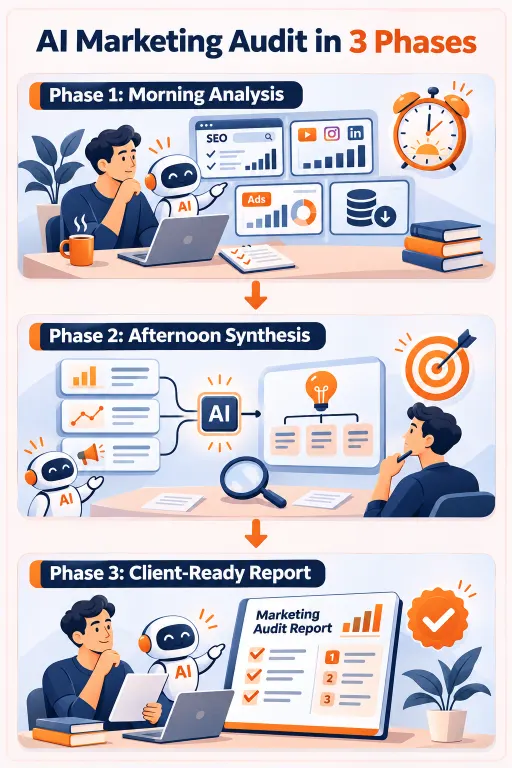
3 Phases of an AI Digital Marketing Audit: Analysis to Client Report

What makes this audit more valuable than a traditional one

The AI-assisted audit is not just faster. It is structurally better in two specific ways.

First, it is more consistent. A traditional manual audit is only as thorough as the marketer’s energy and attention at each domain. By domain six of eight, the analysis is shallower than domain one. AI does not get tired — every domain receives the same analytical depth.

Second, it surfaces patterns humans often miss. The cross-domain synthesis is the highest-value element of the workflow because it explicitly asks for relationships between findings — something human analysts often skip in favour of domain-specific recommendations. The reason paid advertising is performing poorly might be in the brand search volume data, not in the ad account. Only a cross-domain view surfaces it.


Student learning React Native mobile app development with AI, Expo, APIs, and practical projects at Learn2Earn Labs.

AI Integrated React Native Mobile App Development Training

Build a job-ready mobile app development profile through practical coding, industry-style projects, AI-assisted workflows, career preparation, mentor-guided learning, real-world app deployment, API integration, and hands-on portfolio development.

How Learn2Earn Labs builds audit skills into the digital marketing program

At Learn2Earn Labs, the Digital Marketing program includes a structured client audit project as a core practical deliverable — not a theoretical exercise but a real audit of a real business conducted using the AI-integrated workflow described in this blog.

Students learn each domain’s analytical framework, practise the cross-domain synthesis, and produce a client-ready report reviewed for depth of analysis, quality of insight, and clarity of recommendation. Finding real issues, synthesising cross-domain patterns, and writing recommendations a business owner can act on — this is what converts digital marketing knowledge into professional consulting capability.

Career counselling prepares students to use the audit as a portfolio piece and a sales tool — because a marketer who leads with a one-day audit as a first engagement for a new client delivers value immediately, builds trust quickly, and positions every subsequent engagement on demonstrated analytical capability.

With alumni placed at TCS, Accenture, Cognizant, Infosys, and Nagarro, and with decades of experience shaping digital marketing careers across India, Learn2Earn Labs produces marketers who walk into a client relationship at day one and immediately demonstrate the kind of thinking that makes them worth keeping.

Visit learntoearnlabs.com or write to team@learntoearnlabs.com

Conclusion

A one-day digital marketing audit powered by AI is not a shortcut. It is a workflow — a structured sequence of domain analysis, cross-domain synthesis, and report generation that produces better output faster because AI handles the work that does not require human judgment while freeing the marketer to focus entirely on the work that does.

The marketer’s expertise determines what data to gather, which findings to prioritise, and whether the AI’s cross-domain patterns are accurate. The AI determines the speed, consistency, and comprehensiveness of the analysis.

Together, they produce an audit a client will read, trust, and act on — in one day.

Frequently Asked Questions

These FAQs target informational search intent around AI digital marketing audits, ChatGPT audit prompts, SEO analysis, marketing performance reviews, and client reporting.

1. How can I conduct a digital marketing audit using ChatGPT?

You can conduct a digital marketing audit using ChatGPT by collecting relevant data from your website, SEO tools, social media platforms, advertising accounts, and analytics systems. Provide structured data to ChatGPT and ask it to identify performance issues, summarize findings, and recommend improvements. Review each recommendation against the original data before preparing a client report. ChatGPT supports the analysis but does not replace access to reliable marketing data or professional judgment.

2. What should be included in a complete digital marketing audit?

A comprehensive digital marketing audit should examine website performance and technical SEO, on-page SEO and content quality, social media presence, paid advertising, email marketing, competitor positioning, and brand messaging consistency. The findings should be combined into a report containing major issues, potential opportunities, prioritized recommendations, and suggested next steps. The exact scope depends on the client’s business objectives, marketing channels, and available data.

3. Can AI complete a digital marketing audit in one day?

AI can help marketers complete a focused digital marketing audit within one working day by accelerating data interpretation, issue categorization, cross-channel analysis, and report drafting. However, completing a thorough audit depends on the website’s size, campaign complexity, data availability, and required validation. Large websites or businesses with multiple campaigns may require additional time for accurate analysis and implementation planning.

4. Which tools are useful for an AI-powered digital marketing audit?

Useful tools include Google Search Console for organic search data, Google Analytics for website performance, Screaming Frog or Sitebulb for technical SEO crawling, and Google Ads or Meta Ads Manager for advertising performance. Social media analytics platforms and email campaign reports provide additional insights. ChatGPT can help interpret exported data, organize findings, identify possible relationships, and draft recommendations. Each tool should be selected according to the audit scope.

5. How do I create a client-ready digital marketing audit report using AI?

Start by organizing verified audit findings by marketing channel and severity. Use ChatGPT to draft an executive summary explaining the most important problems, their business implications, and recommended actions. Include supporting evidence, prioritized fixes, implementation requirements, responsible teams, and measurable outcomes. Review the report for factual accuracy and ensure that clients can clearly understand what needs to change and why.