How to write compelling client case studies with AI using 5 ChatGPT prompts
Table of Contents
ToggleThe most convincing sales document your agency can produce is one your clients write for you. AI helps you make it exceptional.
Every digital marketing agency, freelancer, and consultant knows the answer without hesitation: what is the single most effective thing a prospect looks at before deciding to work with you?
Case studies. Not the portfolio. Not the team page. Not the pricing. The documented proof that you have taken someone in a situation similar to theirs and produced a result they care about.
The problem is that most agencies produce case studies that underperform badly. Written in the passive voice. Leading with the agency’s process rather than the client’s problem. Describing work done instead of results achieved. Containing vague statements like “increased engagement significantly” instead of “engagement rate rose from 1.2 percent to 6.8 percent in 90 days.” Written from the agency’s perspective — which makes them sound like self-promotion rather than evidence.
A well-written case study does the opposite. It puts the client’s situation front and centre, documents the specific problem with enough detail that a prospect recognises their own situation, describes the intervention with enough specificity to establish credibility, and delivers results with numbers concrete enough to be believed and compelling enough to create urgency.
AI — with the right prompts — produces this second kind of case study consistently, from a raw interview or a set of notes, in under two hours.
AI Integrated Digital Marketing Training
Build practical skills in SEO, Google Ads, Social Media Marketing, Analytics, Content Marketing, and AI-powered workflows through projects, live classes, internship exposure, and industry-focused learning.
The anatomy of a case study that actually wins clients
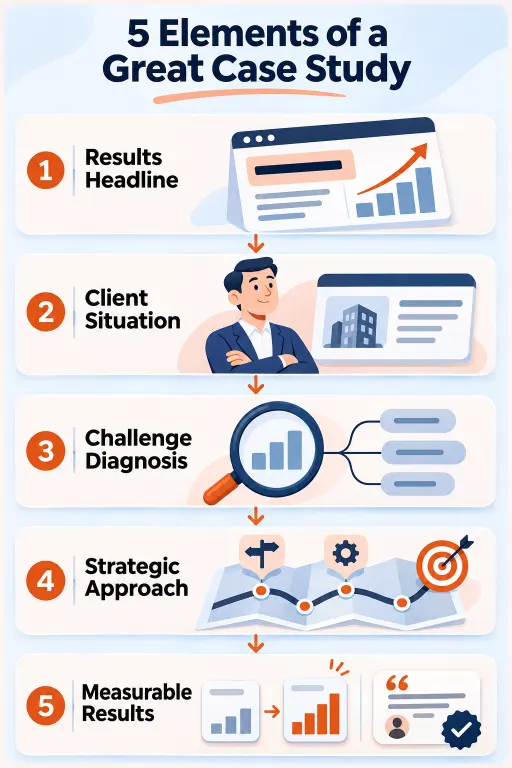
Most case studies fail at the structural level before a single word of the writing is evaluated. A case study that wins clients has five sections, each with a specific job.
The headline and result summary must contain the specific result — not “how we helped a startup grow” but “how we grew a Noida-based SaaS startup’s organic traffic from 3,000 to 47,000 monthly visitors in 8 months.” Specific numbers, specific timeframe, specific starting point — these are what make a headline credible rather than promotional.
The client situation describes the client’s world before the engagement — their industry, stage, specific challenge, and why that challenge was costing them something. This section should be written from the client’s perspective. A prospect reading it should think “this is me.”
The challenge diagnosis explains what was actually wrong and why — not just symptoms but root causes. This is the section that demonstrates expertise, because correctly diagnosing the root cause of a marketing problem is harder than fixing it.
The approach is not a list of services delivered — it is a narrative of decisions and their rationale. This section shows strategic thinking, not just tactical execution.
The results, with context. “Organic traffic increased by 1,467%” means more with “from a base of 3,200 monthly visitors” than without it. Every number needs its baseline.
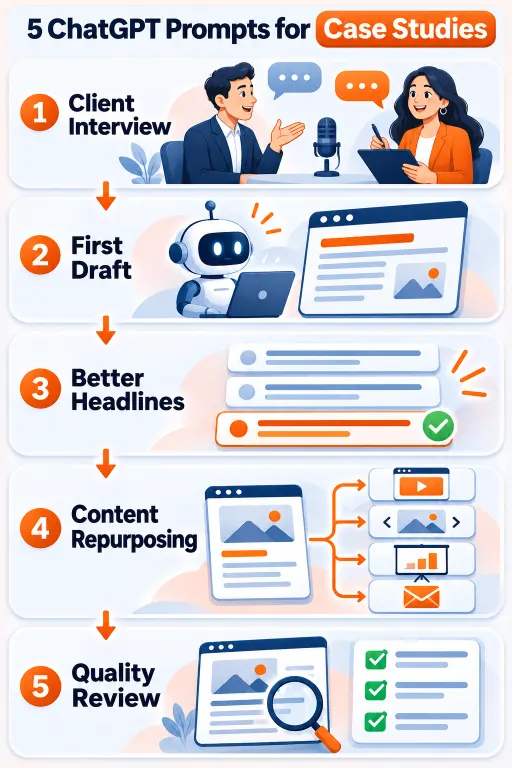
Prompt 1: The client interview extraction
The raw material for a great case study exists in an interview with the client. Most agencies either skip the interview or extract a fraction of its value. Use AI to generate a structured interview guide that produces case study gold:
Client background: [industry, size, engagement type]
Primary result: [describe] | Agency type: [describe]
Generate a structured 20-question interview guide that extracts:
- The specific situation before engagement — what was happening,what was at stake, what had already been tried
- The emotional experience of the problem — how it felt, not just the business impact
- Why they chose this agency — decision criteria and what gave them confidence
- Their process experience — what surprised them, what moments mattered
- The results in the client’s own language
- Business impact beyond marketing metrics (sales conversations, investor confidence, hiring, etc.)
- What they would say to someone considering this agency
Each question: open-ended and specific. Not “were you happy with the results?” but “when did you first realise that what we were doing was working?”
“Were you happy with the results?” produces a yes/no or a diplomatic non-answer. “When did you first realise that what we were doing was working?” produces a moment — a specific memory, a specific conversation, a specific number that changed things. That is the content that makes a case study feel real.
Prompt 2: The case study first draft
With interview notes in hand, generate the first draft:
Client: [type, e.g. “B2B SaaS startup in Noida”] | Industry: [describe]
Engagement: [services provided] | Duration: [length]
Data:
- Baseline metrics before engagement: [list]
- Results achieved: [specific numbers with timeframes]
- Business impact beyond marketing metrics: [downstream effects]
Client quotes: [paste 3-5 verbatim quotes]
Write a complete case study:
- Headline: primary result, specific numbers, timeframe — 20 words max
- Result summary box: 3-4 bullet points, each specific and numerical
- Client situation (200-250 words): third person, client’s perspective, ending with the specific challenge that brought them to seek an agency
- Challenge diagnosis (150-200 words): what was wrong and why — demonstrates depth of diagnosis, not speed of response
- Approach (250-300 words): a narrative of decisions and rationale, not a list of services
- Results with context (200-250 words): specific numbers, context, business impact, 1-2 client quotes integrated naturally
- Client testimonial: strongest quote as pull quote, 50 words max, attributed with name, title, company
Tone: specific, credible, confident — not self-promotional. Write from documented evidence, not marketing claims. Minimal passive voice. Integrate quotes naturally.

AI Integrated Full Stack Development Training
Master HTML, CSS, JavaScript, React, Node.js, Express.js, MongoDB, REST APIs, and AI-powered development workflows through live coding, practical projects, internship opportunities, and career-focused training.
Prompt 3: The headline and hook variations
The headline most often undersells the content. Generate multiple options, each emphasising a different dimension of the result:
Core results: [list 3-5 significant outcomes]
Client profile: [describe] | Agency specialisation: [describe]
Generate 10 headline options, each emphasising a different dimension:
- Primary metric: leads with the biggest single number
- Transformation: before → after structure
- Timeframe: leads with how quickly the result was achieved
- Problem-solution: names the problem, implies the solution
- Outcome: leads with business outcome, not marketing metric
- Specificity: exact numbers, exact timeframe, exact starting point
- Audience-specific: written for the exact prospect this study targets
- Question: a question the prospect is asking that this study answers
- Social proof: positions the client as proof, agency as facilitator
- SEO-optimised: for the agency website case study page
Recommend which 3 are strongest and explain why.
Prompt 4: The distribution and repurposing plan
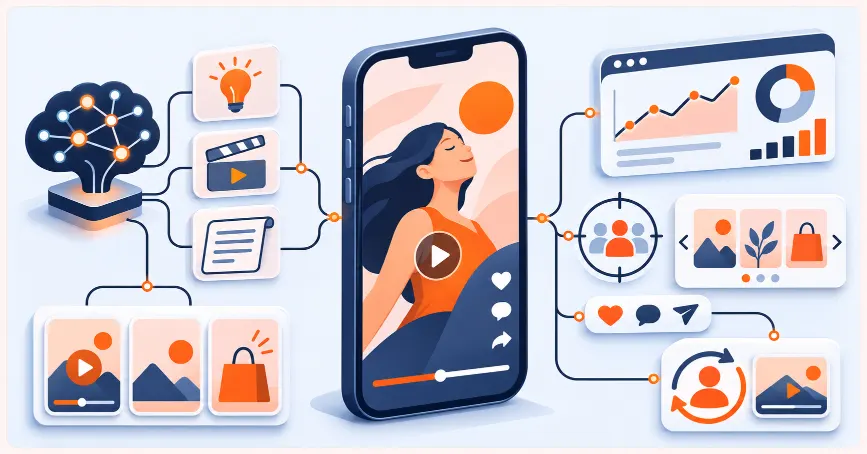
A case study that stays on the website page is one most prospects never see. Well-written content can be repurposed into every channel where prospects encounter the agency:
Case study highlights: [3-4 bullet summary of key results and story]
Target prospect: [describe]
Repurposing plan:
- LinkedIn post (150-200 words): lead with the most surprising result, tell the story arc in compressed form, end with a question inviting engagement from similar prospects
- Instagram carousel (5 slides): headline + result hook / 3 key story moments / result + soft CTA
- Cold email snippet (3-4 sentences): references the case study as social proof without making the email about the case study
- Agency pitch deck slide (2-3 bullet points): designed to be read in 15 seconds while the presenter talks
- Website headline A/B test: two homepage headline variations using this result as credibility anchor
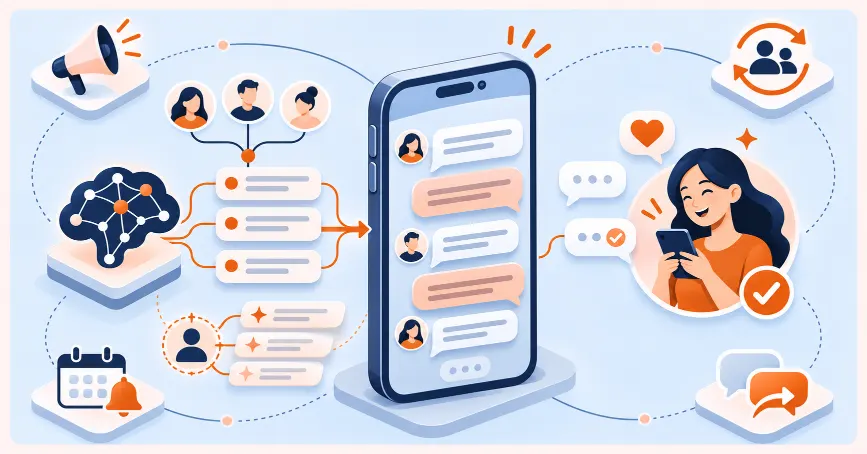
- WhatsApp follow-up message (60-80 words): for warm prospects who have not converted — case study answers their most common objection
Prompt 5: The case study review and quality check
Before publishing, run the case study through a structured quality review:
[Paste the complete case study]
Evaluate against:
- Headline: does it contain specific numbers, timeframe, and clear result? Rate 1-10 with explanation.
- Prospect recognition: would a similar prospect recognise their own situation in the first 100 words? Rate 1-10.
- Vague claims: identify every unsubstantiated claim (“significant results,” “dramatically improved,” “highly engaged”)
- Agency-centricity: how many times does the copy focus on what the agency did versus how the client experienced the work? The client’s experience should dominate.
- Quote quality: are the client quotes specific and quotable, or diplomatic and forgettable?
- Results context: are results presented with enough baseline to be believable?
- Overall conversion rating (1-10): how likely is this to convert a similar prospect?
List the 3 most important improvements to make before publishing.
AI Integrated React Native Mobile App Development Training
Build a job-ready mobile app development profile through practical coding, industry-style projects, AI-assisted workflows, career preparation, mentor-guided learning, real-world app deployment, API integration, and hands-on portfolio development.
How Learn2Earn Labs builds client communication skills into the digital marketing programme
At Learn2Earn Labs, the ability to document and communicate marketing results — in case studies, client reports, pitch presentations, and proposals — is treated as a professional skill as important as the marketing techniques themselves. A marketer who produces exceptional results but cannot document and communicate them is limiting their own career and their clients’ ability to understand the value of the work.
Students in the Digital Marketing programme learn to build result narratives, structure case study interviews, write client-facing documentation that demonstrates strategic depth rather than tactical activity, and use AI to produce this quality of work consistently and quickly. The case study workflow described in this blog is a core programme deliverable — every student produces at least one complete, publication-ready case study during training.
Career counselling at Learn2Earn Labs prepares students for the client acquisition responsibilities that come with professional digital marketing roles — because most agencies and consultants fail not because they lack technical skill, but because they cannot communicate the value of that skill to the clients who pay for it.
With alumni placed at TCS, Accenture, Cognizant, Infosys, and Nagarro, and with decades of experience shaping careers across digital marketing, agency services, and business development across India, Learn2Earn Labs produces marketers as effective at winning work as they are at doing it.
Visit learntoearnlabs.com or write to team@learntoearnlabs.com
Conclusion
A case study that wins clients is not written from the agency’s perspective. It is written from the evidence’s perspective — letting specific numbers, the client’s authentic words, and the documented transformation do the selling, while the agency stays firmly in the role of narrator and expert, not self-promoter.
AI, given the right prompts, produces this kind of case study from raw interview notes in under two hours. The five prompts here — interview extraction, first draft, headline variations, repurposing plan, and quality review — are the complete production workflow.
Write the case study. Distribute it everywhere the prospect looks. Let the client’s result close the conversation your agency starts.
Frequently Asked Questions
1. How can I use ChatGPT to write a professional client case study?
You can use ChatGPT to write a professional client case study by providing verified project details, client interview notes, baseline metrics, strategies implemented, and measurable results. Ask ChatGPT to organize the information into a results-focused headline, client background, challenge diagnosis, strategic approach, and outcomes. Review the draft carefully to ensure that all figures, quotations, and claims are accurate and approved for publication.
2. What are the essential elements of a digital marketing case study?
A digital marketing case study typically includes five essential elements: a results-focused headline, the client’s initial situation, the underlying business challenge, the strategy implemented, and measurable results with supporting context. Including authentic client quotations and relevant performance evidence can strengthen credibility. A strong case study explains not only what improved but also how the marketing decisions contributed to the outcome.
3. Can AI help marketing agencies attract more clients through case studies?
AI can help marketing agencies produce clearer, more structured case studies that communicate previous client results effectively. ChatGPT can assist with interview preparation, drafting, headline variations, and repurposing case studies for websites, presentations, and social media. These materials can support credibility and client acquisition, but their effectiveness depends on authentic evidence, relevance to prospective clients, and the agency’s actual track record.
4. How do I write a case study when I have limited client data?
Start by identifying the information you can verify, such as the client’s initial challenge, project objectives, work completed, available performance metrics, and qualitative feedback. Use ChatGPT to structure these details and identify missing information that requires clarification. Do not invent statistics, testimonials, or business outcomes. If numerical results are unavailable, clearly explain the documented work and observations without exaggerating its impact.
5. How can I repurpose a client case study for digital marketing?
You can repurpose a verified client case study into LinkedIn posts, Instagram carousels, agency website content, proposal slides, email outreach, and relevant follow-up messages. ChatGPT can adapt the case study’s main findings, verified results, and client quotations for each format while preserving factual accuracy. Obtain appropriate permission before publishing client identities, confidential information, or identifiable testimonials.