Home » Career » First 90 Days in Your First Job: A Fresher’s Guide

How to Succeed in the First 90 Days of Your First Job

Young Indian professional learning, collaborating with colleagues and completing work during the first 90 days of a new job.

You got the offer. Now the real thing begins

Getting the job is the goal you have been working toward for months — sometimes years. The resume, the applications, the interviews, the waiting. Then the offer letter arrives and for a brief moment, everything feels resolved.

It is not resolved. It is just beginning.

The first 90 days of your first job will shape more of your career trajectory than almost any other period of equal length. The reputation you build, the relationships you form, the habits you establish, the mistakes you make and how you handle them — all of it creates a professional identity that follows you far longer than you expect.

Most freshers walk into their first role with no preparation for this phase. They know how to get the job. Nobody taught them what to do once they are inside. So they improvise, they guess, and they make entirely avoidable mistakes that cost them quietly for months.

This blog is the preparation nobody gave you.

Learn2Earn Labs AI Integrated Digital Marketing Training banner featuring AI-powered marketing skills, SEO, Google Ads, social media marketing, analytics, automation, practical projects, internship experience, and career-focused learning.

AI Integrated Digital Marketing Training

Build practical skills in SEO, Google Ads, Social Media Marketing, Analytics, Content Marketing, and AI-powered workflows through projects, live classes, internship exposure, and industry-focused learning.

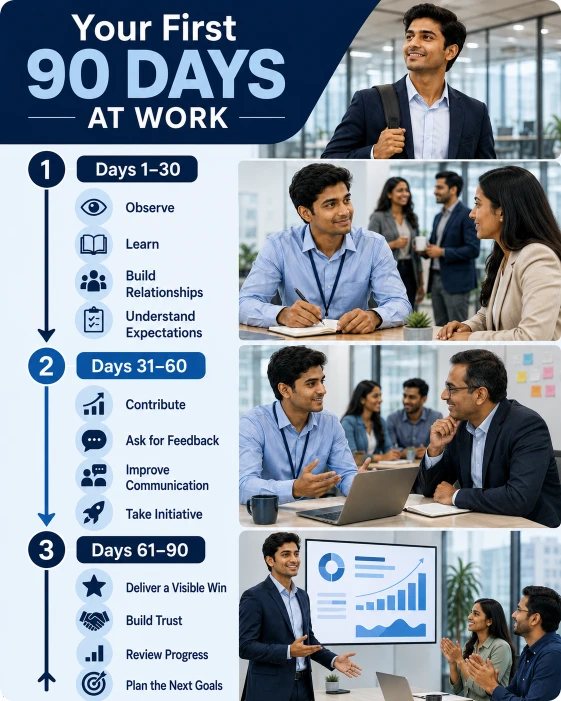
The first two weeks: observe far more than you speak

Most freshers enter their first job wanting to prove themselves immediately. That impulse is well-intentioned and entirely understandable. It is also one of the most common sources of early career missteps.

The first two weeks are not the time to introduce yourself through ideas and opinions. They are the time to learn — how the team communicates, how decisions get made, who the informal leaders are, and what the culture actually rewards versus what it says it rewards.

Every organisation has a gap between stated values and operational reality. The people who succeed fastest read that gap early — by observing what actually gets praised, what gets ignored, and what quietly marks someone as a poor fit.

Listen more than you speak in meetings. Ask questions that show you are paying attention, not ones designed to demonstrate what you know. First impressions in the workplace are built over weeks, not minutes. The person who spends the first two weeks genuinely absorbing their environment is far better positioned than the one who spends it performing.

The first month: build the relationships that will define your growth

Two relationships matter more than any other in determining how your first year unfolds: your immediate manager and at least one senior colleague who can guide you informally.

Your manager controls what projects you get, how your performance is evaluated, and how you are represented in conversations you are not part of. Building a working relationship based on reliability and clear communication is not optional — it is strategic.

Understand early what your manager values most. Speed? Quality? Constant updates? Independence? Ask directly in your first week: “How would you prefer I update you on ongoing work?” That question alone signals self-awareness and professionalism most new joiners never demonstrate.

Find one senior colleague who has been around for a few years and is willing to share perspective informally. Not a formal mentor — just someone whose work you respect and who will answer honest questions. These informal relationships are how real organisational knowledge is transferred, and having one early gives you years of context that would otherwise take much longer to accumulate.

The first month: understand the actual expectations of your role

One of the costliest mistakes freshers make is assuming they understand what success looks like in their role — and discovering weeks later their definition was completely different from their manager’s.

Ask directly in your first two weeks: “What would excellent performance in this role look like at the 30-day mark? At the 90-day mark?” The answer tells you more about how to spend your time than any job description ever could.

Job descriptions describe what the role involves. They rarely define what outstanding performance looks like. The manager’s answer to that question is the real standard — and knowing it from day one means you build toward it instead of discovering it only at your first performance review.

Write it down. Revisit it at the 30-day mark. Adjust if you have drifted.

Thirty-sixty-ninety-day plan showing how a fresher can observe, contribute, build trust and succeed in a first job.
AI Integrated Full Stack Development training with React Node.js MongoDB and AI tools at Learn2Earn Labs

AI Integrated Full Stack Development Training

Master HTML, CSS, JavaScript, React, Node.js, Express.js, MongoDB, REST APIs, and AI-powered development workflows through live coding, practical projects, internship opportunities, and career-focused training.

The middle stretch: deliver something visible and meaningful

By day 30 to 60, the observation phase is behind you. You understand the team, the expectations, the culture. Attention now shifts from learning to contributing — visibly enough to matter.

Every new joiner needs at least one clear win in their first 90 days. Not a dramatic breakthrough — something specific, delivered well, that demonstrates you can do the work at a standard that earns respect.

This win does not need to be large. It needs to be thorough. A task completed ahead of deadline with better output than expected. A problem solved before being asked. A document that made someone else’s job easier. The combination of quality and initiative is what makes it register.

The goal is not to impress through volume — 12-hour days, copying every email, volunteering loudly for everything. The goal is to demonstrate through one or two specific pieces of work that you take quality seriously and can be relied upon.

That reputation — reliable, quality-conscious, self-motivated — builds one piece of work at a time. Once established, it compounds quietly in your favour across every opportunity that follows.

The mistakes most freshers make — and how to avoid them

Asking for help too late

Struggling silently with something for two days that a five-minute conversation could have resolved is not independence — it is a poor use of everyone’s time, including yours. Ask early. Ask specifically. Asking for help when you are genuinely stuck is professional behaviour, not weakness.

Comparing themselves to colleagues out loud
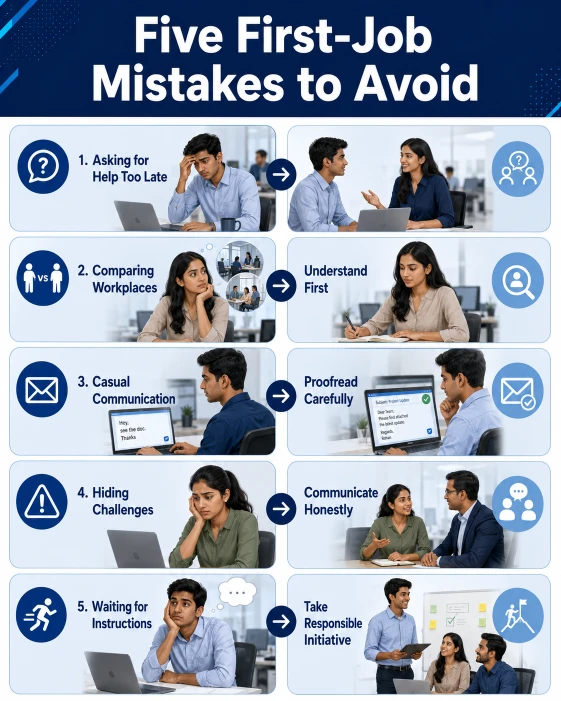
Infographic explaining five common mistakes freshers make in their first job and the professional actions they should take instead.

“In college, we used to do it differently” or “my friend at another company does it this way” immediately marks you as someone who has not yet accepted the environment they are in. Comparisons may be valid internally — expressing them before you have earned credibility is almost always counterproductive.

Treating email and written communication casually

Corporate written communication carries professional weight in a way that college group chats do not. A poorly worded email to a senior colleague or a client reflects on your professionalism and is far harder to undo than most freshers realise. Write carefully, proofread before sending, and match the tone of the organisation’s established communication style.

Going quiet when they are struggling

Many freshers, when they are finding the role harder than expected, withdraw and hope nobody notices. Managers always notice. The far better approach is to be honest early — “I am finding this particular aspect of the work challenging and I want to discuss how I can improve” — before the challenge becomes a pattern that is hard to address.

Waiting to be told everything

The freshers who grow fastest in their first job are not the ones who wait for complete instructions before taking any step. They are the ones who take reasonable initiative within their defined scope, communicate what they have done, and ask for feedback on the approach. Initiative, communicated clearly, is one of the strongest early signals of high potential.


Student learning React Native mobile app development with AI, Expo, APIs, and practical projects at Learn2Earn Labs.

AI Integrated React Native Mobile App Development Training

Build a job-ready mobile app development profile through practical coding, industry-style projects, AI-assisted workflows, career preparation, mentor-guided learning, real-world app deployment, API integration, and hands-on portfolio development.

How Learn2Earn Labs prepares students for this phase

Technical skills get you through the interview. What happens after depends almost entirely on how prepared you are for the human, professional, and organisational dimensions of the job — and that preparation is something most training programmes never address.

At Learn2Earn Labs, career preparation does not stop at placement. Students receive structured guidance on what to expect in their first 90 days, how to build relationships with managers and colleagues, how to communicate professionally in a corporate environment, how to manage expectations clearly, and how to handle the specific challenges that freshers consistently face in their first role.

This guidance is grounded in real experience. With decades of experience working with students and professionals across technology, marketing, and business — and with alumni placed at companies including TCS, Accenture, Cognizant, Infosys, and Nagarro — the team at Learn2Earn Labs has a detailed, practical understanding of what happens after the offer letter arrives and what determines whether a fresher’s first year is the foundation of a strong career or a period of avoidable setback.

Technical programmes at Learn2Earn Labs — Full Stack Web Development, React Native Mobile App Development, Digital Marketing, Data Analytics, AI and Data Science, Business Development — are built around real projects, real industry tools, and real professional standards. Students do not just leave ready for the interview. They leave ready for what comes after.

Career counselling, mock interviews, LinkedIn optimisation, resume building, and post-placement support are all part of the programme — because Learn2Earn Labs measures its success not by how many students get offers, but by how well those students perform and grow once they do.

If you are preparing to enter the workforce and want to build the skills, the professional readiness, and the career foundation that makes the first 90 days a launchpad rather than a learning curve — speak with the team at Learn2Earn Labs.

Visit learntoearnlabs.com or write to team@learntoearnlabs.com

Conclusion

Nobody tells you this before you join your first job: the three months after the offer letter are when the career actually begins.

The technical skills you built got you in the door. What you do in those first 90 days — how you listen, how you communicate, how you deliver, how you handle being wrong, how you build relationships under genuine professional pressure for the first time — is what determines the trajectory of everything that comes after.

Walk in with your eyes open. Observe before you speak. Deliver with care. Build trust deliberately. Ask for help before you are drowning. And treat every day of those first three months as the foundational investment it actually is.

Your career is not built at the interview. It is built starting on day one.

Frequently Asked Questions

1. What should I do during the first 90 days of my first job?

Use the first 90 days to understand the workplace culture, learn your responsibilities, build relationships with your manager and colleagues, clarify performance expectations, and deliver at least one meaningful piece of work. Focus on becoming reliable rather than trying to impress everyone immediately.

2. How can I impress my manager in my first job?

Understand how your manager prefers to receive updates, complete assigned work carefully, communicate problems early, meet deadlines, and ask for feedback. Consistent reliability and clear communication usually create a stronger impression than volunteering for every available task.

3. What should I ask my manager during the first week?

Ask how they prefer to receive work updates, which tasks should be prioritised, and what good performance should look like after 30 and 90 days. These questions help you understand expectations before investing time in the wrong areas.

4. Is it okay to ask for help in a new job?

Yes. Asking for help after making a reasonable attempt is professional and can prevent unnecessary delays. Explain what you are trying to accomplish, what you have already attempted, and where you are specifically stuck instead of asking a vague question.

5. What are the most common mistakes freshers make in their first job?

Common mistakes include speaking before understanding the workplace, asking for help too late, communicating casually, hiding difficulties, comparing the organisation with college or other companies, and waiting for complete instructions before taking initiative.