Table of Contents
ToggleA certificate tells a recruiter you attended something. GitHub tells them what you can actually build.
There is no shortage of developers in India who have collected certifications. AWS Certified Developer. React.js Fundamentals. Python for Everybody. Courses from Udemy, Coursera, NPTEL, and a dozen other platforms.
These certificates sit on resumes in long lists. They signal effort and the ability to complete a structured course. What they do not signal — what they fundamentally cannot signal — is whether the person who earned them can actually build something real under their own steam.
This is the gap a strong GitHub profile closes in a way no certificate ever can.
When a recruiter or technical hiring manager opens your GitHub, they are not reading claims about what you know. They are looking directly at what you have built — the code you wrote, the decisions you made, the problems you solved. They are evaluating evidence, not credentials.
In technical hiring, evidence beats credentials every time. And GitHub is where evidence lives.
This blog explains what a strong GitHub profile communicates, what specific elements make it compelling versus forgettable, and why building it alongside your technical skills is one of the highest-return career investments a developer can make.
AI Integrated Digital Marketing Training
Build practical skills in SEO, Google Ads, Social Media Marketing, Analytics, Content Marketing, and AI-powered workflows through projects, live classes, internship exposure, and industry-focused learning.
What happens when a technical recruiter opens your GitHub
Technical recruiters and engineering hiring managers — particularly at product companies, funded startups, and technology-forward organisations — routinely look up candidates’ GitHub profiles before deciding whether to schedule an interview call. Sometimes this happens after receiving a resume. Sometimes it happens instead.
What they see in the first thirty seconds determines whether they keep looking.
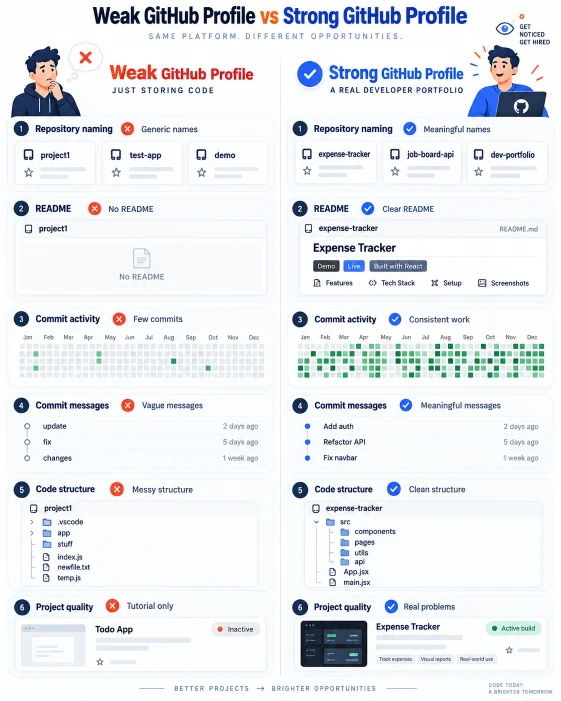
A profile with repositories untouched for eighteen months, no README files, and projects named “project1” and “test-app” communicates one thing: this person learned some things in a course and stopped. No evidence of self-directed work. No evidence of curiosity beyond the curriculum. No professional discipline.
A profile with well-named repositories, detailed READMEs explaining what each project does and why, a commit history showing consistent engagement, and at least one project complex enough to suggest real problem-solving — this communicates something entirely different. This person builds. This person is curious. This person’s skills will keep developing.
That assessment happens in thirty seconds. It shapes everything that follows.
What a strong GitHub profile actually communicates
Each element of a GitHub profile communicates something specific to someone who knows how to read it. And most technical hiring managers know exactly how to read it.
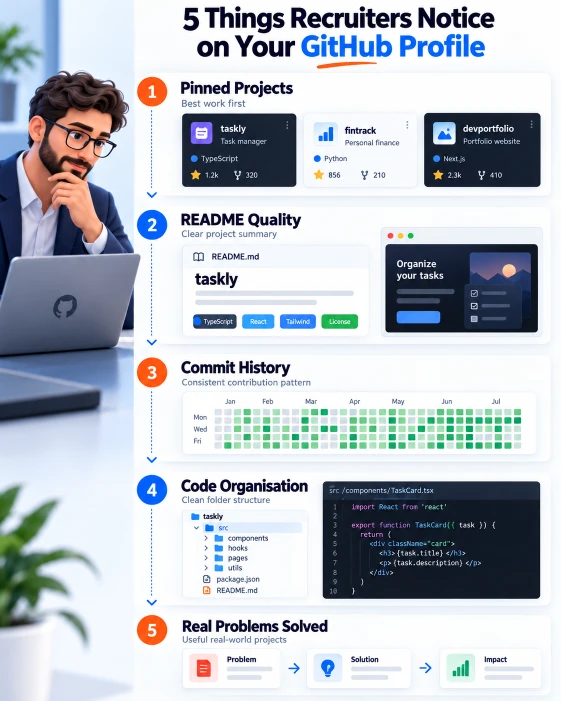
Pinned repositories.
The first thing anyone sees is your six pinned repositories. If they are chosen thoughtfully — a full stack web application, a REST API, a mobile app, a data project — a recruiter immediately understands your range. If they are not pinned at all, the recruiter sees whatever GitHub surfaces by default, which is rarely your best work.
README quality.
A well-written README signals someone who thinks about communication, not just code. It should explain what the project does, what problem it solves, what stack it uses, and what the key features are. A README that says only “This is a project for learning React” tells a recruiter almost nothing — and leaves them to do detective work themselves. They will not.
Commit history and consistency.
A commit history showing gradual, meaningful progress — commit messages describing what changed and why, complexity increasing over time — signals professional discipline and real ownership. A history with two commits — “initial commit” and “final version” — signals something was copied or rushed.
The contribution graph matters less than commit quality, but a completely empty graph tells a recruiter that GitHub is where code goes to be archived, not where a developer actively works. Modest, consistent activity — a few commits per week — signals ongoing engagement with the craft.
Code quality and organisation.
A recruiter who is a developer — common at product companies and startups — will read the code. Enough to assess naming conventions, structure, and whether it reads as written by someone thinking clearly or copying quickly. Clean, organised code in a public repository is free advertising for your technical judgment.
Evidence of real problems solved.
The most compelling GitHub repositories are the ones solving something recognisable. Not “Todo App Number 4” — a real estate listing platform, a patient management system, an AI-powered resume reviewer, a mobile expense tracker with charts and analytics. The more specifically a project’s README describes the problem it was built to solve, the more the project demonstrates that the developer understood requirements, scoped a solution, and built toward an outcome.

AI Integrated Full Stack Development Training
Master HTML, CSS, JavaScript, React, Node.js, Express.js, MongoDB, REST APIs, and AI-powered development workflows through live coding, practical projects, internship opportunities, and career-focused training.
What certificates do that GitHub cannot — and why it is not enough
Certificates do serve a purpose. A Google or AWS certification signals engagement with a structured curriculum and a defined knowledge standard. In some hiring contexts — particularly at large traditional companies — they carry genuine weight.
But certificates face two limitations that a strong GitHub profile does not.
The first is verifiability. Anyone can list a certification on a resume. A GitHub profile cannot be faked at the depth a technical recruiter examines it. The code is real or it is not. The commit history is genuine or it is not. GitHub is verified by its nature.
The second is depth signal. A certificate says you know the concepts. A GitHub profile says you have applied them — repeatedly, in multiple contexts, with your own decisions and your own code. In a technical interview, this difference surfaces almost immediately. A candidate with certifications but no portfolio struggles to discuss what they actually built. One with a strong GitHub profile speaks with specificity and genuine ownership about every decision in every repository.
Certificates open doors. GitHub profiles open conversations. In technical hiring, the conversation is where the decision is made.
The GitHub mistakes that most freshers make
Understanding what makes a profile strong also means knowing what quietly undermines it.
Repositories with no description and no README.
A repository that tells you nothing about what it is or why it exists is a repository that gets skipped. Every repository should have a one-line description and a README, at minimum.
Forked repositories with no contribution.
A forked repository with no subsequent commits shows nothing about your ability. Fork to contribute — not to clutter a profile that should be showing original work.
Private repositories hiding your best work.
Unless there is a genuine confidentiality reason, make your best projects public. A recruiter cannot evaluate what they cannot see.
Commit messages that say nothing.
“update,” “fix,” “changes,” “done” — these commit messages are the equivalent of writing “I worked today” in a work journal. They tell nothing about what changed, why it changed, or what thinking went into the change. Writing meaningful commit messages is a professional habit that takes thirty extra seconds per commit and signals years of professional maturity to anyone who reads the log.
Treating GitHub as an archive rather than an active presence.
Developers who use GitHub only to upload finished projects rather than as the working environment in which they develop treat it as a filing cabinet. A recruiter who looks at a profile last updated six months ago draws a natural conclusion about how actively that developer is engaging with their craft.
AI Integrated React Native Mobile App Development Training
Build a job-ready mobile app development profile through practical coding, industry-style projects, AI-assisted workflows, career preparation, mentor-guided learning, real-world app deployment, API integration, and hands-on portfolio development.
How Learn2Earn Labs builds developer profiles that get noticed
At Learn2Earn Labs, GitHub is not a submission system for completed assignments. It is the working environment in which students develop their projects from the first week of training.
Students in Full Stack Web Development, React Native Mobile App Development, Data Analytics and Data Science, AI and Machine Learning, and related technical programmes build their projects on GitHub from day one — making real commits, writing meaningful commit messages, maintaining proper README documentation, and progressively building a profile that tells a coherent, credible story of a developer’s growth.
Career counselling at Learn2Earn Labs includes a dedicated GitHub profile review — evaluating pinned repository selection, README quality, commit history patterns, and code organisation against the specific standards that technical recruiters and hiring managers at target companies actually look for. Weak repositories are strengthened before students enter the market. Profiles are built to stand up to scrutiny.
The outcome is not just a resume with a GitHub link. It is a GitHub profile that, when opened by a technical recruiter, does the work of a reference letter — demonstrating real capability through real code, in a form that is immediately, independently verifiable.
With alumni placed at TCS, Accenture, Cognizant, Infosys, and Nagarro, and with decades of experience preparing developers for the Indian job market, Learn2Earn Labs understands what technical hiring managers in this country are looking for when they open a candidate’s profile. That understanding is built into every part of how students develop and document their work.
If you want to build a GitHub presence that actually helps your job search — not just as a checkbox but as a genuine career asset — speak with the team at Learn2Earn Labs.
Visit learntoearnlabs.com or write to team@learntoearnlabs.com
Conclusion
Certificates tell recruiters what you studied. GitHub tells them what you built.
In a job market where dozens of candidates have identical qualifications on paper, the one who can point to real, verifiable, public work — code that can be read, projects that can be visited, a commit history that tells the story of a developer actively growing — has an advantage that no certificate list can replicate.
Build the profile. Make the commits meaningful. Write the READMEs. Pin the best work. Keep contributing.
Because the recruiter who opens your GitHub tomorrow is not looking for evidence that you attended something. They are looking for evidence that you can build. Give them that evidence — cleanly, clearly, and in a form they can evaluate in thirty seconds.
That is what a strong GitHub profile does. And no certificate in the world does it quite like that.
Frequently Asked Questions
These are written to work for both traditional SEO and GEO/AEO, meaning they give concise, self-contained answers that Google AI Overviews, ChatGPT-style search systems, and other answer engines can easily understand.
1. Does a GitHub profile help you get a developer job?
Yes. A strong GitHub profile gives recruiters and technical hiring managers evidence of what you can actually build. Projects, code quality, documentation, commit history, and problem-solving can demonstrate skills that are difficult to communicate through a resume or certificate alone.
2. What should a fresher include in a strong GitHub profile?
A fresher should showcase their best projects through well-named and pinned repositories, clear README files, meaningful commit messages, organised code, consistent development activity, and projects that solve identifiable real-world problems.
3. Do recruiters check GitHub profiles during hiring?
Technical recruiters and engineering hiring managers may review GitHub profiles when evaluating developers, particularly when the candidate includes a GitHub link on their resume or portfolio. A well-maintained profile can give them additional evidence of coding ability and project ownership.
4. Is GitHub more important than certificates for developers?
They serve different purposes. Certificates can demonstrate that a developer completed structured learning or met a defined knowledge standard, while GitHub can demonstrate how that knowledge was applied through real code and projects. For technical roles, having both can be valuable, but practical evidence strengthens a candidate’s credibility.
5. What makes a GitHub profile attractive to recruiters?
A recruiter-friendly GitHub profile includes strong pinned repositories, detailed READMEs, meaningful commits, clean and organised code, consistent activity, and projects that demonstrate genuine problem-solving rather than only copied tutorials or basic practice applications.