Table of Contents
Toggle“I don’t know anyone.” That is where most people stop. It is also where the real strategy begins.
Every fresher told “networking is how you get jobs” hits the same wall immediately: what do you do when you have no network?
You did not grow up in a family with industry connections. Your college did not place you at a well-known company. You have no seniors at the companies you want to work for. Your LinkedIn has 150 connections — mostly classmates, a few teachers, people you have never spoken to.
The conventional advice — “reach out to people in your industry, build relationships” — is accurate. But it is vague to the point of being useless without knowing precisely who to reach, what to say, and what to do before any of that to make the outreach worth responding to.
This blog is the specific version of that advice. It covers what a referral actually does, why you are not as far from one as you think, and the exact steps that consistently produce referrals — even for people who genuinely know nobody.
AI Integrated Digital Marketing Training
Build practical skills in SEO, Google Ads, Social Media Marketing, Analytics, Content Marketing, and AI-powered workflows through projects, live classes, internship exposure, and industry-focused learning.
What a referral actually does — and why it matters so much
When you apply through Naukri or LinkedIn, your application enters a queue with hundreds of others, gets screened by ATS, reviewed for a few seconds, and either shortlisted or discarded. Studies consistently show that fewer than 3 percent of applications through job portals result in interviews at competitive companies.
When someone inside the company refers you, the process changes completely. Your profile goes directly to the recruiter or hiring manager with a personal endorsement from an employee they trust. Referred candidates are reviewed first, faster, and with a degree of presumed credibility a cold application cannot manufacture. Most companies have formal referral programs that give employees a financial incentive to refer candidates who get hired — meaning even someone who barely knows you has a concrete reason to push your profile through.
Referred candidates are between 5 and 15 times more likely to receive an interview call than cold applicants. That is not a subtle advantage. That is a structural one.
Getting one referral — from one person — is worth more than fifty additional cold applications.
Why you are not as far from a referral as you think
A referral does not require someone to vouch for your character after years of friendship. It requires someone to pass your name and profile to their hiring team with a brief note saying you seem like a credible candidate worth looking at. That is a far lower bar — one that a relatively new professional connection can clear if your profile gives them enough to work with.
Think about it from the other side: if someone from your training program messaged you saying “my friend is a strong React developer — would you pass their profile to your hiring manager?” — most people would say yes. It takes three minutes, might earn them a referral bonus, and if the candidate is decent, it reflects well on them.
You are not asking for a personal guarantee. You are asking someone to press forward a profile that is already strong enough to justify the ask.
You do not need to know people. You need to meet the right people, give them a reason to help, and make the ask easy to say yes to.
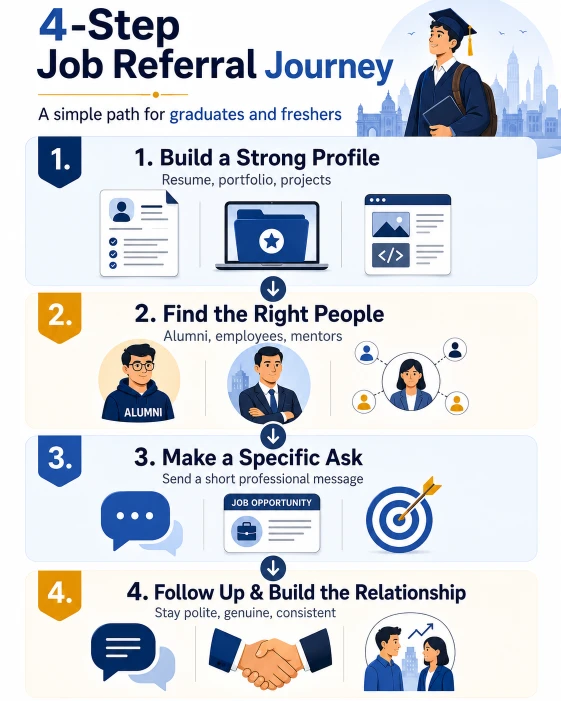
Step 1: build something worth referring before you ask for anyone’s help
This is the step most people skip — and the reason most referral attempts fail.
If your profile is weak, your resume is generic, and you have no projects to show, you are asking someone to stake their professional credibility on a candidate who gives them nothing to work with. Most people will not do that — not because they are unkind, but because it is a genuinely uncomfortable position.
Before reaching out to a single person, make sure your profile can stand on its own. LinkedIn: a specific headline with named skills, an About section explaining what you do, at least one project described with enough specificity that someone thinks “this person can actually do the job.” GitHub if you are in development — at least one live project with a proper README. A campaign portfolio if you are in digital marketing. A documented analysis project if you are in data analytics.
A strong profile does two things: it makes the referral request credible — the person you are asking can look at your work and feel good about forwarding it. And it makes the referral more likely to succeed — because the first thing a recruiter does after receiving it is look you up.
AI Integrated Full Stack Development Training
Master HTML, CSS, JavaScript, React, Node.js, Express.js, MongoDB, REST APIs, and AI-powered development workflows through live coding, practical projects, internship opportunities, and career-focused training.
Step 2: find the right people to reach out to
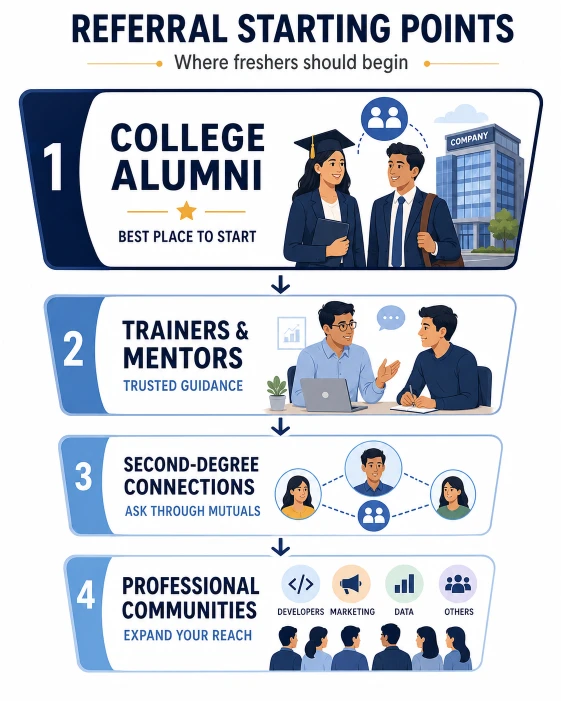
Start close before going far.
Alumni from your college are your highest-probability starting point. An institutional bond immediately reduces social distance. Search your college name on LinkedIn, filter by “People,” and look for alumni in your target companies or domain. These are your first contacts.
Trainers, instructors, and mentors from any program you have completed are next. They know your skills firsthand, are invested in your success, and often have industry networks built over years of practice. A trainer who places a student benefits reputationally — the best ones actively help students make connections.
Second-degree connections at target companies are the next circle. LinkedIn shows you who in your existing network is connected to people at a company you search. A mutual connection provides a natural opening: “I noticed we are both connected to [name] from [context] — I am a full stack developer exploring opportunities at your company and would love a brief conversation.”
Domain communities are often overlooked but effective. LinkedIn groups, Discord servers, Slack communities, and WhatsApp networks for developers, digital marketers, or data professionals have thousands of members who are often willing to help a well-prepared fresher who approaches them thoughtfully.
Step 3: write an outreach message that is easy to say yes to
Most outreach messages fail because they are too long, too formal, too needy, or too vague. All four qualities make it easy for the recipient to feel no urgency to respond.
An effective referral message is short — four to six sentences. Specific — names the company, the role, and one concrete reason you are relevant. Direct — asks for something specific rather than leaving it open-ended. Easy to action — all the person needs to do is say yes or no.
A message that works: “Hi [name], I noticed we are both alumni from [college] and that you work at [company]. I am a full stack developer with experience in React.js and Node.js, and I have been following your company’s product work closely. I recently completed a structured training program and have built three live projects. Would you be open to a 10-minute call, or to passing my profile to your hiring team if you think it is relevant? Happy to share my resume and portfolio.”
Specific, easy to evaluate, small concrete ask. No begging. No overexplaining. Everything the person needs to decide in under two minutes.
Step 4: follow up once, then build the relationship regardless of the outcome
If someone does not respond, follow up once after five to seven days — briefly, without frustration. Most non-responses are not rejections. They are people who got busy.
If someone helps you — whether or not it leads to an interview — thank them specifically and keep the connection alive. Send a brief update when you get an interview. Let them know the outcome. Comment on something they post a month later. These micro-interactions are how a one-time helpful contact becomes a professional relationship that compounds over years.
If someone cannot help for this role, that does not mean they cannot help for the next one. The connection exists. It is worth maintaining.
AI Integrated React Native Mobile App Development Training
Build a job-ready mobile app development profile through practical coding, industry-style projects, AI-assisted workflows, career preparation, mentor-guided learning, real-world app deployment, API integration, and hands-on portfolio development.
How Learn2Earn Labs builds the network foundation before students need it
At Learn2Earn Labs, building the professional infrastructure that makes referrals possible is a structured part of career preparation — not something students figure out alone after training ends.
Students across all programs — Full Stack Web Development, React Native, Digital Marketing, Data Analytics, AI and Data Science, and Business Development — build the profile, projects, and portfolio that make a referral ask credible before they send a single outreach message. The work done during training is exactly what gives a potential referrer something solid to point a hiring manager toward.
Career counselling includes specific guidance on LinkedIn outreach, alumni network activation, and writing referral messages that are professional, specific, and easy to respond to. Students are walked through this systematically — not left to guess.
The alumni network at Learn2Earn Labs — spanning placements at TCS, Accenture, Cognizant, Infosys, and Nagarro — represents professionals who were once in the same position the current batch is in. That network is actively facilitated, connecting current students with alumni in relevant companies to make the referral pathway shorter and more accessible.
With decades of experience shaping careers across technology, marketing, and business, Learn2Earn Labs understands that getting a job is as much about who knows your profile exists as about its quality. Both are built here.
Visit learntoearnlabs.com or write to team@learntoearnlabs.com
Conclusion
Not knowing anyone in the industry is a starting condition, not a permanent one. Every professional who now has a strong network began exactly where you are — with no network at all.
The strategy is not complicated. Build a profile worth referring. Find the people closest to your world who are inside the companies you want to enter. Make a specific, easy, low-pressure ask. Follow up once. Build the relationship regardless of the immediate outcome.
Referrals are not the reward for having connections. They are what happens when a prepared candidate meets an accessible person and makes it easy for them to help.
Be prepared. Be accessible. Make it easy.
Frequently Asked Questions
I would use these questions because they target long-tail search intent while also being easy for Google and AI answer engines to understand.
1. Can I get a job referral if I don’t know anyone at the company?
Yes. You do not need a long-standing personal relationship to get a referral. Start by connecting with college alumni, mentors, second-degree connections, or professionals in relevant communities. A strong profile and a specific, low-pressure request can make someone comfortable forwarding your profile to their hiring team.
2. Who should freshers contact first for a job referral in India?
College alumni are often the best starting point because the shared institutional connection reduces the social distance. After alumni, consider trainers or mentors, second-degree connections at target companies, and members of relevant professional communities. This follows the outreach hierarchy described in the article.
3. What should I include in a LinkedIn referral message?
Keep the message short and specific. Mention how you found the person or what connection you share, identify the company and role, briefly explain your relevant skills or projects, and make a clear request. The article recommends keeping effective outreach concise, direct and easy for the recipient to act on.
4. Should a fresher ask directly for a job referral?
Yes, but only after making sure the profile is strong enough to support the request. Before approaching someone, improve your resume and professional profile and show relevant projects, portfolio work, GitHub work, or other evidence of your skills. That gives the person a credible reason to recommend your profile.
5. How long should I wait before following up on a referral request?
If the person does not respond, follow up once after five to seven days. Keep the follow-up short, polite and pressure-free. If they help you, thank them and maintain the professional relationship even if the referral does not immediately result in an interview.