Home » Career » How to Handle Job Rejection Without Losing Confidence or Momentum

How to handle rejection after rejection without losing confidence or momentum

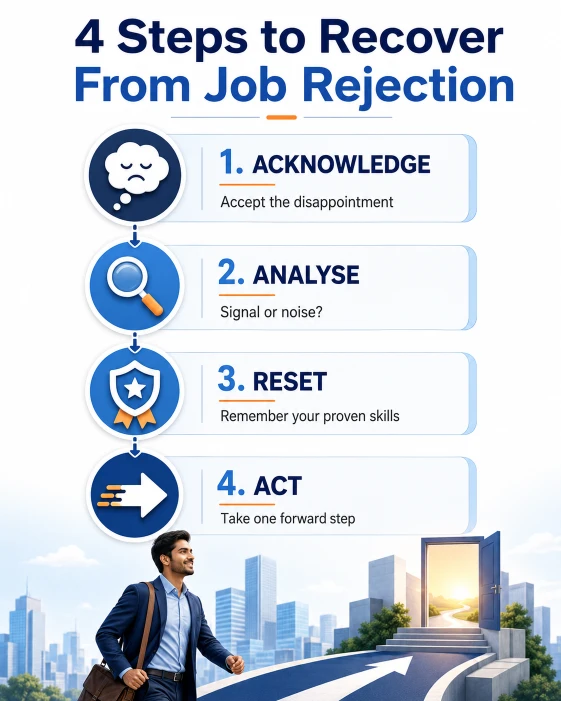
Young professional staying confident and moving forward after job rejection

Nobody warns you how much it actually hurts

You prepared. You applied. You waited. And then the email arrived — or worse, nothing arrived at all — and the opportunity was gone.

Once, that is manageable. Twice, still recoverable. But when it happens five times, ten times — when you have been through months of applications, rounds, and silences with no offer — something starts to shift inside.

It is not just disappointment any more. It is doubt. You begin to question whether the problem is the resume, the interviews, or something deeper. And once that question takes hold, it quietly affects everything: how you write the next application, how you walk into the next interview, how you speak about yourself in the next room.

This is one of the most psychologically demanding experiences in a young professional’s life — and it is almost completely ignored in career advice, which focuses on how to get interviews but almost never on what to do when they keep not working out.

This blog is about that. Not the logistics of job searching — the inner game. How to stay functional, grounded, and moving forward through rejection that would break most people’s momentum entirely.

Learn2Earn Labs AI Integrated Digital Marketing Training banner featuring AI-powered marketing skills, SEO, Google Ads, social media marketing, analytics, automation, practical projects, internship experience, and career-focused learning.

AI Integrated Digital Marketing Training

Build practical skills in SEO, Google Ads, Social Media Marketing, Analytics, Content Marketing, and AI-powered workflows through projects, live classes, internship exposure, and industry-focused learning.

Understanding what rejection is actually telling you

Most candidates interpret rejection as a verdict — a judgment of their value as a professional. That interpretation is understandable when you have invested genuine time and energy. But it is almost always inaccurate.

Rejection from a job process is rarely a clean signal about your capability. It is a messy combination of factors, many having nothing to do with you. The internal candidate who was always going to be prioritised. The role quietly put on hold the day before your final round. The hiring manager who recalibrated the profile mid-search. The other candidate who happened to use one specific tool the team was already running.

None of these reflect on your ability. But they all produce the same outcome: a rejection that feels personal when it is largely situational.

This does not mean ignoring every rejection as meaningless. Some carry useful signal — a technical round where you were clearly unprepared, a communication breakdown, a skill gap you had not acknowledged. These are worth analysing carefully because they point to something actionable.

The distinction to develop is between rejections that contain feedback worth acting on and rejections that are simply noise inherent in a process with many variables beyond your control. Learning to categorise each accurately — and respond differently to each — is one of the most important mental skills you can build in a job search.

What repeated rejection does to your performance — and how to stop it

Rejection does not just affect how you feel. It affects how you perform in the very interviews that follow it.

When confidence is shaken, the effects are specific. You begin self-monitoring in interviews — constantly evaluating how you are coming across instead of simply answering from knowledge. That split attention degrades performance. You hedge more, qualify your answers, apologise for gaps a confident candidate would present as context. You rush — speaking faster, giving less structured answers, cutting off your own reasoning before it lands.

These are performance problems, not knowledge problems. And they are all downstream of a mindset that has absorbed too many rejections without adequate processing.

The way to stop this cycle is not to stop feeling the rejection. It is to build a deliberate practice of processing it after each one — so it does not accumulate as unresolved weight you carry into the next room.

A practical framework for processing each rejection

Do this within 48 hours of every rejection. Not days later when you have already half-buried it, and not in the moment when the emotional response is highest.

Step one: acknowledge it honestly

Do not immediately reframe or suppress it. Allow yourself to feel disappointed. Disappointment is an appropriate response to a genuine investment that did not produce the return you hoped for. Bypassing it does not make it go away — it makes it resurface as anxiety in the next interview.

Step two: extract the signal, discard the noise

Ask three questions. Did this reveal a genuine skill gap? Was there a moment communication broke down, and do I know why? Is there something in my preparation I can improve? If the honest answer to all three is no — you prepared well, communicated clearly, and simply did not get through — log it as noise and release it. If any answer is yes, write it down and make it a preparation task before the next attempt.

Step three: restate what you know to be true

This sounds simple and is frequently dismissed as self-help cliché. It is neither. When rejection accumulates, the narrative running in your head shifts gradually from accurate self-assessment to distorted self-criticism. Deliberately restating what you know about your actual capabilities — the projects you have built, the skills you have developed, the things you can do — counteracts that drift. Not as empty affirmation, but as a factual correction of a narrative that has started to misrepresent you to yourself.

Step four: take one concrete forward action within 24 hours

Not a massive action. One specific, small thing — refine one section of your resume, practise one interview answer out loud, reach out to one person in your network. The action itself is less important than what it does neurologically: it shifts your brain from passive-suffering mode into active-agency mode. Agency is the antidote to helplessness, and helplessness is what repeated rejection produces when it is not actively countered.


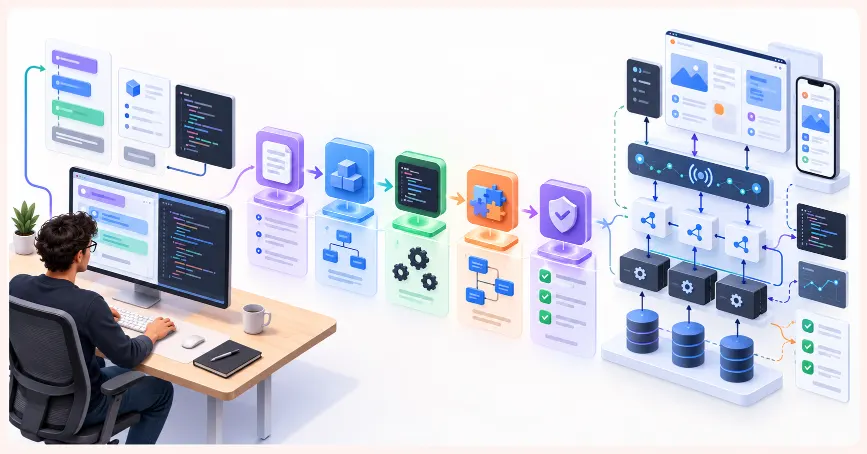
AI Integrated Full Stack Development training with React Node.js MongoDB and AI tools at Learn2Earn Labs

AI Integrated Full Stack Development Training

Master HTML, CSS, JavaScript, React, Node.js, Express.js, MongoDB, REST APIs, and AI-powered development workflows through live coding, practical projects, internship opportunities, and career-focused training.

Protecting your momentum across a long job search

Momentum in a job search is not about applying more. It is about maintaining the quality of your effort over a longer-than-expected timeline.

The candidates who eventually land strong roles after extended searches are rarely the ones who did the most in their most motivated week. They are the ones who maintained consistent, quality effort through the weeks when motivation was lowest.

A fixed, non-negotiable weekly process

Not a goal — a process. “I will apply to five tailored roles, practise two interview answers, and spend one hour updating my portfolio.” Process runs on commitment, which is far more reliable over a long timeline than inspiration.

Set boundaries

Your job search should not consume every hour of every day. When it does, every absence of progress is magnified. Maintain other areas of your life — exercise, relationships, projects you care about. These are not distractions. They are what keeps your capacity functional enough to perform well when an opportunity arrives.

Tracking process, not just outcomes

Resume improved — check. Mock interview done — check. LinkedIn updated — check. Tracking what you control gives you evidence that you are not standing still, even when external results are not yet visible.

Honest conversations with people who know this territory

Isolation amplifies the distortion rejection creates. Talking to a mentor, a peer, or a career counsellor normalises the experience and provides perspective you cannot generate alone when you are inside it.

When to re-examine the strategy rather than just the mindset

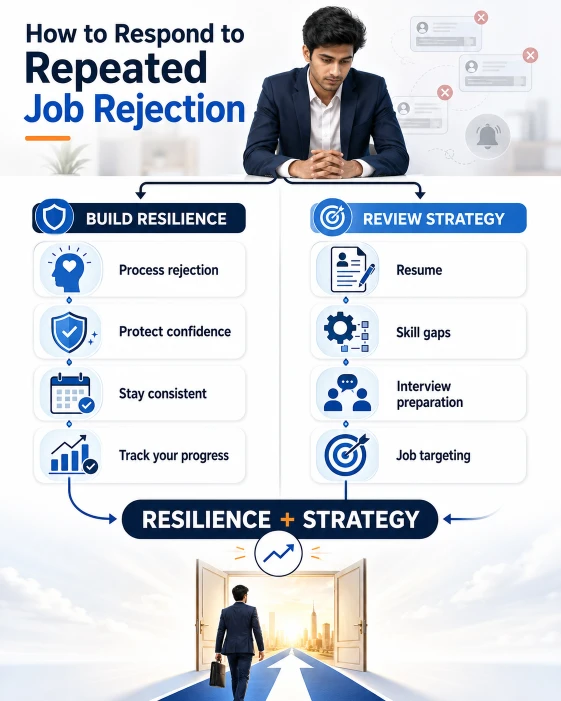
Mindset matters enormously. But there is a point where it is not the right prescription — where the problem is not confidence but strategy.

More than fifteen applications with fewer than three interview calls means the resume and profile need serious review. Consistently failing technical rounds means skill gaps need structured attention. Getting to final rounds but not offers means interview preparation needs to go deeper.

Resilience keeps you going. Strategy determines where you go. Both are necessary, and conflating them leads to the wrong intervention. Know which one you are dealing with — often it is both, operating simultaneously.

Infographic showing when job seekers should build resilience or change their job search strategy
Student learning React Native mobile app development with AI, Expo, APIs, and practical projects at Learn2Earn Labs.

AI Integrated React Native Mobile App Development Training

Build a job-ready mobile app development profile through practical coding, industry-style projects, AI-assisted workflows, career preparation, mentor-guided learning, real-world app deployment, API integration, and hands-on portfolio development.

How Learn2Earn Labs supports students through the full journey — including the hard parts

At Learn2Earn Labs, the understanding that a job search is as much a mental and strategic challenge as a skills challenge is built into how career support works.

Students do not just receive training and then face the market alone. Career counselling at Learn2Earn Labs includes honest, individualised conversations about where a search is going wrong — a resume problem, a preparation problem, a targeting problem, a confidence problem — and specific, structured guidance on fixing it.

The mock interview process is designed partly for skill development and partly for the kind of pressure-exposure that builds genuine resilience. Students who have already faced difficult mock rounds and come through them enter real interviews with a composure that candidates who have only studied can rarely access.

Career counsellors at Learn2Earn Labs have worked with students across every kind of search difficulty — extended timelines, repeated rejections, skill gaps larger than expected, confidence that needed rebuilding from a low point. The guidance is not generic encouragement. It is specific, grounded, and based on decades of real experience with what works in India’s job market.

With alumni placed at TCS, Accenture, Cognizant, Infosys, and Nagarro — many of whom went through extended, difficult searches before landing — Learn2Earn Labs brings the full picture of what the journey looks like, not just the highlight reel.

Visit learntoearnlabs.com or write to team@learntoearnlabs.com

Conclusion

Rejection in a job search is not a sign that you are wrong for the roles you are pursuing. It is a sign that you are in a process — a real, difficult, often unpredictable process — that asks more of you than you might have expected when you started.

The people who come through it with their confidence and momentum intact are not the ones who never doubted. They doubted. They just built practices that prevented the doubt from settling into permanence.

Process the rejection. Extract what is useful. Discard what is not. Protect your momentum. Stay in the room.

The offer is not a matter of whether. It is a matter of when — and when is determined, more than almost anything else, by whether you keep going at the quality you are capable of, even on the days when the evidence does not yet agree with you.

Frequently Asked Questions

1. How do you handle repeated job rejection?

Acknowledge the disappointment, review each rejection for useful feedback, identify anything you can improve, and then take one concrete step toward your next opportunity. The goal is not to ignore rejection but to prevent it from negatively affecting your next application or interview.

2. How can I stay confident after multiple job rejections?

Focus on evidence of your actual abilities rather than treating rejection as a judgment of your professional value. Review the projects you have completed, skills you have developed and problems you can solve. Continue improving areas where genuine gaps exist while recognizing that hiring decisions can also involve factors outside your control. The article specifically distinguishes useful feedback from situational “noise.”

3. Why does repeated job rejection affect interview performance?

Repeated rejection can reduce confidence and cause candidates to overthink their performance during interviews. This may lead to rushed answers, unnecessary hesitation, excessive qualification of answers or difficulty communicating knowledge clearly.

4. When should I change my job search strategy?

Review your strategy when you repeatedly struggle at the same stage of the hiring process. Few interview invitations may indicate that your resume, profile or job targeting needs improvement, while repeated technical-round difficulties can point to skill gaps. Reaching final rounds without converting them into offers may indicate a need for deeper interview preparation.

5. How can I maintain momentum during a long job search?

Create a consistent weekly process based on activities you can control, such as applying to carefully selected jobs, practising interview questions, improving your portfolio and strengthening your professional profile. Track these actions rather than measuring progress only by job offers.

Leave a Reply