How Prompt Engineering Can Improve a Developer’s Career and Salary Potential
Table of Contents
ToggleThe salary gap between two developers who look identical on paper is quietly widening. Here is what is causing it.
Two developers. Same college. Same graduation year. Roughly the same technical stack. Both applied to the same company six months ago.
One got ₹6.5 LPA. The other got ₹9 LPA.
The difference was not a better CGPA, an extra certification, or a more impressive college name. The difference was a technical discussion in the interview where one candidate demonstrated that they could work with AI tools in a way that made them significantly more productive from day one — and the other could not.
The first candidate knew how to code. The second knew how to code and how to direct AI to help them code better, faster, and with fewer errors. In the current market, these are no longer equivalent skills. The gap between them is measurable, growing, and showing up most visibly in the salary packages companies are willing to offer.
This blog explains exactly why prompt engineering has become a salary-differentiating skill, what companies are actually paying for, and what this means for any developer still treating it as optional.
AI Integrated Digital Marketing Training
Build practical skills in SEO, Google Ads, Social Media Marketing, Analytics, Content Marketing, and AI-powered workflows through projects, live classes, internship exposure, and industry-focused learning.
What changed in the industry — and when
The debate about whether AI would replace developers is over. The question every developer now faces is whether they are on the side of the change that benefits them or the side that does not.
AI coding tools — GitHub Copilot, ChatGPT, Cursor, Amazon CodeWhisperer — became genuinely useful for production-grade work. Not just simple scripts, but complex debugging, API design, test generation, and documentation. Companies noticed and started expecting their developers to use them.
Then something more consequential happened. Companies noticed a significant performance gap between developers who used these tools well and those who did not. A developer who wrote structured, context-rich prompts generated usable code far faster than one who typed vague requests and got mediocre output. The productivity delta became visible — in sprint velocity, in code review cycles, in time-to-deployment.
Once visible, companies began screening for it. Once companies screen for something, the market prices it.
What prompt engineering actually looks like in a developer’s salary negotiation
Salary is shaped by perceived value. The question a company answers when deciding your package is: what is this developer worth, and what would it cost to lose them?
A developer who demonstrates — not claims — that they work at a meaningfully higher output rate because of how they use AI has changed that calculation. They are not one of ten equivalent developers at that experience level. They are one of the few who will actually deliver more from week one.
This is what prompt engineering does to salary negotiation. It shifts a developer from “adequate” to “distinctly valuable” — in a market where adequate developers are abundant and distinctly valuable ones are actively sought.
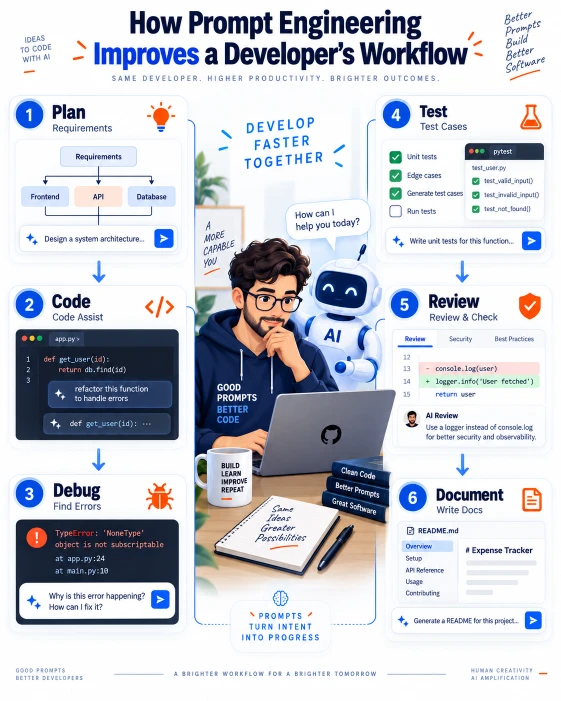
In a technical interview, a candidate who describes a workflow that includes prompting AI for architecture suggestions, generating test cases, directing code reviews for security vulnerabilities, and critically evaluating all output before integrating it — is demonstrating something most candidates cannot. They are showing both the code and the meta-skill of directing AI productively. That combination earns the premium.
The productivity multiplier and why companies pay for it
If a developer without AI fluency ships a medium-complexity feature in five days, and one with strong prompt engineering skills ships the same feature in three days — the second developer is delivering roughly 40 percent more output per week at the same fixed cost.
That advantage translates into fewer hours on boilerplate code, faster debugging cycles, better-documented APIs, more thorough test coverage, and faster onboarding to new codebases.
Paying a developer 15 to 20 percent more in salary to get 40 percent more output is not a difficult decision for any company. It is straightforward value arithmetic. As product companies and funded startups — where developer productivity directly impacts delivery speed — have internalised this, the salary premium for AI-fluent developers has become a consistent feature of the market.
This is not yet uniform across every company in India. Large IT services firms are slower to price it. But product companies, startups, digital agencies, and the remote-first job market are pricing it actively — and these are increasingly where the most desirable roles live.
AI Integrated Full Stack Development Training
Master HTML, CSS, JavaScript, React, Node.js, Express.js, MongoDB, REST APIs, and AI-powered development workflows through live coding, practical projects, internship opportunities, and career-focused training.
Specific ways prompt engineering creates measurable value in development
The salary premium is not abstract. It comes from specific, measurable improvements in how work gets done.
Faster feature development.
A developer who knows how to prompt AI with full context — the existing codebase architecture, the specific requirements, the constraints, the expected edge cases — generates code that requires significantly less rework than one who prompts vaguely and patches the output manually. The code review cycle shortens. The deployment happens sooner.
Better debugging at lower cost.
Debugging is one of the most time-intensive parts of development. A developer who can construct a precise debugging prompt — including the error, the relevant code, the expected behaviour, the actual behaviour, and the environment — extracts targeted diagnostic help rather than generic suggestions. Issues that might take two hours to isolate manually get resolved in twenty minutes.
Higher quality documentation and tests.
Two of the most universally neglected parts of professional development work. A developer who uses structured prompts to generate documentation from existing code, and test cases that cover edge cases they might not have thought of manually, produces significantly more professional output without significantly more time. This is noticed in code reviews. It is noticed in production.
Faster onboarding to new codebases.
When a developer joins a new project or company, the time spent understanding an unfamiliar codebase is significant. AI prompts that summarise code structure, explain design patterns, and surface dependencies reduce that ramp-up period substantially. A developer who onboards in two weeks instead of four has already justified part of their salary premium.
Reduced dependency on senior developers for routine guidance.
Junior and mid-level developers who use prompt engineering effectively become more self-sufficient — because they can direct AI to explain patterns, suggest approaches, and review logic in ways that previously required escalation to a senior. This makes them more valuable to the team and more attractive to hire.
Why most developers are still not doing this
The most common answer to why most developers are not building this skill is: “I use ChatGPT sometimes. I know how it works.”
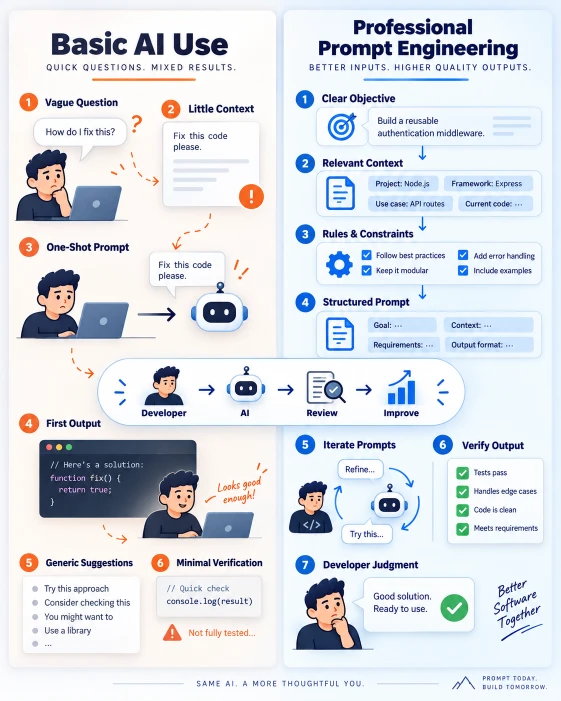
Using ChatGPT to ask a vague question and accept what comes back is not prompt engineering. It is the equivalent of knowing how to type a Google search and calling it research skills. Structuring prompts with full context, iterating when the first output misses, chaining prompts for complex problems, evaluating output critically — these require deliberate study and consistent practice.
Most developers treat it casually. The ones who treat it as a genuine professional skill are building the salary premium.
The second reason: prompt engineering is not yet taught in most college curricula or training programs. The educational infrastructure has not caught up to market reality. Developers who do not seek it out deliberately are unlikely to encounter it.
This is a significant opportunity — the market is pricing a skill the educational system is not yet systematically producing.
AI Integrated React Native Mobile App Development Training
Build a job-ready mobile app development profile through practical coding, industry-style projects, AI-assisted workflows, career preparation, mentor-guided learning, real-world app deployment, API integration, and hands-on portfolio development.
How Learn2Earn Labs integrates prompt engineering into developer training
At Learn2Earn Labs, prompt engineering is not a standalone module added to the end of a development curriculum. It is integrated into every stage of the Full Stack Web Development and React Native Mobile App Development programs from the beginning.
Students learn to use AI tools — ChatGPT, GitHub Copilot, and others — as active collaborators in their development workflow. Not to replace their thinking, but to extend it. They learn how to write context-rich prompts for code generation, how to use AI for debugging and code review, how to evaluate AI output critically, and how to use prompt chaining for complex, multi-step development tasks. Every one of these skills is practised on live projects — not on isolated exercises — so students graduate with genuine, demonstrated fluency.
The result is graduates who, when asked in an interview to describe how they approach building a feature, can walk through an AI-integrated workflow that demonstrates exactly the kind of productivity multiplier that companies are currently paying a premium for.
Career counselling at Learn2Earn Labs specifically prepares students to communicate this skill in interviews — because knowing how to use AI tools and knowing how to demonstrate that value to a hiring manager are two different things. Both matter. Both are built here.
With alumni placed at TCS, Accenture, Cognizant, Infosys, and Nagarro, and with decades of experience preparing developers for India’s job market, Learn2Earn Labs understands where the salary premium is being earned and builds every student’s profile toward that standard.
If you are a developer who wants to build the skills that translate into measurably better salary outcomes — not just better code — speak with the team at Learn2Earn Labs.
Visit learntoearnlabs.com or write to team@learntoearnlabs.com
Conclusion
The salary gap between developers who use AI fluently and those who do not is not closing. It is widening — as the companies that understand the productivity value of AI fluency compete more aggressively for the developers who have it.
Prompt engineering is not a future skill. It is a present one — already being screened for, already being priced, already separating the developers who are winning in this market from the ones who are waiting to see how things develop.
The developers earning the better packages right now are not necessarily the most technically brilliant in their cohort. They are the ones who understood that the way developers work changed — and changed their approach accordingly.
That is all it takes. Understand the change. Build the skill. Show the value.
Frequently Asked Questions
1. What is prompt engineering for software developers?
Prompt engineering for software developers is the practice of giving AI tools clear goals, technical context, requirements, constraints, code examples, and expected outputs so they can provide more useful assistance with tasks such as coding, debugging, testing, documentation, architecture, and code review.
2. Can prompt engineering help developers earn a higher salary?
Prompt engineering does not guarantee a higher salary, but strong AI-assisted development skills can increase a developer’s productivity and professional value. Developers who can demonstrate faster problem-solving, effective AI workflows, critical evaluation, and better output may strengthen their position in interviews and salary negotiations.
3. How can developers use prompt engineering in their daily work?
Developers can use prompt engineering for architecture planning, code generation, debugging, test-case creation, documentation, code reviews, security checks, understanding unfamiliar codebases, and exploring alternative solutions. The key is providing sufficient context and verifying the AI’s output before using it.
4. Is using ChatGPT the same as knowing prompt engineering?
No. Simply asking ChatGPT occasional questions is different from professional prompt engineering. Effective prompting involves defining objectives, providing relevant context, specifying constraints, iterating on responses, chaining prompts for complex tasks, and critically evaluating the generated output.
5. What prompt engineering skills should developers learn?
Developers should learn how to provide context, define requirements and constraints, structure complex prompts, break problems into smaller steps, iterate on outputs, use prompt chaining, validate generated code, identify AI errors, and integrate AI assistance without replacing their own technical judgment.