Home » Prompt Engineering » How Prompt Engineering Is Taught Inside Learn2Earn Labs’ Full Stack Programs

How Prompt Engineering Is Integrated into Full Stack Developer Training

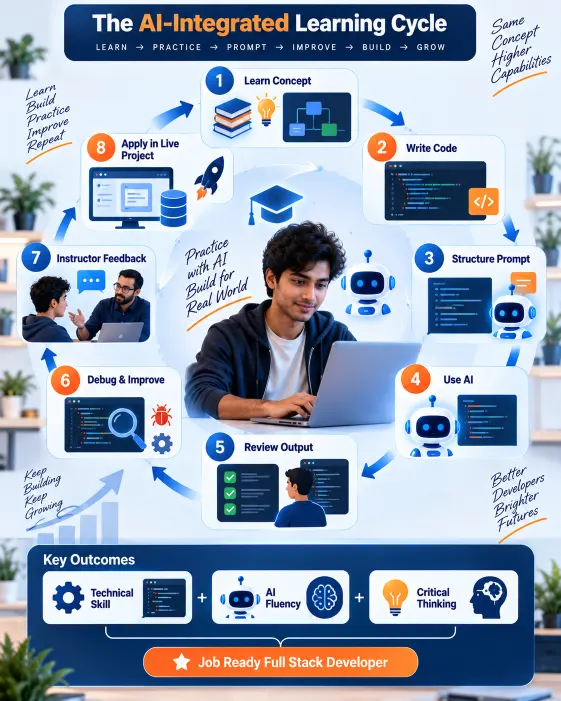
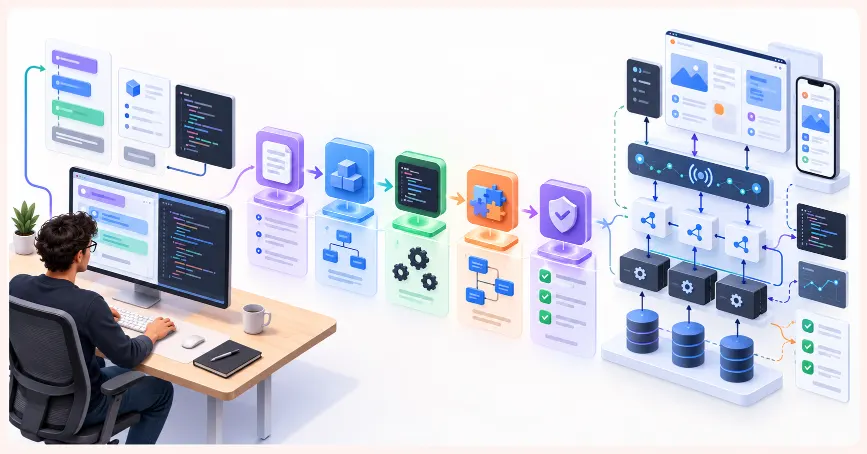
Student learning full stack development with AI prompting, coding, debugging and instructor feedback

A look inside what most training programs are afraid to show you

Every training institute in India currently claims AI-integrated curriculum. Landing pages, brochures, admission conversations — the claim is everywhere.

So here is the question worth asking: if you enrolled tomorrow, what would you actually do on day one that involves AI? How would your instructor evaluate whether your AI skills are developing? When you submit a feature for review, does anyone check how you used AI to build it — or only whether the code works?

Most institutes cannot answer these questions specifically. Not because they are hiding something — because there is nothing specific to describe. The “AI integration” is a session. Maybe two. A module that runs separately from the main curriculum rather than through it.

This blog describes, specifically and honestly, how prompt engineering is actually taught inside the Full Stack Web Development program at Learn2Earn Labs — what students do, how they are evaluated, and what a graduate who has gone through this process looks like when they enter the job market.

If you are evaluating training programs, this is the level of specificity you should be demanding from every option you consider.

Learn2Earn Labs AI Integrated Digital Marketing Training banner featuring AI-powered marketing skills, SEO, Google Ads, social media marketing, analytics, automation, practical projects, internship experience, and career-focused learning.

AI Integrated Digital Marketing Training

Build practical skills in SEO, Google Ads, Social Media Marketing, Analytics, Content Marketing, and AI-powered workflows through projects, live classes, internship exposure, and industry-focused learning.

Why the approach is built differently from the ground up

Companies hiring developers today — particularly product companies and funded startups — are not looking for developers who have heard of GitHub Copilot. They want developers who use it as part of how they work: writing prompts that produce production-appropriate output, evaluating AI-generated code critically, and describing their AI workflow in an interview with the same confidence they bring to their technical stack.

Building that capability requires more than adding an AI module to an existing curriculum. It requires rethinking how the entire learning process works — so that AI is not something students learn about but something they practise with, from the first exercise to the last project.

That rethinking is what the Learn2Earn Labs full stack curriculum is built around.

How it actually starts: week one, before the complexity begins

The prompt engineering foundation begins in week one — not week six, not as a bonus module at the end, but on the same days students are writing their first routes and components.

The timing is deliberate. Habits formed in the first week of a learning program are the hardest to change and the most durable. A student who begins using AI as part of every development task builds an integrated workflow that carries through the entire program. One who encounters AI only after establishing a “write it manually first” habit is far harder to retrain.

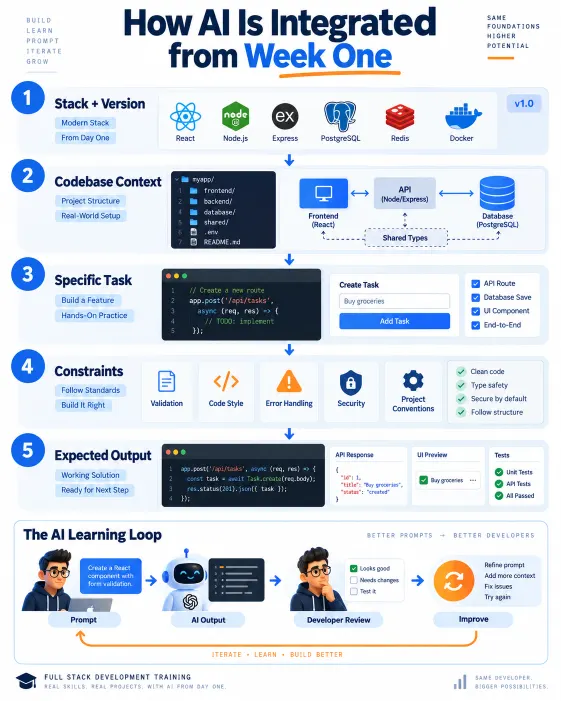
In week one, students are introduced to the five-element prompt structure that underpins every AI interaction in the program: technology stack and version, existing codebase context, the specific task, constraints that must be respected, and expected output format.

This is not taught as a framework to memorise. When a student writes their first Express.js route, they simultaneously write a prompt for that route — including the framework version, error handling pattern, response format convention, and constraints. They then compare what the AI produced with what they would have written independently. The instructor facilitates a discussion: where did the prompt produce better output? Where did it fall short? What element of the prompt caused the AI to make assumptions?

This first exercise establishes two things simultaneously: the working habit of using AI as part of development, and the critical evaluation instinct — the ability to assess output rather than simply accept it — that distinguishes a developer who uses AI well from one who uses it carelessly

Why the approach is built differently from the ground up

Companies hiring developers today — particularly product companies and funded startups — are not looking for developers who have heard of GitHub Copilot. They want developers who use it as part of how they work: writing prompts that produce production-appropriate output, evaluating AI-generated code critically, and describing their AI workflow in an interview with the same confidence they bring to their technical stack.

Building that capability requires more than adding an AI module to an existing curriculum. It requires rethinking how the entire learning process works — so that AI is not something students learn about but something they practise with, from the first exercise to the last project.

That rethinking is what the Learn2Earn Labs full stack curriculum is built around.

How it actually starts: week one, before the complexity begins

The prompt engineering foundation begins in week one — not week six, not as a bonus module at the end, but on the same days students are writing their first routes and components.

The timing is deliberate. Habits formed in the first week of a learning program are the hardest to change and the most durable. A student who begins using AI as part of every development task builds an integrated workflow that carries through the entire program. One who encounters AI only after establishing a “write it manually first” habit is far harder to retrain.

In week one, students are introduced to the five-element prompt structure that underpins every AI interaction in the program: technology stack and version, existing codebase context, the specific task, constraints that must be respected, and expected output format.

This is not taught as a framework to memorise. When a student writes their first Express.js route, they simultaneously write a prompt for that route — including the framework version, error handling pattern, response format convention, and constraints. They then compare what the AI produced with what they would have written independently. The instructor facilitates a discussion: where did the prompt produce better output? Where did it fall short? What element of the prompt caused the AI to make assumptions?

This first exercise establishes two things simultaneously: the working habit of using AI as part of development, and the critical evaluation instinct — the ability to assess output rather than simply accept it — that distinguishes a developer who uses AI well from one who uses it carelessly.


Infographic showing stack, context, task, constraints and output in prompt engineering training
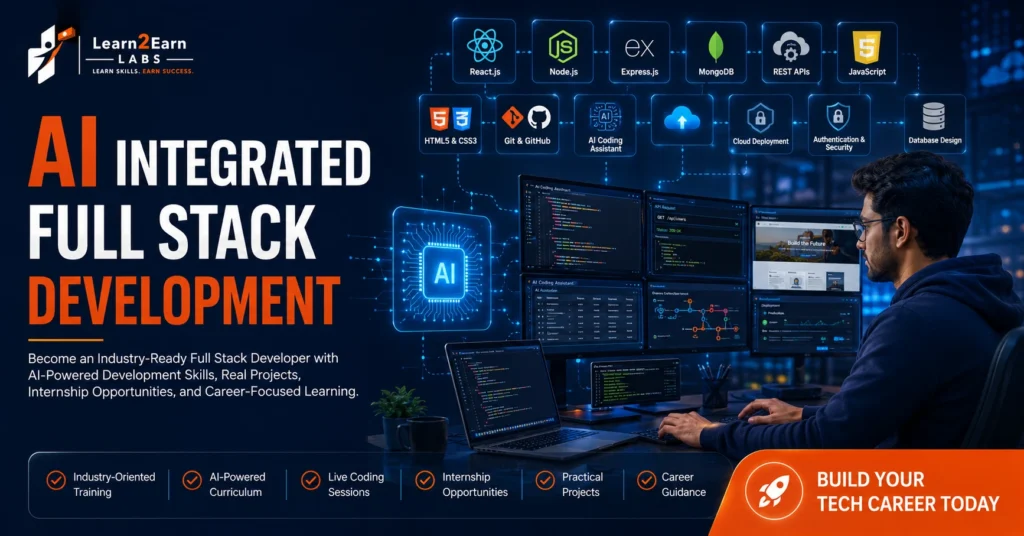
AI Integrated Full Stack Development training with React Node.js MongoDB and AI tools at Learn2Earn Labs

AI Integrated Full Stack Development Training

Master HTML, CSS, JavaScript, React, Node.js, Express.js, MongoDB, REST APIs, and AI-powered development workflows through live coding, practical projects, internship opportunities, and career-focused training.

The part most programs skip entirely: reviewing prompts alongside code

When a student submits a feature for instructor review at Learn2Earn Labs, the submission includes two things: the code, and the prompts used to build it.

The instructor does not just evaluate whether the code works. They evaluate prompt quality — whether the student provided adequate context, whether constraints were well-defined, whether the subsequent evaluation and editing of AI output demonstrates genuine understanding.

A vague prompt that produced generic code requiring heavy rewriting is reviewed very differently from a well-structured prompt that produced directly useful output requiring minimal adjustment. Both teach the student something, but the feedback and the trajectory of improvement are different.

This creates something that unmonitored AI practice never does: accountability for how well you are using the tool, not just whether you are using it. Students see their prompt quality improving across weeks of the program — in the same way they see their code quality improving — because it is evaluated alongside their code, not treated as invisible.

It also prevents the most damaging outcome of unsupervised AI use in training: students who accept output without understanding it, who produce work they cannot explain, and who graduate with credentials that overstate their actual ability. At Learn2Earn Labs, a student cannot graduate without being able to explain everything in their codebase — regardless of whether a human or an AI first wrote it.

Debugging with AI: where the deepest learning happens

Debugging reveals the most about how a developer actually thinks. It is also the context in which prompt engineering practised properly produces its most significant and least expected learning outcomes.

When a student encounters a bug in a live project, the first step is not to ask the instructor. It is to construct a structured debugging prompt — error message, relevant code, expected behaviour, actual behaviour, and what has already been attempted — and work through the AI-assisted diagnostic process before escalating.

What students consistently discover: they often understand the problem before the AI responds. The act of articulating the error clearly — what is happening, what should be happening, what has already been ruled out — frequently surfaces the solution independently, because explaining something precisely forces the kind of structured thinking that leads directly to a diagnosis.

The habit of completely articulating a problem before seeking external help — whether from AI or from a human instructor — makes students faster at debugging independently, not more dependent on assistance. This is one of the counterintuitive benefits of structured prompt engineering in a training context.

Live projects and capstone work: AI as a genuine collaborator

Capstone projects — live, deployed applications built during the program — are where everything comes together and prompt engineering is tested under conditions that genuinely resemble professional work.

Students build using AI throughout: architectural discussion, boilerplate generation they understand and extend, pre-submission code review, documentation, test case generation. AI is not a shortcut. It is a collaborator that accelerates work without replacing thinking.

The standard expected of capstone work reflects this explicitly. AI-assisted development is held to a higher bar than purely manual development — the expectation is that proper AI collaboration should produce more features, cleaner architecture, more thorough documentation, and broader test coverage. A student who uses AI well delivers more. One who uses it carelessly delivers less. This is made explicit in assessment.

Instructor review of capstone submissions includes direct conversation about the AI-integrated process: how key prompts were structured, what was changed in the AI output and why, what was not used from AI suggestions and why. A student who cannot walk through these questions confidently has not used AI the way the program teaches. One who can — speaking with specificity and genuine ownership about how AI contributed to and was shaped by their judgment — has built exactly the fluency the market is looking for.

Infographic showing coding, prompting, AI review, debugging, feedback and live projects in full stack training
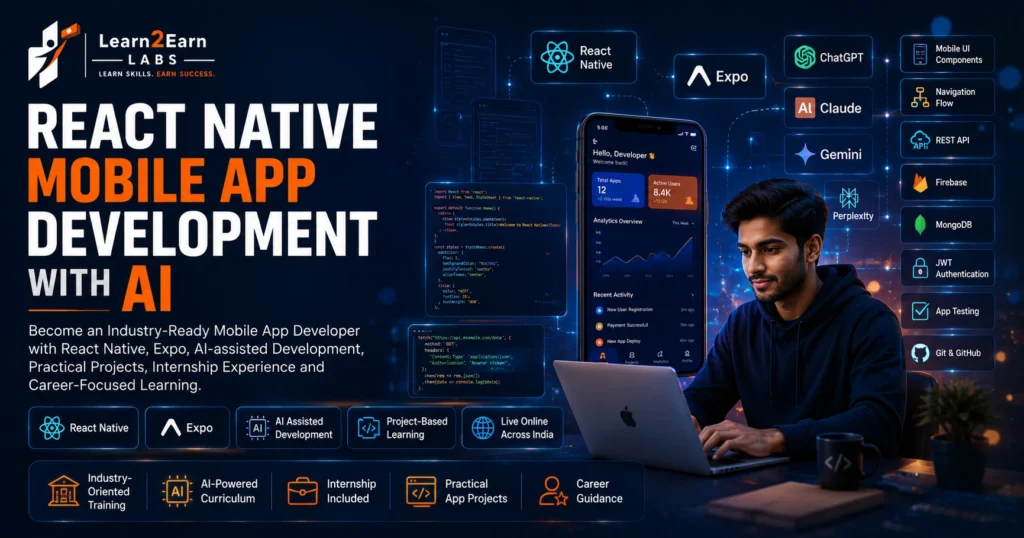
Student learning React Native mobile app development with AI, Expo, APIs, and practical projects at Learn2Earn Labs.

AI Integrated React Native Mobile App Development Training

Build a job-ready mobile app development profile through practical coding, industry-style projects, AI-assisted workflows, career preparation, mentor-guided learning, real-world app deployment, API integration, and hands-on portfolio development.

Preparing to show it in the interview room

Having genuine prompt engineering fluency is one thing. Demonstrating it credibly under interview conditions is another.

Career counselling at Learn2Earn Labs specifically prepares students for the growing number of interviews — at product companies, startups, and technology-forward organisations — that now include questions about how a candidate works with AI. These range from “describe your AI-integrated development workflow” to practical demonstrations where the candidate shows their approach in real time.

Students practise articulating their workflow: how they structure prompts, how they evaluate AI output, where they trust AI judgment and where they override it, and how AI contributed to specific portfolio projects. This ensures the genuine fluency built during training converts cleanly into interview performance — and into the salary premium and shortlist advantage that AI-fluent developers are consistently earning right now.

What the graduate looks like

A student who completes the program has not just learned to build applications. They have learned to build them the way the industry now builds them — with AI as an active, structured part of every development decision.

They arrive at their first job knowing how to write prompts that produce relevant output for a specific codebase. They evaluate AI output critically before integrating it. They debug with AI in a way that accelerates their own thinking. They talk about their workflow in interviews with specificity and confidence.

They know all of this because they have been practising it, receiving feedback on it, and improving it across every week of the program — not because they attended a session that told them it mattered.

With alumni placed at TCS, Accenture, Cognizant, Infosys, and Nagarro, and with decades of experience preparing developers for India’s job market, Learn2Earn Labs has built this approach through direct observation of what the market demands — and what training genuinely produces it.

If you want to learn full stack development the way the industry currently works — with AI built into how you learn, not added on at the end — speak with the team at Learn2Earn Labs.

Visit learntoearnlabs.com or write to team@learntoearnlabs.com

Conclusion

The programs producing genuinely job-ready developers are not the ones that added an AI session to an existing curriculum. They are the ones that rebuilt how learning happens so that AI fluency develops the same way technical skill develops — through practice, feedback, and increasing complexity over time.

That is not a module. That is a method.

And when a graduate sits across from a hiring manager and walks through how they actually work — the difference is immediately, unmistakably visible.

Frequently Asked Questions

1. What is prompt engineering training for developers?

Prompt engineering training for developers teaches them how to give AI tools clear technical context, requirements, constraints, codebase information, and expected outputs. The goal is to use AI more effectively for coding, debugging, testing, documentation, architecture, and code review while still understanding and validating the generated output.

2. How is prompt engineering integrated into full stack training?

Prompt engineering can be integrated directly into coding exercises, debugging, project work, code reviews, testing, and documentation. Instead of learning AI in a separate module, students use structured prompts alongside their regular development tasks and receive feedback on both the code and the quality of their AI interaction.

3. Why should students learn prompt engineering alongside coding?

Learning prompt engineering alongside coding helps students practise how to describe technical problems clearly, provide relevant context, identify constraints, evaluate generated code, and improve solutions. These habits can strengthen both AI fluency and technical problem-solving skills.

4. How can AI be used for debugging in full stack development?

Developers can use AI for debugging by providing the exact error message, relevant code, expected behaviour, actual behaviour, environment details, and previous troubleshooting 5: Should AI-generated code be reviewed by developers?

5. Should AI-generated code be reviewed by developers?

Yes. AI-generated code should always be reviewed, tested, and understood before being used in a project. Developers should check whether the code matches the existing architecture, security requirements, coding standards, error handling patterns, and business logic.