Home » Career » What Recruiters Actually Look for in the First 10 Seconds of Your Resume

Title Goes From Here

Recruiter reviewing a job candidate resume during the initial screening process

Ten seconds. That is all you get.

Not a minute. Not three minutes. Not the careful read you imagined when you spent four hours formatting that document.

Research consistently shows that recruiters make their first pass-or-reject decision on a resume in six to ten seconds. In that window, they are not reading — they are scanning, moving through the page in a specific, predictable pattern, looking for specific signals, and making a judgment faster and more instinctively than most candidates ever realise.

This is not cynical. It is practical. A recruiter handling 200 applications for a single role cannot spend five minutes on each one. The ten-second scan is a professional filter that identifies the small number of resumes worth reading carefully from the large number that are not.

The scan is not random. It follows a pattern. It looks for specific things in specific places. Once you know that pattern, you can build your resume to work with it — so that in those ten seconds, the recruiter finds exactly what they need, exactly where they expect it.

This blog tells you precisely what happens in those ten seconds, what causes an immediate reject, and what earns the next thirty seconds that most candidates never get.

Learn2Earn Labs AI Integrated Digital Marketing Training banner featuring AI-powered marketing skills, SEO, Google Ads, social media marketing, analytics, automation, practical projects, internship experience, and career-focused learning.

AI Integrated Digital Marketing Training

Build practical skills in SEO, Google Ads, Social Media Marketing, Analytics, Content Marketing, and AI-powered workflows through projects, live classes, internship exposure, and industry-focused learning.

The eye-tracking pattern: where recruiters look and in what order

Eye-tracking studies — including research by LinkedIn — consistently show that a recruiter’s eye follows a predictable path across a resume.

The first point of focus is the top third of the page. Within that third, the eye moves in an approximate F-pattern: across the name and contact line, down the left side, and across again wherever a heading or bold element draws attention.

What this means practically: the top third of your resume — name, headline, professional summary, and the opening of your skills section — is doing 80 percent of the work. The rest of the page is what a recruiter reads when the top third has already earned their attention.

If the top third is weak, generic, or visually cluttered, the recruiter moves on. The well-described project on page two never gets seen.

Your resume is not read top to bottom. It is scanned top to left, privileging the beginning and the left margin above everything else. That single insight should change almost every decision you make about what goes where.

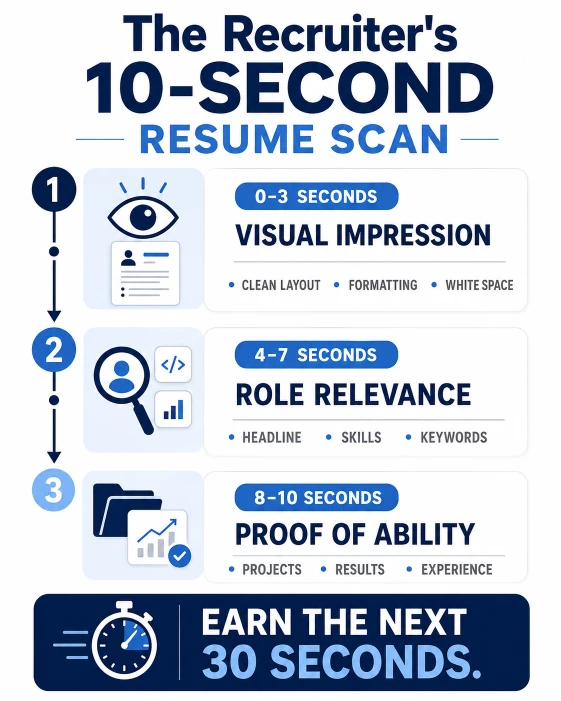
What happens in the first three seconds

The first three seconds are purely visual. The recruiter has not read a single word. They are forming an impression of the document itself — and that impression shapes everything that follows.

What they register: whether the document looks clean and professional or cluttered and hard to read, whether the formatting is consistent, whether there is enough white space to make the content navigable.

A resume with dense text blocks, inconsistent fonts, and a colour scheme that belongs on a creative portfolio creates immediate cognitive friction. The recruiter’s brain registers “effort required” before a single line is read — and in a stack of 200 applications, effort is a reason to move on.

A clean resume — single column, consistent font, clear headings, appropriate white space, saved as a PDF — removes that friction entirely. It signals competence before the recruiter has absorbed a single fact about you.

Formatting is not a cosmetic decision. It is a first-impression decision. And first impressions happen before the words begin.

What happens in seconds four through seven

Now the recruiter begins to read — but not your most recent job or your projects. They read your name and your headline.

Your name confirms they have the right document. Your headline is the first actual content they process — and it either immediately answers “is this person relevant to this role?” or it does not.

“B.Tech Computer Science | 2024 Graduate | Looking for Opportunities” answers nothing useful. Both facts are already on the resume. The most valuable piece of real estate on the page has been wasted.

“Full Stack Developer | React.js | Node.js | MongoDB | Open to Junior Developer Roles” answers the question immediately. The recruiter knows what you do, what you use, and what role you want — in under three seconds of reading.

After the headline, the eye drops to the skills section or the first project entry. The recruiter scans for two things: relevance and specificity.

“Good at communication and teamwork” is filler — every resume says it and it registers as nothing. “Built a full stack inventory management system using React.js, Node.js, Express, and MongoDB — deployed on Render with role-based access for three user types” is specific, verifiable, and immediately impressive. The difference in how those two things land in the four-to-seven second window is enormous.


Recruiter reviewing a job candidate resume during the initial screening process
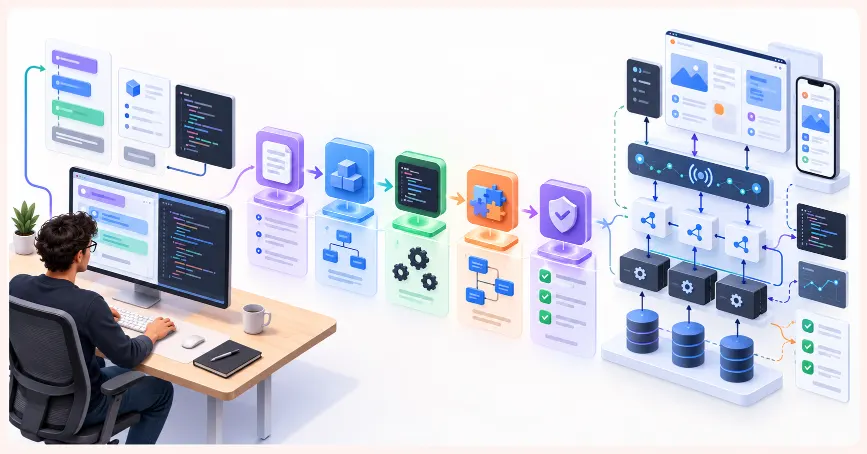
AI Integrated Full Stack Development training with React Node.js MongoDB and AI tools at Learn2Earn Labs

AI Integrated Full Stack Development Training

Master HTML, CSS, JavaScript, React, Node.js, Express.js, MongoDB, REST APIs, and AI-powered development workflows through live coding, practical projects, internship opportunities, and career-focused training.

What causes an immediate reject in the first ten seconds

Certain things on a resume produce an almost reflexive rejection before the recruiter has consciously decided to move on. These are the patterns that experienced recruiters have seen enough times that they register as red flags without requiring careful analysis.

A generic or vague headline

As discussed above, this signals immediately that the candidate either does not know how to present themselves or has not thought about the reader’s experience. Either interpretation is unfavourable.

Walls of text with no visual hierarchy

Dense paragraphs, bullet points running four to five lines, no clear section separation — these create an immediate “this will take too long” signal.

Unexplained gaps or timeline inconsistencies

A recruiter scanning dates quickly will notice a two-year gap. They will not investigate — they will move to the next resume. Gaps need to be contextualised on the resume itself, not saved for the interview.

Obvious formatting issues

A resume that looks different on different screens or that has clearly been assembled from a template without adjusting the placeholder content — incomplete sections, default fonts mixing inconsistently, leftover template text — signals carelessness in a way that immediately undermines the candidate’s credibility.

Contact information that is incomplete or unprofessional

A missing phone number, a missing LinkedIn URL, or an email address that looks like it was created at age fourteen sends a small but distinct signal about the candidate’s level of professional awareness.

Nothing in the top third that earns continued reading

This is the most common and most expensive mistake. A resume that buries its best information — a strong project, a relevant certification, a notable skill — below the fold is a resume that never gets to that information. If the top third does not compel continued reading, the rest of the page is irrelevant.

What makes a recruiter slow down and read carefully

The transition from scanning to reading happens when the top third produces enough positive signals to justify more time.

A recruiter slows down when they see a headline that matches the role, skills from the job description, and at least one specific piece of evidence — a project, a result — that shows the candidate can actually do the work, not just describe it.

All three need to be visible in the first third of the page without scrolling.

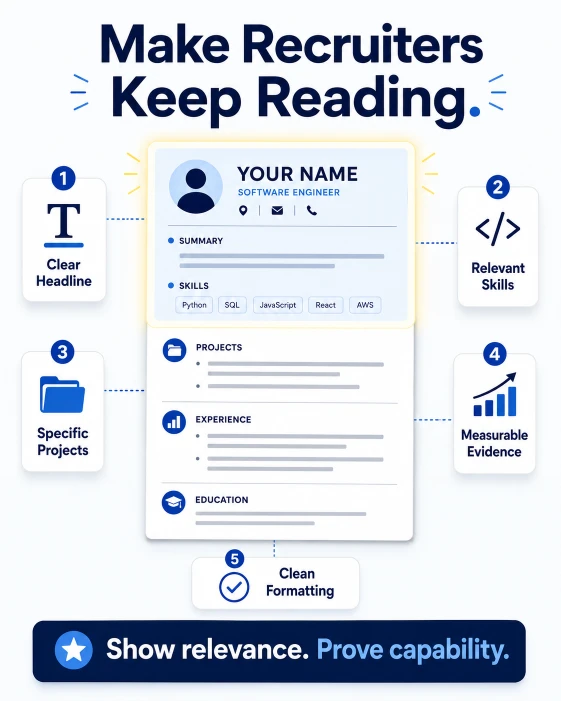
This is why a fresher resume should be structured: name and contact at the top, a specific headline, a two-to-three line professional summary, a skills section with named tools, then your projects — all before education or certifications.

Education goes last — not because it is unimportant, but because it is the least differentiating element on a fresher resume. The recruiter will check it. It should not be the first thing they see.

Infographic showing five elements that help a resume get recruiter attention
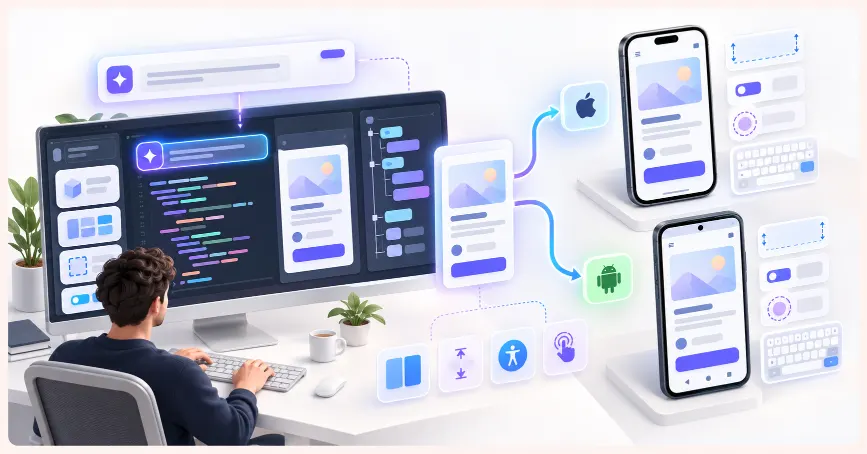
Student learning React Native mobile app development with AI, Expo, APIs, and practical projects at Learn2Earn Labs.

AI Integrated React Native Mobile App Development Training

Build a job-ready mobile app development profile through practical coding, industry-style projects, AI-assisted workflows, career preparation, mentor-guided learning, real-world app deployment, API integration, and hands-on portfolio development.

How Learn2Earn Labs builds resumes that pass the ten-second test

Understanding what recruiters do in the first ten seconds is one thing. Building a resume that exploits that knowledge is another — and it requires specificity, critical review, and an honest evaluation of what each section is actually communicating.

At Learn2Earn Labs, resume building is treated as a critical professional skill, not a formatting exercise. Every student’s resume goes through a structured review process that evaluates it specifically against recruiter scanning behaviour — headline clarity and keyword relevance, top-third composition, skills section precision, project description specificity, and ATS compatibility.

Generic summaries are revised. Vague skill listings are replaced with named, specific tools. Project descriptions that say “worked on a web application” are rewritten to say exactly what was built, what stack was used, what features were implemented, and what the outcome was. The goal is a resume that answers the recruiter’s question — “is this person relevant and capable?” — within the first ten seconds.

Students across all programs at Learn2Earn Labs — Full Stack Web Development, React Native Mobile App Development, Digital Marketing, Data Analytics, AI and Data Science, and Business Development — graduate with resumes built to this standard. Paired with LinkedIn profiles optimised for recruiter search, real project portfolios, and thorough interview preparation, they enter the job market as candidates who are visible, credible, and ready to convert recruiter attention into offers.

With decades of experience preparing students for careers across technology, marketing, and business — and alumni placed at TCS, Accenture, Cognizant, Infosys, and Nagarro — the team at Learn2Earn Labs understands exactly what it takes to get a resume past the first ten seconds and into the shortlist pile.

If you want your resume to earn the attention it deserves — and the interview calls that follow — speak with the team at Learn2Earn Labs.

Visit learntoearnlabs.com or write to team@learntoearnlabs.com

Conclusion

The recruiter scanning your resume is not trying to find reasons to reject you. They are trying to find reasons to keep reading — and they are doing it fast, in a pattern, with specific signals in mind.

Give them those signals. Put your strongest, most specific, most relevant information in the first third of the page. Make the headline do its job. Name your tools precisely. Describe your projects specifically. Remove everything that does not answer the question the recruiter is asking.

Ten seconds is all you get. Make every one of them count.

Frequently Asked Questions

1. What do recruiters look for first in a resume?

Recruiters typically notice the overall presentation first, followed by your name, professional headline, relevant skills, and evidence that you match the role. A clean layout and a clear top section make it easier for them to identify your relevance quickly.

2. How long do recruiters spend looking at a resume?

During the initial screening, recruiters may spend only a few seconds scanning a resume before deciding whether it deserves closer attention. This makes the first section of your resume especially important.

3. What should be in the top third of a fresher’s resume?

The top third should ideally include your name and contact information, a role-specific professional headline, a short professional summary, relevant technical skills, and strong project evidence. The blog recommends prioritizing these elements before education and certifications for freshers.

4. What resume mistakes can cause quick rejection?

Common problems include vague headlines, dense blocks of text, unexplained employment or education gaps, inconsistent formatting, incomplete contact information, and failing to show relevant information near the top of the resume.

5. How can freshers make their resumes stand out to recruiters?

Freshers should focus on specific skills and practical evidence rather than generic claims. Clearly name the tools you know, describe what you built in your projects, mention important features or outcomes, and tailor your headline and skills to the role you are targeting. The article emphasizes specific, verifiable project descriptions over vague statements.

Leave a Reply