
AI-Integrated Industry Training:
Web Development, Data Analytics, Digital Marketing, Java & Python
|
2 Months Practical Training + 1 Month Internship
|
Fee:
₹9,999 per Program
|
Apply Now

The Changing Expectations from Higher Education in India
Indian higher education has traditionally focused on syllabus completion, examinations, and degree delivery. While these remain important, they are no longer sufficient.
Today, universities are expected to produce graduates who:
Are job-ready from day one
Can adapt to fast-changing industries
Possess strong communication and professional skills
Show clarity in career direction
Are capable of continuous learning
Private universities, in particular, face intense competition. Infrastructure, campus size, and program count are no longer enough to stand out. What truly differentiates institutions now is student outcomes. This is where mentorship becomes critical.
Understanding Mentorship in an Institutional Context
In higher education, mentorship is often misunderstood as informal guidance or occasional counseling. In reality, effective mentorship is a structured, outcome-driven academic support system.
Mentorship in a university context means:
Continuous guidance beyond classroom teaching
Individual attention to academic, professional, and personal growth
Career-oriented direction aligned with industry needs
Regular monitoring of student progress and readiness
When implemented properly, mentorship complements teaching. Teaching delivers knowledge. Mentorship ensures that knowledge is applied, refined, and directed toward real-world success.
Key Challenges Faced by Indian Private Universities Today
Before understanding the value of mentorship, it is important to recognize the challenges it addresses.
Lack of career clarity among students
Many students enroll in programs without a clear understanding of career paths. This leads to confusion, poor engagement, and dissatisfaction in later semesters.
Gap between curriculum and industry
Despite syllabus updates, industry expectations often evolve faster than academic frameworks. Students struggle to bridge this gap on their own.
Weak employability skills
Employers frequently report gaps in communication, problem-solving, teamwork, and professional behavior, even among technically qualified graduates.
Overdependence on final-year placement training
Placement-focused training is often compressed into the final semester, which limits its effectiveness and creates unnecessary pressure.
Mentorship provides a continuous solution to these challenges rather than a last-minute fix
How Mentorship Improves Student Outcomes
Mentorship works because it focuses on the individual student, not just the batch.
Through mentorship:
Students gain clarity about career options early in their academic journey
Learning becomes purposeful rather than exam-oriented
Confidence improves through regular guidance and feedback
Weaknesses are identified and addressed in time
Students develop professional discipline and accountability
As a result, students become more prepared for internships, projects, interviews, and real workplace environments.
Mentorship and Employability: A Direct Connection
In 2026, employability is not defined only by technical knowledge. Employers seek graduates who can think, communicate, adapt, and contribute.
Mentorship directly supports employability by helping students:
Build strong portfolios and project work
Understand industry tools, workflows, and expectations
Prepare for interviews with realistic guidance
Develop professional communication and workplace etiquette
Make informed career decisions rather than reactive choices
Universities that integrate mentorship into academic life often see improved placement quality, not just placement numbers.
Role of Mentorship in Student Retention and Engagement
Student dropout and disengagement remain serious concerns for private universities. Often, students do not leave because of academic difficulty, but due to confusion, lack of motivation, or feeling unsupported.
Mentorship creates a sense of connection and belonging. Students feel noticed, guided, and valued. This leads to:
Higher engagement in academic activities
Better attendance and participation
Reduced dropout rates
Stronger trust in the institution
From an administrative perspective, mentorship becomes a powerful retention tool.
Alignment with NAAC, Accreditation, and Quality Frameworks
Accreditation bodies increasingly emphasize holistic student development, outcome-based education, and continuous improvement.
A structured mentorship system supports:
Student progression and success metrics
Industry interaction documentation
Academic support and guidance records
Quality enhancement initiatives
Mentorship is not just good practice. It strengthens compliance and quality benchmarks when implemented systematically.
Mentorship Models Suitable for Indian Private Universities
There is no one-size-fits-all approach. Universities can adopt mentorship models based on scale, discipline, and resources.
Faculty-led academic mentorship
Faculty members mentor a fixed group of students, focusing on academic progress, learning gaps, and study discipline.
Industry-integrated mentorship
Industry professionals guide students on real-world expectations, career paths, and practical applications.
Career and placement mentorship
Dedicated mentors focus on career planning, internships, skill development, and placement readiness from early semesters.
Project and research mentorship
Mentors support students in projects, innovation, startups, and research activities, improving depth and originality.
Hybrid mentorship models
A combination of on-campus and online mentoring allows flexibility, scalability, and access to diverse expertise.
The key is structure, accountability, and continuity.

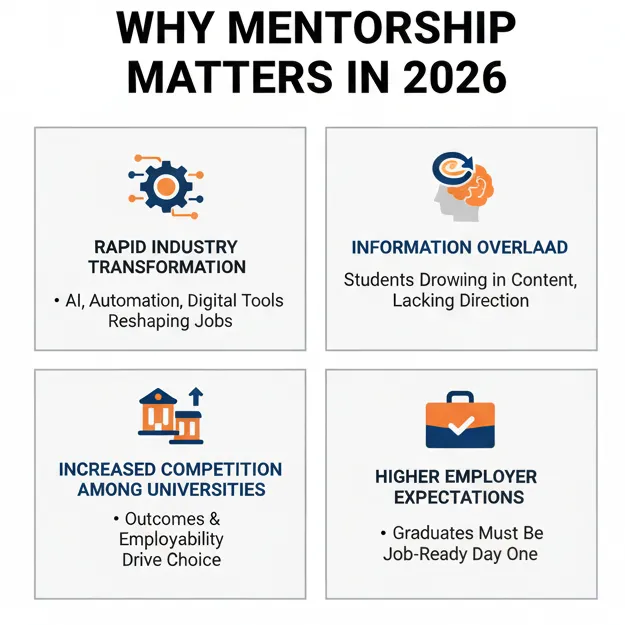
Why Mentorship Has Become Critical in 2026
Several forces make mentorship indispensable today.
Rapid industry transformation
AI, automation, and digital tools are reshaping job roles faster than traditional curricula can adapt.
Information overload
Students have access to unlimited online content but lack direction on what truly matters.
Increased competition among institutions
Students and parents compare universities based on outcomes, not just facilities.
Higher expectations from employers
Employers expect graduates to contribute immediately, not undergo extended training.
Mentorship helps universities respond proactively to these realities.
Leadership Responsibility in Building Mentorship Culture
Mentorship cannot succeed as a side initiative. It requires leadership commitment.
University leadership must:
Treat mentorship as an academic strategy, not a support service
Allocate time, training, and resources
Define clear objectives and outcomes
Monitor effectiveness and refine continuously
When mentorship is embedded into institutional culture, its impact multiplies across departments and programs.