Digital Marketing Funnel Explained: From Traffic to Conversion
Table of Contents
ToggleIntroduction: Why the Digital Marketing Funnel Matters
Many businesses invest in digital marketing.
They run ads.
They post on social media.
They write blogs.
But still, results do not come.
Traffic increases, but sales do not.
Leads come, but conversions stay low.
This happens because marketing works best when it follows a process.
That process is called the digital marketing funnel.
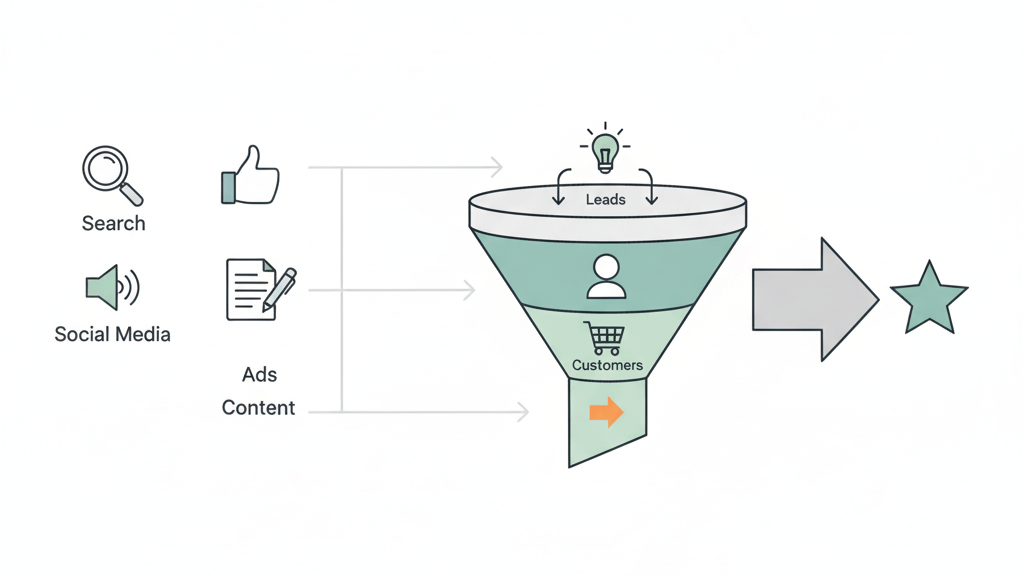
A digital marketing funnel helps guide people step by step.
It moves them from awareness to action.
It turns visitors into customers.
For students, the funnel explains how digital marketing actually works.
For business owners, it explains how to get results, not just views.
Understanding funnels changes how you see digital marketing. It helps you plan campaigns, crack interviews, and work confidently on real projects
What Is a Digital Marketing Funnel?
A digital marketing funnel is a structured journey.
It shows how a user moves from:
First contact with your brand
To becoming a paying customer
It does not happen in one step.
People rarely buy immediately.
They observe.
They compare.
They trust.
Then they decide.
The funnel helps marketers plan content, ads, and actions for each stage.
Without a funnel, marketing becomes random. It is just a noise.
With a funnel, marketing becomes purposeful.
Stage 1: Awareness – Attracting the Right Traffic
Awareness is the top of the funnel.
At this stage, people do not know your brand well.
They only know they have a problem or a need.
Your goal here is visibility, not selling.
Common Awareness Channels
- Blog posts and SEO
- Google Ads
- Social media posts
- YouTube videos
- Referral links
The key point is right traffic.
Not everyone is your customer.
Many businesses fail here by chasing numbers.
More traffic does not mean better traffic.
Good awareness focuses on relevance.
Stage 2: Interest – Engaging the Audience
Once people notice you, interest begins.
Now they want to learn more.
This stage builds curiosity and connection.
What Works at the Interest Stage
Educational blog content
Short videos and reels
Informative social posts
Email newsletters
Content matters most here.
If content feels confusing or sales-heavy, people leave.
If content feels helpful, people stay.
Interest grows when users feel understood.
Stage 3: Consideration – Building Trust and Intent
At this stage, users compare options.
They know your brand now.
They also know your competitors.
Trust becomes the deciding factor.
What Helps in the Consideration Stage
- Service or product pages
- Testimonials and reviews
- Case studies
- Clear explanations of benefits
People ask silent questions:
- Can I trust this brand?
- Will this solve my problem?
- Is it worth the money?
Your content must answer these questions clearly.
Stage 4: Conversion – Turning Visitors into Customers
Conversion is the action stage.
This is where users finally decide.
Conversion does not always mean a sale.
It can be:
Filling a form
Making a call
Booking a demo
Purchasing a product
What Improves Conversion
Clear call-to-action (CTA)
Simple landing pages
Strong headlines
Minimal distractions
Confusion kills conversions.
At this stage, clarity matters more than creativity.
Stage 5: Retention – Turning Customers into Loyal Users
Many marketers ignore this stage.
But retention is powerful.
It costs less to keep a customer than to acquire a new one.
Retention Methods
Follow-up emails
Helpful post-purchase content
Customer support
Regular engagement
Happy customers bring repeat business.
They also bring referrals.
A strong funnel continues even after conversion.

Digital marketing works best when strategy meets execution. A clear funnel helps your business turn visitors into real customers, not just website traffic
Digital Marketing Funnel Example for a Business
Let us take a simple example.
A digital marketing training institute.
Awareness
Blog on digital marketing careers
Instagram reels on marketing tips
Interest
Free guides
Educational YouTube videos
Consideration
Training program details
Student testimonials
Conversion
Contact form submission
Phone call inquiry
Retention
Continuous learning support
Advanced courses
This is how traffic slowly becomes customers.
Digital Marketing Funnel for Students and Beginners
For students, funnels explain real-world marketing.
Instead of memorizing terms, they understand flow.
Funnels help students:
Understand campaign strategy
Answer interview questions confidently
Plan real projects logically
Students who understand funnels think like marketers, not learners.
Common Funnel Mistakes That Stop Conversions
Many funnels fail due to simple mistakes.
Sending traffic to irrelevant pages
Ignoring middle funnel content
Overusing ads without value
No follow-up system
Poor tracking and analysis
Funnels need patience.
Results grow step by step.
How to Build a Simple Digital Marketing Funnel
You do not need complex tools.
Start simple.
Identify your target audience
Create awareness content
Engage with helpful information
Build trust with proof
Use clear CTAs
Follow up after conversion
Simplicity works better than complexity.
Digital marketing success is not about doing more, but doing the right things in the right order. A well-built funnel gives your efforts structure, clarity, and measurable results.
Conclusion: Funnels Bring Direction to Digital Marketing
Digital marketing is not magic.
It is a structured journey.
The digital marketing funnel gives direction.
It reduces confusion.
It improves results.
For businesses, it increases conversions.
For students, it builds strong fundamentals.
When you understand the funnel, marketing becomes meaningful.