Home » Programming » Data Analytics » Agentic Analytics: The Next Big Shift in Data Workflows

Agentic Analytics: The Next Big Shift in Data Workflows

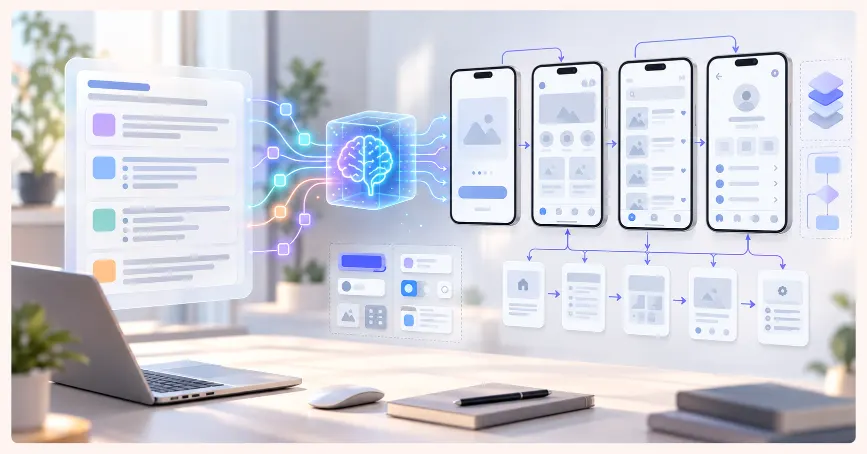
AI agent autonomously analyzing real-time data streams in an agentic analytics workflow

Introduction

If you have been working with data — or just starting your analytics journey — you have probably heard the buzz around AI. But something bigger than AI-assisted dashboards is quietly reshaping the entire data landscape in 2026: Agentic Analytics.

Forget the old model where you open a tool, run a query, and wait for a chart to appear. Agentic analytics flips that script. Instead of you going to the data, the data — powered by AI agents — comes to you, interprets itself, flags anomalies, and in some cases, takes action on its own.

Whether you are a recent graduate stepping into your first data role, or an IT professional looking to level up, understanding agentic analytics is no longer optional. It is quickly becoming the baseline expectation in data-driven organizations across industries.

In this blog, we will break down what agentic analytics is, how it works, where it is being used, how it differs from traditional analytics, and most importantly — what it means for your career.

The best time to upskill was yesterday. The second best time is right now. Don’t let the AI revolution pass you by — be the one driving it.

What is Agentic Analysis?

Agentic Analytics is the application of autonomous AI agents to data workflows. These agents do not just generate insights when asked — they continuously monitor data streams, detect patterns, raise alerts, explain findings in plain language, and in some cases, act on decisions automatically.

Think of it as the difference between a calculator and an accountant. Traditional analytics tools are calculators — powerful but passive. Agentic systems are more like accountants who proactively scan your finances, spot a problem, draft a report, and flag it before you even knew to ask.

The technology behind it combines:

  • Large Language Models (LLMs) — for natural language reasoning
  • Machine Learning pipelines — for pattern recognition and prediction
  • Automation frameworks — to execute multi-step workflows
  • APIs and data connectors — to interact with real business systems

How AI Agents Are Changing Data Analytics Workflows?

Traditional analytics followed a simple but limited loop:

Human asks question → Tool fetches data → Human interprets result → Human decides

Agentic analytics breaks this loop entirely:

Agent monitors data continuously → Detects anomaly or insight → Agent explains it → Agent acts or alerts the right person

This is a massive operational shift. Instead of data teams spending hours pulling reports, cleaning data, and writing summaries, AI agents handle the repetitive cognitive work — freeing analysts to focus on strategy, interpretation, and decision-making.

Practical Example

  • A sales analytics agent detects that revenue in one region dropped 18% week-over-week.
  • It cross-references inventory, marketing spend, and competitor activity data.
  • It writes a plain-language explanation: ‘Region 3 revenue dropped likely due to out-of-stock issues after a spike triggered by a competitor promotion.’
  • It raises a ticket in the CRM and sends a Slack alert to the sales head — without any human intervention.

This is agentic analytics in action.

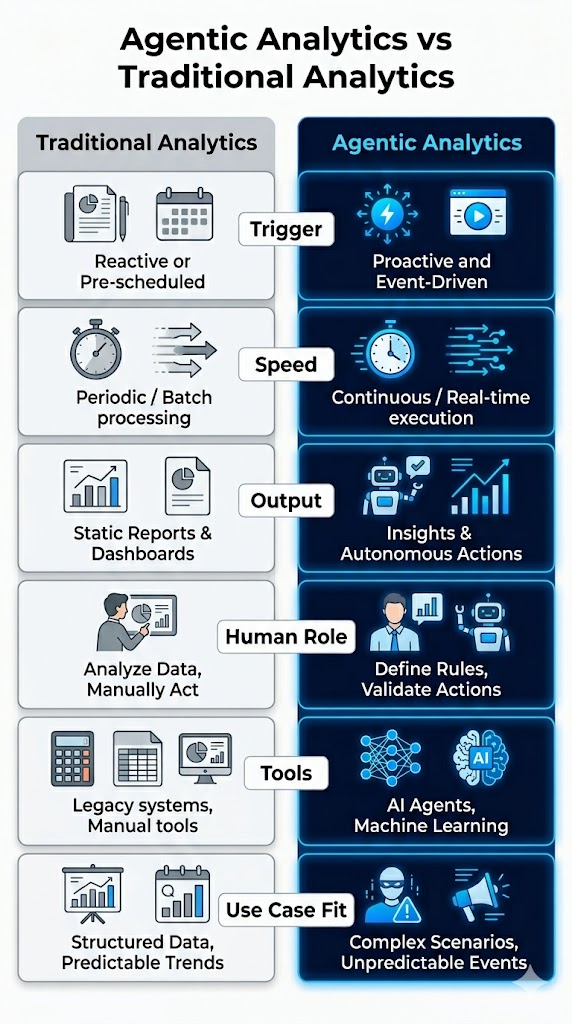
Comparison of Traditional Analytics vs Agentics Analysis

Comparison of Traditional Analytics versus Agentic Analytics across six features

Feature comparison

Feature Traditional analytics Agentic analytics
Trigger Human-initiated query Continuous autonomous monitoring
Speed On-demand Real-time / proactive
Output Charts, reports Actions, alerts, explanations
Human role Retrieval + interpretation Strategy + validation
Tools Power BI, Tableau, SQL LLMs + ML + Automation
Use case fit Reporting, dashboards Decision intelligence, operations

The key insight: traditional analytics tells you what happened. Agentic analytics tells you what happened, why it happened, and what to do about it — before you even thought to ask.

Infographic comparing agentic analytics vs traditional analytics across trigger, speed, output, tools and human role

Every expert was once a beginner. All it takes is one decision to start — and the right program to guide you every step of the way.

Real-World Use Cases of Agentic Analytics

1. Banking & Finance

Banks use agentic systems to monitor transaction streams in real time, automatically flag suspicious activity, assess fraud probability, and trigger case escalations — all within milliseconds.

2. E-Commerce & Retail

Retail brands deploy agents to watch inventory, demand signals, competitor pricing, and logistics data simultaneously. When demand spikes for a product, the agent automatically initiates a reorder workflow.

3. Healthcare Analytics

Hospitals use agentic pipelines to process patient vitals from IoT devices, flag early warning signs, and alert the medical team — reducing response times significantly.

4. Digital Marketing

Marketing analytics agents track campaign performance 24/7, reallocate budgets toward high-performing channels, and generate plain-language reports for non-technical stakeholders.

5. Supply Chain & Manufacturing

Agentic systems monitor production data, predict equipment failures before they occur, and automatically schedule maintenance — cutting downtime and operational losses.

Python Tools Used in Agentic Data Workflows

For developers and analysts looking to build or work with agentic systems, Python remains the backbone. Here are the key libraries and frameworks you should know:

  • LangChain / LangGraph — for building multi-step AI agent pipelines
  • AutoGen (by Microsoft) — for creating multi-agent conversations and task execution
  • Pandas & NumPy — for data manipulation within agent workflows
  • PySpark — for scaling agentic workflows on big datasets
  • Apache Kafka (via Python) — for real-time data streaming
  • OpenAI / Anthropic APIs — for embedding LLM reasoning into pipelines
  • Prefect / Airflow — for orchestrating automated data workflows
  • Plotly Dash — for building interactive dashboards triggered by agents

If you are just starting out, focus on Python + LangChain + Pandas as your initial stack. These three tools alone will let you prototype functional agentic analytics pipelines.

Your career won’t wait, and neither should you. The analysts who learn Agentic AI today will be the leaders companies fight to hire tomorrow.

Why This Matters for Your Career

Here is the honest truth: the role of the data analyst is evolving — but not disappearing.

As AI agents take over the mechanical parts of analytics — data pulling, report writing, anomaly detection — the value of a human analyst shifts upstream. The 2026 job market is looking for professionals who can:

  • Design and manage agentic pipelines — not just run queries
  • Interpret AI-generated insights critically — not just trust them
  • Translate data narratives into business decisions — not just visualize data
  • Validate and govern AI agent behavior — to prevent bad automated decisions

For University Passouts

You are entering the market at a time when foundational skills in Python, SQL, and machine learning — combined with knowledge of agentic tools — give you a clear edge over those who only know traditional BI tools.

For Working IT Professionals

The transition is a natural upskill. If you already know SQL and have worked with data pipelines, adding agentic frameworks to your toolkit is the next logical step — and it can significantly accelerate your career trajectory.

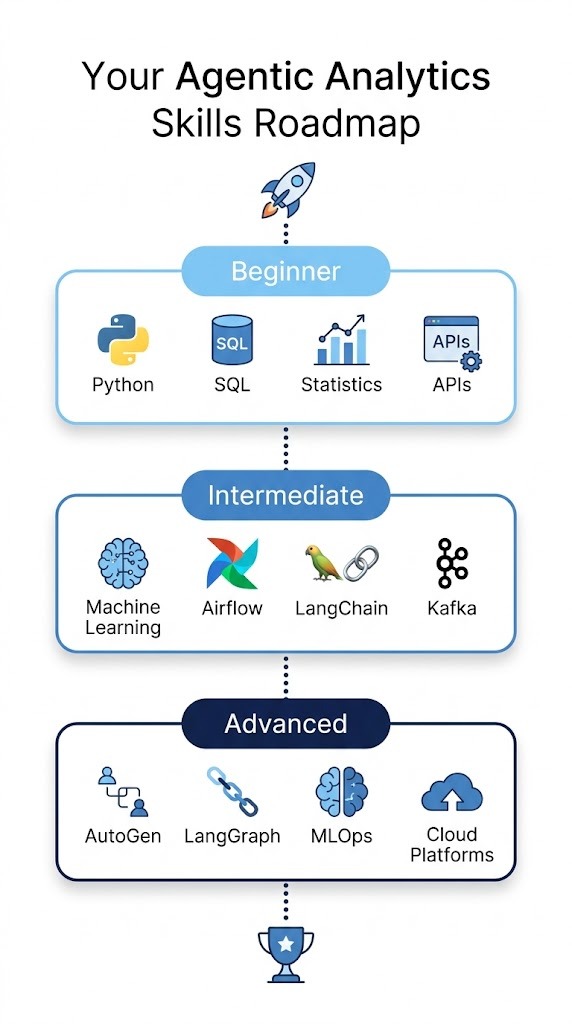
Skills Roadmap to Get Started

Skills roadmap table with three levels: Beginner, Intermediate, and Advanced

Skills roadmap

Level Skills to build
Beginner
Python (Pandas, NumPy) SQL Basic Statistics APIs & JSON
Intermediate
Machine Learning (Scikit-learn) Airflow / Prefect LangChain Apache Kafka
Advanced
AutoGen LangGraph MLOps AI Ethics AWS GCP Azure

The good news: you do not need to master all of this at once. Start with Python and work your way up.

Step-by-step skills roadmap infographic for learning agentic analytics from beginner to advanced level

Will AI Agents Replace Data Analysts?

This is the question everyone is asking — and it deserves a direct answer.

No — but they will replace analysts who do not adapt.

Gartner projects that 40% of enterprise applications will embed task-specific AI agents by end of 2026. This means the volume of agentic systems will grow sharply. But these systems still need humans to define goals, validate outputs, maintain ethical guardrails, and interpret results in business context.

The data analyst of 2026 and beyond is less of a report builder and more of an AI systems collaborator — someone who works alongside autonomous agents to drive smarter, faster decisions.

The opportunity is enormous for those who embrace this shift early.

Conclusion

Agentic analytics is not a trend to watch from the sidelines — it is the new frontier of data-driven work. Organizations are already deploying AI agents that monitor, analyze, and act on data autonomously.

The analytics professionals who thrive in this era will be those who understand how these systems work, can contribute to building them, and know how to translate their outputs into real business value.

Whether you are just stepping out of college or are a seasoned IT professional, now is the ideal time to invest in the skills that position you at the center of this transformation — not on the periphery of it.

FAQ (Frequently Asked Questions)

Q: What is agentic analytics and how does it work?

A: Agentic analytics uses autonomous AI agents to continuously monitor data, detect insights, and take actions — without waiting for a human to initiate a query. It combines LLMs, machine learning, and automation to make analytics proactive rather than reactive.

Q: How is agentic analytics different from traditional analytics?

A: Traditional analytics is human-initiated and produces static reports. Agentic analytics is continuous, autonomous, and can produce not just insights but also automated actions and plain-language explanations.

Q: What Python tools are used in agentic data workflows?

A: Key tools include LangChain, AutoGen, Pandas, PySpark, Apache Kafka, and cloud LLM APIs like OpenAI or Anthropic. These are used to build pipelines where agents can process, reason over, and act on data autonomously.

Q: What skills do I need for AI-powered data analytics jobs?

A: Start with Python, SQL, and basic ML. Then build into LLM integration, pipeline orchestration, and multi-agent system design. Communication and critical thinking remain equally important.

Q: Will AI agents replace data analysts in the future?

A: Not entirely. AI agents will automate repetitive analytical tasks, but human analysts are still needed for strategy, ethics, validation, and business context interpretation. The role evolves — it does not disappear.

🚀 Ready to Build a Future-Ready Career in Data Analytics?

Explore the AI, Data Analytics & Machine Learning program at Learn2Earn Labs — designed for both fresh graduates and working IT professionals.

Contact Learn2Earn Labs

Leave a Reply