AI-Integrated Industry Training:
Web Development, Data Analytics, Digital Marketing, Java & Python
|
2 Months Practical Training + 1 Month Internship
|
Fee:
₹9,999 per Program
|
Apply Now
The Importance of Classroom Teaching in the Indian Education System
Before talking about change, it is important to understand why classroom teaching still matters so much in India.
Why classrooms are still the backbone of learning
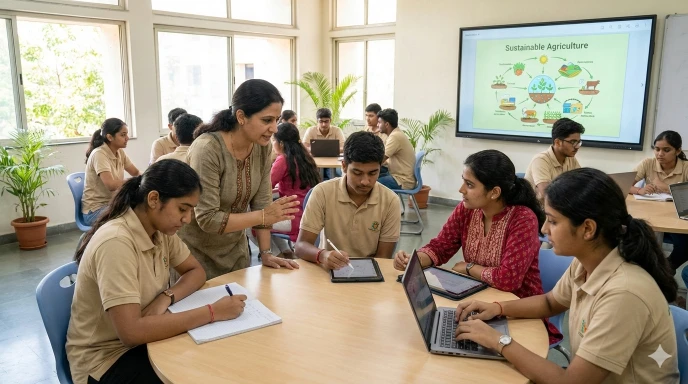
Classrooms provide a structured learning environment. Students follow a routine.
They learn discipline, time management, and responsibility. This structure is especially important for young learners.
Classroom teaching also allows direct interaction between teachers and students.
A good teacher can motivate, guide, and correct students in ways that books and videos cannot. Peer learning is another major advantage.
Students learn from discussions, group activities, and shared experiences.
In India, classrooms also play a social role. They help students from different backgrounds interact, collaborate, and grow together.
Role of teachers in shaping Indian students
Teachers in India are not just instructors. They are mentors, guides, and role models.
Many students in India continue to look up to their teachers for moral guidance, self-confidence, and direction in life.
This is why the role of teachers remains deeply important in the Indian education system.
This human connection cannot be replaced by technology. That is why classroom teaching should not be removed.
Instead, it should be strengthened with modern methods.
Where Traditional Classroom Teaching Falls Short Today
While classroom teaching is important, traditional methods are struggling to meet today’s needs.
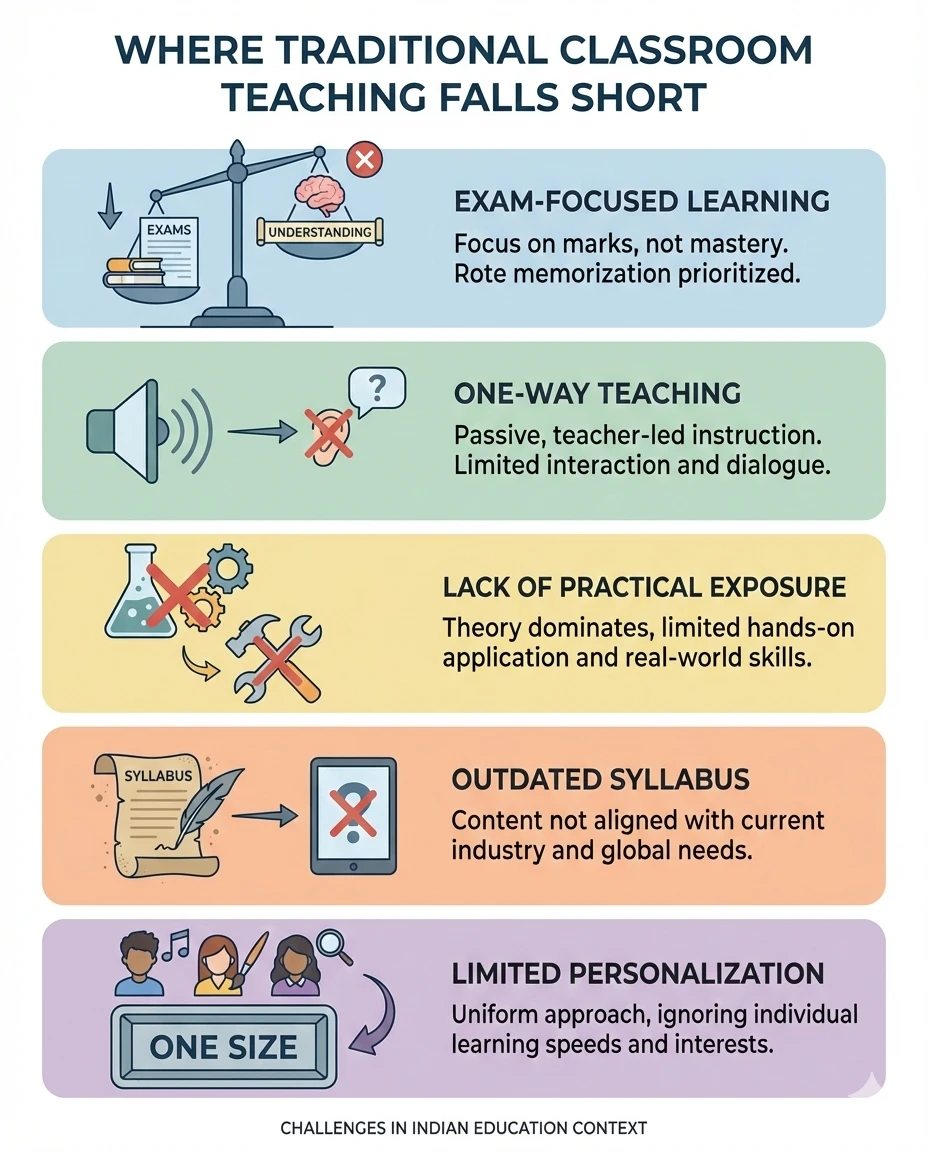
One-size-fits-all teaching approach
In most Indian classrooms, the same lesson is taught in the same way to all students. But every student learns differently.
Some students grasp concepts quickly, while others need more time. Some learn better through visuals, while others understand best through practical examples.
In such cases, a one-size-fits-all teaching approach does not work.
Traditional classrooms rarely address these differences.
As a result, fast learners feel bored and slow learners feel stressed. Both groups suffer.
Overemphasis on marks and exams
Indian education has long been exam-oriented. Success is often measured only by marks and ranks.
This leads to rote learning. Students memorise answers instead of understanding concepts.
They study to pass exams, not to build skills.
Impact of exam-oriented education on skill development
When education focuses only on exams, students struggle with real-world problems.
They lack confidence, communication skills, and practical exposure. Many graduates feel unprepared when they enter colleges, jobs, or professional life.
This is one of the biggest challenges in the Indian education system today.
Gap between classroom learning and industry needs
Another major issue is the gap between what students learn in classrooms and what industries expect.
Syllabi are often outdated. Practical exposure is limited. Students complete degrees but still lack job-ready skills.
This leads to unemployment and frustration among educated youth.
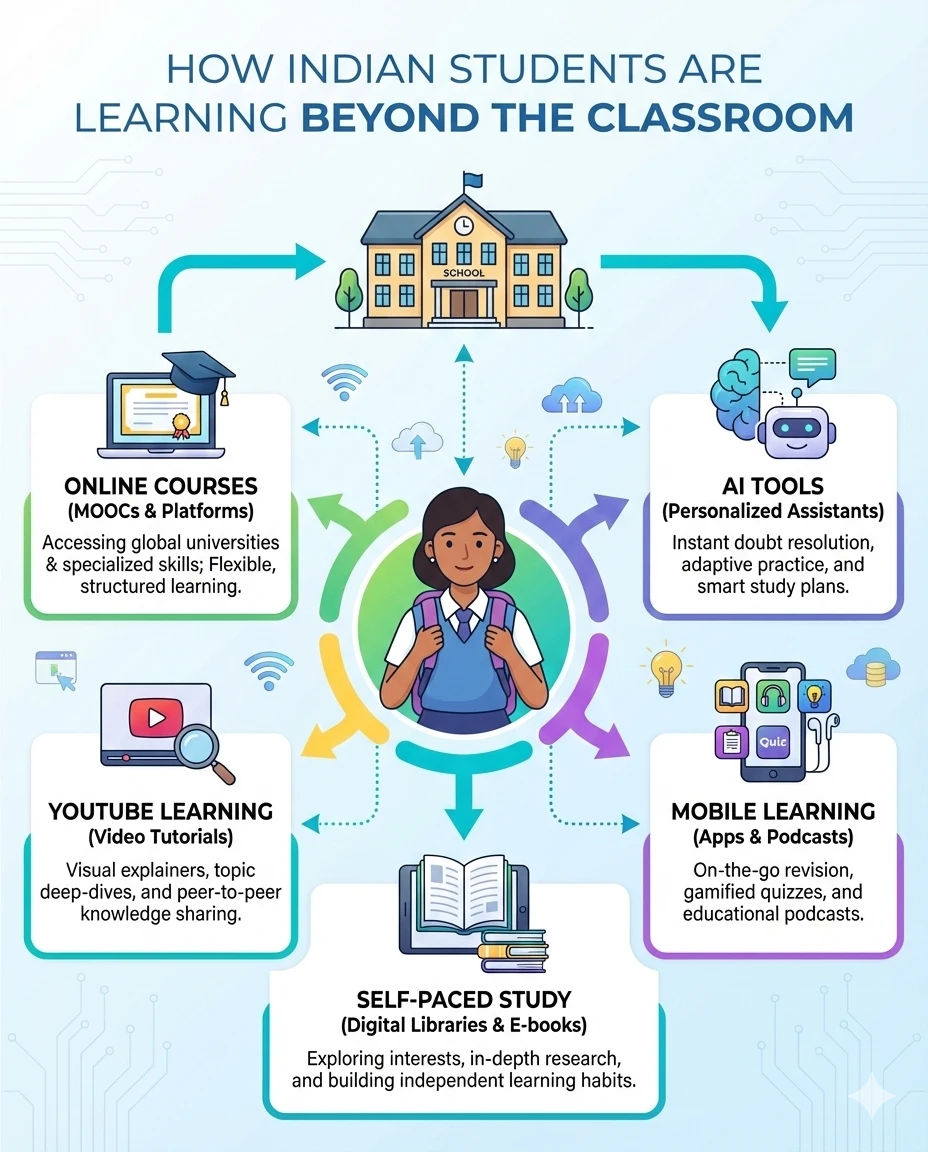
How Indian Students Are Learning Beyond the Classroom
Interestingly, students have already started upgrading their learning, even if classrooms have not.
Rise of digital and self-driven learning
The digital revolution in India has accelerated the growth of online education in recent years.
With over 700 million internet users, learning is now accessible to a much wider audience across the country.
Today’s students learn from YouTube, online platforms, and digital courses. They watch tutorials, solve problems online, and explore topics beyond textbooks.
They learn coding, digital marketing, data analysis, communication skills, and more.
This self-driven learning shows that students want more practical and flexible education.
Use of technology and AI by students
Many Indian students now use AI tools for learning support.
They use them to understand concepts, practise questions, and get explanations in simple language.
This does not mean students want shortcuts. It means they want clarity, speed, and better understanding.
Education has already moved beyond the four walls of the classroom.
What an Upgraded Classroom Should Look Like in India
Instead of fighting change, Indian education should embrace it.
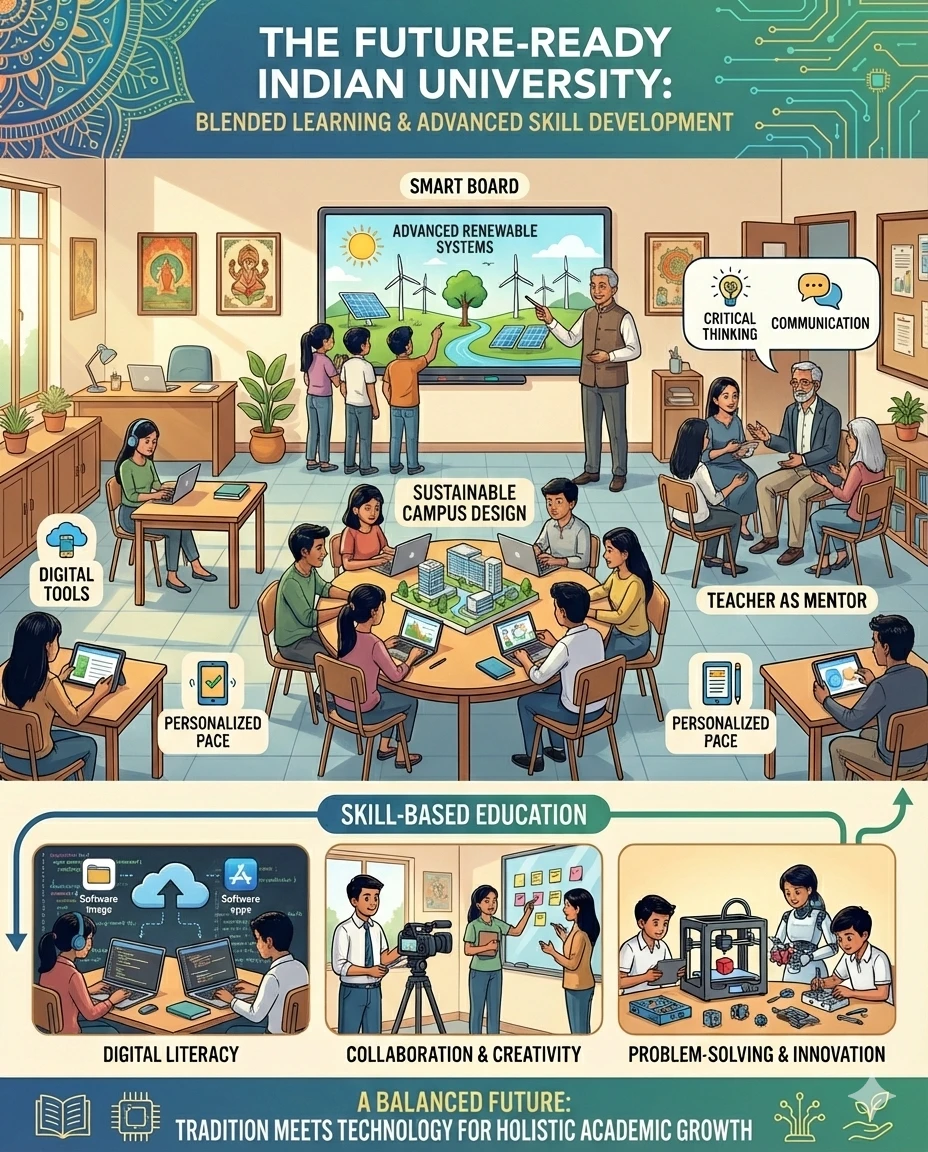
Blended learning: Classroom plus digital tools
An upgraded classroom should combine traditional teaching with digital support.
Teachers can use presentations, videos, and online resources to explain concepts better.
Recorded lectures can help students revise. Digital assessments can track progress more effectively.
This blended learning model improves understanding and engagement.
Shift from rote learning to skill-based education
Classrooms must focus more on skills, not just theory.
Students should work on projects, case studies, and presentations. They should learn problem-solving, communication, teamwork, and critical thinking.
Aligning education with employability and careers
Indian education must prepare students for careers, not just certificates.
This includes internships, industry interactions, workshops, and career guidance.
When students see the real-world application of what they learn, their motivation increases.
Personalized learning within classrooms
With the help of technology and better planning, teachers can support different learning speeds.
Extra help for slow learners and advanced challenges for fast learners can exist in the same classroom.
This makes education inclusive and effective.
The Changing Role of Teachers in Modern Indian Classrooms
As classrooms evolve, the role of teachers also changes.
From lecturers to facilitators and mentors
Teachers no longer need to be the only source of information. Information is everywhere.
Instead, teachers should guide students on how to learn, think, and apply knowledge.
They should encourage questions, discussions, and curiosity.
This makes classrooms more interactive and meaningful.
Need for continuous teacher upskilling
Teachers also need support. They must be trained in digital tools, modern teaching methods, and industry trends.
Upskilling teachers is not a weakness. It is a necessity in a changing world.
When teachers grow, students grow.