AI-Integrated Industry Training:
Web Development, Data Analytics, Digital Marketing, Java & Python
|
2 Months Practical Training + 1 Month Internship
|
Fee:
₹9,999 per Program
|
Apply Now
1. The Future of Digital Marketing Careers
Let’s start with the big picture.
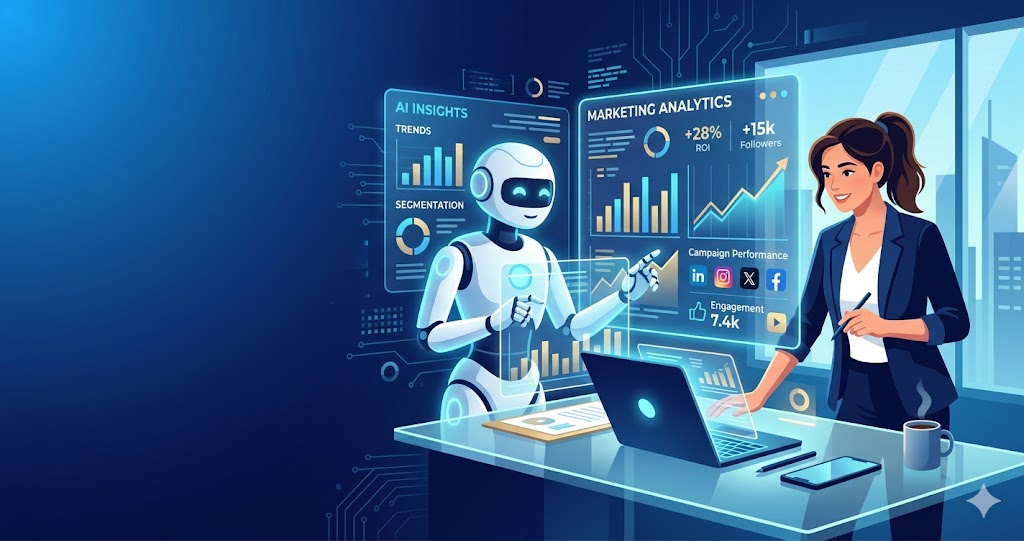
Digital marketing is not dying. It is evolving — and fast. The future of digital marketing careers looks very different from what it did even three years ago. AI is now doing many of the repetitive, time-consuming tasks that marketers used to spend hours on.
Things like scheduling posts, generating ad copy variations, segmenting email lists, running A/B tests — AI can now handle all of this in minutes.
So what does this mean for marketers?
It means the nature of marketing work is shifting. Less manual execution. More strategy, creativity, and decision-making. The marketers who understand how artificial intelligence is changing the marketing industry — and embrace it — will be the ones who grow faster and earn more.
The ones who ignore it? They will find it harder and harder to compete.
How AI is Changing Marketing Roles
AI is not replacing marketing roles overnight. It is quietly changing what those roles look like from the inside.
A content marketer today spends less time writing first drafts and more time editing, strategizing, and ensuring brand voice is consistent. A social media manager spends less time scheduling posts and more time building community and analyzing trends. An SEO specialist spends less time doing manual keyword research and more time interpreting AI-generated data and making smart decisions.
Examples of AI replacing tasks in digital marketing are everywhere. But replacing tasks is very different from replacing people.
AI Content Generation — The Good and the Bad
AI can write. There is no denying that. Tools like ChatGPT and Claude can produce a 1,000-word blog post in seconds. But can AI write blog posts better than humans? Not quite — at least not yet.
AI-generated content often lacks personality, real-world experience, and emotional depth. It can sound generic. It misses cultural nuances. It does not know your brand story the way you do. Human editing, human judgment, and human creativity are still what make content truly connect with an audience.
AI Scheduling Tools for Social Media
Tools like Buffer, Hootsuite, and Later now use AI to suggest the best times to post, auto-generate captions, and even recommend content formats. This is a huge time-saver for social media managers. But the strategy behind what to post and why — that still requires a human brain.
2. AI Replacing Marketing Jobs — Which Roles Are Actually at Risk?
Let’s be honest. Some marketing roles are more vulnerable than others.
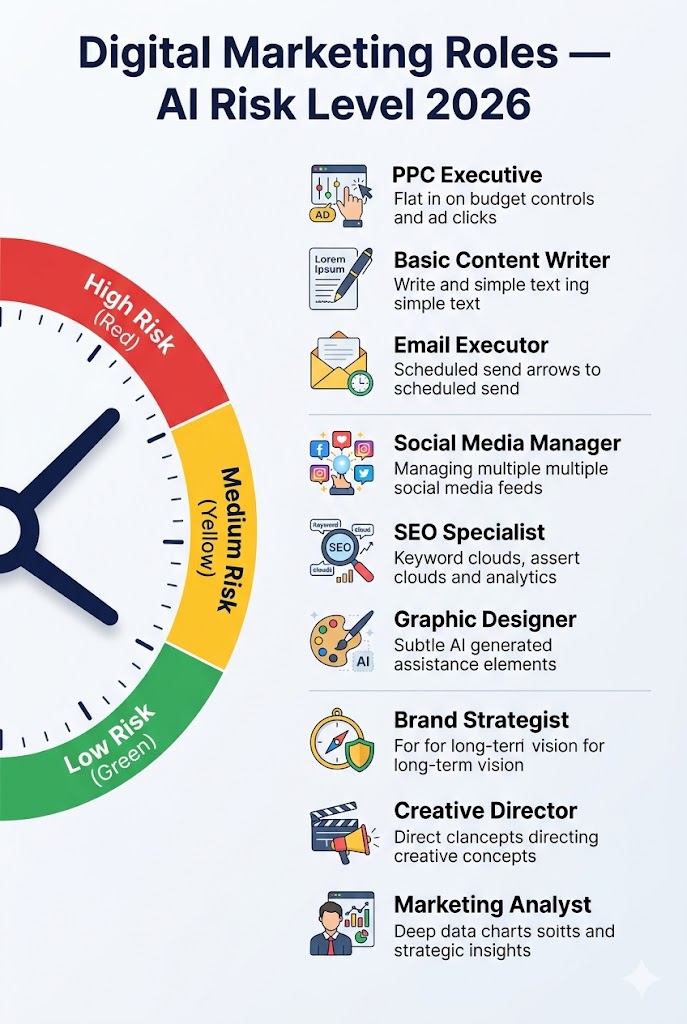
AI replacing marketing jobs is a real phenomenon — but it is happening selectively. The roles most at risk are those that rely heavily on repetitive, rule-based tasks with little need for creative thinking or human judgment.
Which digital marketing roles are most at risk from AI? Here is a realistic look.
AI Impact on Email Marketing Jobs
Email marketing has been one of the first areas where AI has made a big dent. AI tools can now write subject lines, personalize email content, segment audiences, and even decide the best time to send emails — all automatically.
Does this mean email marketers are out of a job? No. But it does mean that email marketers who only know how to press “send” are at risk.
Email Personalization Using AI
AI-driven email personalization is incredibly powerful. Tools like Klaviyo and Mailchimp now use AI to customize email content for each individual subscriber based on their behavior. This is a task that used to take hours of manual segmentation. Now it takes minutes.
The smart email marketer of today focuses on strategy — understanding customer psychology, crafting compelling offers, and interpreting campaign data — rather than manual list management.
PPC Jobs Affected by AI Automation
Pay-per-click advertising has seen massive automation in recent years. Google’s Smart Bidding, Performance Max campaigns, and Meta’s Advantage+ are all AI-driven systems that automatically manage bids, targeting, and even ad creative.
This has directly affected PPC specialists who relied on manual campaign management as their primary skill.
AI Bidding Strategies in Google Ads
AI bidding strategies in Google Ads have become the default. Smart Bidding uses machine learning to optimize bids in real time — something no human can do at the same speed or scale. Can AI manage Google Ads better than humans in terms of raw data processing? Yes. But can it understand business context, seasonal nuances, or brand positioning? No. That is still where humans win.
AI Impact on SEO Professionals
SEO is also going through a major shift. Google’s Search Generative Experience (SGE) and AI Overviews are changing how search results look. AI tools can now perform keyword research, audit websites, and generate meta descriptions in seconds.
Are SEO jobs at risk? Partially. The technical, repetitive parts of SEO are being automated. But strategic SEO — understanding user intent, building authority, and creating content ecosystems — remains deeply human.
AI Keyword Research Tools — How They Compare
Tools like Semrush, Ahrefs, and SurferSEO now use AI to suggest keyword clusters, predict ranking difficulty, and even generate content briefs. They are powerful. But an experienced SEO professional still needs to interpret the data, apply business context, and make judgment calls that AI simply cannot make on its own.
3. How AI is Changing Marketing Roles From the Inside
Beyond job risk, it is important to understand how AI is changing marketing roles at a deeper level.
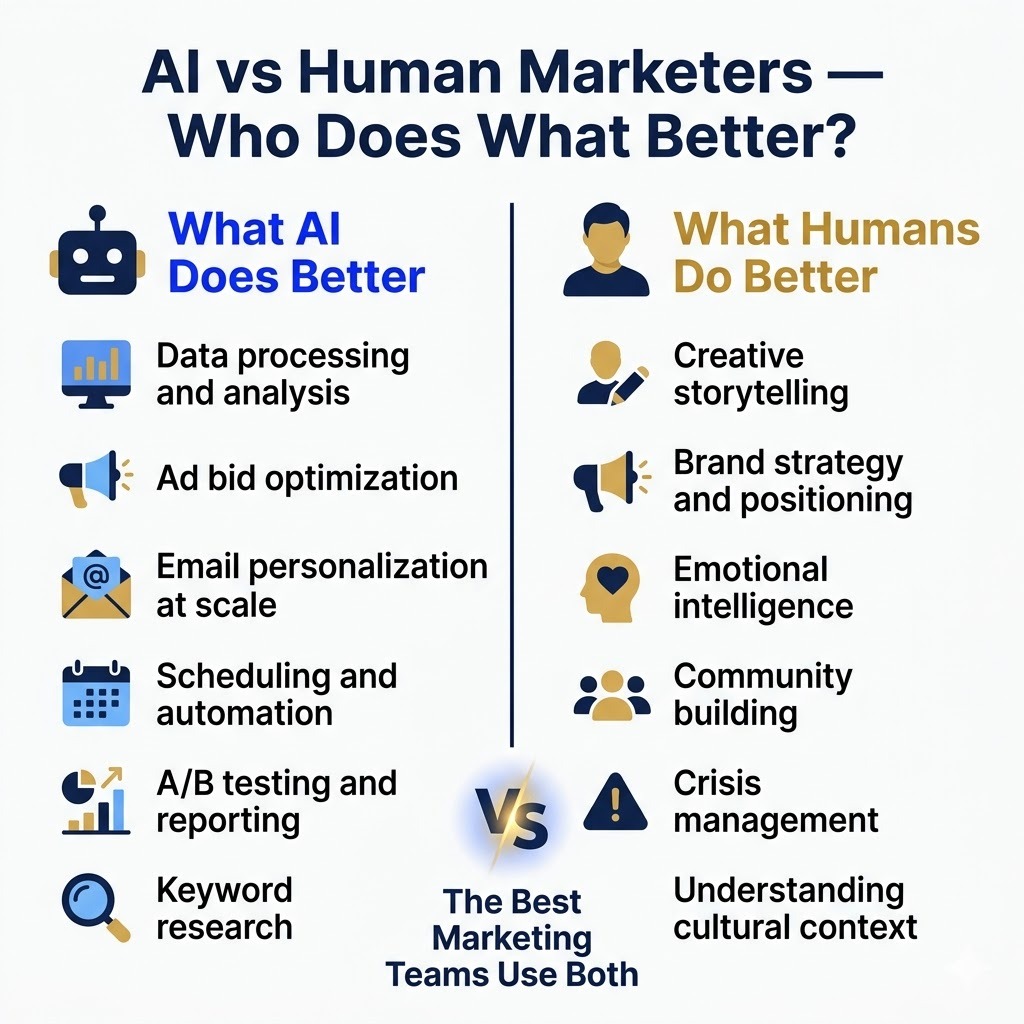
The difference between AI marketing tools and human marketers is not about intelligence — it is about judgment. AI is excellent at processing data, identifying patterns, and executing repetitive tasks. Humans are excellent at empathy, creativity, storytelling, and building relationships.
The best marketing teams today are those that combine both.
AI Automation in Content Marketing
Content marketing has been dramatically changed by AI. First-draft generation, topic research, content repurposing, and even SEO optimization are now partially automated. Can AI write blog posts better than humans in terms of speed and volume? Absolutely. In terms of depth, authenticity, and emotional resonance? Not even close.
The role of a content marketer today is less about writing from scratch and more about being a skilled editor, strategist, and brand storyteller who uses AI as a powerful assistant.
AI in Social Media Management
Can AI do the job of a social media manager? It can handle the mechanical parts — scheduling, basic caption writing, hashtag suggestions, performance reporting. But social media management is fundamentally about human connection.
Building a community, responding to comments with empathy, handling a PR crisis, or creating a campaign that goes viral — these require human intuition, cultural awareness, and emotional intelligence.
AI vs Human Social Media Strategy
When it comes to AI vs human social media strategy, think of it this way — AI can tell you when to post and what format performs best. But it cannot tell you why your audience cares about your brand, or how to make them feel something. That emotional layer is entirely human — and it is what separates good social media from great social media.
4. AI Tools Used in Digital Marketing Today
Whether you like it or not, AI tools are now a standard part of the digital marketing toolkit. Knowing how to use them is no longer optional — it is a baseline expectation.
Here is a look at how to use AI tools to grow as a marketer and stay competitive in 2026.
Best AI Tools for Digital Marketers
The market is flooded with AI tools, but not all of them are worth your time. Here are the ones that are genuinely useful for digital marketers right now.
ChatGPT vs Claude for Marketing Tasks
Both ChatGPT and Claude are powerful AI writing assistants, but they have different strengths. ChatGPT is widely used for brainstorming, content drafting, and social media copy. Claude tends to perform better for longer, more nuanced content — like detailed blog posts, strategic documents, and brand messaging. For marketers, the best approach is to try both and use each for what it does best.
Google Analytics 4 for Marketers
Google Analytics 4 uses AI-powered insights to surface trends, predict user behavior, and highlight anomalies in your data automatically. For marketers, learning Google Analytics 4 is non-negotiable in 2026. It is the foundation of data-informed decision-making — and understanding its AI features can give you a serious competitive edge.
5. Marketing Jobs That AI Cannot Replace
Here is the part you have been waiting for — the good news.
There are plenty of marketing jobs that AI cannot replace. Not because AI is not powerful, but because some aspects of marketing are fundamentally human. Marketing jobs that will never be replaced by AI are those that require empathy, creativity, ethical judgment, and real human relationships.
Human Skills vs AI in Marketing
When it comes to human skills vs AI in marketing, the contrast is clear. AI is fast, consistent, and data-driven. Humans are creative, empathetic, and culturally aware. The best marketers of the future will be those who use AI to handle the heavy lifting — while they focus on the things only humans can do.
Creativity and storytelling in marketing is the most obvious example. A brand’s story is rooted in real human experience — its founders, its customers, its values, its journey. AI can write a story, but it cannot live one. Audiences can feel the difference.
Emotional Intelligence in Marketing
Emotional intelligence is perhaps the most important human skill in marketing — and it is the one AI struggles with the most. Understanding what your audience is feeling, what they fear, what they dream about, and how to speak to them in a way that builds trust — this is deeply human work.
The good news is that new digital marketing job opportunities created by AI are emerging every day. Roles like AI Prompt Strategist, AI Content Editor, Marketing Automation Manager, and AI Campaign Analyst did not exist five years ago. They are growing fast today.
6. Digital Marketing Skills You Need for the AI Era
So what should you actually do to protect and grow your career?
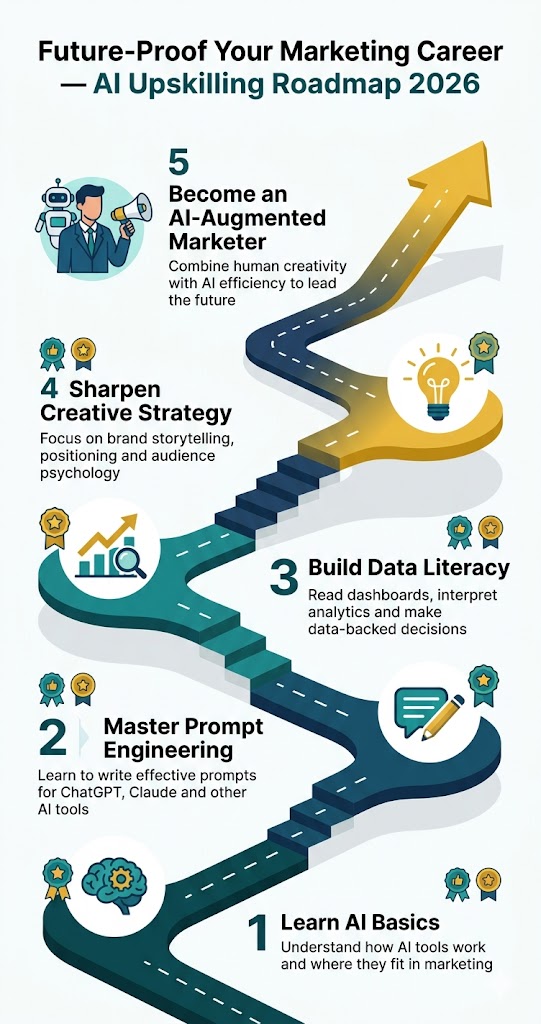
The answer is clear — invest in skills that make you more valuable in an AI-powered world. What skills do digital marketers need to survive AI? Here is a practical roadmap.
The key to how to future-proof your digital marketing career is not to fight AI — it is to learn how to work with it better than anyone else.
Upskilling for Digital Marketers
The best investment you can make right now as a marketer is in continuous learning. The best courses for digital marketers to learn AI are widely available — from Google’s AI courses to HubSpot’s AI marketing certifications to dedicated platforms like Coursera and LinkedIn Learning.
But beyond formal courses, the most important thing is to simply start using AI tools in your daily work. Experiment. Make mistakes. Learn what works. That hands-on experience is more valuable than any certificate.
Prompt Engineering for Marketers
Prompt engineering for marketers is one of the most practical and high-value skills you can develop right now. It simply means knowing how to give AI tools the right instructions to get the best output. How to use ChatGPT as a digital marketing professional effectively comes down to how well you can write prompts — and that is a skill anyone can learn with practice.
Think of it like this — the marketer who knows how to get great results from AI tools will always be more productive than the one who does not. And productivity means value.
Data Analytics Skills for Marketers
AI generates a lot of data. The marketers who can interpret that data — find the story in the numbers, connect it to business goals, and make smart decisions based on it — will always be in demand.
Data analytics skills for marketers are no longer a “nice to have.” They are essential.
Why Data Literacy Is Non-Negotiable
One of the biggest benefits of AI for digital marketing professionals is the sheer volume of insights it can generate. But those insights are only useful if someone can understand them. Data literacy — knowing how to read dashboards, interpret trends, and make data-backed decisions — is what separates the marketers who grow with AI from those who get left behind.