Table of Contents
ToggleThe Question That Decides the Interview Before It Begins
You walk in, shake hands, sit down. The interviewer smiles and says the five words every candidate dreads more than any technical question:
“Tell me about yourself.”
And everything freezes.
You either launch into a memorized monologue name, hometown, parents’ professions, college, hobbies or you pause awkwardly, lose the thread halfway through, and end with an apologetic smile wondering if you just failed the interview before it began.
Here is what you need to understand. This is not an icebreaker. Interviewers ask it because the way you answer reveals what your resume cannot your communication ability, your self-awareness, your confidence, and whether you understand what the role requires.
It is the most important ninety seconds of the entire interview. And almost nobody answers it well.
This blog gives you the exact framework to build an answer that sounds natural, lands with confidence, and makes the interviewer want to ask the next question.
The interview starts long before technical questions begin. Make your first 90 seconds impossible to forget
Why Most Candidates Get This Wrong
Most candidates either memorize a fixed script word for word and panic when they lose their place or improvise completely, trusting the moment. Both fail for the same reason: they treat this as a question about biography, when it is a question about professional value.
The interviewer already has your resume. They do not want you to read it back to them. They want to understand who you are as a professional how you think, what you have built, and why you are right for this specific role.
A memorized delivery feels like a performance. An unstructured improvisation meanders. The answer needs to feel like a confident conversation but with the invisible skeleton of a well-prepared professional holding it together.
The Framework That Works: Past, Present, Future
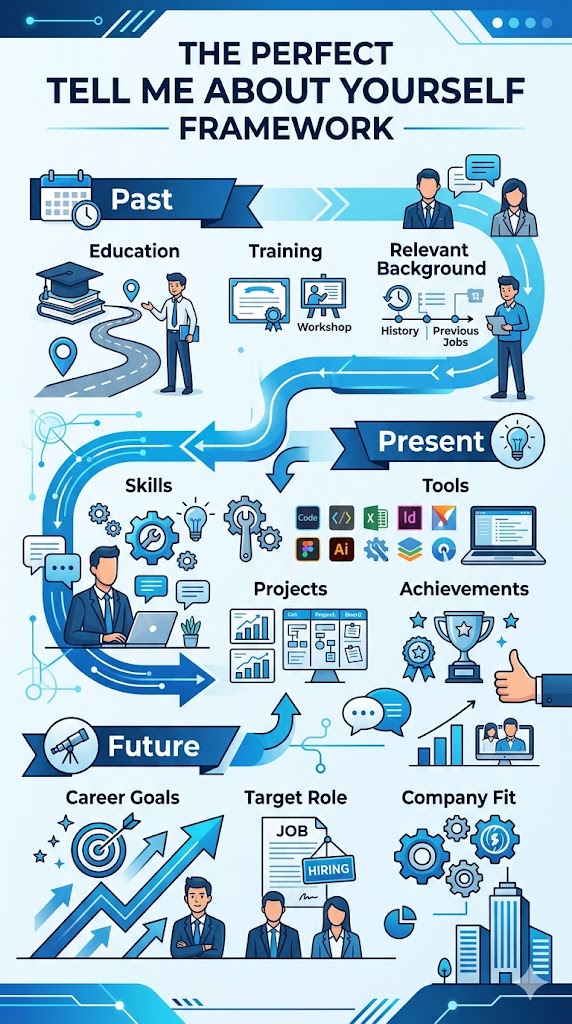
The most effective answer is built on three pillars: where you come from professionally, where you are right now, and where you are going. This is called the Past, Present, Future framework and it works because it creates a narrative arc that is easy to follow and naturally leads toward your fit for the role.
Past: One to two sentences on your academic background and the training or experiences that shaped your direction. Not your life story. The most relevant parts of your journey.
Present: Your current skills, the projects you have built, and the tools you work with. This is the core of your answer spend the most time here.
Future: One sentence on what you are looking for and why this role aligns with it. Brief, but it signals that you have thought about the fit deliberately.
The entire answer should run sixty to ninety seconds when spoken. Long enough to cover the substance. Short enough to hold complete attention.
Building Your Answer: What to Include and What to Cut
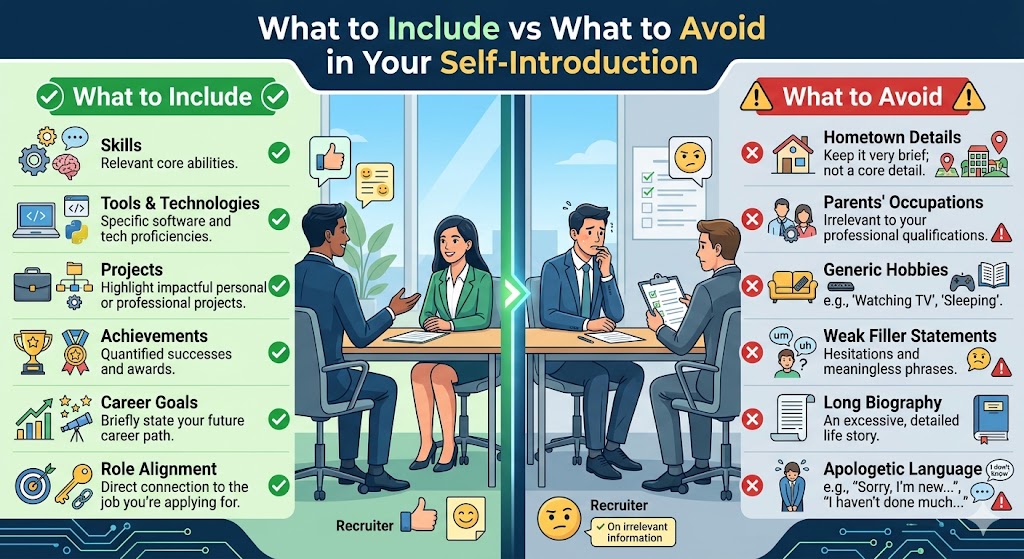
What to include
A strong opening line that does not start with your name
The interviewer already knows your name. Starting with “My name is…” is the most predictable opener in every interview room. Open instead with a statement of professional identity what you are and what you do.
“I am a full stack developer with hands-on experience building web applications using the MERN stack…”
“I am a digital marketing trainee who has spent the last six months specializing in SEO, content strategy, and Meta advertising…”
That first sentence immediately reframes the answer from a personal introduction to a professional one. It sets a confident, focused tone for everything that follows.
Specific skills and tools, named precisely
Generic claims like “I am good at technology” or “I have strong marketing skills” mean nothing to an interviewer who has heard them forty times that week. Name the actual tools: React.js, Node.js, MongoDB, Figma, Google Analytics, Power BI. Specificity signals genuine knowledge.
A project or achievement that proves your skills
One concrete example described in one sentence does more for your credibility than five minutes of claimed competence. “I built a fully functional job portal application with real-time notifications and a role-based dashboard” tells the interviewer you can actually deliver. “I have worked on various projects” tells them nothing.
A clear statement of what you are looking for
End your answer by connecting your current skills and direction to this specific role. Do not make it generic “looking for an opportunity to grow” sounds like every other candidate. Make it specific to them.
“…which is why this junior developer role at your company is a strong fit your focus on product-based development aligns directly with the kind of work I want to build my career on.”
What to cut
Your hometown, your parents’ occupations, your school’s name, and your hobbies do not belong in a professional interview answer unless specifically asked for. These details are irrelevant to the hiring decision and waste the most valuable ninety seconds of your interview.
Your CGPA, unless it is exceptional. If it is not something that helps you, do not volunteer it here there are better moments in the interview to address it if needed.
Filler phrases that pad without adding value. “I am a hardworking individual.” “I am a quick learner.” “I am passionate about my work.” Every candidate uses these phrases. They register as nothing. Replace every claim with evidence.
Confidence isn’t about having all the answers—it’s about communicating your value clearly and professionally
The Delivery Is Half the Answer
You can have the perfect script and still lose the interview if the delivery is wrong.
Pace
Most nervous candidates speak too fast. Rushing signals anxiety and anxiety is contagious. Speak at about seventy percent of your natural conversational speed. Slow feels confident. Fast feels desperate.
Eye contact
In a panel interview, distribute eye contact across everyone. Staring at one person or avoiding eye contact entirely both feel uncomfortable. Natural, balanced eye contact signals composure.
Do not apologize for your answer
Never end with “I hope that was okay” or “Sorry if that was not what you wanted.” These phrases undo everything confident you just said. End on your closing line and stop there.
The pause before you begin
A two-second pause after the question is not weakness it is presence. It signals thoughtfulness, not hesitation. That pause alone communicates calmer than anything you can say.
A Complete Sample Answer for a Fresher Developer
Here is what a well-built answer sounds like for a fresher applying for a junior developer role:
“I am a full stack developer trained in the MERN stack React.js, Node.js, Express, and MongoDB. Over the past six months, I completed a structured development program where I built two live projects: a task management application with user authentication and a role-based dashboard, and a fully functional e-commerce platform with payment integration using Razorpay.
During that time, I also worked with GitHub for version control, learned to build and consume REST APIs, and developed a strong foundation in responsive UI design using Tailwind CSS.
I am looking for a junior developer role where I can contribute to real product development from day one. Based on what I have read about your team’s work, I believe this role is a strong match for where I want to grow and I am confident that I can add value quickly.”
That answer is ninety seconds. It is specific. It has a beginning, a middle, and an end. It names real skills, real projects, and real tools. It ends with a connection to the role. There is no hometown, no CGPA, no apology, and no filler just a clear, confident, professional introduction that does exactly one job: make the interviewer want to ask the next question.
Practice your story, showcase your skills, and walk into every interview ready to stand out
How Learn2Earn Labs Prepares You to Walk in Ready
The difference between a candidate who fumbles this question and one who delivers it with confidence is not talent. It is preparation.
At Learn2Earn Labs, interview preparation is not a last-day session. It is a structured, repeated process built into the program from the start because no amount of technical skill converts into an offer letter if a candidate cannot communicate their value in an interview room.
Students go through multiple rounds of mock interviews HR and technical with feedback that is specific, honest, and actionable. The “tell me about yourself” answer is workshopped individually, not just explained theoretically. It needs to reflect each student’s actual projects, actual skills, and actual direction and it needs to sound like a person talking, not a person reciting.
Programs at Learn2Earn Labs Full Stack Web Development, React Native, Digital Marketing, Data Analytics, AI and Data Science, Business Development are built to give students the live project experience that makes the “present” section of their answer genuinely compelling. The best answer to this question is backed by real work. Real work is exactly what Learn2Earn Labs trains students to produce.
With 12+ years of experience and alumni placed at TCS, Accenture, Cognizant, Infosys, and Nagarro, the team knows what it takes to walk out of that room with an offer.
Visit learntoearnlabs.com or write to team@learntoearnlabs.com
Conclusion: Sound Like Yourself, Not Like Everyone Else
Every candidate in that waiting room has prepared for “tell me about yourself.” Most of them prepared the same answer name, hometown, college, CGPA, hobbies. The one who stands out is not the one with the best resume. It is the one who walks in with a clear, specific, confident narrative and delivers it like a professional who knows exactly what they offer and exactly why they are right for this role.
That answer is not born in the moment. It is built in preparation with structure, with specifics, with practice, and with the genuine self-awareness that comes from having actually built something worth talking about.
Build the answer. Practice it out loud. Then go and prove it right.
Conclusion: Sound Like Yourself, Not Like Everyone Else
Every candidate in that waiting room has prepared for “tell me about yourself.” Most of them prepared the same answer name, hometown, college, CGPA, hobbies. The one who stands out is not the one with the best resume. It is the one who walks in with a clear, specific, confident narrative and delivers it like a professional who knows exactly what they offer and exactly why they are right for this role.
That answer is not born in the moment. It is built in preparation with structure, with specifics, with practice, and with the genuine self-awareness that comes from having actually built something worth talking about.
Build the answer. Practice it out loud. Then go and prove it right.
FAQ’s
Q1. How long should a Tell Me About Yourself answer be?
Ideally between 60 and 90 seconds. Long enough to communicate value but short enough to maintain attention.
Q2. What is the best structure for answering Tell Me About Yourself?
The Past-Present-Future framework is one of the most effective approaches because it creates a clear and logical narrative.
Q3. Should I mention my hobbies in Tell Me About Yourself?
Generally no, unless they are directly relevant to the role or interviewer specifically asks about them.
Q4. Can freshers answer Tell Me About Yourself without work experience?
Yes. Freshers should focus on education, training, projects, skills, certifications, and career goals.
Q5. What is the biggest mistake candidates make?
Reciting a memorized script or giving a personal biography instead of focusing on professional value.