Home » Career » How to Write a Resume When You Have No Work Experience at All

How to Write a Resume When You Have No Work Experience at All

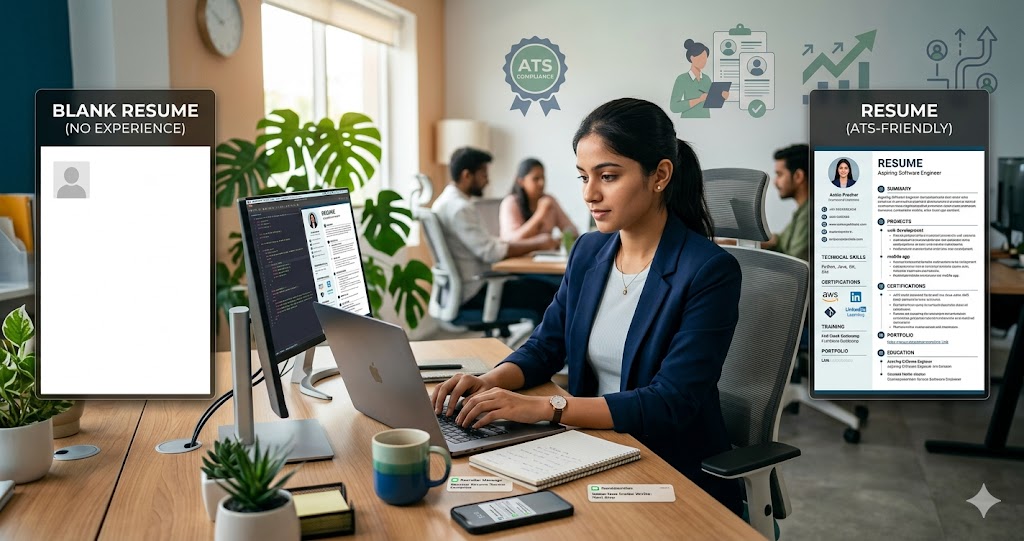
Fresher creating a professional ATS-friendly resume highlighting skills, projects, and certifications despite having no work experience

Everyone Starts with a Blank Page. What You Put on It Is the Difference

Every working professional you admire once sat exactly where you are staring at a blank resume document with no job title to list, no company to name, and no experience section to fill.

The blank page is not a problem unique to you. It is the universal starting point. The people who built strong careers from it did not wait for experience to arrive. They understood one critical truth: a resume is not a record of your past. It is a marketing document for your future.

That shift from “what have I done” to “what can I offer” is what separates a forgettable fresher resume from one that earns a recruiter’s attention when they have 200 profiles to review.

This is your complete, practical guide to building a resume that gets you shortlisted without a single day of formal work experience.

Every experienced professional started with no experience. What matters is how effectively you showcase your skills and potential

Why Most Fresher Resumes Fail Before They Are Read

Before building something better, understand why most fresher resumes fail.

The most common mistake is treating a resume like a school assignment filling every section with whatever exists and hoping volume impresses someone. Academic clubs nobody cares about. Participation certificates from college events. A hobbies section listing reading, travelling, and music.

None of this tells a recruiter what you can do for their company. And that is the only question your resume needs to answer.

The second mistake is using a template without understanding what each section is for. A template is a structure. What goes inside requires strategy. Most freshers fill it with the first things that come to mind producing a resume that looks complete and says nothing.

The rule that should guide every decision: every line on this page must answer “why should we hire this person?”  directly or indirectly. If it does not, it does not belong.

Section by Section: What to Write and What to Leave Out
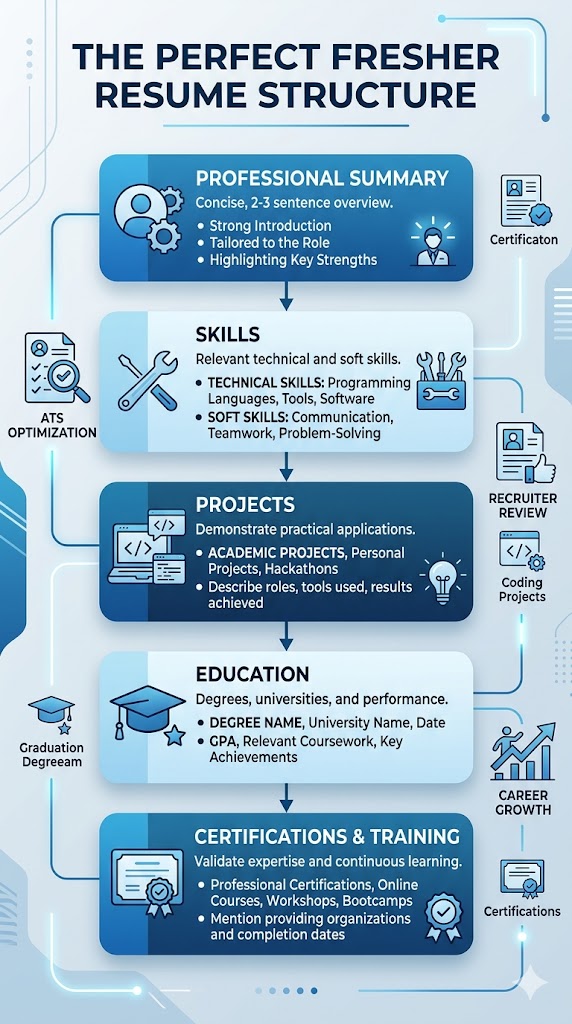
Infographic showing the ideal structure of a fresher resume including summary, skills, projects, education, and certifications

Professional Summary Your Opening Argument

Most freshers leave this blank or write “seeking a challenging position in a dynamic organization.” That sentence says nothing. Every applicant in the world could write the same thing.

Your summary needs to do three things: state who you are professionally, mention your strongest skill or area of expertise, and signal the role you are targeting.

Example for a fresher with training: “Full Stack Web Development trainee skilled in React.js, Node.js, and MongoDB. Completed two live projects including a functional e-commerce platform. Actively seeking a junior developer role where I can contribute immediately and grow technically.”

Three sentences. A recruiter knows exactly who you are, what you have done, and what you want. That clarity alone puts you ahead of 80 percent of the fresher resumes they will read that day.

Skills The Section That Gets You Found

This section is critically important for two reasons. First, it tells a recruiter immediately what tools and technologies you know. Second, it determines whether your resume surfaces in ATS searches, because recruiters use these exact skill names as search filters.

List only relevant, verifiable skills. If you are applying for a developer role, list your programming languages, frameworks, databases, and tools precisely as companies name them in job descriptions. React.js, not “frontend development.” Node.js, not “backend technologies.” MongoDB, not “database management.”

For a digital marketing fresher: SEO, Google Analytics, Meta Ads Manager, Canva, Email Marketing, Content Writing. Named specifically, not described vaguely.

Do not list soft skills like “good communication” or “team player” in this section. Recruiters do not search for those, and listing them here weakens the credibility of your technical skills section.

Projects Your Most Powerful Section

If you have no work experience, your projects section is your experience section. This is where the interview is won or lost for freshers, and most candidates dramatically underuse it.

For every project, include the name of the project, the technology stack, what the project does, what your specific role was, and any outcome or feature worth highlighting. If it is deployed or on GitHub, include the link.

Weak project entry: “Developed a website as part of college project.”

Strong project entry: “E-Commerce Web Application | React.js, Node.js, Express.js, MongoDB Built a fully functional e-commerce platform with user authentication, product search and filtering, cart management, and Razorpay payment integration. Deployed on Render. GitHub: [link]”

The second entry shows a recruiter a technology stack they recognize, a feature set that demonstrates real skill, and a deployed product they can actually visit. That entry alone described this way is worth more than a CGPA of 8 on a resume with no projects.

Include two to four projects. Quality and specificity over quantity. One well-described project is far more powerful than five vague ones.
A recruiter doesn’t hire your past experience alone—they hire the value you can bring from day one

Education Present It Cleanly, Do Not Bury Yourself in It

For freshers, education is typically the first section but only if you have nothing stronger to lead with. If you have relevant training, certifications, or strong projects, those can lead.

In the education section, list your degree, institution, graduation year, and CGPA  if your CGPA is above 7. If it is below 7, you can omit it from the resume entirely. It is not mandatory to include it, and in many cases, leaving it out is the smarter choice.

Do not pad the education section with every subject you studied or every exam you appeared for. Keep it clean: degree name, specialization, institution, year, and CGPA if it helps you.

Certifications and Training the Section That Replaces Experience

This is the section most fresher resume guides neglect, and it is one of the most valuable sections you can build.

Certifications from recognized platforms Google, HubSpot, Meta, Coursera, LinkedIn Learning signal initiative and domain interest to a recruiter. A structured training program from a credible institute signals practical, job-focused learning that goes beyond a degree.

List every certification and training program that is relevant to your target role. Include the name of the certification, the issuing organization, and the year. If the training involved live projects, mention that in a single line underneath.

This section is what transforms a resume that says “student with no experience” into a resume that says “person who took initiative, learned the right skills, and built real things.” That is a fundamentally different candidate in a recruiter’s mind.

What to Cut Completely

Every section that does not serve your candidacy for the specific role you are applying for. That includes:

A “hobbies and interests” section, unless a hobby is directly relevant to the role. Generic interests’ cricket, music, Netflix contribute nothing.

An “objective” section that restates the obvious. “I want to work at a good company and learn and grow” is not an objective. It is noise.

A long list of participation certificates from unrelated college events. One or two achievements that show leadership or initiative are fine. Ten certificates from rangoli competitions and cricket tournaments are not.

References “available upon request.” This phrase wastes space and adds nothing. If a company wants references, they will ask.

Every word you remove that does not earn its place gives more space and weight to the words that do.

The One Resume Mistake That Kills Freshers’ Chances in ATS

Formatting.

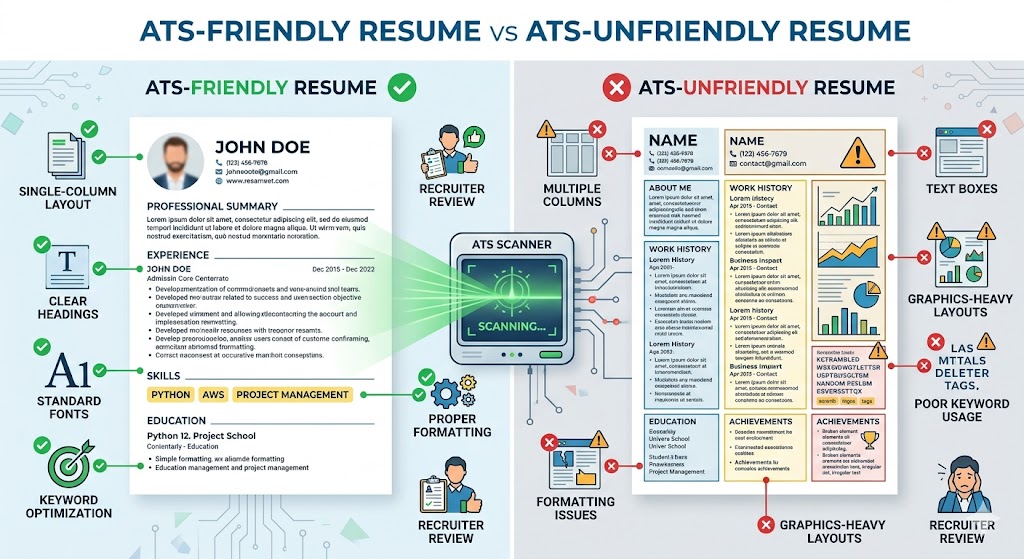
Many students use visually impressive templates with columns, text boxes, and graphics. They look great to a human. They are catastrophic when parsed by an ATS.

An Applicant Tracking System reads your resume as plain text. Complex column layouts get read sideways your name, phone number, and a skill might land on the same parsed line. Your project description might merge with your education. The result is a strong resume that gets filtered out before any human sees it.

Use a clean, single-column layout. Standard headings. Clear fonts Calibri, Arial, or Georgia. Consistent formatting. Save as a PDF. That is the resume that clears ATS and reaches a recruiter.

Build real-world projects, develop in-demand skills, and create a resume that opens doors to opportunities

How Learn2Earn Labs Builds Fresher Resumes That Actually Get Shortlisted

At Learn2Earn Labs, resume building is not a last-day session. It is an outcome built throughout the entire training program.

Every student who completes a program whether in Full Stack Web Development, React Native, Digital Marketing, Data Analytics, AI and Data Science, or Business Development finishes with live projects they have actually built, demonstrable skills, and a resume reviewed against real recruiter standards.

The review process is specific: professional summaries checked for clarity, project descriptions reviewed for technical depth, skills sections verified against what companies in that field actually search, and ATS compatibility confirmed throughout. Every section is evaluated against one question does this give a recruiter a clear reason to shortlist this candidate?

Beyond the resume, Learn2Earn Labs covers LinkedIn optimization, mock HR and technical interviews, and placement support that continues until an offer is received. The goal is never a certificate. The goal is an offer letter.

With 12+ years of experience and alumni placed at TCS, Accenture, Cognizant, Infosys, and Nagarro, Learn2Earn Labs knows exactly what a fresher resume needs to do and ensures every student leaves with one that does it.

Visit learntoearnlabs.com or write to team@learntoearnlabs.com

Conclusion: Experience Is Not What Gets You the Interview Evidence Does

No recruiter expects a fresher to have years of work history. What they expect what they are hoping to find when they open your resume is evidence that you can do the job.

That evidence lives in your projects. Your skills. Your certifications. Your training. Your professional summary. Every section of your resume is an opportunity to present that evidence clearly, specifically, and compellingly.

The blank page is not a barrier. It is an invitation to build something from scratch just like the career you are about to start.

Write a resume that makes the argument for you. Then go and prove it right.

FAQ’s

Q1. Can I get a job without any work experience?

Yes. Recruiters often hire freshers based on skills, projects, certifications, internships, and training rather than formal work experience.

Q2. What should I put on a resume if I have no experience?

Include a professional summary, relevant skills, projects, certifications, training, education, and portfolio links.

Q3. How many projects should a fresher include on a resume?

Two to four well-documented projects are generally enough if they demonstrate relevant skills and technologies.

Q4. Should freshers create ATS-friendly resumes?

Yes. Most companies use Applicant Tracking Systems (ATS), so a simple, keyword-optimized format improves visibility.

Q5. Can certifications replace work experience?

Certifications alone cannot replace experience, but combined with projects and practical training they significantly strengthen a fresher’s profile.

Leave a Reply