
AI-Integrated Industry Training:
Web Development, Data Analytics, Digital Marketing, Java & Python
|
2 Months Practical Training + 1 Month Internship
|
Fee:
₹9,999 per Program
|
Apply Now

First, Understand Why Companies Set CGPA Cutoffs
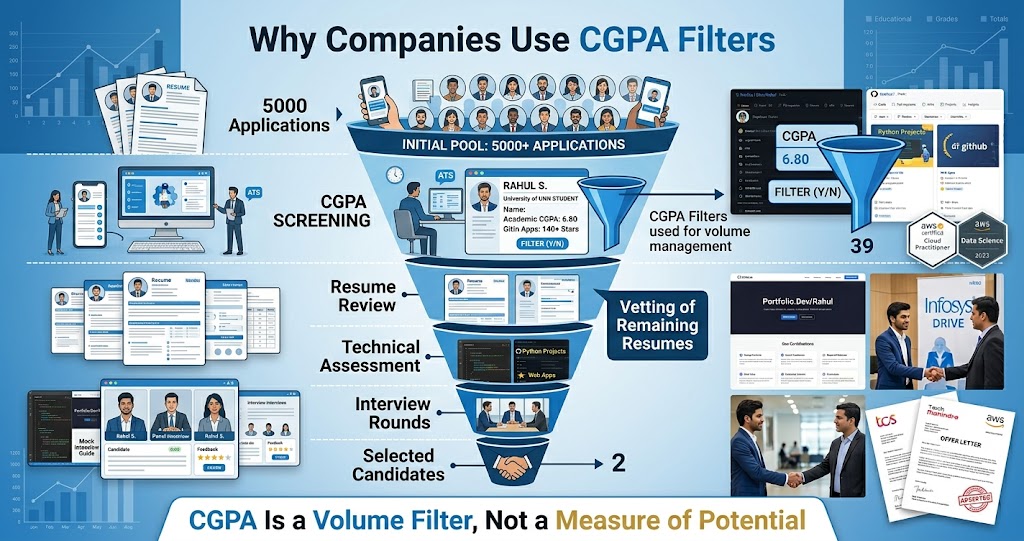
Most companies that set a CGPA cutoff do not actually believe grades perfectly predict performance. They do it because they receive thousands of applications and need a fast way to reduce volume.
CGPA is a lazy filter. Fast, scalable, and defensible but not accurate.
Knowing these matters because it changes your approach. The cutoff is not a verdict on your ability. It is a volume management tool. And there are ways around it through referrals, off-campus applications, internship pathways, and by building a profile so strong that hiring managers override the filter because they do not want to lose you.
Step 1: Accept the Reality and Stop Wasting Time on Regret
The grades are done. Spending energy on regret takes it away from building what actually matters now.
Every week in paralysis is a week a classmate with similar grades but a stronger project portfolio gets further ahead. The gap between a student who acts in the next three months and one who waits is not three months it is often years of career trajectory.
The students who crack placements with low CGPA did not find a magic trick. They decided to compete on a different battlefield. Not grades skills. Not transcripts evidence. Make that decision now.
Step 2: Build Skills That Are Immediately Visible and Verifiable
This requires honest self-assessment. What can you actually do right now not what you studied, but what you can build, execute, or deliver that a company would pay for?
If the answer is “not much yet,” that is not a permanent state. That is a starting point.
Companies that hire without a CGPA filter and there are many in tech, digital marketing, and business development are looking for one thing above all else: proof. A working application. A real marketing campaign result. A data dashboard built from scratch. A mobile app deployed to a store.
Proof beats grades every time in an interview room. A recruiter sitting across from a student who says “I built this e-commerce platform here is the GitHub link, here is the tech stack, here is what I solved” is not thinking about CGPA. They are thinking about whether they can deploy this person from day one.
Building that proof means structured, project-based learning not just tutorials. It means completing something real and being able to discuss every decision you made.
Step 3: Build a Resume That Leads With Strength
Students with low CGPAs often make a critical mistake on their resume: they put their education section first, leading immediately with the number that hurts them most.
Restructure your resume to lead with your strengths.
Start with a strong professional summary two to three lines that say who you are, what you can do, and what you are looking for. Follow with a skills section that lists every relevant tool and technology you have worked with, named precisely as companies name them in job descriptions. Then put your projects described with specificity, stack details, and outcomes. Push your education to the bottom.
By the time a recruiter reaches your CGPA, they have already seen what you have built and what you can do. The number carries a fraction of the weight it would have carried if it appeared first.
This is not manipulation. It is smart presentation. You are leading with your strongest arguments, not your weakest.
Step 4: Own Your CGPA in the Interview Do Not Hide From It
This is where most low-CGPA students lose interviews they could have won. They get nervous the moment grades come up. They apologize. They over-explain. They look defensive. And that defensiveness signals to the interviewer that the student has not grown past it.
When your CGPA comes up, acknowledge it directly, give it one honest sentence of context, and immediately redirect to what you have done since: “My grades were not where I wanted them I struggled with the theoretical exam format. But in parallel, I focused on building real projects and completed a structured training program. I can show you exactly what I built. I believe the work speaks more accurately to what I can do.”
That answer shows self-awareness, honesty, and most importantly evidence of action. It does not dwell. It moves forward. That is what a high-performing professional does with a setback, and interviewers notice.
Practice this out loud until it sounds natural. Own the narrative rather than being owned by it.
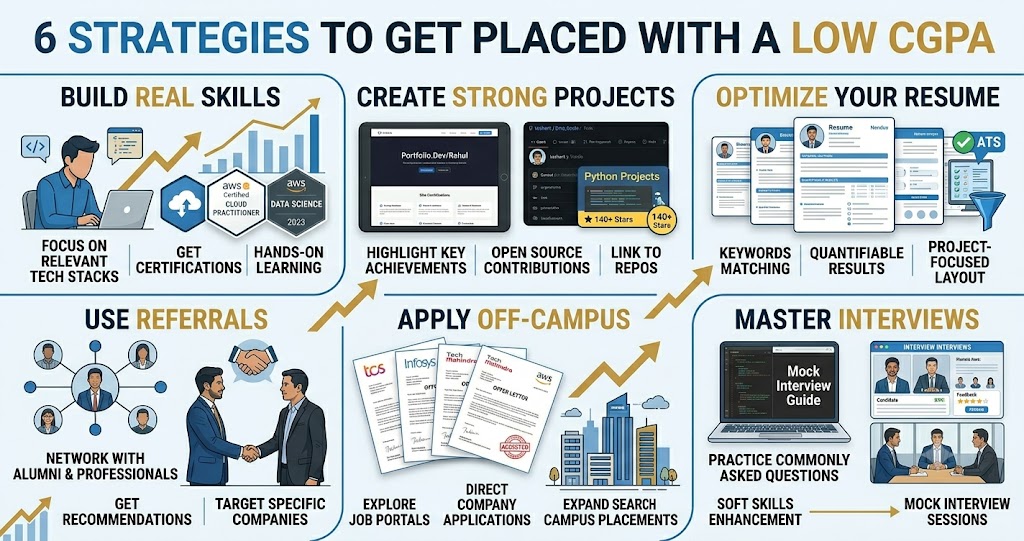
Step 5: Target the Right Companies and the Right Entry Points
Not every company uses CGPA as a filter. And not every entry point into a company is through the front door of mass campus recruitment.
Off-campus applications often have more flexible requirements than on-campus drives. Many companies that filter you out on-campus will consider a strong profile submitted directly.
Startups and mid-size companies care far more about what you can do than what you scored and they are often where motivated, skilled people grow fastest.
Internship-to-full-time pathways are one of the most overlooked routes for low-CGPA students. An internship bypasses the academic filter and gives you a chance to demonstrate real ability in a live environment.
Referrals carry significant weight. When someone inside a company vouches for you, the CGPA filter is frequently set aside entirely. Build relationships with placed seniors, trainers, and professionals on LinkedIn. A credible referral does more than any grade correction ever could.
Step 6: Prepare for Technical and HR Rounds at a Different Level
If you have a low CGPA and you want to impress, you cannot be average in your interview. Average will not overcome a low-grade filter. You need to be genuinely impressive technically sharp, clearly articulate, and confident.
That means real, structured interview preparation. Not just watching YouTube videos. Actual mock interviews with real feedback. Technical rounds where your code is reviewed and explained, not just written. HR rounds where you practice your narrative, handle tough questions, and learn to communicate your value clearly.
The students who crack placements despite low grades are not the ones who got lucky. They are the ones who prepared harder than everyone else because they knew they did not have the cushion of a high GPA to fall back on.
Treat every mock interview like the real thing. Record yourself answering questions and watch it back. Get feedback from people who know what companies actually look for. Iterate. Improve. Go in ready.