Home » Career » Internship vs Training Program: What Actually Strengthens Your Resume?

Internship vs Training Program: What Looks Better on a Fresher’s Resume?

Indian fresher comparing an internship and a project-based training program to build a stronger resume

Everyone tells you to get an internship. Nobody asks whether it is actually helping you.

Ask any college student what they should be doing during holidays or final year to improve their prospects, and the answer is almost universal: get an internship. The advice is everywhere – every career blog, every placement officer, every LinkedIn post.

And internships can be genuinely valuable. But there is a conversation almost nobody is having, and it is the one that actually matters for most students in India right now.

Not all internships are created equal. A large number of freshers spend two to three months observing meetings they cannot contribute to, updating spreadsheets, and receiving a certificate that says “Intern” – without learning anything a recruiter finds impressive, and without building anything they could show.

Meanwhile, a well-structured training program – one that teaches real skills, builds live projects, and ends with something demonstrable – can do more for a fresher’s resume than a passive internship where nobody had time to teach them.

This blog is not anti-internship. It is pro-clarity. It breaks down what each option actually does for your resume, what recruiters look for when they see either, and how to decide based on where you are right now.

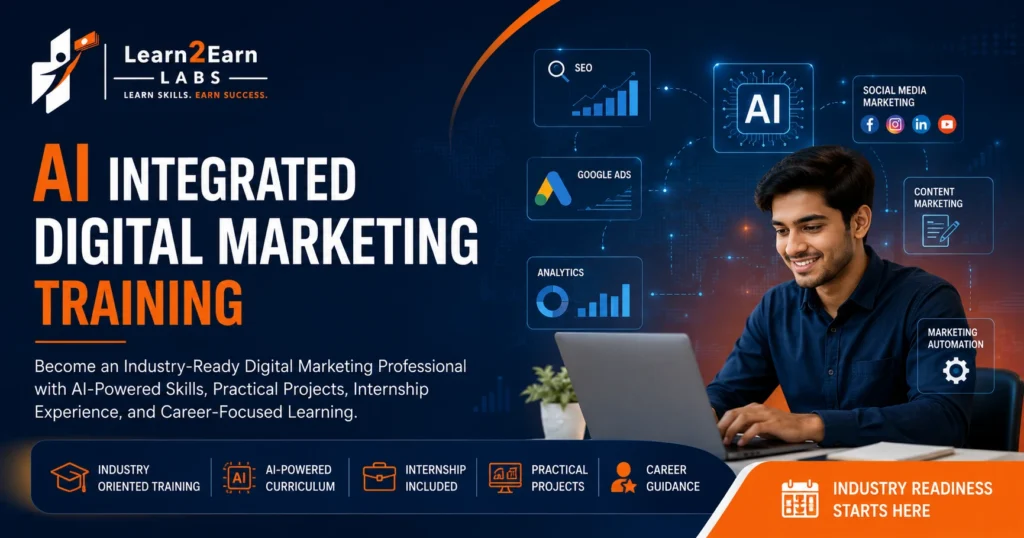
Learn2Earn Labs AI Integrated Digital Marketing Training banner featuring AI-powered marketing skills, SEO, Google Ads, social media marketing, analytics, automation, practical projects, internship experience, and career-focused learning.

AI Integrated Digital Marketing Training

Build practical skills in SEO, Google Ads, Social Media Marketing, Analytics, Content Marketing, and AI-powered workflows through projects, live classes, internship exposure, and industry-focused learning.

What a recruiter actually sees when they look at your resume

Before comparing the two, understand the lens a recruiter uses.

When a recruiter sees “Internship – ABC Company, June–August 2024,” they ask one question: what did this person actually do there, and what can they do now because of it?

The title and company name are almost irrelevant at the fresher level. What matters is the description underneath – and what the candidate can demonstrate in an interview room.

A fresher who interned at a well-known company but cannot articulate what they built or the tools they used is a weaker candidate than one who completed a rigorous training program, built two live projects with real functionality, and can explain every decision they made.

The resume line is not the destination. What it enables – the conversation, the demonstration, the proof – is what actually changes shortlist rates.

What internships offer – and where most of them fall short

A good internship offers something no training program can replicate: real work environment, real team dynamics, real deadlines, and organisational culture. When it works well, an intern contributes to actual projects, receives mentorship, and builds contextual understanding that is difficult to develop anywhere else. That experience is genuinely valuable.

The problem is that this version of an internship is the exception, not the norm – particularly for freshers in India with no prior experience and limited networks.

Most internships available at this level involve tasks too simple to develop real skill, insufficient mentorship because the team is busy, no access to real tools or data, and no meaningful project to show. The intern gets exposure – to the office, to meetings – but not depth.

Depth is what a resume needs. Not a logo.

Internships are also often unpaid or minimally paid – making three months without income a real financial cost, especially for students from Tier-2 and Tier-3 cities. Three months that produces a vague certificate and no demonstrable skill is an expensive outcome.

What a structured training program offers – and where it genuinely wins

A well-designed training program is built with one goal that internships often lack: producing a specific, verifiable learning outcome within a defined timeframe.

The best AI-integrated programs in technology, digital marketing, data analytics, and business development are structured around real projects, real tools, and real deliverables. Students do not just learn concepts – they apply them, build with them, and finish the program with something they can show in a portfolio and speak about confidently in an interview.

From a recruiter’s perspective, a resume that says “Built a full stack e-commerce application using React.js, Node.js, and MongoDB – deployed on Render, includes payment integration and user authentication” is more compelling than “Software Development Intern – assisted development team with various tasks.” The first tells a recruiter exactly what the candidate can do. The second tells them almost nothing.

Training programs also offer something unstructured internships rarely do: curriculum. A thoughtfully designed program teaches skills in sequence, building earlier concepts into more complex applications – ensuring genuine competence, not just exposure.

For freshers with no prior experience, career-changers, or non-technical graduates entering technology or marketing, a structured training program is often the fastest and most reliable path to being genuinely job-ready.
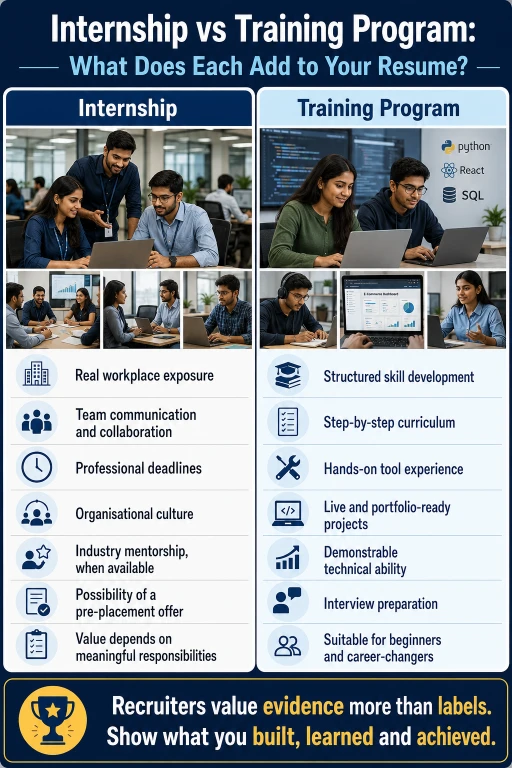
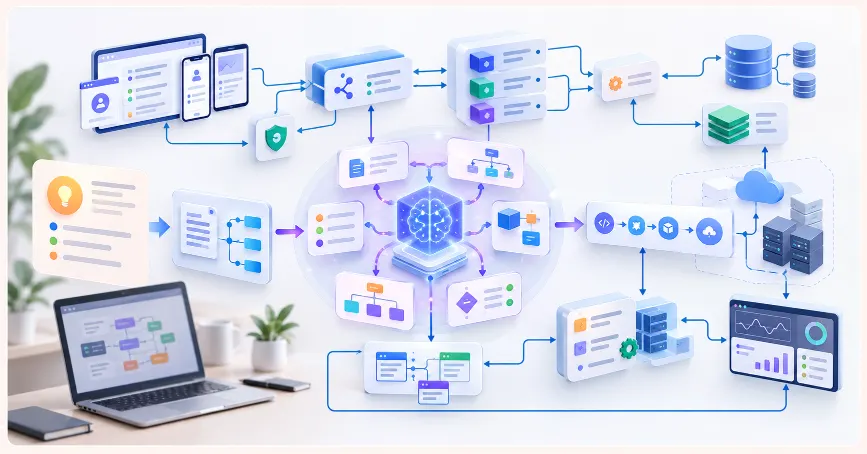
Comparison of internships and training programs based on skills, projects, mentorship, workplace exposure and resume value

When an internship is genuinely the better choice

There are situations where an internship is clearly the better option.

If the role offers real mentorship and meaningful work – part of an actual project team, given ownership of a deliverable, taught by professionals with time for you – take it without hesitation. If it is at a company with strong brand recognition and a defined set of responsibilities, particularly one that leads to a pre-placement offer, that experience carries genuine weight.

If you are in your final year with foundational skills already in place and need corporate exposure more than new skills, an internship makes more sense than additional training. And if it is paid, structured, and in your target domain – almost always worth pursuing.

The key question to ask before accepting any internship: what will I have built or learned by the end that I can show and speak to in an interview? If you can answer that concretely, take it. If the honest answer is “I am not sure” – look more carefully before committing three months.

The most powerful answer: both – in the right sequence

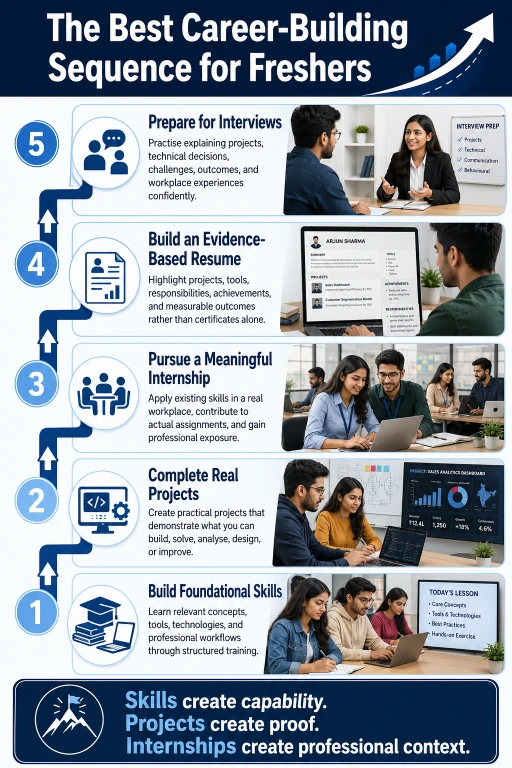
The students who build the strongest fresher profiles almost always follow a sequence rather than choosing one or the other.

They start with a structured training program that builds genuine, demonstrable skills and produces live projects they can show. From that foundation, they pursue internships – and because they now have real skills, they are competitive for internships that offer actual responsibility rather than just observation. The internship then adds the corporate exposure layer on top of a skills foundation that is already solid.

This sequence – skill first, exposure second – produces a resume with both depth and context. The training program provides the proof of ability. The internship provides the proof of professional readiness. Together, they answer the full set of questions a recruiter has at the fresher level.

The reverse sequence – internship first, training later – often produces a resume with exposure but no depth, and training that comes too late to be reflected in the most recent and visible part of the resume.
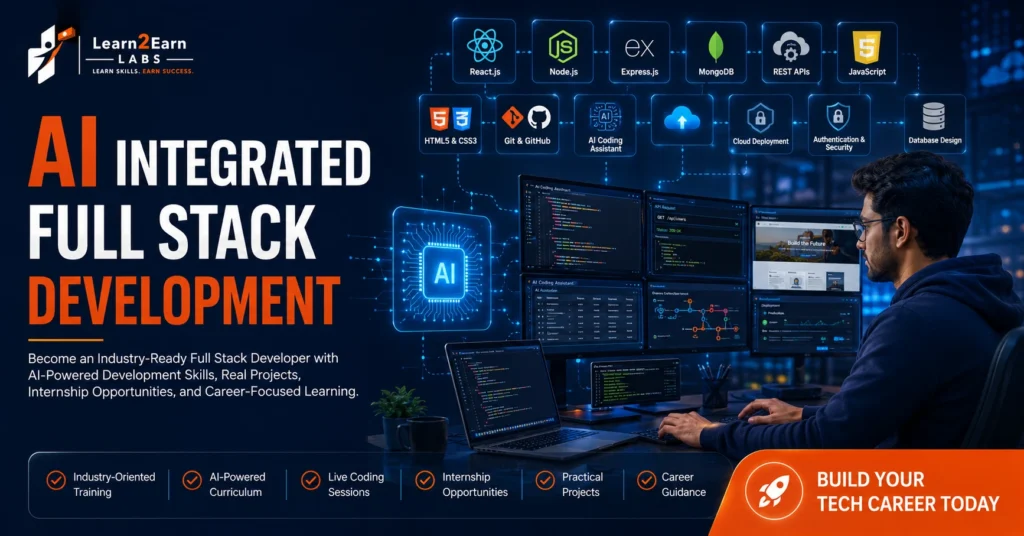
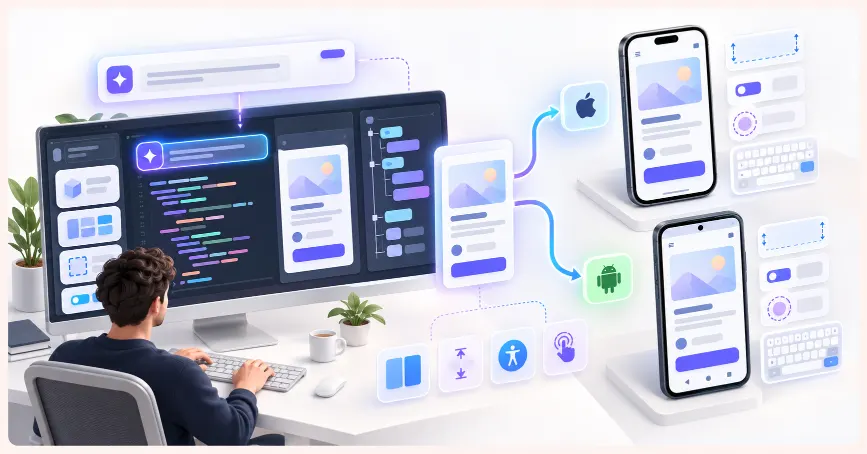
AI Integrated Full Stack Development training with React Node.js MongoDB and AI tools at Learn2Earn Labs

AI Integrated Full Stack Development Training

Master HTML, CSS, JavaScript, React, Node.js, Express.js, MongoDB, REST APIs, and AI-powered development workflows through live coding, practical projects, internship opportunities, and career-focused training.

How to present either option on your resume for maximum impact

Regardless of which path you have taken, how you describe it on your resume matters as much as what you did.

For an internship: never write “assisted with” or “helped the team with.” Write what you specifically did, what tools you used, and what the outcome was. If you contributed to a campaign, describe the campaign. If you worked on a feature, describe the feature. Specificity is what converts a vague resume line into a convincing one.

For a training program: lead with the project, not the program name. The project you built is the evidence. The program name is the context. A recruiter cares more about what you built than where you learned to build it – so put the project description first and mention the training program as the context in which you built it.

In both cases, the rule is the same: evidence over claims, specifics over generalities, demonstration over description.

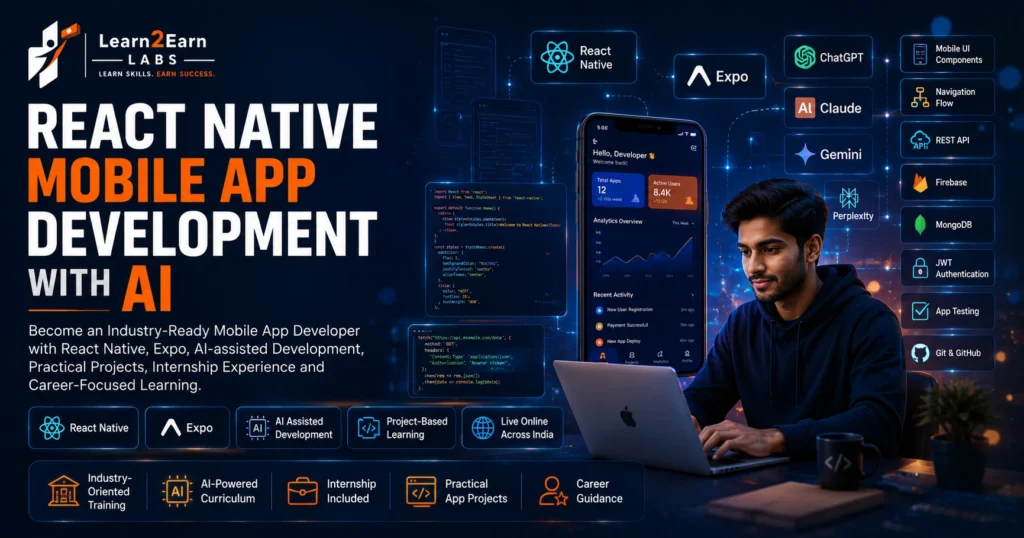
Student learning React Native mobile app development with AI, Expo, APIs, and practical projects at Learn2Earn Labs.

AI Integrated React Native Mobile App Development Training

Build a job-ready mobile app development profile through practical coding, industry-style projects, AI-assisted workflows, career preparation, mentor-guided learning, real-world app deployment, API integration, and hands-on portfolio development.

How Learn2Earn Labs bridges the gap between training and real-world readiness

At Learn2Earn Labs, the training programs are built specifically to close the gap that passive internships often leave open.

Every program – Full Stack Web Development, React Native Mobile App Development, Digital Marketing, Data Analytics, AI and Data Science, and Business Development – is designed around live projects, real tools, and demonstrable outcomes. Students do not leave with a certificate that says they attended. They leave with projects they built, skills they can demonstrate, and a resume that gives a recruiter something specific and compelling to shortlist.

The AI-integrated curriculum ensures that students are not just learning the technical fundamentals – they are learning to work the way the industry currently works, using the tools that companies are actually using, building with the workflows that real teams use every day.

Career counselling at Learn2Earn Labs helps every student understand not just what to learn, but how to present what they have learned in a way that actually produces interview calls. Resume reviews, LinkedIn optimisation, mock interviews, and placement support are all part of the program – not afterthoughts.

Alumni from Learn2Earn Labs have been placed at companies including TCS, Accenture, Cognizant, Infosys, and Nagarro. That track record is the clearest evidence of what structured, outcome-focused training produces when it is done properly.

With decades of experience preparing students for careers in technology, marketing, and business, Learn2Earn Labs understands exactly what a fresher resume needs – and builds every student toward that standard from day one.

If you are a student weighing your options and trying to figure out the fastest, most reliable path to a job offer – speak with the team at Learn2Earn Labs. The conversation is free. The clarity it produces is worth far more.

Visit learntoearnlabs.com or write to team@learntoearnlabs.com

Conclusion

An internship title on a resume does not get you shortlisted. A training program certificate does not get you shortlisted. What gets you shortlisted is evidence – specific, demonstrable proof that you can do the job.

Whether that evidence comes from a well-structured internship or a rigorous training program matters far less than whether the evidence actually exists and whether you can speak to it confidently in an interview room.

Build the skills first. Build the proof. Present both clearly. The opportunity will follow.

Frequently Asked Questions

1. What looks better on a fresher’s resume: an internship or a training program?

Neither option is automatically better. A meaningful internship looks valuable when it includes real responsibilities, mentorship, tools, and measurable contributions. A structured training program can be stronger when it produces practical skills, live projects, and portfolio-ready work. Recruiters mainly evaluate what the candidate can demonstrate.

2. Can a training program replace an internship on a resume?

A strong training program can compensate for a lack of internship experience, especially for beginners and career-changers. However, it should include practical assignments, real tools, completed projects, and clear learning outcomes. A certificate alone is unlikely to create significant resume value.

3. Should freshers complete training before applying for internships?

For students who lack practical skills, completing structured training first can be beneficial. It helps them build projects and become eligible for internships that offer meaningful responsibilities. The ideal sequence is often skill development, project building, internship experience, and then job applications.

4. How should an internship be described on a resume?

Freshers should mention the specific tasks they completed, tools they used, projects they contributed to, and outcomes they helped achieve. Generic phrases such as “assisted the team” should be replaced with clear action-oriented descriptions that show individual contribution.

5. How should a training program be presented on a resume?

Lead with the projects and practical skills developed during the program. Mention the technologies, tools, features, challenges, and outcomes involved. The training provider can be included as context, but the main focus should remain on demonstrable work rather than the certificate.

Leave a Reply