AI-Integrated Industry Training:
Web Development, Data Analytics, Digital Marketing, Java & Python
|
2 Months Practical Training + 1 Month Internship
|
Fee:
₹9,999 per Program
|
Apply Now


Understanding what makes a YouTube script different from other content
A blog post rewards patience. A reader who skips a slow opening often returns when content gets useful. YouTube does not reward patience. A viewer bored at second twenty is gone — and their departure signals the algorithm to deprioritise the content. Click-through rate and audience retention are YouTube’s two most powerful organic ranking signals, and both are determined almost entirely by the script, not the production.
AI-generated video scripts cannot be structured like written content. The inverted pyramid does not work. Meandering introductions — which appear in a significant proportion of AI-generated scripts when prompts do not explicitly prevent them — are the single most common cause of early viewer drop-off.
A YouTube script must be structured around the viewer’s immediate emotional state: what they want right now, the fastest credible path to giving it, and how each segment rewards continued attention. Every section must earn the viewer’s stay for the next. This is not a writing principle — it is a psychological and algorithmic requirement. When AI prompts account for this, the output is different. When they do not, scripts look fine on the page and fail on the platform.
The five-component script structure that AI builds best
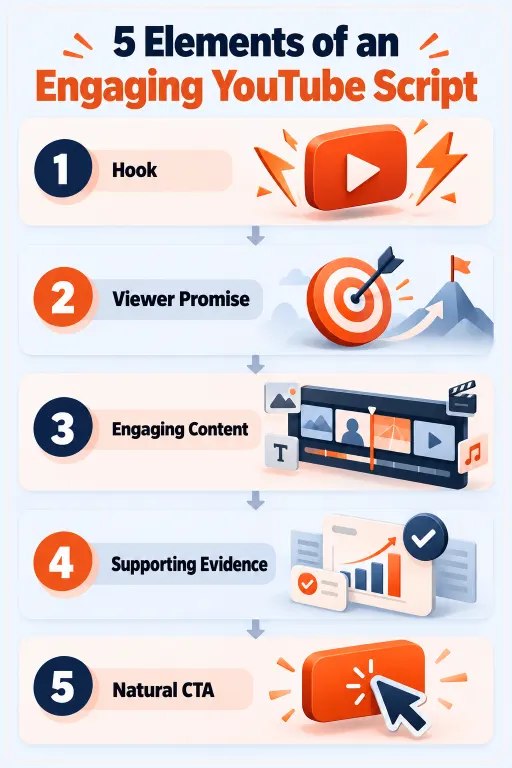
The most consistently high-retention YouTube video structure has five components: the hook, the promise, the content body with pattern interrupts, the evidence layer, and the call to action. Prompting AI to build each component deliberately — rather than generating the script as a single flowing document — produces significantly better output.
The hook (first 15-30 seconds) must create an immediate emotional response, establish the video is specifically for this viewer, and tease the most valuable content without revealing it. A hook that works is not an introduction. It is a provocation.
The promise (seconds 30-60) tells the viewer specifically what they will get and why it is worth their time — not vaguely (“we’re going to cover some great strategies”) but specifically (“by the end of this video, you will have a framework for X that you can apply today”).
The content body with pattern interrupts. Pattern interrupts — B-roll cuts, tonal shifts, rhetorical questions — are inserted every 60 to 90 seconds to reset viewer attention. In a script, these are written as explicit markers that tell the editor and presenter where shifts should occur.
The evidence layer. Specific examples, data points, and case studies that prove the claims in the body. This is where most AI scripts without good prompts become generic — they state principles without grounding them in evidence.
The call to action — stated once, clearly, integrated naturally into the value the video delivered rather than appended as an awkward request.
Prompt 1: The hook
The hook is where retention is won or lost. Prompt it separately before generating the rest of the script. Channel type and audience: [e.g. “digital marketing education channel targeting small business owners”]
Video topic: [specific topic]
Target keyword: [YouTube search term]
Generate 5 hook options, each using a different technique:
- Counterintuitive statement — contradict what the viewer expects to hear
- Specific result — open with a credible, specific outcome (with a number or timeframe)
- Problem-agitation — name the exact painful problem they are trying to solve right now
- Story — open with a specific moment or scenario the viewer will recognise
- Curiosity gap — create a gap between what they know and what they are about to learn
Each hook: 30-45 seconds spoken (75-100 words).
Do not start with “In this video,” “Today we’re going to,” the presenter’s name, or the channel name. End each hook with a sentence that leads naturally into a promised outcome.
Generating five options rather than one matters because the hook is the highest-leverage element in the script and the first option is rarely the best. Five options allows a deliberate choice, not a default acceptance.
Prompt 2: The promise and structure
Once the best hook is selected, generate the promise section and the overall structure of the body.
Selected hook: [paste chosen hook]
Generate:
- A 30-45 second promise section that:
– Tells the viewer specifically what they will learn or be able to do
– Names the number of sections/steps in the video (signals structure)
– Adds one credibility element for this topic
– Ends by teasing the most valuable point as the final reveal
- A content body structure:
– 3-5 main sections with clear titles
– For each: key point in one sentence, explanation approach, and where a pattern interrupt should be placed
– Which section contains the highest-value insight (to be saved for last)
- A one-sentence bridge transition between each section that keeps the viewer engaged through natural drop-off points
Teasing the most valuable point as the final reveal fights mid-video drop-off — if viewers know the best content is coming at the end, they have a reason to stay. This should be explicit in the promise: specific enough to be genuinely enticing.

Prompt 3: the full script with pattern interrupts marked
With the structure defined, generate the full body content with pattern interrupt markers already included.
Write the full video script for section [X]: [section title]
based on the hook, promise, and structure established.
Requirements:
- – Conversational spoken language (short sentences, contractions, informal transitions)
- – 130-150 words per minute pace — mark [PAUSE] where presenter pauses naturally
- – Mark pattern interrupts as [PATTERN INTERRUPT: type] (types: B-roll cut, on-screen text, rhetorical question, tonal shift, example story)
- – At least 2 specific examples with numbers, names, or verifiable results (not “some marketers” — specific, named, credible)
- – Avoid: passive voice, filler words (essentially, basically, kind of), sentences beginning with “So…”
- – End each paragraph with a question, surprising fact, or statement of mild tension (prevents viewer from feeling “done” mid-section)
- – Section length: approximately [X] minutes of spoken content
Marking pattern interrupt types explicitly separates a script from a draft. Without markers, the script is a text block an editor must interpret. With them, it is a production document — every cut, every B-roll moment, every tonal shift is planned.
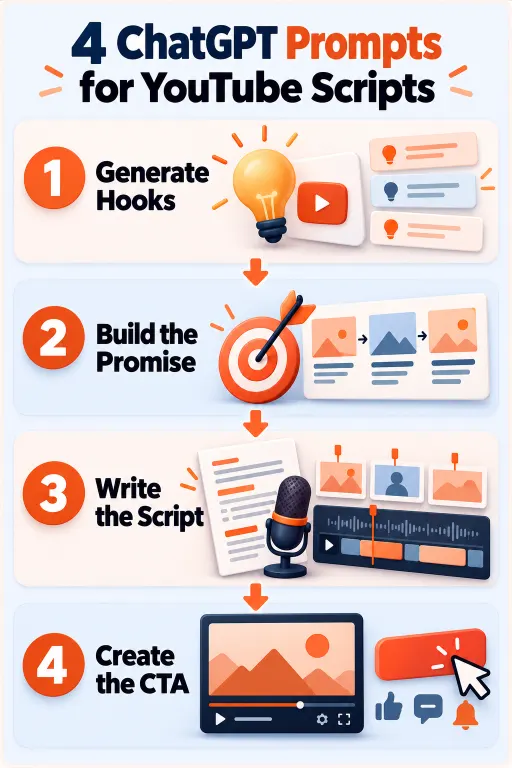
Prompt 4: the call to action that does not feel like a call to action
The CTA is the most frequently mishandled part of AI-generated YouTube scripts. A CTA that sounds like a CTA breaks the engagement the rest of the video built.
Generate the closing section of this YouTube video script.
Video covered: [brief summary]
Primary CTA: [subscribe / visit link / download / book call]
Requirements:
- – CTA feels like a natural extension of the value delivered, not a separate request
- – Refer back to something specific from the hook or body that the viewer now understands differently
- – State the CTA once only, with a specific reason to act now
- – End with a memorable final line — something quotable, not “see you in the next video”
- – Length: 30-45 seconds spoken
- – Do not use: “if you found this valuable,” “hit the like button,” “I appreciate your support,” or any variation
Referring back to the hook or body in the CTA creates the narrative closure that makes a video feel complete. A viewer who feels the video delivered on its promise is far more likely to subscribe than one who feels the value delivery ended before the closing section began.