
Home » Prompt Engineering » How to use ChatGPT to build a complete SEO content strategy: 6 practical prompts

How to use ChatGPT to build a complete SEO content strategy for any niche

Vector illustration of an AI-powered SEO content strategy workflow with keyword research, analytics, content planning and editorial calendar

What a content strategist used to charge ₹50,000 for, you can now build in a weekend

A few years ago, if a small business wanted a serious SEO content strategy — keyword research, content pillars, competitor gap analysis, editorial calendar — they hired a content strategist or went without. A proper strategy from a competent professional started at ₹40,000 to ₹60,000, with no guarantee it would be tailored to their specific niche or competition.

Most small businesses and freshly launched digital marketing professionals went without.

That gap has closed. Not because content strategists are no longer valuable — they are, especially at the execution layer — but because the intelligence-intensive structural work of building a strategy is now something any marketer who knows how to prompt correctly can produce in a fraction of the time and cost.

This blog walks through exactly how — using ChatGPT as the primary tool, with a six-prompt sequence that builds from niche definition to a fully populated editorial calendar, each step grounded in the output of the one before it. The prompts are specific, the framework is practical, and the output is a strategy you can act on the same week you build it.

Learn2Earn Labs AI Integrated Digital Marketing Training banner featuring AI-powered marketing skills, SEO, Google Ads, social media marketing, analytics, automation, practical projects, internship experience, and career-focused learning.

AI Integrated Digital Marketing Training

Build practical skills in SEO, Google Ads, Social Media Marketing, Analytics, Content Marketing, and AI-powered workflows through projects, live classes, internship exposure, and industry-focused learning.

The right framework before the first prompt
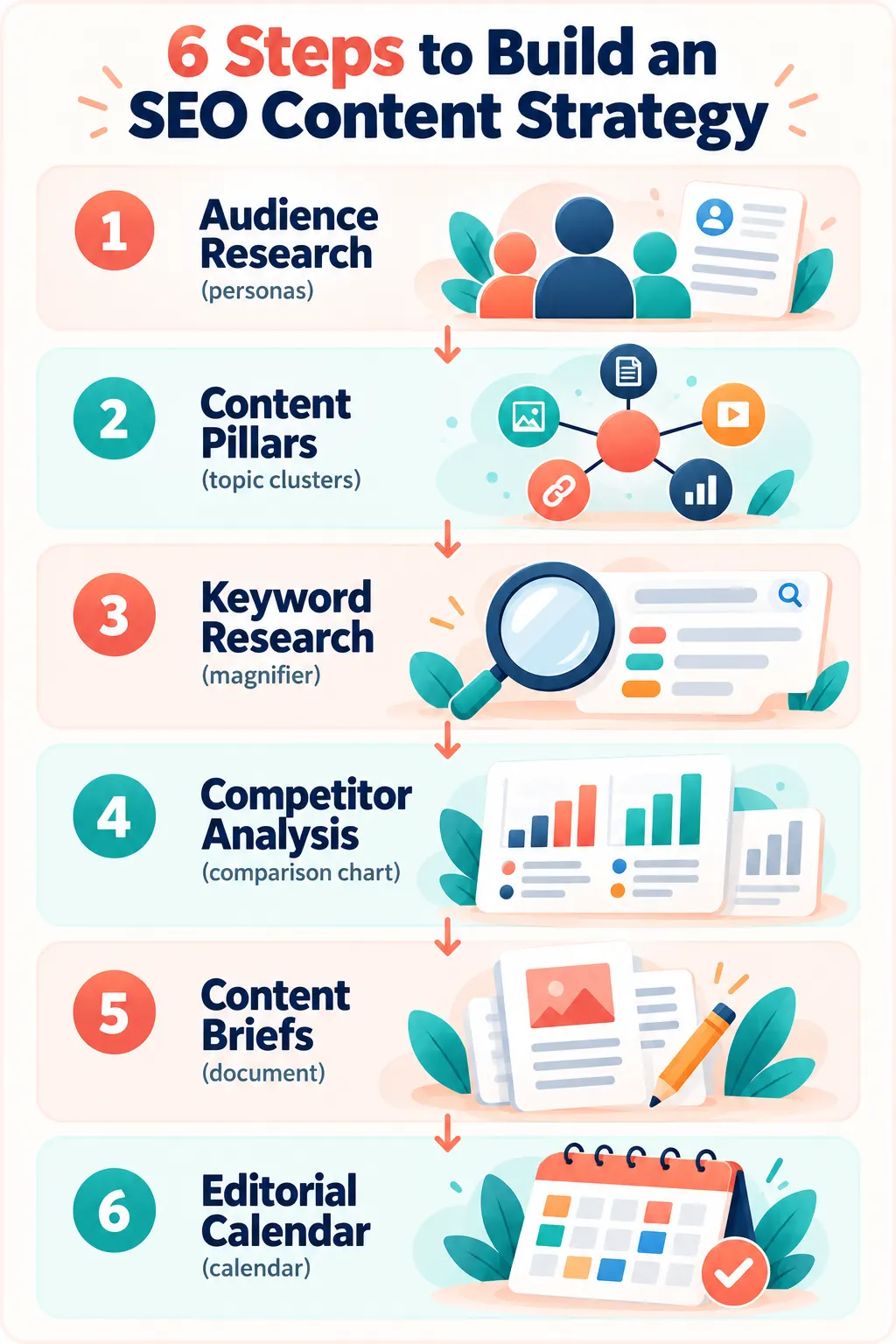
Vertical infographic showing six stages of ChatGPT SEO strategy, from audience research and content pillars to keyword research, competitor analysis, content briefs and editorial calendar.

The most common mistake in AI-assisted SEO strategy work is asking too much in a single prompt. “Give me an SEO strategy for a fitness brand” produces something that sounds like a strategy but reads like a marketing textbook — general, flat, and not specific to any real competitive landscape or audience.

A strategy that is actually useful is built in layers, each more specific than the last.

The framework here has six layers: niche definition and audience profiling, content pillar identification, keyword research and prioritisation, competitor gap analysis, content brief development, and editorial calendar construction. Each is a prompt that builds on the previous output. The accumulated context is what makes the final output specific and actionable.

Layer 1: define the niche and profile the audience

Before any keyword research or content planning, the audience must be defined with enough precision to make content decisions against. A strategy for “fitness” is a different document from one for “strength training for women over 35 returning to exercise after a long break.” The second can actually be written from.

I am building an SEO content strategy for [describe your brand/website/client].

Niche: [specific — not “fitness” but “strength training for women over 35”]

Website: [URL if relevant]

Primary content goal: [rank for informational queries / drive purchases / build email subscribers / establish thought leadership]

Define:

  1. Three audience segments with:

   – Demographics and psychographics

   – Problems they are trying to solve

   – Search language (formal terms vs colloquial)

   – Awareness stage (problem-aware / solution-aware / brand-aware)

   – Preferred content format

  1. Primary search intent categories with niche-specific examples

   (informational, navigational, commercial, transactional)

  1. Content gaps in this niche — questions most sites answer poorly

The output is the strategic foundation — the audience profile every subsequent content decision is tested against. Before any keyword is targeted or article planned, this document should answer: who are we writing for, what do they need, and how do they search?

Layer 2: identify the content pillars

Content pillars are the broad topical areas that the strategy will own. Each pillar represents a cluster of related content — the pillar page that covers the topic broadly and the cluster content that covers specific subtopics in depth.

Based on our audience profiles and search intent categories, identify 5-7 primary content pillars.

For each pillar:

– Name and 2-sentence description

– Primary audience segment served

– Core question answered at a broad level

– 3-5 cluster subtopics

– Best content format (guide, comparison hub, FAQ hub, tool, resource library)

– Business value (what action does ranking here drive)

Also identify:

– 2 pillars with highest commercial intent (likely to drive conversions)

– 2 pillars with highest volume potential (traffic-driving but lower conversion)

– 1 pillar most defensible through original research or proprietary data

The final three questions separate a traffic strategy from a business strategy. Most content plans chase volume. A well-designed strategy balances traffic volume, commercial intent, and defensibility — knowing which pillars serve which purpose is what drives the right prioritisation decisions.

Layer 3: keyword research and prioritisation

With pillars defined, generate the keyword universe for each:

For the content pillar “[Pillar Name]”, generate a comprehensive keyword list.

Include:

  1. Head terms (broad, high-volume, high-competition): 3-5 with estimated intent
  2. Long-tail keywords (specific, lower competition): 10-15 grouped by subtopic
  3. Question-based keywords (featured snippet opportunities): 8-10 examples
  4. Comparison/alternative keywords (commercial investigation): 5-7 examples
  5. Niche-modified keywords (geography, demographic, situation): 5-7 examples

For each, note: search intent, estimated difficulty (high/medium/low), featured snippet potential, audience segment served.

Recommend which 3 to target first — considering site authority, competition, and business alignment.

Run this prompt for each content pillar. The combined output is the keyword universe for the entire strategy — a structured, prioritised list a writer or team can work from directly.
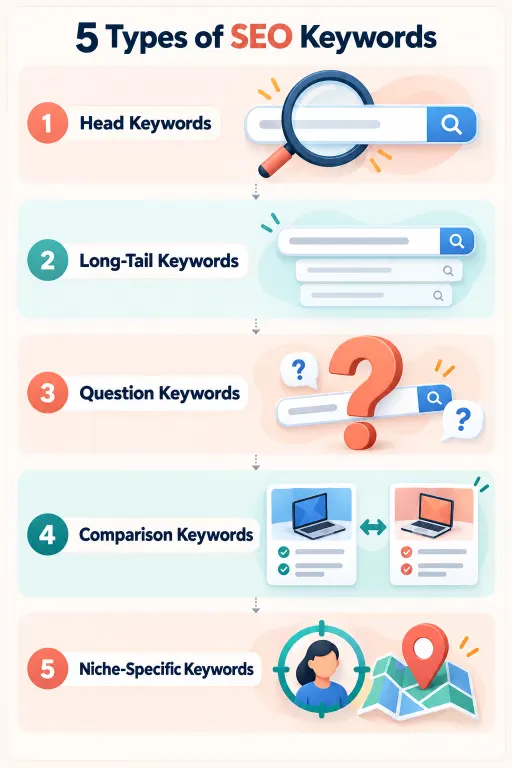

Educational infographic illustrating five keyword categories for SEO research: head terms, long-tail, question-based, comparison and niche-specific keywords
AI Integrated Full Stack Development training with React Node.js MongoDB and AI tools at Learn2Earn Labs

AI Integrated Full Stack Development Training

Master HTML, CSS, JavaScript, React, Node.js, Express.js, MongoDB, REST APIs, and AI-powered development workflows through live coding, practical projects, internship opportunities, and career-focused training.

Layer 4: competitor gap analysis

Keyword volume is only half the picture. What competitors are not ranking for well identifies the opportunities where new content gains traction fastest: Perform a conceptual competitor gap analysis for our niche.

Assume the main competitors are the top 3-5 sites ranking for [core head term from our pillar].

  1. What topics do most authoritative sites cover thoroughly?   (Table stakes — needed but hard to rank for early)
  1. What topics do most sites cover poorly or superficially?   (Quick-win opportunities where better content ranks faster)
  1. What questions does the audience ask that almost no site answers well?   (White space opportunities)
  1. What content formats are underused despite audience demand?   (Video, tools, templates, original research, data-driven guides)
  1. For a new site: what is the most realistic content strategy for the first 6 months — focusing on what is achievable, not just what is aspirational?

The fifth question — the realistic 6-month strategy — is the most practically valuable part. Most content strategies are written as if the site has existing authority and a team of writers. Most sites implementing a strategy have neither. Asking AI to plan for reality rather than the ideal scenario produces a strategy a real team can actually execute.

Layer 5: content brief for a priority article

With the strategic foundation established, generate detailed content briefs for priority articles — not just a title and notes, but a full specification a writer can produce final content from:

Create a detailed content brief:

Target keyword: [primary keyword]

Supporting keywords: [3-4 related]

Audience segment: [from our profile]

Content pillar: [which pillar]

Word count: [based on what is ranking — typically 1,500-3,000]

Include:

  1. Article title + 2 alternatives for A/B testing
  2. Meta description (155-160 chars, includes primary keyword)
  3. URL slug
  4. Search intent and reader expectation
  5. Article outline with H2/H3 headings and approximate word count per section
  6. Key points required to outrank current top results
  7. Internal linking opportunities (link to and from)
  8. CTA at the end (what should the reader do next)
  9. Original data, case studies, or expert quotes that would strengthen the piece
  10. Schema markup recommendation (article, FAQ, how-to, or none)

A brief of this depth separates articles written to fill a calendar from articles written to rank. Every element — H2 structure, schema recommendation — is a ranking signal or UX decision. AI generates the structure; the writer focuses entirely on quality.

Layer 6: build the editorial calendar

The final layer converts strategy into an execution plan: Build a 12-week editorial calendar based on our pillars, keyword priorities, and competitor gap analysis.

Assumptions:

– Publishing frequency: [X articles/week]

– Team: [size and type]

– Site authority: [new / established]

For each week:

– Article title and target keyword

– Content pillar

– Priority (must publish / should publish / can defer)

– Estimated word count

– Internal linking target

– Audience segment served

Sequence pillar content before cluster content that links back to it.

Flag articles needing social media distribution.

Identify the 3 articles with highest potential traffic impact.

Sequencing pillar content before cluster content matters for SEO. Many editorial calendars are built chronologically or by perceived interest rather than internal linking logic. Getting this right from the start means every cluster article published can immediately link to a pillar that already exists.

Student learning React Native mobile app development with AI, Expo, APIs, and practical projects at Learn2Earn Labs.

AI Integrated React Native Mobile App Development Training

Build a job-ready mobile app development profile through practical coding, industry-style projects, AI-assisted workflows, career preparation, mentor-guided learning, real-world app deployment, API integration, and hands-on portfolio development.

How Learn2Earn Labs trains digital marketers to use AI this way

At Learn2Earn Labs, the Digital Marketing program is built around exactly the kind of AI-integrated, structured thinking this blog describes. Students do not learn SEO strategy as a set of concepts — they build real content strategies for real niches, using AI as the intelligence engine and their own marketing judgment as the editorial filter.

Every student goes through the six-layer workflow here on at least one live project — producing a strategy that is specific, actionable, and grounded in real keyword research and competitive analysis, not a generic framework copied from a course handout.

Career counselling prepares students to present their AI-assisted strategy work in interviews and freelance pitches — because a digital marketer who walks through how they produced a comprehensive content strategy in a fraction of the usual time is demonstrating strategic thinking and structured process, not just tool familiarity.

With alumni placed at TCS, Accenture, Cognizant, and Nagarro, and with decades of experience shaping careers across digital marketing, technology, and business, Learn2Earn Labs trains every student to operate at the intersection of marketing intelligence and AI fluency that the industry is rapidly making standard.

Visit learntoearnlabs.com or write to team@learntoearnlabs.com

Conclusion

An SEO content strategy built through six well-structured prompts — audience profile, pillars, keyword universe, competitor gaps, content briefs, editorial calendar — is not a lesser version of what a professional strategist would produce. In many cases it is more comprehensive, because AI does not get tired, does not miss subtopics, and does not stop asking clarifying questions when the brief is under-specified.

What it requires is a marketer who understands the strategy well enough to know when the output is right, when it needs refinement, and how to make the judgment calls AI will not make.

Build the strategy. Then build the content.

Frequently Asked Questions 

The following five FAQs are written to match relevant informational search queries, answer common reader questions, and complement the existing blog without duplicating the six main prompts.

1. How can I use ChatGPT to create an SEO content strategy?

You can use ChatGPT to create an SEO content strategy by following six steps: define your target audience, identify content pillars, research keywords, analyze competitor content gaps, prepare detailed content briefs, and build an editorial calendar. Use the output of each step as input for the next. Validate AI-generated suggestions using real search data and competitor research before implementing the strategy.

2. Can ChatGPT perform keyword research for SEO?

ChatGPT can help generate keyword ideas, group related search terms, identify search intent, and organize head keywords, long-tail keywords, question-based queries, and comparison keywords. However, it cannot reliably provide live search volumes, keyword difficulty scores, or current rankings without access to suitable data sources. Use keyword research tools and Google Search Console to validate its suggestions.

3. What are content pillars in an AI-powered SEO strategy?

Content pillars are broad topics around which a website organizes related content. Each pillar typically includes a comprehensive main page and several supporting articles that cover specific questions or subtopics. ChatGPT can help identify relevant pillars, suggest topic clusters, map audience search intent, and develop internal linking opportunities that support a well-structured SEO content strategy.

4. How can ChatGPT help with SEO competitor analysis?

ChatGPT can help structure competitor gap analysis by identifying topics to investigate, preparing comparison frameworks, evaluating supplied competitor content, and suggesting opportunities for better content coverage. For accurate competitor analysis, provide verified search results, competitor URLs, or exported SEO data. ChatGPT’s conceptual suggestions should not be treated as evidence of actual competitor rankings.

5. How do I create a 12-week SEO content calendar using ChatGPT?

To create a 12-week SEO content calendar, provide ChatGPT with your content pillars, prioritized keywords, target audience, publishing frequency, available resources, and business objectives. Ask it to organize content by week and include article titles, primary keywords, content formats, priorities, and internal linking targets. Review the schedule to ensure that pillar pages are published before the supporting articles that link to them.

Leave a Reply