How to build a high-converting landing page with AI using 6 ChatGPT prompts
Table of Contents
ToggleYou do not need a designer to build a landing page that converts. You need the right prompts.
The traditional route to a high-converting landing page required two specialists and several days. A copywriter for the messaging. A designer to make it visually compelling. A developer to build it. And if the first version did not convert — which it usually did not — another round of all three.
Most small businesses, solo marketers, and digital marketing freshers do not have that budget or team. They build from templates and wonder why conversion rates stay flat. Or they hire one specialist and end up with a page that is well-written but poorly structured, or polished but copy that misses the mark.
AI has changed this equation. Not by replacing experienced conversion specialists — that judgment still matters at the top of the craft — but by giving any marketer who knows how to prompt correctly access to the structural principles, psychological triggers, and copy frameworks those specialists apply. Combined with tools like Webflow, Framer, or Carrd, a marketer with the right prompts can build a landing page structured for conversion without a designer, a developer, or a large budget.
This blog walks through exactly how — with specific prompts for every element, in the order they should be built.
AI Integrated Digital Marketing Training
Build practical skills in SEO, Google Ads, Social Media Marketing, Analytics, Content Marketing, and AI-powered workflows through projects, live classes, internship exposure, and industry-focused learning.
What makes a landing page convert — and why most AI-generated ones do not
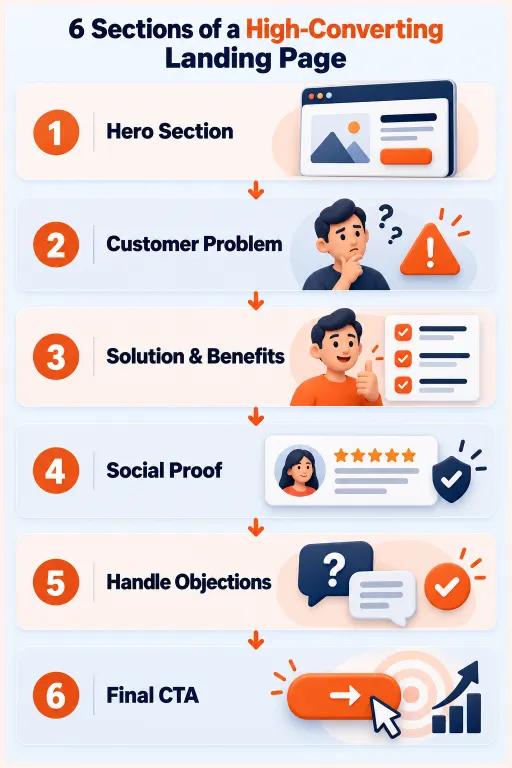
Most landing pages fail for one of three reasons: the message is wrong for the audience, the structure does not guide the visitor toward the action, or the copy prioritises describing the product over addressing the visitor’s problem.
When marketers use AI without understanding these failure modes, they get pages that sound polished but miss all three. The headline is grammatically correct but does not speak to the visitor’s specific problem. The structure follows a generic template without accounting for awareness level. The copy talks about features instead of outcomes.
The prompts in this blog prevent all three failures — by building in audience specificity, structural awareness, and problem-first framing that average AI output does not include without explicit instruction.
Prompt 1: the above-the-fold section
The above-the-fold section is the first thing a visitor sees. It needs to do three things in under four seconds: confirm they are in the right place, state the primary value proposition, and give them a reason to keep reading. Every word is doing load-bearing work.
Product/service: [describe the offer]
Target visitor: [precise description — not “small business owners” but “freelance graphic designers losing clients to cheaper competitors who need a way to justify higher rates”]
Their primary fear right now: [one sentence]
The outcome they most want: [one sentence]
The mechanism that delivers it: [one sentence]
Generate the above-the-fold section:
- Headline (8-12 words): addresses the outcome or fear, not the product
- Subheadline (15-25 words): adds “who this is for” and “how it works”
- Hero supporting text (2-3 sentences): agitates the problem, pivots to promise
- CTA button text (3-6 words): outcome-focused (“Get my free strategy” not “Submit”)
- Social proof line below CTA: one brief trust signal
Write 3 versions of each element.
Asking for three versions is borrowed from direct response copywriting — the headline that seems obvious to the writer rarely resonates most with the reader. Three options force comparison and improve the probability of choosing something genuinely effective.
Prompt 2: the problem and empathy section
The section immediately below the fold should demonstrate understanding of the visitor’s problem better than they can articulate it themselves. This earns trust through recognition, not testimonials.
Audience: [repeat audience description]
Write the problem and empathy section:
– Describe the painful situation using specific recognisable language (not “you might be struggling” but “you’ve tried X, Y, Z and still feel Z”)
– Validate the problem as real and not the visitor’s fault
– Identify the root cause (what they have been doing wrong that this product corrects)
– End with a pivot sentence transitioning into the solution
Length: 150-200 words | Tone: direct, empathetic, not patronizing Second person throughout | No bullet points, headers, or numbered lists
Avoid: “Many people find that…” / “It’s common to feel…” Use specific, concrete language only.
“Many people find that” and “It’s common to feel” are the hallmarks of AI copy that sounds empathetic but is not — they describe the problem from outside the experience. Removing them forces the AI to write from the visitor’s perspective, not about them.
Prompt 3: the solution and mechanism section
This section introduces the product — but only after the problem has been fully established. Introducing the solution too early is the most common landing page structural mistake.
Write the solution section:
- Transition sentence: names the root cause from the problem section and introduces the solution as the corrective
- 2-3 sentences on the mechanism — how it works, not what it is (“By doing X, which causes Y, you get Z” not “This is a tool that helps you do Z”)
- Three core benefits (not features) in parallel structure: Format: “[Outcome]: [one sentence on why this matters to them]” Frame as what the visitor experiences, not what the product has
- Visual element description: what an image, diagram, or short video in this section should show to reinforce the mechanism claim
Features describe the product. Mechanisms explain the result. A visitor reading a mechanism intuitively understands how the product produces the outcome they want. A visitor reading a feature list must make that connection themselves — and most do not.

AI Integrated Full Stack Development Training
Master HTML, CSS, JavaScript, React, Node.js, Express.js, MongoDB, REST APIs, and AI-powered development workflows through live coding, practical projects, internship opportunities, and career-focused training.
Prompt 4: social proof
Generic social proof converts nobody. “Great product!” from “John D.” is decorative. Specific, outcome-describing testimonials from identifiable people convert.
Generate the social proof section:
- Testimonial guidelines for collecting real testimonials:
- – What outcomes should be described?
- – What objections should at least one testimonial address?
- – What format works best (before/after, specific numbers, time to result)?
- Three placeholder testimonials in authentic customer language:
- – Specific before/after transformation
- – Specific result where possible
- – Sounds like a person, not a press release
- – Name, role/company type, photo placeholder
- Trust badges:
- – What categories are most relevant to this offer?
- – Copy for 3-4 trust elements (5-10 words each)
Prompt 5: the objection-handling section
Every visitor who does not convert has an unaddressed objection. This section’s job is to name and resolve the most common ones before the visitor uses them as a reason to leave.
Audience: [description] | Offer: [product/service]
Identify the 6 most likely objections just before the visitor decides whether to convert.
For each:
- Name it directly: “This sounds too expensive” not “Some worry about investment”
- Answer in 40-60 words using one of:
- Reframe cost as investment against a larger loss
- Remove risk with guarantee or trial
- Use social proof showing others with same objection did convert
- Address timing objection with specific consequence of delay
Format: minimal FAQ — Q&A, plain language, no jargon.
Naming objections directly rather than softening them is the instruction that produces the most improvement in objection-handling copy. Softened objections get softened answers. Direct objections get direct answers. Direct answers convert.
Prompt 6: the CTA section and page structure review
The final prompt builds the closing CTA section and then reviews the complete page structure for conversion logic.
Generate the closing CTA section:
- Restate the primary outcome (not what they are buying)
- Address one risk-reversal element (guarantee, free trial, no-commitment step)
- CTA button text: different from the hero CTA — more urgent, outcome-specific
- Final line: mild urgency without dishonesty (deadline, limited availability, or consequence of not acting)
Then perform a conversion logic review:
- Does the page match visitor awareness level at each scroll depth?
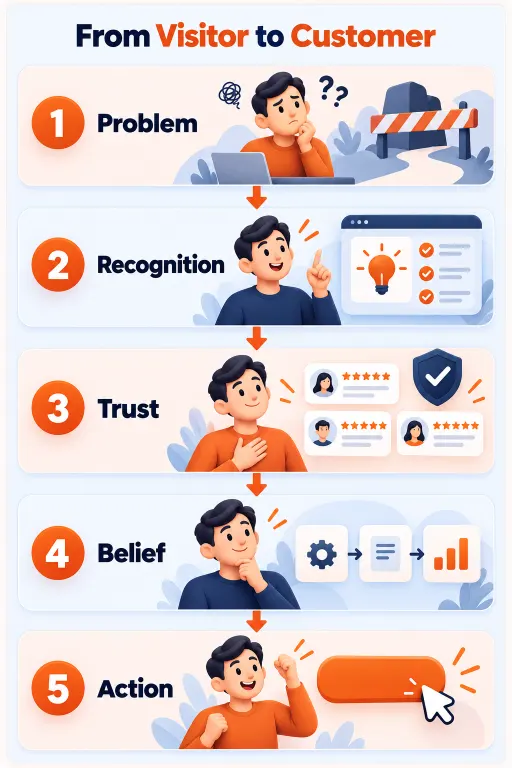
- Is there a logical emotional progression: problem → recognition → trust → belief → action?
- Where might a visitor feel confused or lose momentum?
- What is the single weakest element to test first?
The conversion logic review converts a collection of well-written sections into a coherent page. Each section might be strong in isolation. The question is whether the emotional and logical sequence guides the visitor toward the CTA or creates friction. Getting this review before publishing saves weeks of A/B testing.
AI Integrated React Native Mobile App Development Training
Build a job-ready mobile app development profile through practical coding, industry-style projects, AI-assisted workflows, career preparation, mentor-guided learning, real-world app deployment, API integration, and hands-on portfolio development.
How Learn2Earn Labs builds landing page and conversion skills into the digital marketing programme
At Learn2Earn Labs, the Digital Marketing programme treats conversion-focused copywriting and landing page strategy as core technical skills — foundational competencies every graduate demonstrates, not optional extras.
Students learn the full landing page workflow described in this blog — above-the-fold through objection handling to CTA — and build at least one complete landing page for a real or simulated offer. Pages are reviewed for conversion logic: does the headline speak to the visitor’s outcome, does social proof address real objections, does the structure guide the visitor through the emotional journey that produces a conversion decision?
The AI-integrated approach means graduates know how to produce this quality of work on demand — for any niche, any offer, any client — not just for the one page built during training. The methodology is transferable. The prompts are reusable. The conversion principles they embed are durable.
Career counselling prepares students to present landing page work in job applications and client pitches — because a digital marketer who can show a portfolio page and explain the conversion reasoning behind every structural decision demonstrates strategic thinking most candidates cannot match.
With alumni placed at TCS, Accenture, Cognizant, Infosys, and Nagarro, and with decades of experience shaping digital marketing careers across India, Learn2Earn Labs produces marketers immediately productive in conversion-focused roles.
Visit learntoearnlabs.com or write to team@learntoearnlabs.com
Conclusion
A high-converting landing page is not a design problem. It is a thinking problem. Who is the visitor? What are they afraid of? What do they want? What stops them from acting? What would make them believe you?
The six prompts here answer all of those questions — specifically, in the order that guides a visitor from awareness to action. They work with any landing page tool, for any offer, for any audience.
Build the page in one afternoon. Test it the following week. Refine based on what the data shows.
The page that converts is almost always the one built by a marketer who understood what they were trying to do before they wrote the first word.
Frequently Asked Questions
The following FAQs target questions that potential readers may ask when searching for AI landing page creation, ChatGPT landing page prompts, and conversion optimization techniques.
1. How can I create a high-converting landing page using AI?
You can create a conversion-focused landing page using AI by defining your target audience, identifying their problems, and using ChatGPT to develop persuasive headlines, benefit-driven copy, social proof sections, objection-handling FAQs, and clear calls to action. Arrange these elements in a logical structure and use a no-code platform such as Webflow, Framer, or Carrd to build the page. Test the results using real visitor data to improve conversions.
2. Can ChatGPT build a landing page without coding?
ChatGPT can help you plan a landing page, generate persuasive copy, recommend page layouts, and produce HTML, CSS, or other implementation code when needed. However, a functional published landing page usually requires a website builder, hosting platform, or deployment process. Combining ChatGPT with no-code tools allows marketers and beginners to create professional landing pages without manually writing code.
3. What are the essential elements of a high-converting landing page?
A high-converting landing page typically includes a compelling headline, a clear value proposition, customer problem identification, benefit-focused content, credible social proof, objection handling, and a prominent call to action. These elements should work together to help visitors understand the offer, build confidence, and take the desired action. The ideal structure depends on the audience, offer, and source of traffic.
4. How can AI improve landing page conversion rates?
AI can support landing page conversion optimization by helping marketers develop clearer messaging, generate headline variations, identify possible customer objections, improve calls to action, and evaluate page structure. It can also assist in preparing A/B testing ideas and analyzing supplied performance data. However, conversion improvements are not guaranteed and should be measured through actual visitor behavior and testing.
5. What is the best way to write landing page copy with ChatGPT?
The most effective approach is to use specific, sequential prompts rather than asking ChatGPT to generate an entire landing page in one request. Start with audience research and above-the-fold copy, then develop the problem section, solution, benefits, social proof, objection-handling content, and final CTA. Provide accurate product information, customer insights, and brand guidelines. Review the final copy for clarity, credibility, and consistency before publishing.