AI-Integrated Industry Training:
Web Development, Data Analytics, Digital Marketing, Java & Python
|
2 Months Practical Training + 1 Month Internship
|
Fee:
₹9,999 per Program
|
Apply Now
What sales funnel actually is and why most service businesses do not have one
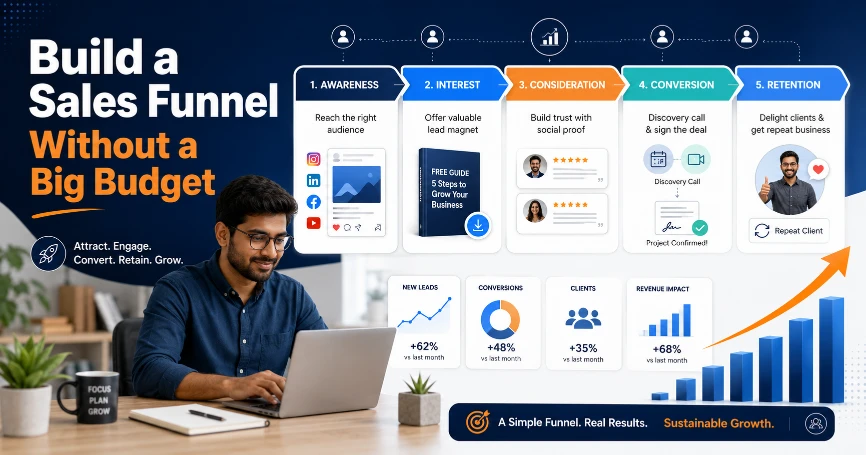
A sales funnel is a structured path that takes a complete stranger from first discovering your business to becoming a paying client. At each stage some people drop off that is expected. The funnel’s job is to make the journey from discovery to decision as clear, trustworthy, and frictionless as possible for the people who are a genuine fit.
Most service businesses have no funnel. They have a disconnected collection of touchpoints a social profile here, a WhatsApp number there, occasional word of mouth with no logic connecting them. When the right person discovers you, they visit your profile, find no clear way to understand what you offer or how to start, and move on. The opportunity disappears without you ever knowing it existed.
A sales funnel fix that. Every stage has a job. Every piece of content, every page, every message serves a defined purpose. When built correctly, it works continuously not just when you are actively hustling.
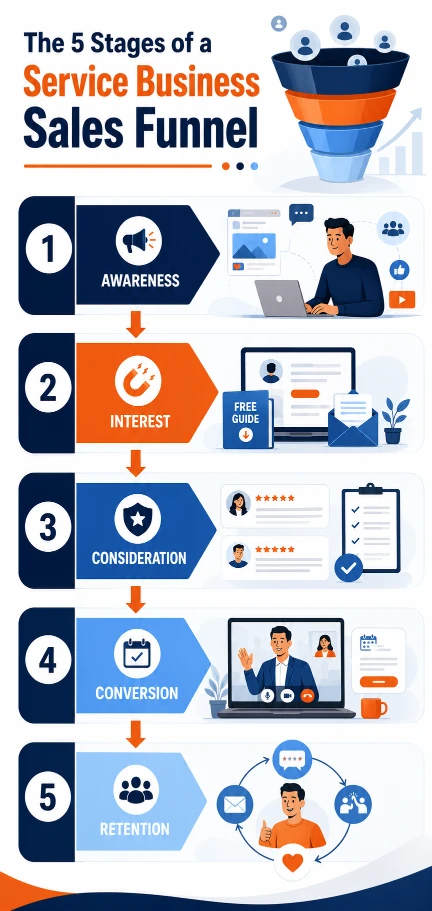
Stage 1: Awareness getting found by the right people
The top of your funnel is about visibility. Not broad, random visibility targeted visibility in front of people who are likely to need what you offer.
For a service business with no budget, the most effective awareness channels are content and community.
Content means publishing material your ideal client is actively searching for. A web developer might post about common website mistakes small businesses make. A digital marketer might create carousels explaining why Facebook ads are not converting. A business consultant might write about the one pricing mistake most small businesses make.
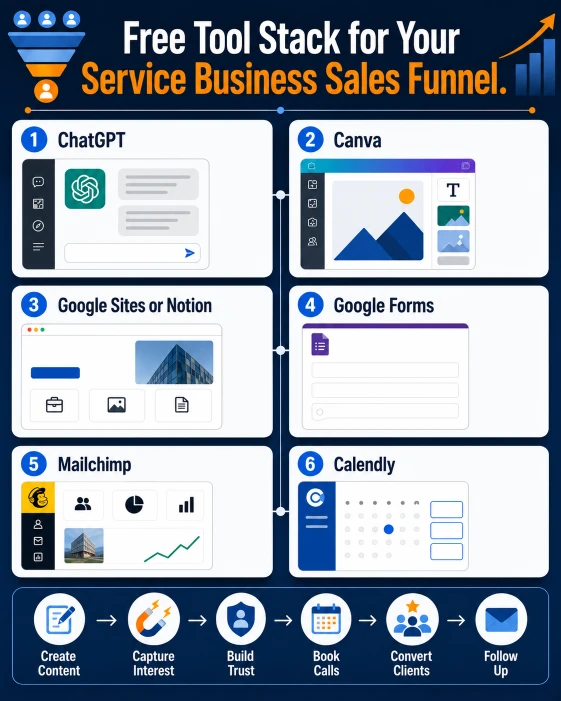
This content attracts the right people and positions you as credible before a word is exchanged about working together. Use ChatGPT to generate 20 questions your ideal client is actively asking. Each question is a content idea. Each piece of content is a funnel entry point.
Community means being genuinely present where your ideal clients gather LinkedIn groups, Facebook communities, local business WhatsApp groups not to pitch, but to contribute. Answer questions. Be the person people think of when they need someone who knows this space.
Awareness built this way is slower than a paid ad. But it is more durable, more trust-building, and completely free.
Stage 2: Interest giving them a reason to stay
Once someone discovers you, the next job of the funnel is to give them a reason to stick around long enough to understand what you offer and why it matters to them.
This is where most service businesses lose people. Someone visits your Instagram or LinkedIn, cannot immediately understand what you do or who you help, and leaves.
Your profile and bio need to answer three questions instantly: who are you, who do you help, and what does work with you produce? A bio that says “freelance developer | tech enthusiast | open to opportunities” answers none of these. One that says “I build fast, clean websites for small businesses in India | helped 20+ brands go from zero to visible online | DM to discuss your project” answers all three.
The second tool at this stage is a lead magnet something genuinely useful offered free in exchange for an email or WhatsApp follow. A checklist, a short guide, a free audit template. Specific enough to be immediately valuable. Use ChatGPT to write the first draft in one sitting, then refine it in your own voice. Host it on Carrd, Google Sites, or a Notion page and share the link in your bio and content.
This converts passive scrollers into active contacts the transition from awareness to interest.
Stage 3: Consideration building enough trust to earn the conversation
At this stage, the potential client knows who you are and what you offer. They are considering you. They are comparing you consciously or not to alternatives. Your job now is to give them enough evidence and reassurance that choosing to speak with you feels like the low-risk, high-upside decision.
Three things do this work better than anything else.
Social proof
Testimonials, results, and case studies. Even one specific testimonial “Rebuilt our website. Traffic increased by 60% in six weeks” is more powerful than a page of claimed expertise. If you have no testimonials yet, document your training projects with specific outcomes and collect testimonials from your very first client, however small.
Consistency
A potential client who has seen your content for two weeks and downloaded your free guide has already been building trust before any conversation begins. Regular presence signals that you are serious and not going anywhere.
Clarity of process
Most service clients hesitate because they do not know what happens if they hire you. A simple “how it works” section three to four steps from first call to final delivery removes this uncertainty and significantly reduces friction between interest and action.

Stage 4: Conversion making it easy to say yes
This is the stage most service businesses handle worst. They have done everything right up to this point produced good content, built trust, attracted genuinely interested people and then made the final step unnecessarily complicated.
The conversion stage needs to be frictionless. One clear call to action. One obvious next step. Not “email me,” “DM me,” “visit my website,” “call me,” and “check out my portfolio” all at once. One thing.
For most service businesses, that one thing is a short discovery call 15 to 20 minutes where you understand the potential client’s situation and they understand whether your service is the right fit. Book this using Calendly’s free tier. Share the link in your bio, your lead magnet follow-up email, and every piece of content that closes with a call to action.
The call itself is not a sales pitch. It is a diagnostic conversation. Ask about their current situation, their biggest challenge, what they have already tried, and what success would look like for them. Listen more than you speak. By the end of the call, if there is a genuine fit, the next step a proposal, a project brief, a quoted engagement should feel like the natural conclusion of the conversation, not a persuasion exercise.
Use ChatGPT to prepare a call framework and a list of discovery questions tailored to your specific service. Go into every call prepared, not improvised.
Stage 5: Retention turning one client into many
The most underused part of any service funnel is what happens after someone becomes a client.
A satisfied client is your most valuable marketing asset they refer others, leave testimonials, return for more work, and expand the engagement. Most service providers deliver, close the project, and move on, missing all of it.
Build a simple post-project process: a follow-up message two weeks after delivery, a testimonial request once results are visible, a light check-in three months later with something genuinely useful. Stay visible without being pushy. The client who hired you once is the easiest person to convert into someone who hires you again or sends three referrals your way.
This costs nothing. It requires only consistency and care.