
Common Mistakes in Data Analytics Beginners Must Avoid: Your Guide to Career Success
So, you’ve decided to dive into the world of Data Analytics.
Smart move! With companies everywhere drowning in data, the demand for people who can actually make sense of it is skyrocketing.
But here’s the reality check: there’s a massive gap between watching a Python tutorial and actually delivering insights that a CEO cares about.
Most beginners struggle not because they aren’t smart, but because they fall into the same predictable traps.
If you want to stand out, avoiding these mistakes is actually more important than mastering the latest fancy tool.
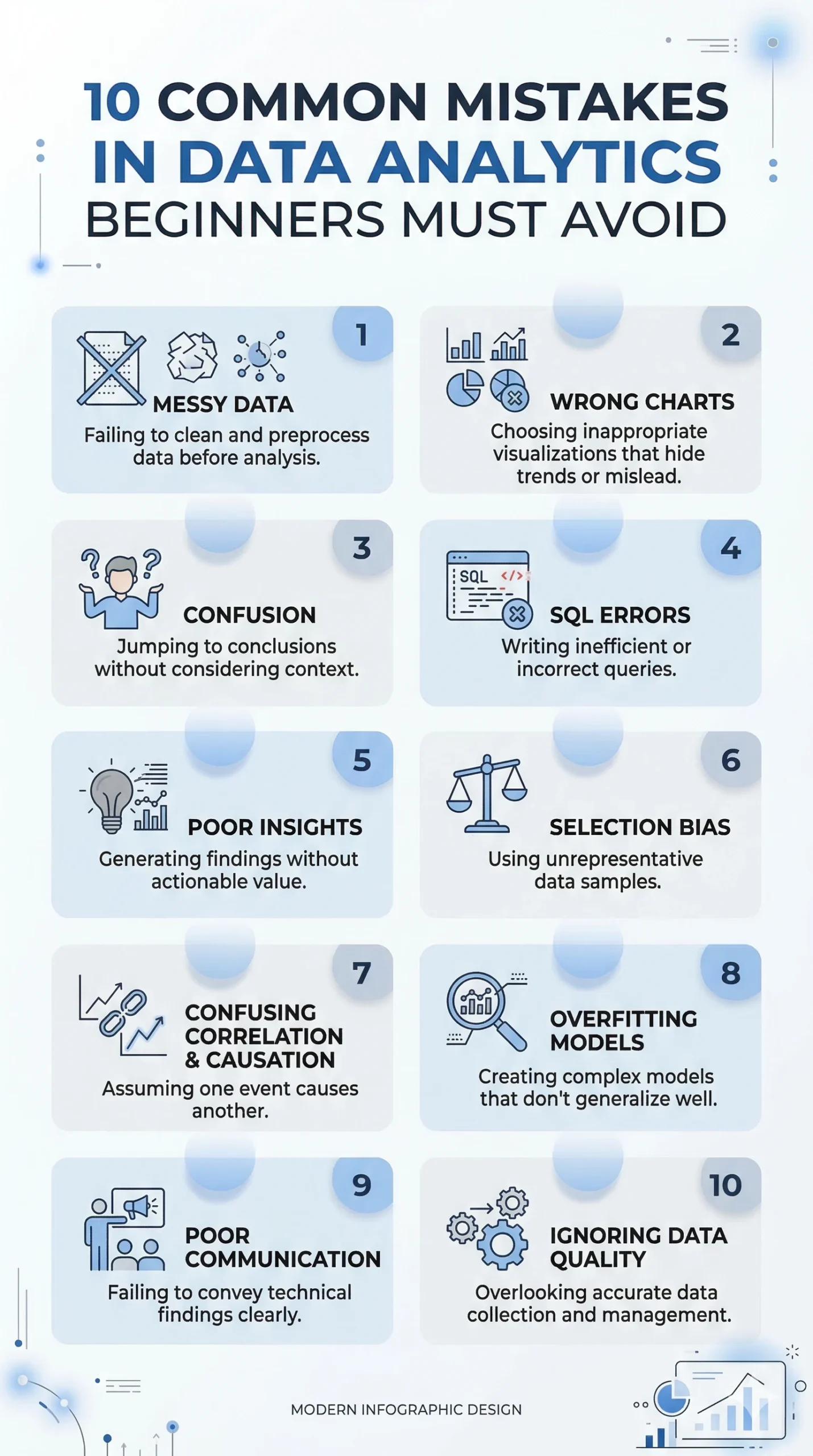
Let’s break down the 10 pitfalls you need to dodge.
Start small, stay consistent, and your data analytics journey will turn into real career growth
Table of Contents
Toggle1. Skipping the “Boring” Data Cleaning Process
We get it. Building a predictive model sounds way cooler than fixing typos in a spreadsheet. But in the real world, 80% of data work is cleaning.
Why it matters: “Garbage In, Garbage Out.” If your data is messy, your insights will be wrong. Period.
Common blunders: Ignoring null values, failing to check for duplicates, or not standardizing formats (e.g., “USA” vs “U.S.A.”).
The Fix: Fall in love with the process. Use tools like Pandas or SQL to automate your cleaning so you can trust your results.
2. Jumping to Tools Without Understanding the Basics
It’s tempting to put “Expert in Power BI and Python” on your LinkedIn right away. But a tool is just a hammer; you need to know how to build the house.
The Trap: Over-reliance on software without understanding the “Why.”
The Core: Data analytics is about logic, statistics, and problem-solving.
The Fix: Before you code, ask yourself: What problem am I actually trying to solve? Build your foundation in basic stats first.
3. Poor Understanding of the Data (The “EDA” Gap)
Beginners often rush to find “the answer” before they even understand the questions.
The Mistake: Not performing Exploratory Data Analysis (EDA).
The Consequence: You might miss hidden patterns or relationships that completely change the story the data is telling.
The Fix: Spend time visualizing distributions and checking correlations before you start deep-diving into analysis.

Every expert was once a beginner. Learn, practice, and keep improving your data skills daily
4. Creating Misleading (or Just Ugly) Visualizations
Just because a chart looks “fancy” doesn’t mean it’s good.
Common Errors: Using 3D pie charts (please, don’t), choosing colors that clash, or failing to label axes.
Best Practice: The best visual is the one that is understood in five seconds. Focus on clarity over “wow” factor. Use bar charts for comparisons and line graphs for trends.
5. Ignoring the Business Context
Data doesn’t exist in a vacuum. If you find a “cool insight” that has zero impact on the business’s goals, it’s useless.
The Gap: Thinking like a mathematician instead of a business owner.
The Fix: Always ask, “How does this insight help the company save money, make money, or save time?”
6. Weak SQL and Data Query Skills
Python is trendy, but SQL is the backbone of the industry. * The Mistake: Writing inefficient, “heavy” queries that slow down the entire database.
The Fix: Practice writing clean, optimized SQL code. It’s often the #1 skill tested in entry-level interviews.
The right guidance can save months of confusion and take you closer to your dream job faster
7. Overcomplicating the Analysis
You don’t always need a Neural Network. Sometimes, a simple average or a pivot table is all the stakeholders need.
The Trap: Trying to use advanced techniques too early to look “smart.”
The Fix: Focus on clarity. If a simple analysis solves the problem, use it. Complexity is the enemy of execution.
8. Not Practicing with Real (Messy) Projects
Kaggle datasets are great, but they are often “pre-cleaned.” Real-world data is chaotic, missing half the values, and formatted incorrectly.
The Mistake: Relying solely on classroom examples.
The Fix: Find a “raw” dataset or scrape your own. Building a portfolio with real, messy data shows employers you can handle the “real world.”
9. Misinterpreting Data Insights
This is the big one: Correlation is not Causation. * The Mistake: Seeing two things happen at the same time and assuming one caused the other (e.g., “Ice cream sales and shark attacks both go up in summer, so ice cream causes shark attacks!”).
The Fix: Be skeptical of your own findings. Always validate your conclusions before presenting them.
10. Lack of Communication Skills
You can be the best coder in the world, but if you can’t explain your findings to a non-technical manager, your work stays on your laptop.
The Reality: Data analytics is 50% math and 50% storytelling.
The Fix: Practice explaining your projects to a friend who doesn’t know anything about data. If they get it, you’re on the right track.
How to Avoid These Mistakes: Your Action Plan
Start Small: Master Excel and SQL before moving to Python/R.
Document Everything: Keep a journal of the “why” behind your steps.
Build a Portfolio: Create 3 solid projects that solve a real problem.
Get Feedback: Don’t learn in a silo. Ask mentors to tear your work apart—it’s the fastest way to grow.
Conclusion
Everyone makes mistakes when they start—it’s part of the game! The key is to learn quickly and keep your focus on the value you provide, not just the tools you use. Keep practicing, stay curious, and remember that data is just a tool to tell a story.
Need a bit more guidance on your data journey? Whether you’re stuck on a project or don’t know which tool to learn next, we’re here to help.
👉 Reach out to us on WhatsApp.
👉 Fill out our Contact Form for a free 1-on-1 guidance session!
FAQs on Data Analytics Mistakes
Q1. Do beginners need coding for data analytics?
While you can start with Excel and Tableau, learning SQL and a bit of Python/R is essential if you want to grow into a high-paying role.
Q2. How long does it take to become job-ready?
With consistent practice (about 10-15 hours a week), most students can become “job-ready” for entry-level roles in 6 to 9 months.
Q3. What is the biggest mistake beginners make?
Ignoring the “Business Why.” Always remember: you aren’t paid to play with data; you’re paid to help the business make better decisions.