AI-Integrated Industry Training:
Web Development, Data Analytics, Digital Marketing, Java & Python
|
2 Months Practical Training + 1 Month Internship
|
Fee:
₹9,999 per Program
|
Apply Now


Why Studying Alone Is Not Enough
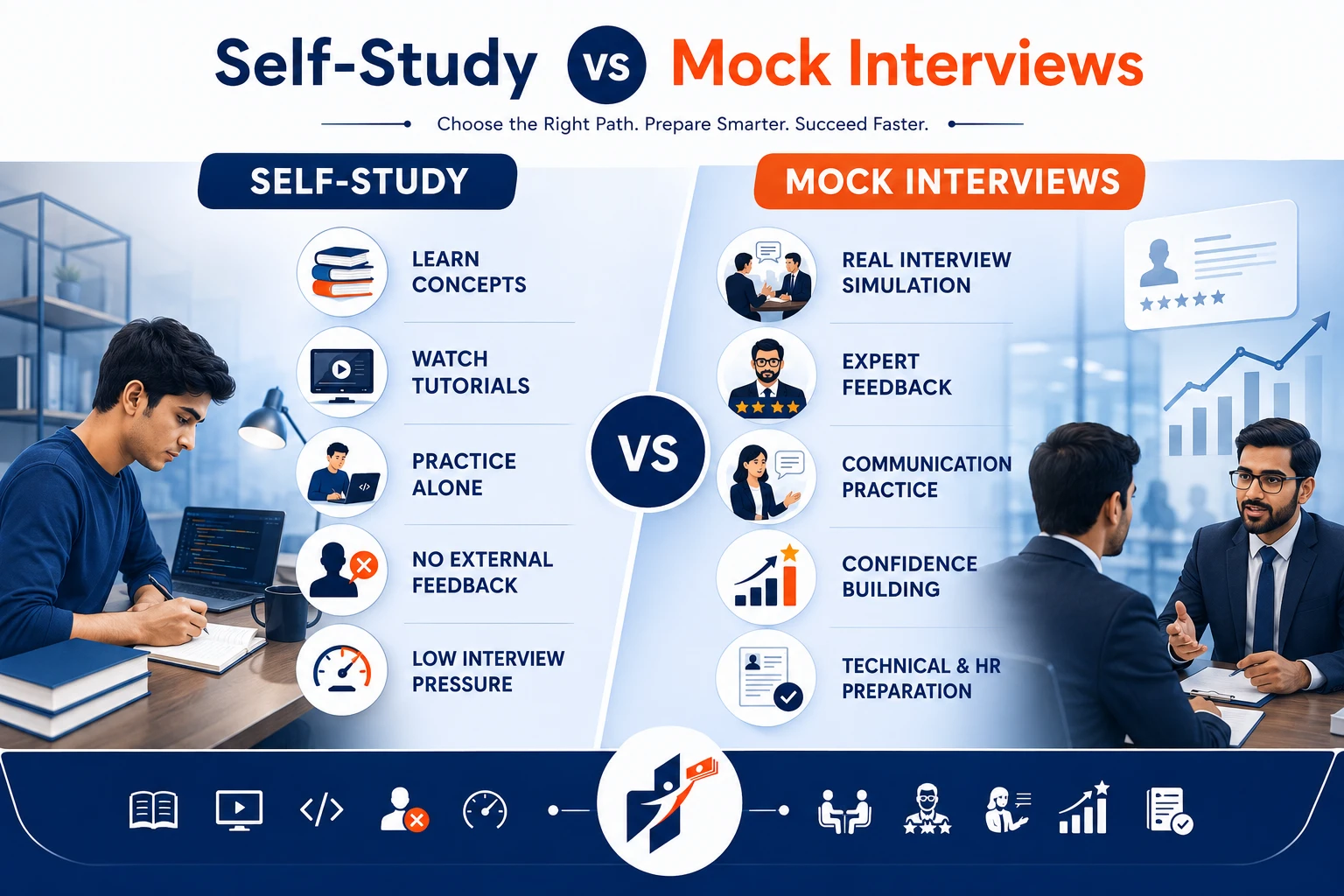
Thorough conceptual preparation is the foundation of interview success but only half of it.
The other half is accessing that knowledge under pressure, organizing it into a clear response, and communicating it confidently while someone watches and evaluates you. These are not skills developed by reading or watching tutorials. They develop by doing the thing repeatedly, under conditions close enough to the real experience to trigger the same physiological response.
When you practice alone, your brain operates in a low-stakes environment. No social consequence to pausing, backtracking, or starting over. You feel prepared because the absence of pressure feels like readiness but that feeling is not evidence of actual interview performance.
The moment you sit across from a real evaluator, everything changes. Your working memory is partially occupied by social awareness how you are being perceived, whether the silence means you are wrong. Answer retrieval slows. Communication becomes less organized. Habits you never noticed filling silence with “basically,” trailing off mid-sentence, avoiding eye contact when uncertain all surface.
You cannot discover these habits practicing alone. You can only discover them by being watched and only correct them by being watched repeatedly until new behaviour becomes automatic.
What a Real Person in the Room Actually Changes
The difference between practicing in front of a mirror and practicing with a real evaluator is not cosmetic. It is neurological.
When another person observes and evaluates you, your brain activates a social performance response the same one that fires in an actual interview. Practicing under this condition repeatedly does something specific: it habituates the response. The first mock interview feels almost as stressful as a real one. The third feels noticeably easier. By the fifth or sixth, the response is significantly reduced because your brain has experienced this situation enough times to stop treating it as an unknown threat.
This is what experienced candidates mean when they say they felt “comfortable” in their final placement interview. They were not more talented than the candidates who froze. They had been in the discomfort enough times that it no longer disrupted their performance.
Beyond the psychological benefit, a real evaluator provides something no self-assessment can: accurate external feedback. You cannot objectively evaluate your own clarity, pacing, or response structure while simultaneously producing the answer under pressure. A real evaluator sees exactly what the actual interviewer will see and tells you specifically what is working and what is not.
What Makes a Mock Interview Genuinely Useful
Not every mock interview is equally effective. A mock session that is too casual, too friendly, or too lenient prepares you for a conversation not an interview. Here is what a mock interview needs to include to actually move the needle on your performance.
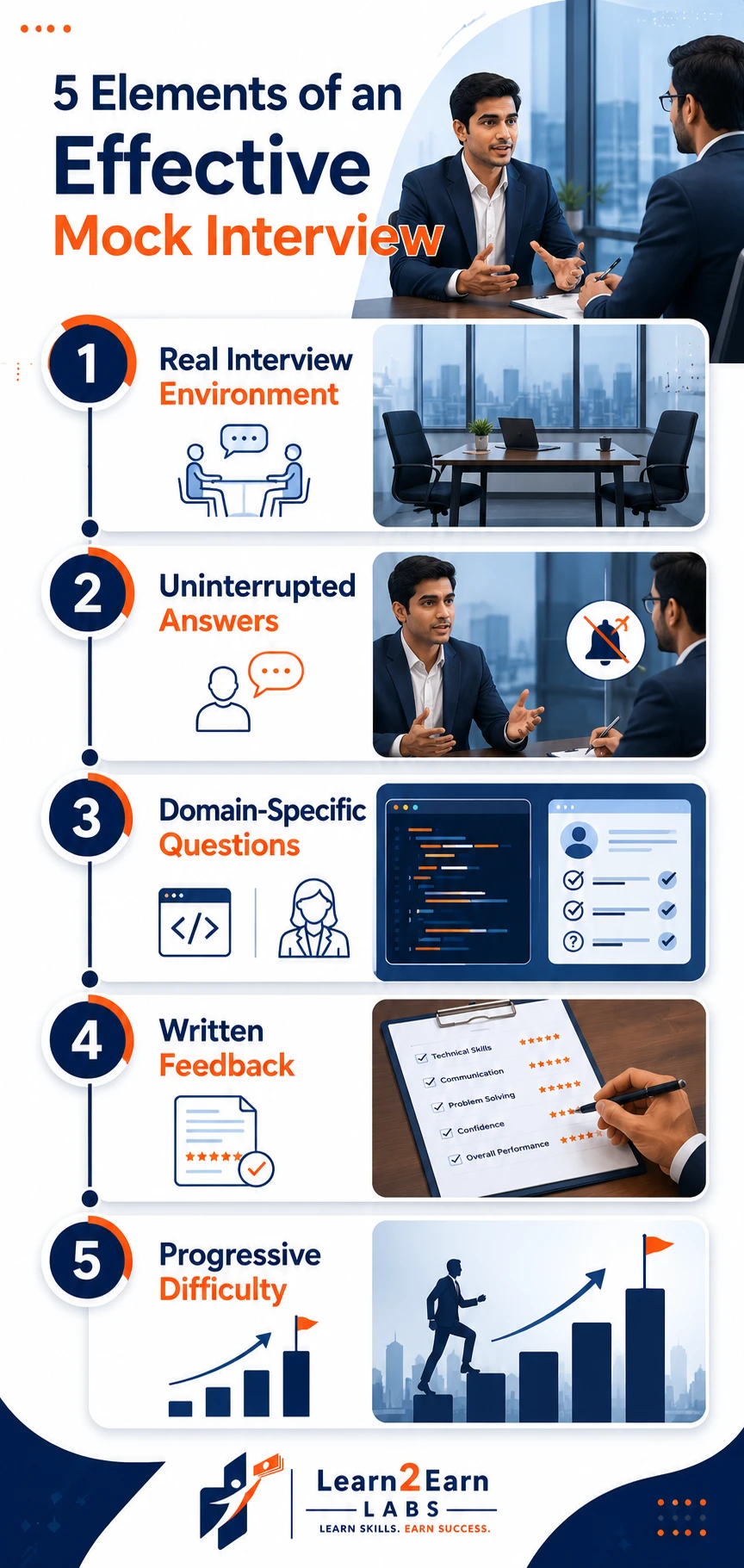
Real interview conditions
Dress the way you would for the actual interview. Sit in a chair across from the evaluator, not side by side. Begin with no warm-up the evaluator asks the first question cold, exactly as a real interview begins. The environment should feel formal enough to trigger the social performance response you are trying to habituate.
Uninterrupted answering
The evaluator should not help you, prompt you, or fill the silence when you pause. Silence is part of the real interview. Learning to sit in a pause without panicking without rushing to fill it with half-formed thoughts is a skill that only develops when the silence is allowed to exist.
Domain-specific technical questions
Generic mock interviews with questions pulled randomly from the internet are less valuable than mock interviews calibrated to your specific target role. If you are preparing for a MERN stack developer role, the mock interview should include JavaScript fundamentals, React concepts, Node.js and Express patterns, and at least one live coding or debugging scenario. If you are preparing for a digital marketing role, it should include campaign analysis scenarios, tool-specific questions, and at least one case study.
Specific, written feedback after every session
Verbal feedback given casually at the end of a session is forgotten within hours. Written feedback noting specific moments where communication broke down, specific questions where the technical answer was incomplete, specific habits that need correction creates a revision list you can work on before the next session.
Progressive difficulty
Your first mock session should feel challenging but manageable. Each subsequent session should raise the standard harder questions, less predictable follow-ups, more pressure on explaining reasoning rather than just delivering answers. Progressive difficulty builds genuine interview resilience, not just comfort with a specific set of questions.
The Questions That Break Most Candidates and How Mock Practice Fixes Them
There are specific question types that consistently produce poor performance from even well-prepared candidates because they require skills that studying alone does not develop.
Explain your thinking out loud as you solve this
This question terrifies students who have only ever solved problems privately. The skill of narrating your logic while simultaneously applying it is genuinely difficult and genuinely trainable but only through repeated practice of doing exactly that.
Why did you choose that approach over the alternatives?
Candidates have never been asked to defend a technical decision. They chose the approach because they knew it, not because they evaluated options. Mock interviews force you to develop the habit of thinking about why and that habit makes you significantly more impressive in a real interview.
That’s not quite right. Can you reconsider?
This is a pressure test. Interviewers use it even when your answer is correct, to see how you respond to apparent failure. Candidates who have never encountered this in practice fold immediately they second-guess their correct answer and change it to something wrong. Candidates who have been through mock sessions where this was deliberate practice hold their ground, re-examine their answer calmly, and either defend it or genuinely improve it. That response is what separates composed candidates from rattled ones.
Tell me about a time you failed or made a mistake
Behavioural questions require a completely different kind of preparation structured storytelling using specific experiences. Candidates who have never rehearsed this out loud to a real person produce either rambling answers that lack a point or over-polished answers that sound rehearsed. The sweet spot a natural, structured, specific story only comes from telling it to a real person and getting feedback on whether it landed.