Home » Career » How to Prepare for a Technical Interview in 30 Days Even If You Feel Underprepared

How to Prepare for a Technical Interview in 30 Days Even If You Feel Underprepared

Student preparing for a technical interview using a structured 30-day roadmap, coding practice, mock interviews, and placement preparation strategies.

30 Days Is Not a Lot of Time

It Is Exactly Enough If You Use It Right.

You just found out about a placement drive in 30 days. Or a shortlist email arrived from a company you genuinely want. Or you have been delaying preparation for months and can no longer afford to.

Whatever brought you here you are staring at four weeks and wondering if it is enough time to go from underprepared to genuinely ready.

Honest answer: 30 days is not enough to learn everything. But it is absolutely enough to prepare well if you stop trying to cover everything and start focusing on the right things.

The candidates who crack technical interviews are rarely the ones who studied the most topics. They studied the right topics, practiced consistently, and walked in knowing exactly what they knew and how to communicate it under pressure.

This blog gives you the strategy, the week-by-week plan, the domain-specific focus areas, and the habits that turn 30 days into genuine readiness.

The difference between feeling underprepared and becoming interview-ready is often just thirty days of focused effor

What Technical Interviews Actually Test

Before building your preparation plan, understand what is being evaluated because most candidates prepare for the wrong things.

A technical interview is not a memory test. Interviewers are evaluating three things:

Problem-solving ability.

Can you break a problem down logically, even when the answer is not immediately obvious? Do you ask the right clarifying questions before diving in?

Communication of technical thinking.

Can you explain what you are doing while you do it? A candidate who codes silently and gets the right answer is less impressive than one who thinks out loud and arrives at a good solution clearly.

Fundamentals depth.

Do you actually understand what you have listed on your resume? If you claimed React.js, can you explain the virtual DOM or the difference between controlled and uncontrolled components? Shallow knowledge gets exposed quickly.

Understanding these three criteria changes your approach. You are not preparing to pass a test. You are preparing to demonstrate a way of thinking.
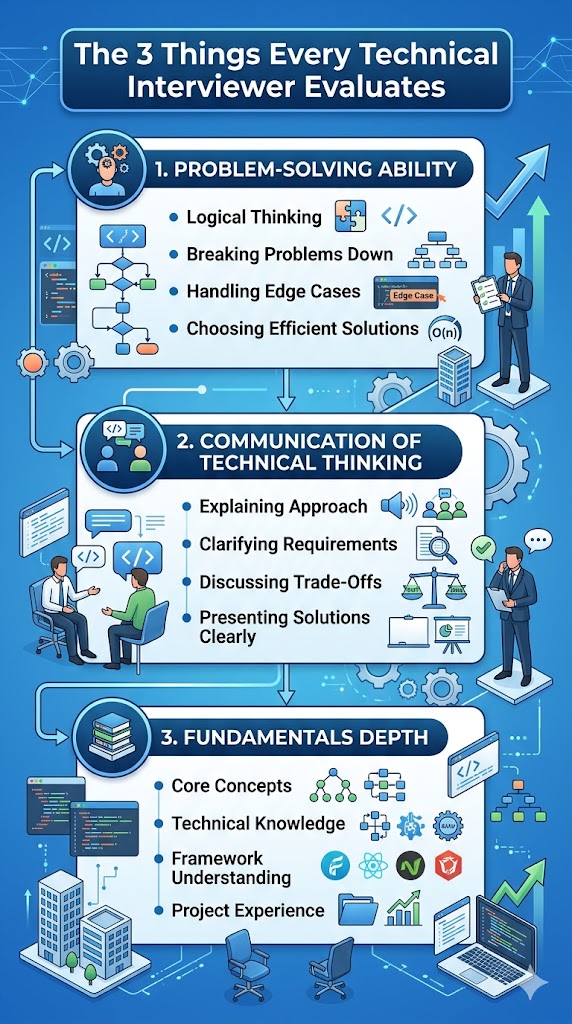
Infographic showing the three primary evaluation areas in technical interviews: problem solving, communication skills, and technical fundamentals.

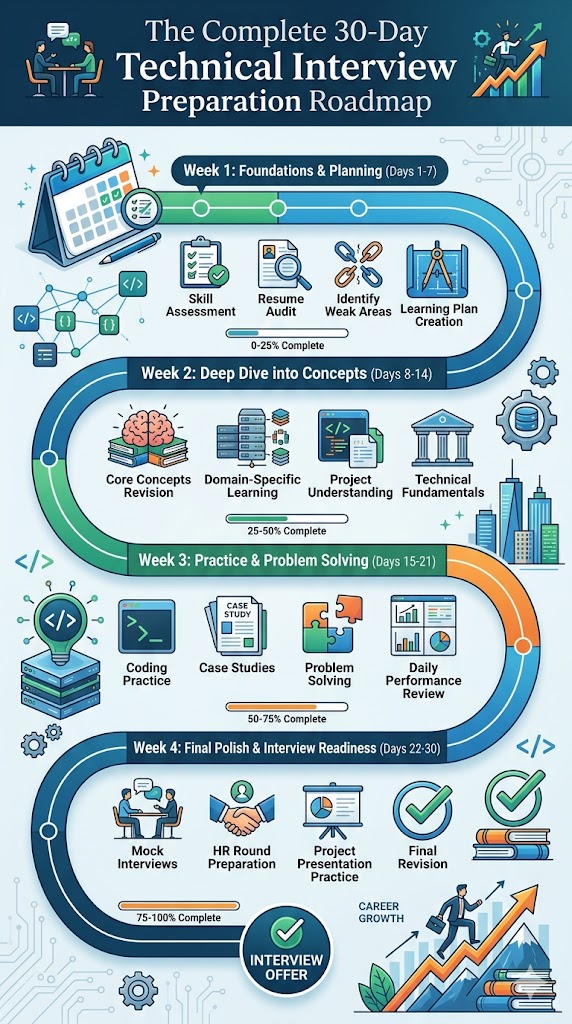
Week 1: Know Exactly Where You Stand

The biggest preparation time-waster is spending days on things you already know while neglecting gaps that will cost you the interview.

Day one and two are not for studying. They are for honest self-assessment.

List every skill and technology on your resume. For each, rate yourself honestly: can you explain it clearly, can you use it but not explain it well, or have you listed it and barely touched it? The third category needs your immediate attention.

Run one or two domain assessments on HackerRank, LeetCode, or GeeksforGeeks not to score well, but to see the gaps objectively. This is uncomfortable. It is also the most valuable hour of these 30 days.

By day three, you should have five to seven specific weak areas identified. The rest of Week 1 goes toward consolidating strengths understanding them deeply enough to explain clearly, not just use.

A candidate who deeply understands eight things is more impressive than one who superficially knows thirty.

Week 2: Build Depth in Your Core Domain

Week 2 is where the real work happens. This is where you go deep on the topics that are most likely to come up in your specific target role.

For Full Stack Developers

Focus on JavaScript fundamentals closures, promises, async/await, event loop because these come up in almost every frontend and backend round. Then React concepts: component lifecycle, hooks, state management, and rendering behaviour. On the backend, REST API design, middleware, authentication flows using JWT, and MongoDB query patterns. One or two database design questions normalization, indexing will almost certainly appear.

For Java Full Stack Developers

Core Java fundamentals OOP concepts, collections framework, exception handling, multithreading basics are tested in virtually every Java interview. Spring Boot configuration, dependency injection, JPA and Hibernate for ORM, and REST controller setup are the practical layer above that.

For React Native / Mobile App Developers

Component architecture, navigation patterns, state management using Redux or Context API, handling API calls with Axios or Fetch, and the difference between platform-specific and cross-platform behaviour.

For Data Analysts and Data Science

SQL joins, subqueries, window functions, group by  is non-negotiable and tested in almost every round. Python basics, Pandas for data manipulation, and at least one visualization library. If the role is more data science oriented, basic ML concepts supervised vs unsupervised learning, overfitting, evaluation metrics will appear.

For Digital Marketers

Google Analytics setup and interpretation, Meta Ads Manager campaign structure, SEO fundamentals, email marketing metrics, and at least one case study of a campaign you managed or can speak about specifically.

Whatever your domain, do not study passively. Write code. Build small examples. Explain concepts out loud as if teaching someone. The act of explaining forces you to find the gaps in your understanding faster than reading ever will.
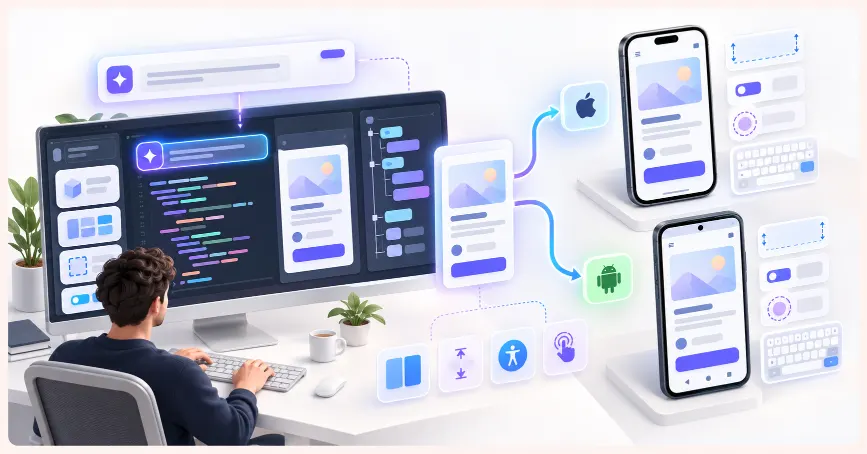
Every interview question becomes easier when your preparation is structured, consistent, and practical

Week 3: Practice Problems and Mock Scenarios

By week three, studying ends and practicing begins. Reading builds knowledge. Solving problems under a time constraint builds the skill interviews actually test.

For coding roles, solve two to three problems daily on LeetCode or HackerRank starting easy, progressing to medium as confidence grows. Do not skip easy problems. Solved confidently and explained clearly, they still impress. The non-negotiable habit: talk out loud while you solve. Narrate your thinking why you chose a loop over recursion, why you are using a hashmap, what edge cases you are considering. This is what makes you impressive in an actual interview. The interviewer sees how you think, not just whether you got the answer.

For non-coding roles marketing, data analytics, business development practice case-based questions. Given a dataset, what would you look for? Given an underperforming campaign, what would you change? Structure your answers situation, analysis, action, outcome not improvised streams of thought.

Every evening of week three, spend fifteen minutes reviewing what you solved. What went wrong? What did you not know? Add it to your weak list and cover it the next morning before new problems.

Week 4: Simulate the Real Interview Environment

The final week is entirely simulation. If you have studied the right things and practiced consistently, the biggest remaining variable is performing under pressure. Week four closes that gap.

Do at least three full mock interviews with another person a classmate, a senior, a trainer. If you cannot arrange someone, record yourself on camera and watch the playback. It is uncomfortable. It is also the fastest way to catch habits speaking too fast, looking down, losing confidence mid-answer that you would never notice otherwise.

Practice your non-technical answers in this week too. “Tell me about yourself,” “What is your greatest weakness,” “Why this company,” “Tell me about a project you built” asked in every interview and answered poorly by most candidates. Prepare them with the same structure and specificity you bring to technical questions.

Prepare two or three questions to ask the interviewer at the end. “What does a typical day in this role look like?” “What are the biggest technical challenges the team is working on?” Thoughtful questions signal genuine interest. Asking nothing signals indifference.

The night before stop studying. Review your strongest projects and key talking points. Sleep. A rested candidate performs better than one who studied until 2 AM. Every placement coordinator who has watched both types of students walk into the same room will confirm this.

Timeline infographic showing a structured four-week technical interview preparation strategy for freshers and students.

Start today, practice every day, and walk into your next interview knowing exactly what you bring to the table

How Learn2Earn Labs Gets Students Interview-Ready Faster

Thirty days of independent preparation is possible. But it is slower, lonelier, and less targeted than preparing with guidance from people who know exactly what companies in your target domain are currently asking.

At Learn2Earn Labs, interview preparation is woven into every training program from the first week not added on at the end. Students in Full Stack Web Development, React Native Mobile App Development, Data Analytics, Digital Marketing, Business Development, and AI programs build their technical foundation while simultaneously building the ability to communicate and demonstrate that foundation under interview conditions.

The mock interview process at Learn2Earn Labs is structured, repeated, and role-specific. Students face technical rounds covering the actual questions that come up at companies like TCS, Accenture, Cognizant, Infosys, and Nagarro because those are the companies where alumni have been placed, and that placement history gives the team direct insight into what those interview rooms actually look like.

Career counsellors at Learn2Earn Labs identify each student’s weak areas early and build a targeted preparation plan around them not a generic syllabus. Resume alignment, LinkedIn readiness, behavioural round preparation, and technical problem-solving practice are addressed together, because an offer letter requires all of them to work at once.

The advantage is not just preparation material. It is accountability, feedback, and the confidence that comes from walking into a real interview having already sat through multiple rounds that felt just as serious.

If you have an interview coming up and you want structured guidance to make the most of the time you have or if you want to build skills and interview readiness from the ground up speak with the team at Learn2Earn Labs.

Visit learntoearnlabs.com or write to team@learntoearnlabs.com

Conclusion: Underprepared Today Does Not Mean Unready in 30 Days

Every strong candidate you will face in that interview room started exactly where you are right now. The difference between the ones who crack it and the ones who do not is almost never raw intelligence or a better college. It is focused preparation, consistent practice, and the discipline to do the uncomfortable work solving problems out loud, recording mock interviews, reviewing mistakes the same evening they happen.

Thirty days of that kind of preparation structured, domain-specific, and progressively more simulation-focused produces a candidate who is genuinely ready.

You have the time. You have the roadmap. All that is left is to start today, not tomorrow.

FAQ’s

Q1. Is 30 days enough to prepare for a technical interview?

Yes. Thirty days is enough to strengthen fundamentals, practice interview questions, improve communication skills, and build confidence through mock interviews.

Q2. What should I focus on first when preparing for a technical interview?

Start by identifying skill gaps, reviewing fundamentals, and assessing the technologies listed on your resume.

Q3. How many coding problems should I solve daily?

For coding roles, solving two to three quality problems daily while explaining your thought process is generally more effective than solving many problems without analysis.

Q4. Are mock interviews important for technical interview preparation?

Yes. Mock interviews help simulate real interview environments, improve confidence, and reveal communication or technical weaknesses before the actual interview.

Q5. What is the biggest mistake candidates make during technical interviews?

Many candidates focus on memorization instead of understanding concepts deeply and communicating their thought process clearly.

Leave a Reply