Best Backend Frameworks for Java Full Stack Developers in 2025
Spring Boot – The Core of Modern Java Full Stack Apps
Spring Boot is the go-to backend framework for Java full stack. It lets you build stand-alone, production-ready applications with minimal configuration.
Key features: embedded server (so you don’t need to deploy to external container). Auto-configuration, starter dependencies, health checks/metrics.
Real-world use: enterprise apps, microservices, web APIs.
If you’re working on a full stack project with a Java backend, Spring Boot is a strong choice.
Jakarta EE – Enterprise-Level Framework
Jakarta EE is the evolution of Java EE. If your project is large, mission-critical, or has legacy systems, Jakarta EE remains relevant.
It offers standardised APIs, strong enterprise support. If you’re in a corporate setting, it may matter.
Micronaut and Quarkus – The New Generation Frameworks
Micronaut and Quarkus are newer frameworks that focus on fast startup times, low memory footprint, cloud-native and microservices environments.
For example: Quarkus emphasises build-time configuration and trimming unused classes. Micronaut uses ahead-of-time (AOT) compilation to reduce runtime reflection.
When you’re building services that need rapid scaling or deployment in container/serverless environments, these frameworks shine.
Best Frontend Frameworks for Java Full Stack Developers
On the frontend side you’ll interface with the backend APIs. You want the UI to be responsive, maintainable, and work well with a Java backend.
Angular – Enterprise-Grade Frontend Power
Angular (especially Angular v20) is a strong match for Java full stack work. With TypeScript, strong structure, modules, and good enterprise support, Angular works well for larger applications.
It pairs well with a Spring Boot backend where you’re exposing REST APIs and building complex user interfaces.
React – Component-Based Efficiency
React is another excellent choice. It gives you flexibility, a strong ecosystem, and plenty of libraries for UI. Many Java full stack developers combine a Java backend with React on the frontend.
If your project needs rapid iteration, dynamic UI and a large community, React is a smart pick.
Vue.js – Simplicity and Speed
Vue.js is lighter weight and simpler to learn than Angular. If you’re building a full stack prototype, smaller project or want faster time-to-market, Vue can be a strong option.
It might not have as many enterprise-features as Angular, but it’s very capable.
Essential Tools for Java Full Stack Developers
Beside frameworks, you’ll need tools for development, build, collaboration, deployment. These often make the difference between smooth workflows and friction.
IDEs and Code Editors
Choose an editor that supports Java well. For example: IntelliJ IDEA, Eclipse IDE, or Visual Studio Code. These give you code completion, debugging, version-control integration.
If you want the best IDEs for Java full stack, pick one that supports your full stack (backend + frontend) and integrates well with your chosen frameworks.
Build and Dependency Management Tools
When working full stack you’ll use build tools like Maven or Gradle for the Java backend, and npm/Yarn for the frontend.
They handle dependencies, build pipelines, packaging. Without good build tools you’ll face version conflicts, deployment issues.
Version Control and Collaboration
Using Git with platforms like GitHub or GitLab is essential. Teamwork, code reviews, branching strategies: full stack projects need this.
This is part of essential tools for Java full stack developers.
Containerization and Deployment Tools
Modern full stack apps are often deployed in containers and orchestrated. Tools like Docker for containerising, and Kubernetes for orchestration. Also CI/CD tools like Jenkins.
These help you ship your Java full stack development stack into production smoothly.
Databases and ORM Frameworks
No full stack app is complete without data. On the database side, you’ll choose between relational (like MySQL, PostgreSQL) or NoSQL (like MongoDB).
For Java backend you’ll often use ORM frameworks like Hibernate or JPA (Java Persistence API) to map between objects and tables.
Having the right database + ORM layers is key for your Java full stack web development and ensures you can persist, query, and scale your data layer.
Integration of Frontend, Backend, and Database
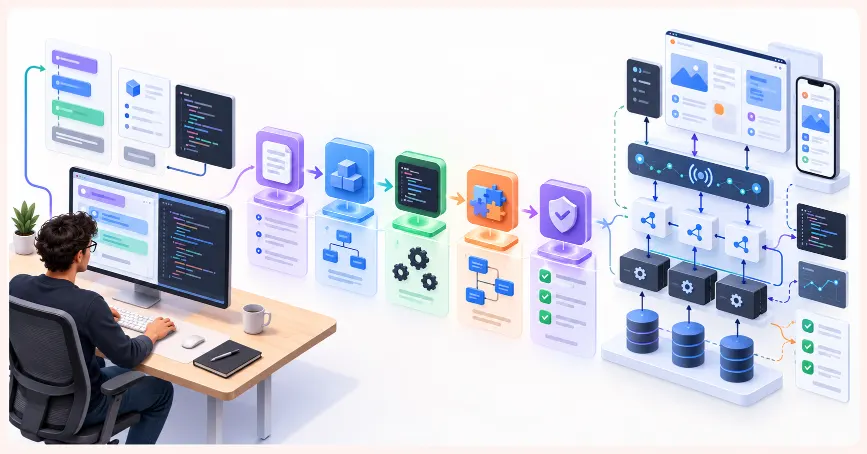
Bringing all layers together is where full stack work happens. A typical workflow:
The frontend (Angular/React) makes HTTP requests (REST or GraphQL) to the backend (Spring Boot).
The backend processes those requests, applies business logic, interacts with the database (via ORM) and returns results.
The database stores and retrieves persistent data.
This integration forms the heart of a Java full stack technology stack.
You need clear API design, error handling, security (authentication/authorization), and good performance to ensure smooth user experiences.